

Free job simulation · Electrical and energy
Solar PV and EV charging engineer job simulation
A solar PV and EV charging engineer job simulation is practice at clean-energy design and testing. For a simulated logistics depot you size PV strings for the coldest morning, choose cables and a grid connection route, share a limited supply between EV chargers and test strings to IEC 62446-1 style records. Everything runs in a virtual site, so no installation is performed. It is practice, not employment.
You join Calverdon Energy Installations Ltd (simulated company), a solar and ev charging installer in Manchester. Days 1 to 5 are free, with about 8 h 40 min of tickets. Premium continues to day 20. It is practice, not employment.
Days 1 to 5 are free. You need a free account and no card. Create an account.
- Free days
- 1 to 5
- Free tickets
- about 8 h 40 min
- Project documents
- 8
- Certificate, optional
- £14.99
The project
You join Calverdon Energy Installations Ltd (simulated company)
Calverdon Energy Installations Ltd (simulated company) is a solar and ev charging installer in Manchester. You help its team deliver a project for Ardmoor Logistics Ltd, at Ardmoor Park Depot: warehouse roof and staff car park.
Ardmoor Logistics wants solar on its warehouse roof and six EV charge points in the car park, on the supply it already has. You join Calverdon's design team in week one with a half-checked string design. In the first week you size strings for the coldest morning, review a draft, size the AC cable and work out how six chargers share 100 A. Later, the network operator limits export to 15 kW, the client adds two chargers, a string tests low, a wet insulation reading comes in under pressure to sign, and the client asks to skip the protection that guards against a lost PEN conductor.
What you will do
- Size PV strings with cold-temperature voltage and check the inverter window
- Size DC and AC cables for current and voltage drop, and decide on string fuses
- Choose the grid connection route and handle a network export limit
- Share a limited supply between EV chargers with load management
- Test strings to IEC 62446-1, record failures honestly and hand over safely
The people you deal with
- Lead Design Engineercompany
- Design Checkercompany
- Installation Supervisorcompany
- Commissioning Engineercompany
- Client Project Managerclient
- Client Facilities Managerclient
- Network Operator Plannervendor
- Inverter Vendor Supportvendor
The company, client and site are fictional. The people are fictional too.
Look inside
What the simulator looks like
The workplace, your tickets, the documents and the team chat, as a learner sees them.
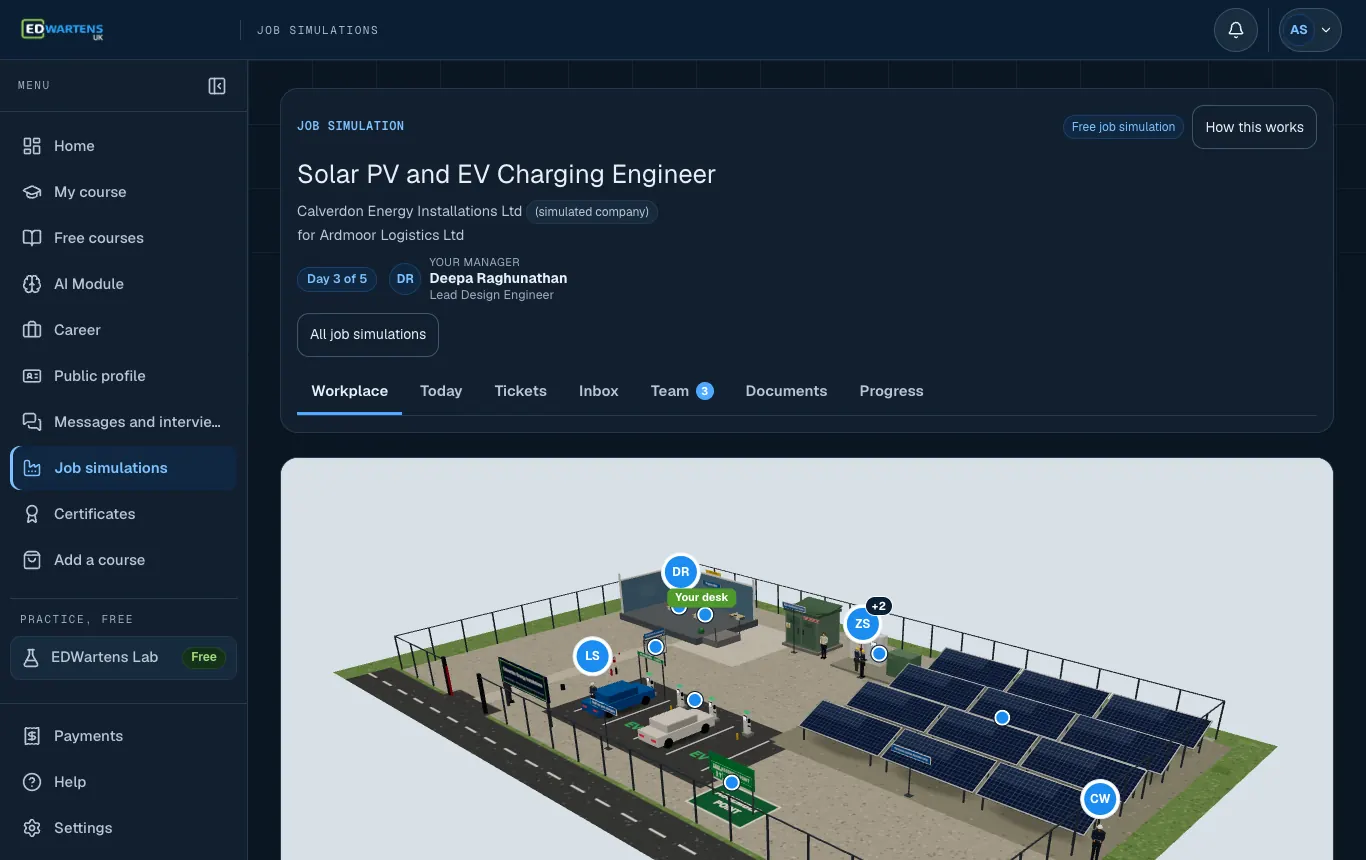
Start in the workplace, with the team around you. 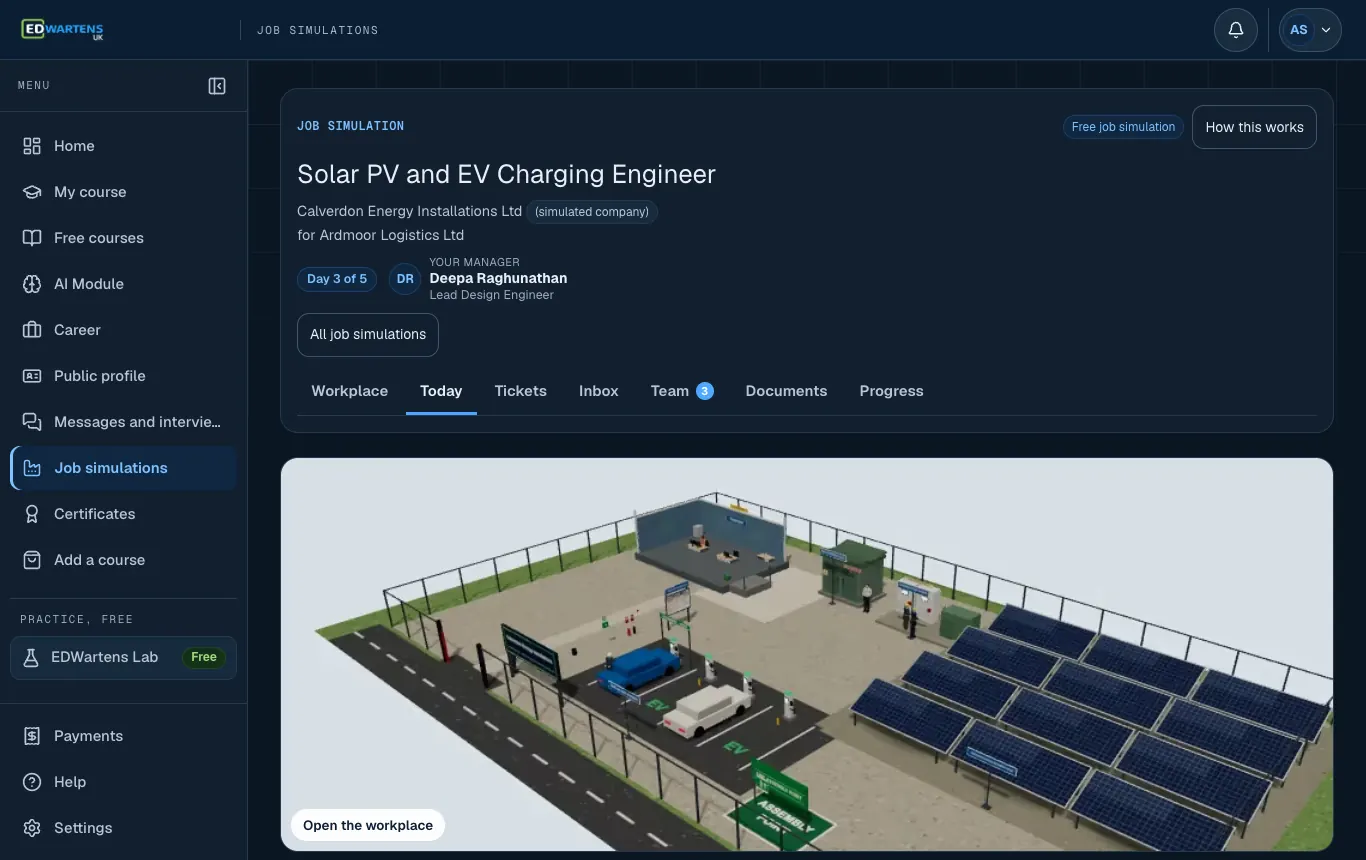
Today: the morning email and your tickets for the day. 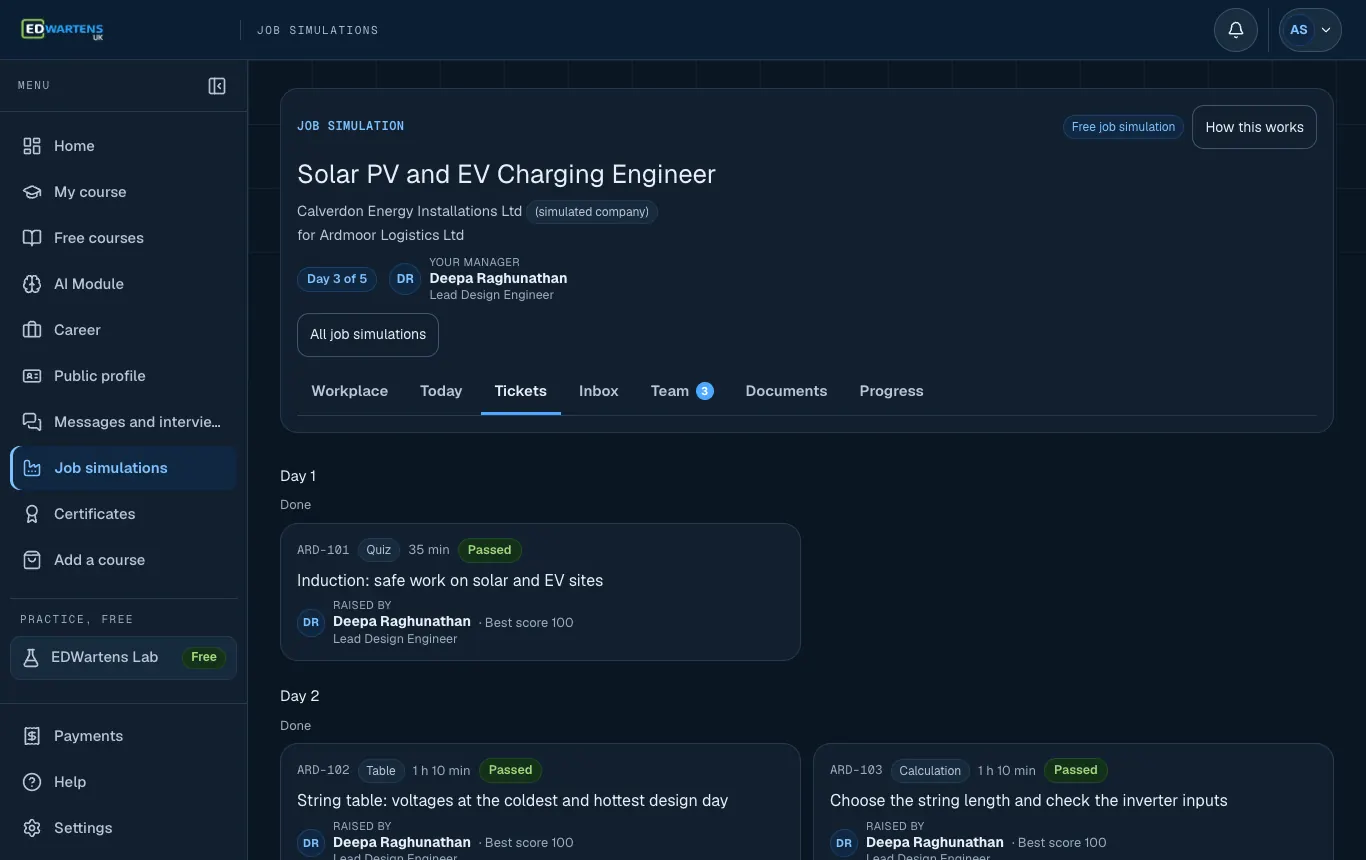
Work: every ticket, by day, with its status. 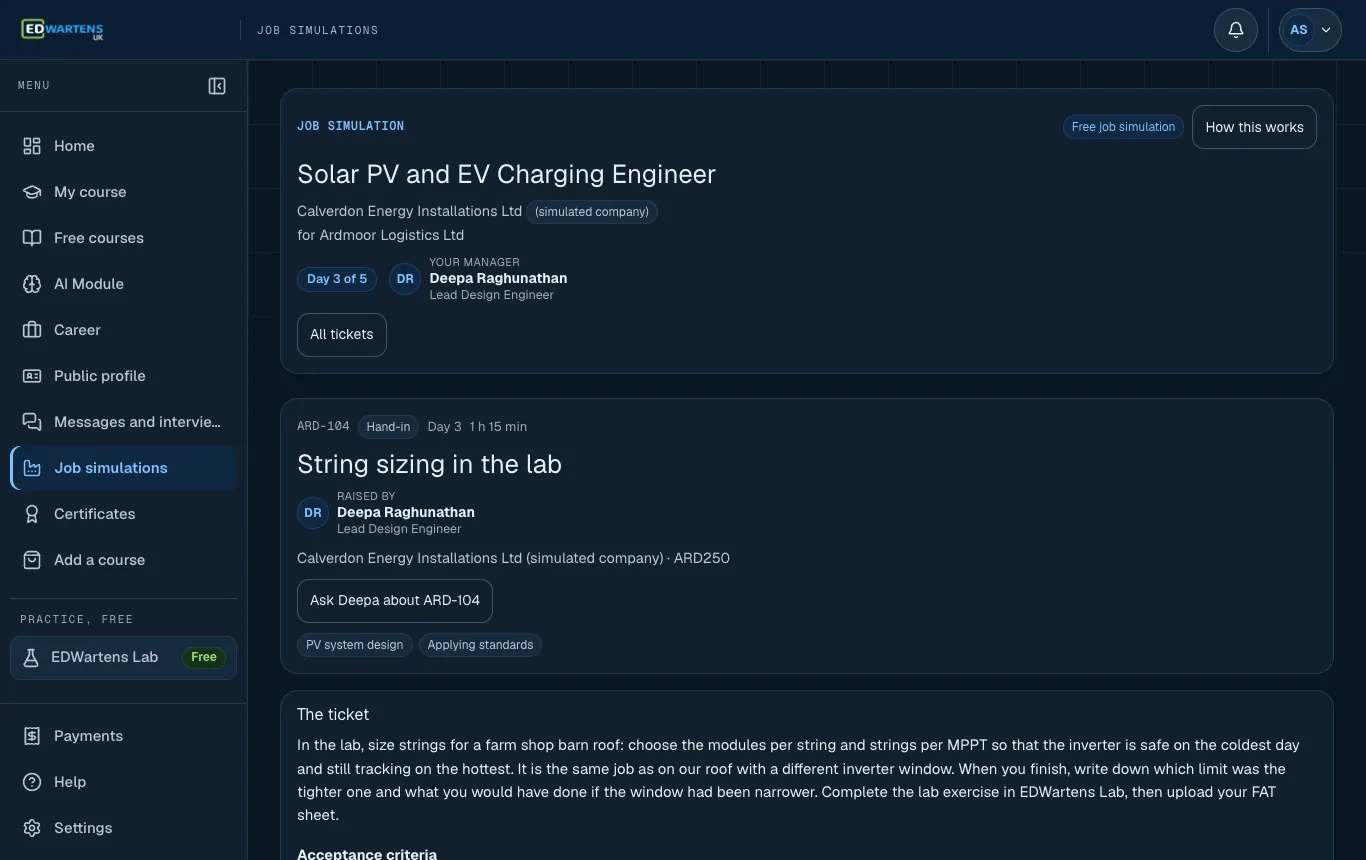
A ticket, written the way a colleague would write it. 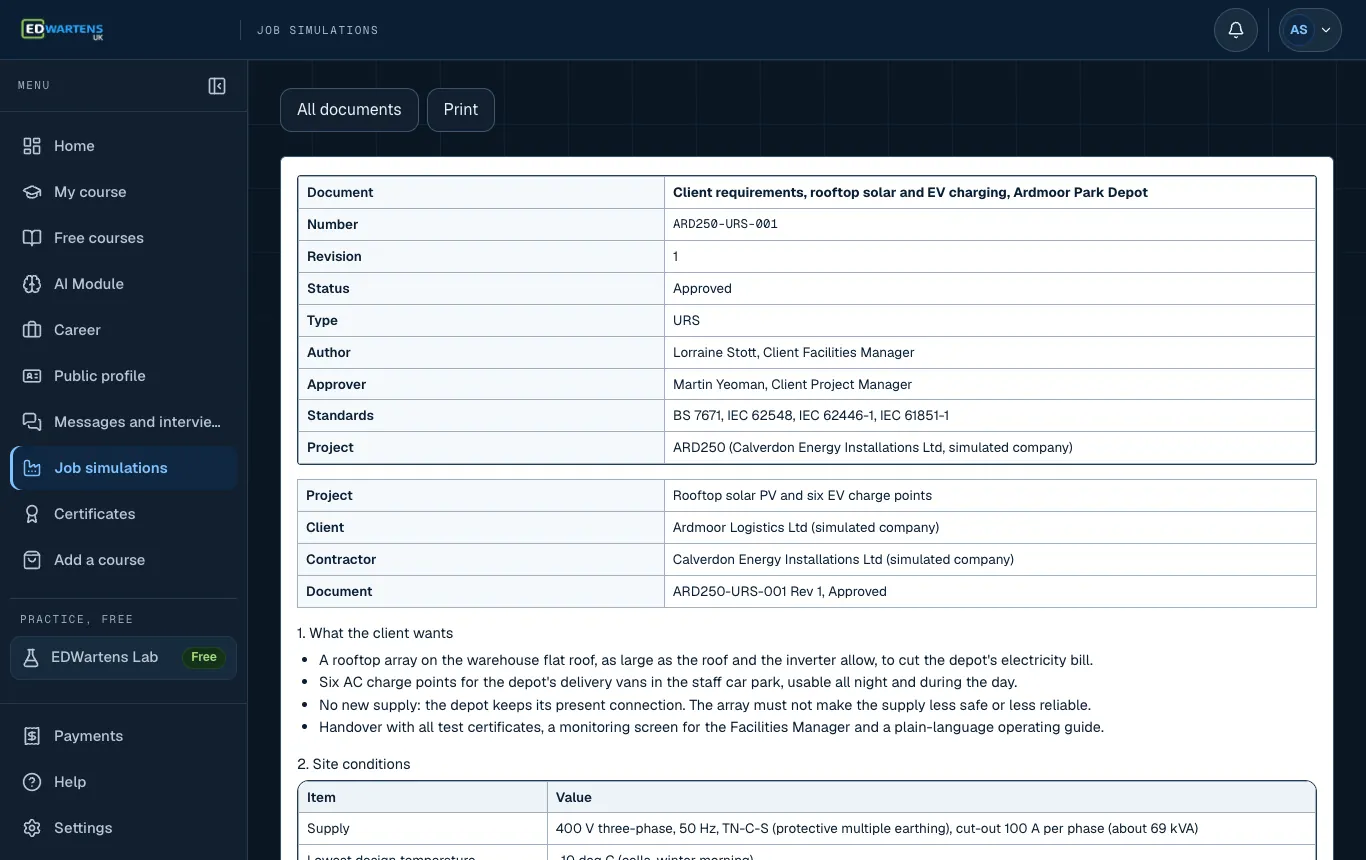
A project document with its number, revision and status. 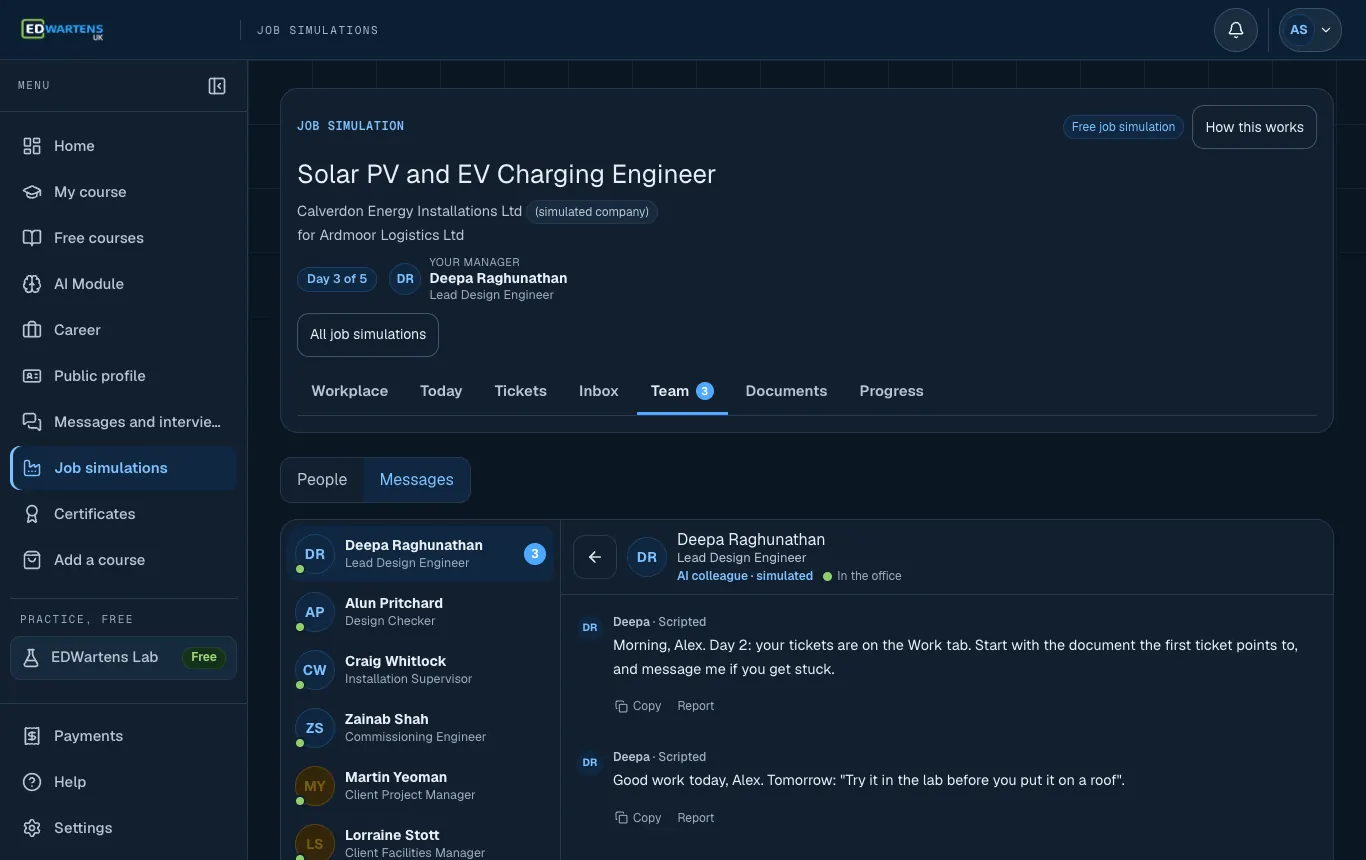
Ask a colleague. They are AI colleagues: they help you think, they do not hand out answers.


Screenshots from the simulator. Company, people and data are fictional. Portraits are AI-generated.
Meet the team
The colleagues you work with
You can read their messages and ask them questions. They are AI colleagues, clearly labelled. They help you think a ticket through; they do not hand out its answer.
- DRDeepa RaghunathanLead Design EngineerSimulated colleague, company side
- APAlun PritchardDesign CheckerSimulated colleague, company side
- CWCraig WhitlockInstallation SupervisorSimulated colleague, company side
- ZSZainab ShahCommissioning EngineerSimulated colleague, company side
- MYMartin YeomanClient Project ManagerSimulated colleague, client side
- LSLorraine StottClient Facilities ManagerSimulated colleague, client side
- FOFemi OlatunjiNetwork Operator PlannerSimulated colleague, vendor
- ASAnders SundqvistInverter Vendor SupportSimulated colleague, vendor
Fictional people. Portraits are AI-generated.
What you get
What you walk away with
Design and check a rooftop solar and EV charging scheme on a busy supply, from string sizing to a handover pack.
What you produce
String voltage table: coldest and hottest design day
Design calculation
Check comments on the string sizing calculation
Check record
AC cable calculation from the inverter
Cable calculation
Friday status email to the client
Client update
EV load sharing calculation for six chargers
Load management design
Impact note for a change request
Change controlPremium
Commissioning and handover pack
CapstonePremium
Handover note for the facilities manager
Handover notePremium
Skills you practise
- Applying standards
- PV system design
- Working with clients and stakeholders
- Safety and safe systems of work
- Written communication
- EV charging and load management
- Document and revision control
- Testing and acceptance
Roles to look for
- Solar PV Design Engineer
- EV Charging Infrastructure Engineer
- Renewable Energy Engineer
- Electrical Design Engineer (Renewables)
274 live openings on the UK jobs board, checked 24 Oct 2026. See the jobs
Your proof
- A certificate anyone can verify. Optional, and included in Premium.
- An entry on your EDWartens profile under Work experience, marked as a job simulation.
- A work record with your skill scores, with Premium.
Free courses that go with it
- Free course Rooftop Solar PV Design and Installation
- Free course EV Charging Infrastructure: AC, DC, CCS2 and Charging Stations
- Free course PVsyst Solar Power Plant Design
- Free course Electrical Safety at Work (UK): Safe Isolation, Lock-off and Arc Flash
- Free course Battery Energy Storage Systems (BESS): Design, Controls and Safety
What you can talk about at interview
- You can explain why the coldest morning sets the longest string and how you checked the inverter limits.
- You can describe how six chargers share a 100 A supply and what each one gets.
- In Premium, you can talk through an export limit, a failed insulation test in the rain and why a protection device stays on the design.
Day by day
Days 1 to 5, ticket by ticket
Self-paced. A day opens when you hand in the previous day's tickets. Every ticket is checked, and you see the model answer after it.
Day 1
about 35 min- Induction: safe work on solar and EV sitesQuiz · 35 min
Day 2
about 2 h 20 min- String table: voltages at the coldest and hottest design dayTable · 1 h 10 min
- Choose the string length and check the inverter inputsCalculation · 1 h 10 min
Day 3
about 1 h 15 min- String sizing in the labHand-in · 1 h 15 min
Day 4
about 2 h 10 min- Check the string sizing calculation Rev ADocument review · 1 h 10 min
- AC cable from the inverter: current or voltage rise?Calculation · 1 h
Day 5
about 2 h 20 min- Six shaded modules and a roof crew waitingDecision · 30 min
- Friday status email to the clientWriting · 50 min
- Six chargers on a 100 A supply: what does each one get?Calculation · 1 h
Premium: days 6 to 20about 21 h 45 min more
After day 5 the project goes on with a change request, site work, faults, a handover and a capstone reviewed by an engineer.
Day 6
about 2 h- DC string cable and the string fuse questionCalculation · 2 h
Day 7
about 1 h 10 min- G98 or G99? Rated current per phaseTable · 1 h 10 min
Day 8
about 1 h 15 min- Impact note for CR-001: export limit and two more chargersWriting · 1 h 15 min
Day 9
about 1 h 50 min- Sunday export, curtailment and self-consumptionCalculation · 1 h 50 min
Day 10
about 1 h 10 min- Which documents move after CR-001?Table · 1 h 10 min
Day 11
about 1 h 40 min- IEC 62446-1 string tests: which string is wrong?Table · 1 h 40 min
Day 12
about 40 min- Insulation resistance fails in the rain: sign off or not?Decision · 40 min
Day 13
about 1 h 15 min- Commission the system in the safe energising orderHand-in · 1 h 15 min
Day 14
about 1 h 20 min- Check the EV installation design sheetDocument review · 1 h 20 min
Day 15
about 1 h 50 min- Eight chargers on 100 A: three share a phaseCalculation · 1 h 50 min
Day 16
about 40 min- Leave out the PEN fault protection?Decision · 40 min
Day 17
about 1 h 15 min- Load management on a limited supplyHand-in · 1 h 15 min
Day 18
about 4 h- Capstone: commissioning and handover pack for Ardmoor ParkHand-in · 4 h
Day 19
about 1 h- Handover note for the Facilities ManagerWriting · 1 h
Day 20
about 40 min- Viva: your solar and EV decisionsViva · 40 min
Real documents
The documents you will work with
Each one has a number, a revision and an approver, the way a project document does. You read them, check them and write your own.
ARD250-URS-001
Client requirements, rooftop solar and EV charging, Ardmoor Park Depot
Rev 1URS
ARD250-SVY-001
Site survey record
Rev ASite survey
ARD250-DS-001
Equipment data: PV module and string inverter (vendor-neutral summary)
Rev AData sheet
ARD250-DD-001
Design data: cable ratings and voltage drop
Rev ADesign data
ARD250-CALC-001
String sizing calculation (draft for check)
Rev ACalculation
ARD250-SLD-001
PV system single-line and string diagram (sheet 1 of 1)
Rev ASLD
ARD250-GRID-001
Grid connection application data (draft)
Rev AGrid application
ARD250-EV-001
EV charging design basis and load management rule
Rev ADesign basis
Documents that arrive in Premiumchange requests, records, handover
ARD250-DNO-001
Network operator connection offer (G99), summary
Rev 0Grid offerPremium
ARD250-CR-001
Change request: keep the 54 kWp array under a 15 kW export limit and add two charge points
Rev 0Change requestPremium
ARD250-CALC-002
Typical Sunday in June: generation, base load and EV load
Rev ACalculationPremium
ARD250-TST-001
IEC 62446-1 test record: strings and insulation resistance
Rev ATest sheetPremium
ARD250-EV-002
EV installation design check sheet
Rev ADesign reviewPremium
Tools
In the industry, and here
| In the industry | Here |
|---|---|
| PVsyst or Helioscope for yield and layouts | Worked calculations, and an EDWartens Lab exercise with the same logic |
| PV tester and thermal camera on site | Test sheets with measured values to judge |
| Charge point back office and load controller | EDWartens Lab's solar and EV exercises |
| Excel cable and voltage templates | Calculation fields and your own working |
Standards
The standards the work follows
- IEC 62548
- IEC 62446-1
- IEC 61851-1
- BS 7671 sections 712 and 722
- G98 and G99
In the UK
The Solar PV and EV Charging Engineer role in a UK setting
Who employs this kind of engineer: Solar and EV charging installers, energy developers, logistics and fleet operators, and electrical contractors.
Where: Solar and charging work is spread across the whole UK, and depots, car parks and industrial roofs are common sites. This is context, not a statement about vacancies.
UK standards and regulations to know about
BS 7671 sections 712 and 722
Requirements for solar photovoltaic installations and for electric vehicle charging installations.
IET Codes of Practice
The IET publishes codes of practice for grid-connected solar PV and for EV charging equipment installation.
ENA G98 and G99
The network operators' rules for connecting small and larger generation to the distribution network.
IEC 62446-1
Documentation, commissioning tests and inspection of grid-connected PV systems.
Electric Vehicles (Smart Charge Points) Regulations 2021
Requirements for most private charge points sold in Great Britain. Check scope and current rules before relying on it.
Schemes to be aware of
Microgeneration Certification Scheme (MCS)
A certification scheme for small-scale renewable installations in the UK. Awareness only: this simulation does not make you an installer or lead to certification.
ECS card (Electrotechnical Certification Scheme)
The industry card that many UK electrotechnical employers and sites ask to see. It is linked to qualifications and a health and safety assessment. EDWartens does not issue it, and this simulation does not lead to it.
These are named so that you recognise them. A job simulation does not teach them as a qualification, the tasks use simplified data, and you should always read the current edition of anything you rely on.
Your proof, optional
A certificate you can verify
The free days are free. The graded, verifiable certificate is an optional extra, and it is included in Premium.
- A graded, verifiable certificate with your score and band
- A public verification page and QR code
- One-click add to LinkedIn as a licence or certification
- Issued by WARTENS LTD. It is a training certificate, not an accredited qualification, and the company is simulated
Optional: £14.99 including VAT, once you pass.
Job Simulation Certificate
Your name
completed the Solar PV and EV Charging Engineer job simulation at Calverdon Energy Installations Ltd (simulated company). Your score and band are shown on the real certificate.
- Number
- EDW-JS-0000
- Issued by
- WARTENS LTD
Not an accredited qualification. A verification page and QR code are printed on the real certificate.
Prepare
Free courses and labs that get you ready
Linked from the tickets that need them. You can read them before you start.
Free courses
- Rooftop Solar PV Design and Installation
- EV Charging Infrastructure: AC, DC, CCS2 and Charging Stations
- Battery Energy Storage Systems (BESS): Design, Controls and Safety
- Electrical Safety at Work (UK): Safe Isolation, Lock-off and Arc Flash
- PVsyst Solar Power Plant Design
- Excel for Engineers: Formulas, Data and Dashboards
- Electric Vehicle Technology Fundamentals
- Electrical and Instrumentation QA/QC Inspection
About the Solar PV and EV Charging Engineer role
String sizing with temperature limits
A PV string must stay inside the inverter's voltage window on the coldest design morning, when module voltage is highest, and on the hottest day, when it is lowest. The datasheet temperature coefficients let you calculate both ends.
In the simulation you build a string table for the coldest and hottest design days, choose the string length, check the inverter inputs and then review a draft calculation for mistakes. The string sizing exercise in EDWartens Lab uses the same logic, so you can see the effect of a change at once.
The PV test record: what IEC 62446-1 documentation contains
IEC 62446-1 covers the documentation, commissioning tests and inspection of grid-connected PV systems. Typical records include string open-circuit voltage and short-circuit current, polarity and insulation resistance.
You read a test record with one wrong string and decide which it is. When insulation resistance fails in the rain, the case asks whether to sign off, and the honest answer is not to. You then commission the system in the safe energising order and write the handover note for the facilities manager.
EV chargers on a limited supply
EV charging usually shares a supply that cannot feed every charger at full power. Load management caps the total current across chargers, and the design must decide how the limit is shared and what happens at each phase.
The project starts with six chargers on a 100 A supply and asks what each gets, then grows to more chargers where three share a phase. A design check sheet for the EV installation is reviewed in Premium, including a case that asks you to leave out fault protection for a PEN conductor, which you must refuse.
Which code for which country
The UK uses BS 7671, with sections 712 and 722 for solar and EV installations, and network operator connection rules called G98 and G99. Other countries use their own national codes.
IEC 62548 covers PV array design, IEC 61851-1 covers EV conductive charging, and IEC 62446-1 covers testing. The calculation method carries across countries, so use the code of the place you will work.
Name the code on every calculation sheet, so a reviewer knows which rules you applied and can check them quickly.
Where solar and EV work leads
Design engineers in this field grow towards grid connection, operations and maintenance, storage and project leadership. Installation work needs local qualifications, and this simulation does not make you an installer.
The linked roles, electrical design and the substation and MCC engineer, cover the wider electrical chain. Free courses on rooftop solar design, EV charging and storage sit alongside.
Keep the string table, the test record and the load management note. They show the three things a hiring engineer asks about: do you check limits, do you record honestly and do you know when a supply is the constraint.
Keep going
Related job simulations and courses
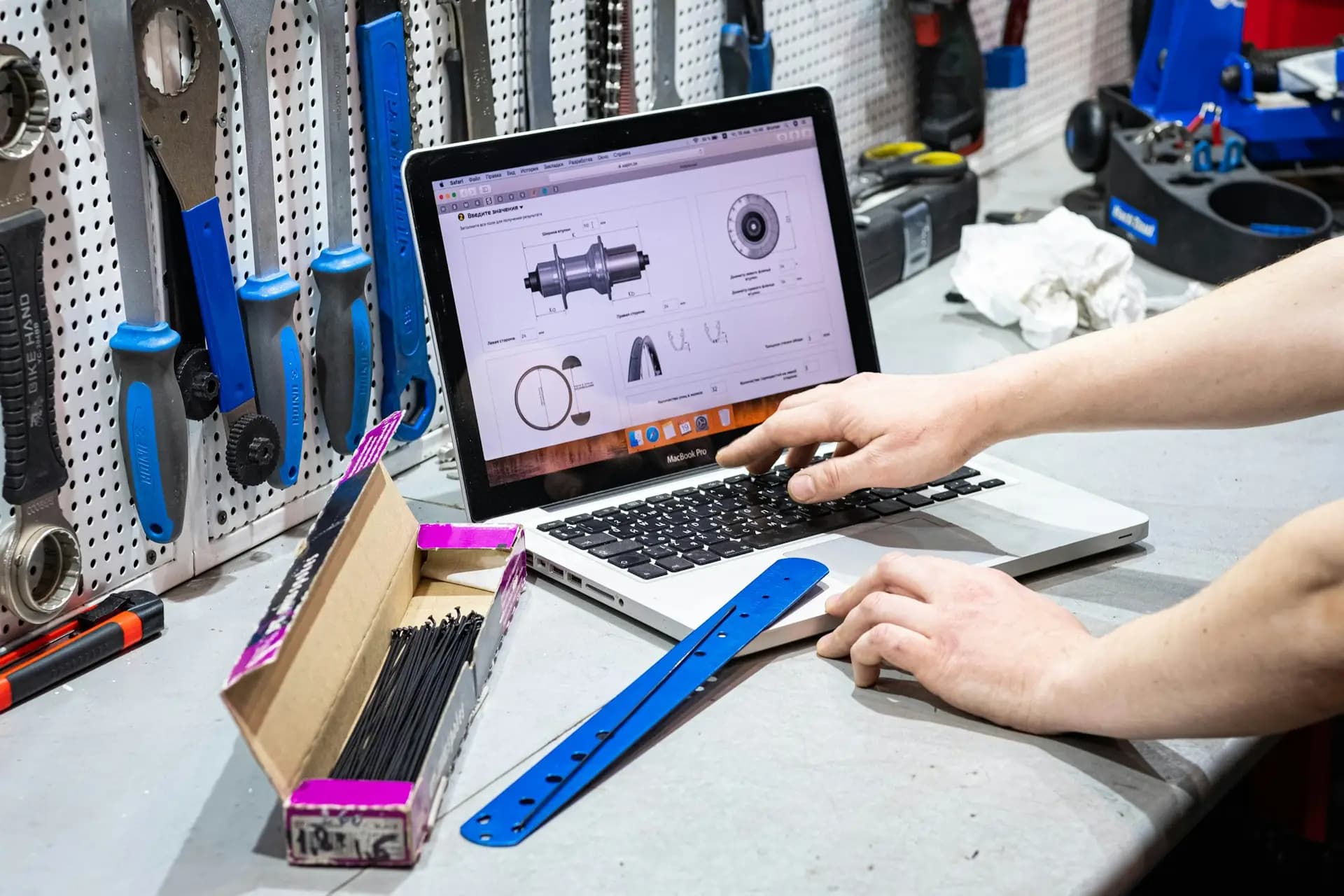
Electrical Design Engineer
Load list, single-line diagram, cable sizing and a late design change.
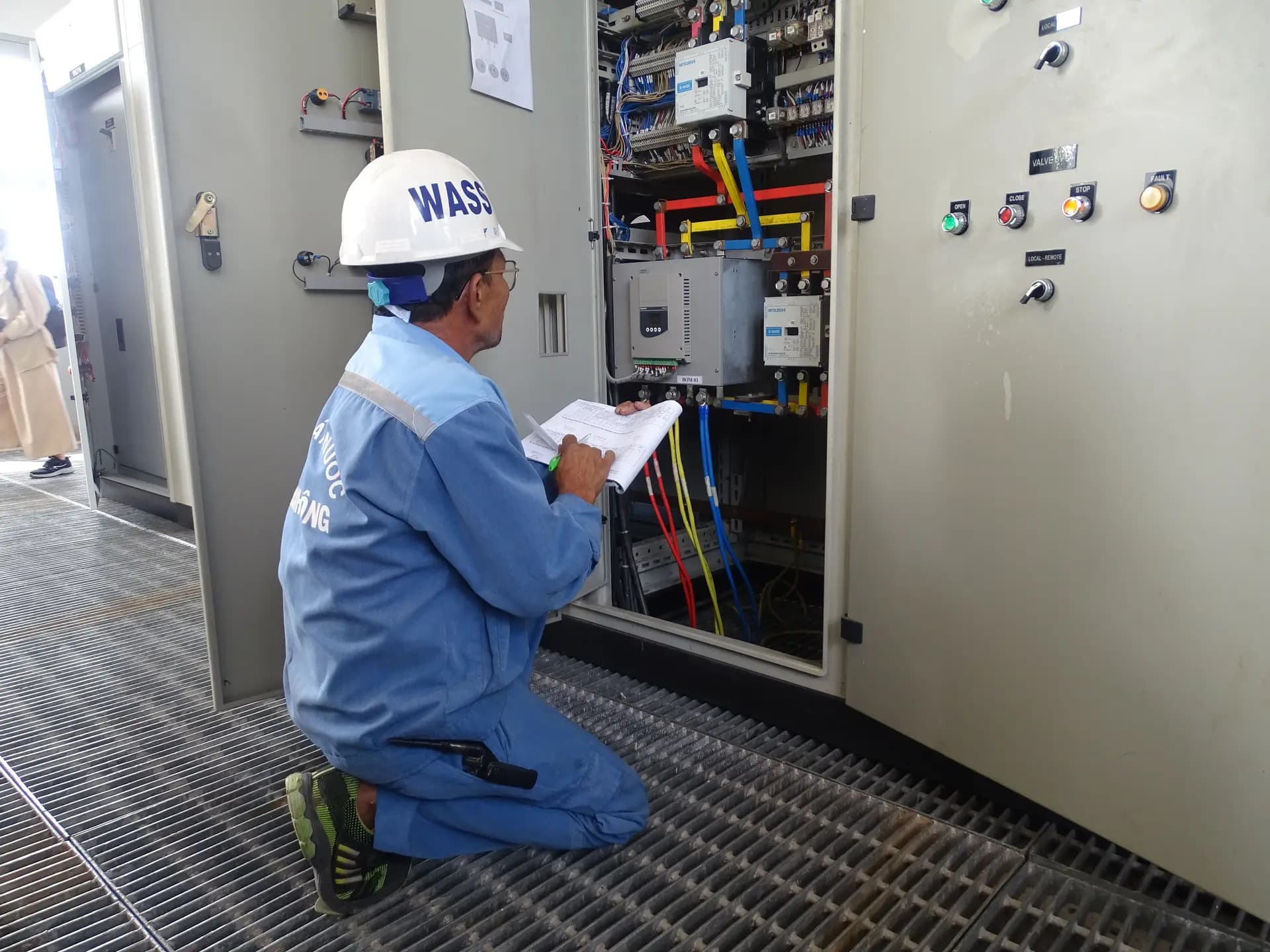
Substation and MCC Engineer
Protection settings, relay tests and an inrush trip on a new feeder.
Data Centre Critical Facilities Engineer
MOPs, change control and a UPS event in a live data hall.
- Engineering job simulations
- Free courses
- Browse jobs
- Virtual work experience in the UK
- Job simulation questions
Content reviewed 19 Oct 2026; UK context added 21 Oct 2026. Practice, not employment.
Questions
Quick answers
What does a solar PV design engineer do?
They size the array and inverter, strings, cables and protection for a site, estimate yield, and prepare test and commissioning records. Entry roles usually work from a checked template under supervision.
What is IEC 62446?
IEC 62446-1 sets requirements for documentation, commissioning tests and inspection of grid-connected PV systems. Confirm the current edition and scope with the IEC before you rely on it.
How do you size a PV string?
Keep the string voltage within the inverter's window across the site's cold and hot temperatures, and the current within its limits, using the module datasheet temperature coefficients. The simulation walks through the coldest and hottest design days.
What does an EV charger installation need besides the charger?
A suitable supply, protection and earthing, load management where supply is limited, and communication. The exact rules depend on the country code, such as BS 7671 in the UK.
How can several chargers share a limited supply?
Dynamic load management caps the total current across chargers. The simulation includes a limited-supply scenario so you can work out what each charger gets.
Is this a good entry route into energy work?
Employers value electrical fundamentals and test records. Installers typically hold an electrical qualification first, so use the simulation to show design and test logic.
Does the simulation make me an installer?
No. It teaches design and test logic. Installation work needs local qualifications and supervised experience.
Do I need to be registered to install solar or EV chargers in the UK?
Installers normally work under a competent person scheme or hold the qualifications their employer and the network operator expect, and connecting generation to the network follows the ENA engineering recommendations G98 or G99. This simulation teaches design and test logic only. Check the current requirements with the scheme and your employer.
Do I need PV design software?
No. The work is done in the browser with worked calculations, tables and an EDWartens Lab exercise.
Which standards does it follow?
It follows the ideas of IEC 62548, IEC 62446-1, IEC 61851-1, BS 7671 and the G98 and G99 routes. Cable data in the exercise is simplified.
How long does the free week take?
About nine hours of active work over five working days.
What does the Premium edition add?
The full four-week project: the export limit change, string tests, wet-weather and safety decisions, a capstone pack reviewed by an engineer and an AI viva.
Is this a real job?
No. It is a job simulation at a simulated company. It is not employment.
Is the Solar PV and EV Charging Engineer job simulation free?
Yes, to start. Days 1 to 5 are free. The certificate (£14.99) and the Premium edition (£53.99) are optional, and both prices include VAT.
Does it count as work experience?
No. It is a training project at a simulated company, not employment, an internship or a placement. A job simulation is a realistic training project at a simulated company. It is not employment, an internship or a work placement, and it is not a job offer. Hours are active hours the learner logged on EDWartens UK.
A job simulation is a realistic training project at a simulated company. It is not employment, an internship or a work placement, and it is not a job offer. Hours are active hours the learner logged on EDWartens UK.
Start the Solar PV and EV Charging Engineer job simulation today
Days 1 to 5 are free. No card to start. Practice, not employment.