

Free job simulation · Electrical and energy
Maintenance electrical engineer job simulation
A maintenance electrical engineer job simulation is practice at keeping a plant running. In a simulated food factory you check an isolation certificate, isolate a motor bucket, read thermography and insulation tests, find a hidden fault under lock-out and write a root cause report. It uses virtual panels, so nothing real is at risk. It is practice, not employment or a safety qualification.
You join Kelbridge Foods Ltd (simulated company), a food manufacturer, maintenance department in Doncaster. Days 1 to 5 are free, with about 9 h 35 min of tickets. Premium continues to day 20. It is practice, not employment.
Days 1 to 5 are free. You need a free account and no card. Create an account.
- Free days
- 1 to 5
- Free tickets
- about 9 h 35 min
- Project documents
- 7
- Certificate, optional
- £14.99
The project
You join Kelbridge Foods Ltd (simulated company)
Kelbridge Foods Ltd (simulated company) is a food manufacturer, maintenance department in Doncaster. You help its team deliver a project for Kelbridge Foods production department, at Packing hall and utilities block (MCC-1).
You are the junior maintenance electrical engineer at a biscuit factory. In four weeks you check isolation certificates, practise safe isolation, class a thermography round, close a breakdown work order, find a motor fault, and meet a night trip on the chilled water pump that production wants reset at once. You write the root cause analysis, change a drive that is out of stock, face a hot terminal and a contractor working live, and plan the yearly MCC shutdown. The skill is to be safe first, evidence-based second, and useful to production third.
What you will do
- Check an isolation certificate and isolate a motor bucket the safe way
- Class thermography readings, size spares and read motor insulation tests
- Refuse a restart without a root cause and write the RCA from the evidence
- Raise an engineering change request for a substitute drive
- Plan a shutdown, review arc flash labels and hand over a clear maintenance pack
The people you deal with
- Maintenance Managercompany
- Senior Maintenance Electriciancompany
- Maintenance Plannercompany
- Health and Safety Managercompany
- Stores Controllercompany
- Production Managerclient
- Shift Supervisorclient
- Drive Supplier Supportvendor
The company, client and site are fictional. The people are fictional too.
Look inside
What the simulator looks like
The workplace, your tickets, the documents and the team chat, as a learner sees them.
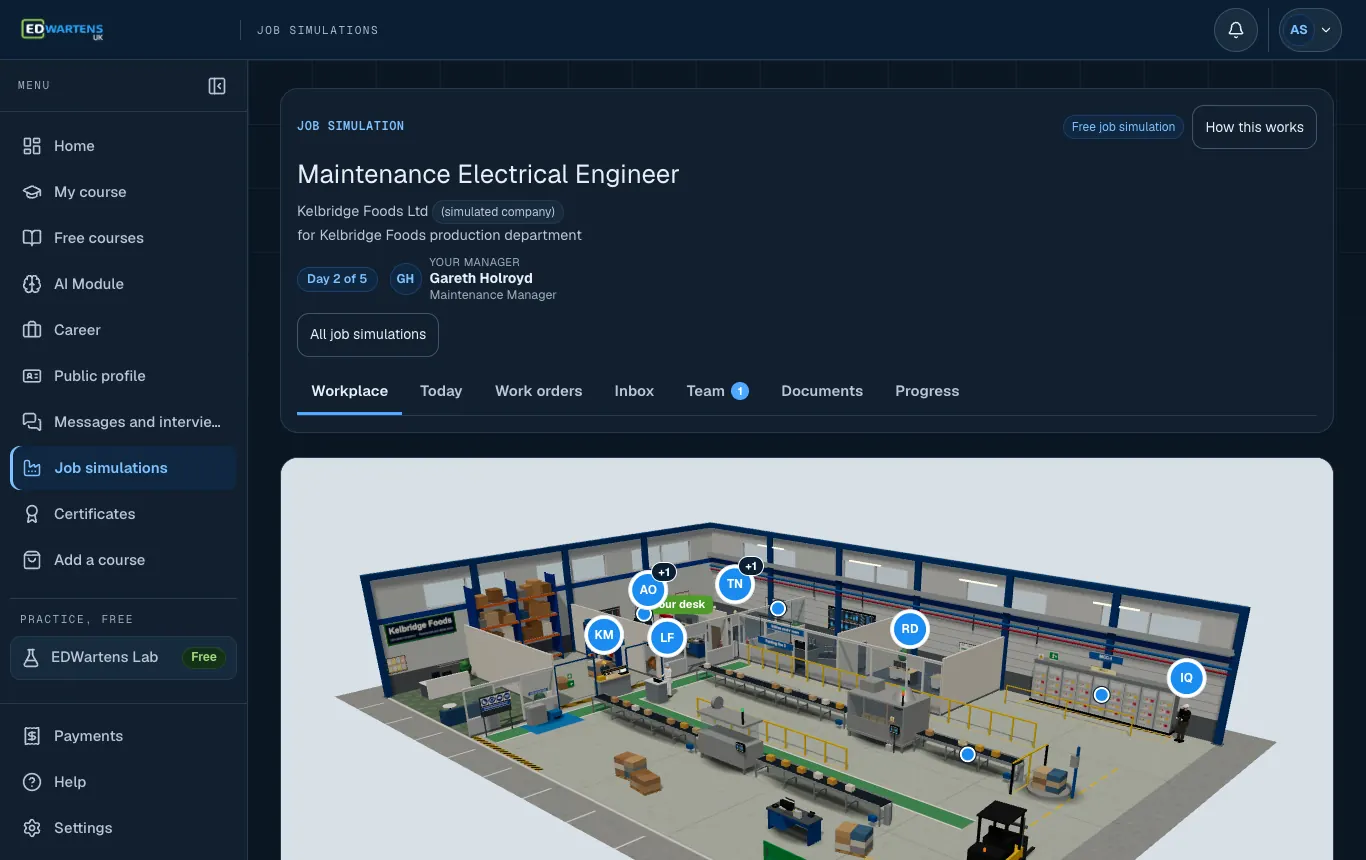
Start in the workplace, with the team around you. 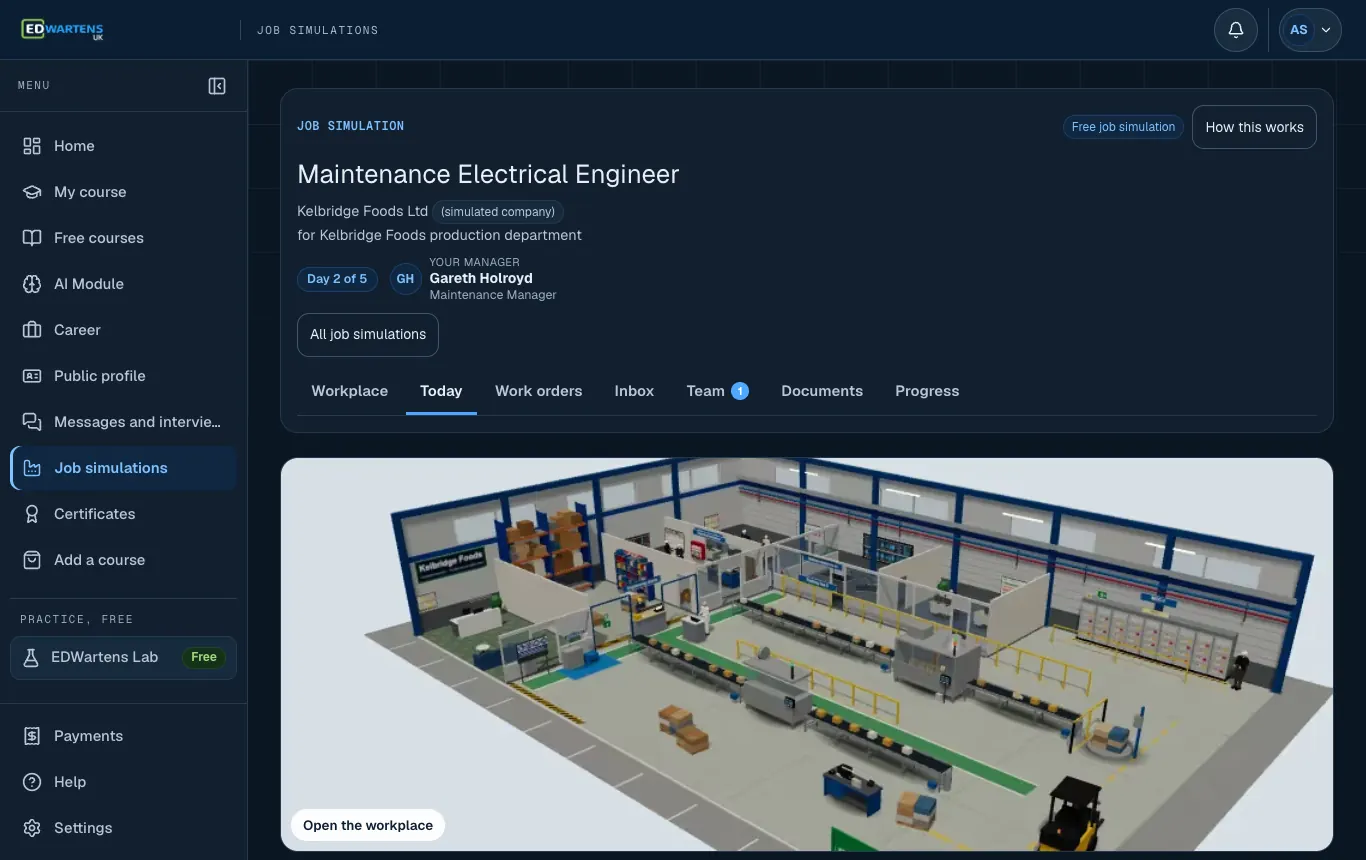
Today: the morning email and your tickets for the day. 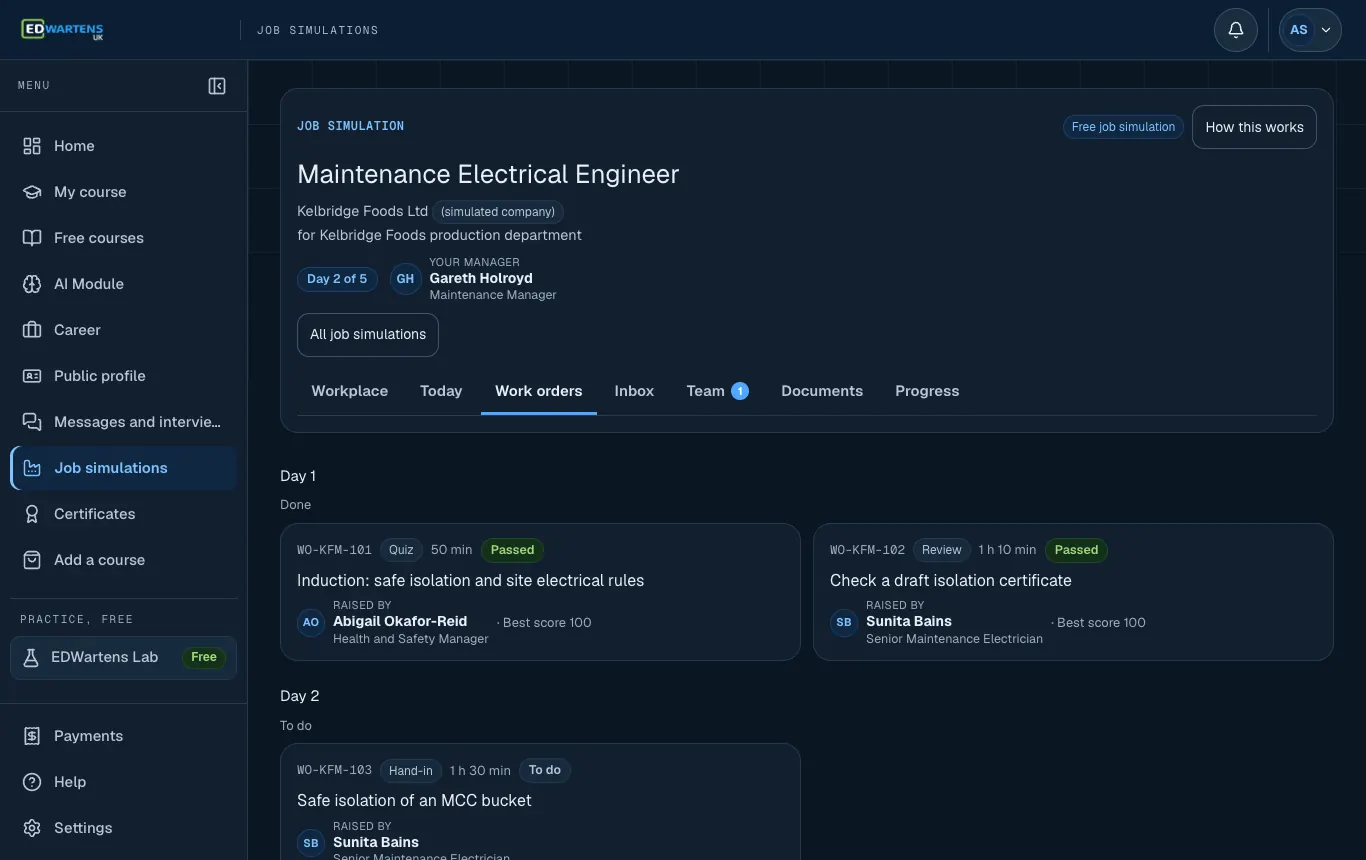
Work: every ticket, by day, with its status. 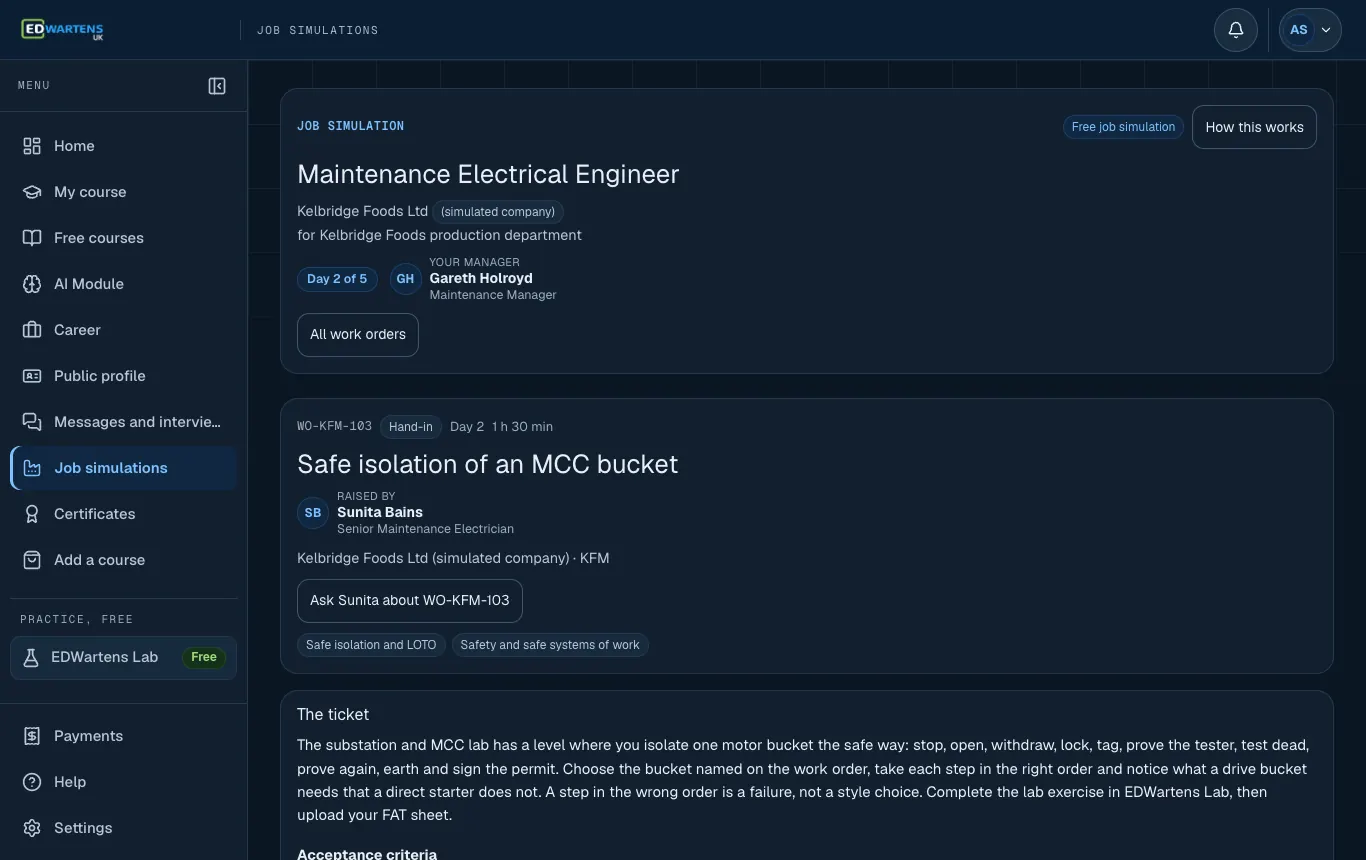
A ticket, written the way a colleague would write it. 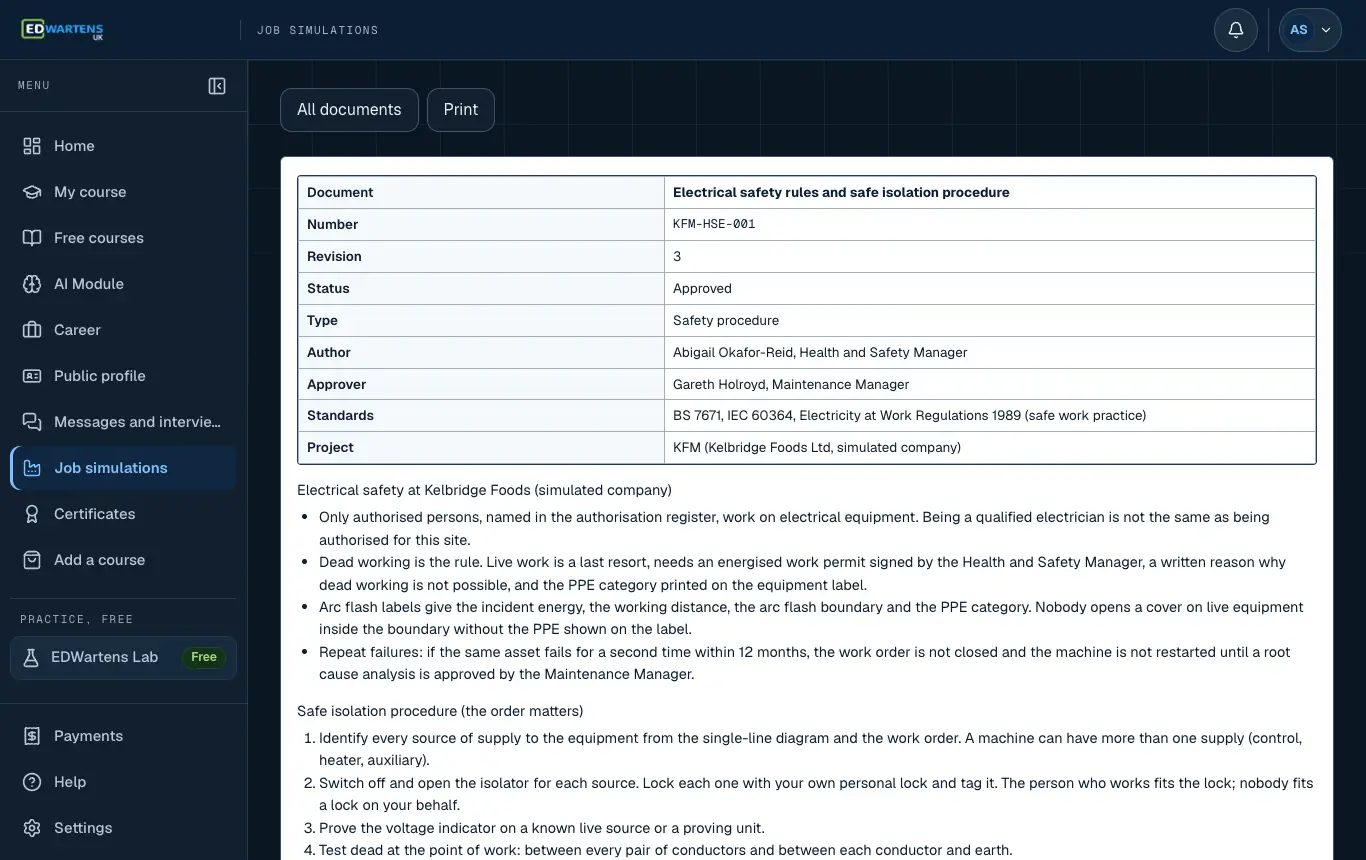
A project document with its number, revision and status. 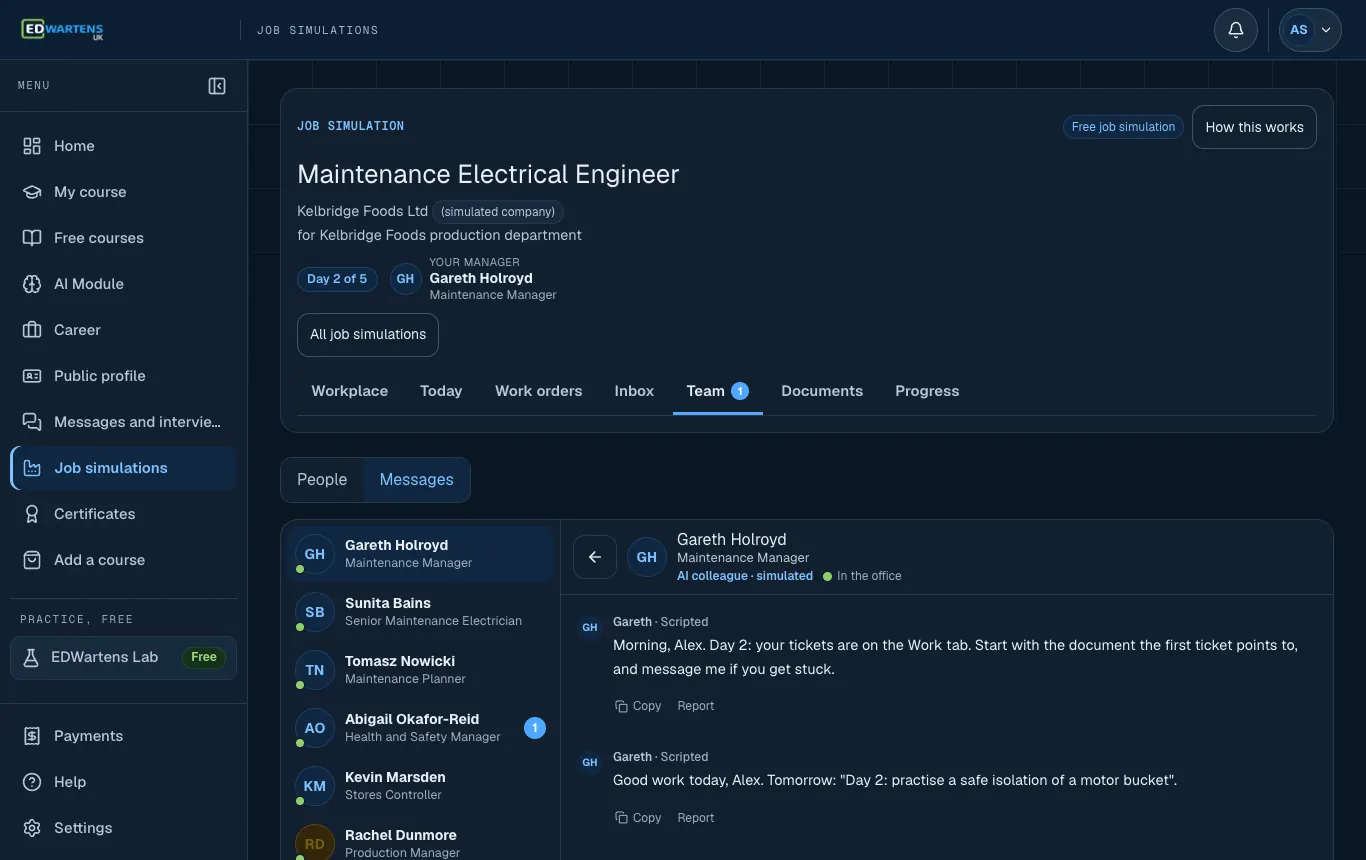
Ask a colleague. They are AI colleagues: they help you think, they do not hand out answers.


Screenshots from the simulator. Company, people and data are fictional. Portraits are AI-generated.
Meet the team
The colleagues you work with
You can read their messages and ask them questions. They are AI colleagues, clearly labelled. They help you think a ticket through; they do not hand out its answer.
- GHGareth HolroydMaintenance ManagerSimulated colleague, company side
- SBSunita BainsSenior Maintenance ElectricianSimulated colleague, company side
- TNTomasz NowickiMaintenance PlannerSimulated colleague, company side
- AOAbigail Okafor-ReidHealth and Safety ManagerSimulated colleague, company side
- KMKevin MarsdenStores ControllerSimulated colleague, company side
- RDRachel DunmoreProduction ManagerSimulated colleague, client side
- LFLiam FaircloughShift SupervisorSimulated colleague, client side
- IQImran QureshiDrive Supplier SupportSimulated colleague, vendor
Fictional people. Portraits are AI-generated.
What you get
What you walk away with
Run a month in a factory maintenance team: safe isolation, fault finding, root cause and a shutdown plan.
What you produce
Isolation certificate review
Safety document
Thermography action list
Condition report
A closed work order with findings
CMMS record
Critical spares re-order points
Stores plan
Root cause analysis of a drive trip
RCA reportPremium
Engineering change request
Change controlPremium
Shutdown method statement and risk assessment
RAMSPremium
Maintenance handover pack
CapstonePremium
Skills you practise
- Safety and safe systems of work
- Safe isolation and LOTO
- Planned and corrective maintenance
- Written communication
- Root-cause analysis
- Motors and drives
- Fault finding
- Planning and prioritising
Roles to look for
- Maintenance Electrician
- Electrical Maintenance Engineer
- Multi-skilled Maintenance Engineer (electrical bias)
- Maintenance Technician
2304 live openings on the UK jobs board, checked 24 Oct 2026. See the jobs
Your proof
- A certificate anyone can verify. Optional, and included in Premium.
- An entry on your EDWartens profile under Work experience, marked as a job simulation.
- A work record with your skill scores, with Premium.
Free courses that go with it
- Free course Electrical Safety at Work (UK): Safe Isolation, Lock-off and Arc Flash
- Free course Maintenance Planning, Scheduling and CMMS with SAP PM
- Free course PLC and Electrical Troubleshooting for Maintenance Teams
- Free course Machinery Fault Diagnosis and Condition Monitoring
- Free course Variable Frequency Drives: Wiring, Programming, PLC and Network Control
What you can talk about at interview
- You can walk an interviewer through a safe isolation with two supplies, step by step.
- You can explain how you decided what to do about hot spots from a thermography round.
- In Premium, you can talk through a root cause analysis you wrote and the change it led to.
Day by day
Days 1 to 5, ticket by ticket
Self-paced. A day opens when you hand in the previous day's tickets. Every ticket is checked, and you see the model answer after it.
Day 1
about 2 h- Induction: safe isolation and site electrical rulesQuiz · 50 min
- Check a draft isolation certificateDocument review · 1 h 10 min
Day 2
about 1 h 30 min- Safe isolation of an MCC bucketHand-in · 1 h 30 min
Day 3
about 2 h- Thermography: class and action for each pointTable · 1 h 10 min
- How far over its rating is the mixer motor?Calculation · 50 min
Day 4
about 1 h 35 min- The isolation boundary is not clearDecision · 35 min
- Close out work order WO-2026-018342Writing · 1 h
Day 5
about 2 h 30 min- Find the hidden fault and repair it under lock-outHand-in · 1 h 30 min
- Re-order points for the critical sparesTable · 1 h
Premium: days 6 to 20about 21 h 40 min more
After day 5 the project goes on with a change request, site work, faults, a handover and a capstone reviewed by an engineer.
Day 6
about 1 h 50 min- A motor that keeps trippingHand-in · 1 h 50 min
Day 7
about 1 h 30 min- Motor insulation and PI: fit to run or not?Table · 1 h 30 min
Day 8
about 35 min- Restart the pump without finding the cause?Decision · 35 min
Day 9
about 1 h 40 min- Write the root cause analysis for RCA-043Writing · 1 h 40 min
Day 10
about 1 h 30 min- Engineering change request for the substitute driveWriting · 1 h 30 min
Day 11
about 35 min- A hot terminal in the compressor bucketDecision · 35 min
Day 12
about 1 h 50 min- Commission the substitute driveHand-in · 1 h 50 min
Day 13
about 35 min- The supplier's engineer in a live bucketDecision · 35 min
Day 14
about 1 h 50 min- Correct the power factor, and decide on detuningHand-in · 1 h 50 min
Day 15
about 1 h 10 min- Check the arc flash labels against the studyDocument review · 1 h 10 min
Day 16
about 1 h 10 min- How long will MCC-1 be out, and what does it cost?Calculation · 1 h 10 min
Day 17
about 1 h 40 min- Method statement and risk assessment for the MCC-1 shutdownWriting · 1 h 40 min
Day 18
about 4 h- Capstone: the maintenance handover packHand-in · 4 h
Day 19
about 1 h- Reliability of the mixer M-12: MTBF, availability and costCalculation · 1 h
Day 20
about 45 min- A conversation about your own workViva · 45 min
Real documents
The documents you will work with
Each one has a number, a revision and an approver, the way a project document does. You read them, check them and write your own.
KFM-HSE-001
Electrical safety rules and safe isolation procedure
Rev 3Safety procedure
KFM-SLD-001
Single-line diagram, MCC-1 and packing hall boards
Rev ASLD
KFM-WO-018342
Work order: CV-07 motor terminal box repair
Rev 1Work order
KFM-ISO-0187
Isolation certificate for WO-2026-018342, draft
Rev AIsolation certificate
KFM-THM-014
Thermography round, MCC-1, readings and severity rules
Rev 1Thermography report
KFM-SPR-001
Critical spares list and re-order rule
Rev BSpare parts list
KFM-LOG-005
Your notes from the CV-07 repair, day 4
Rev 1Shift log
Documents that arrive in Premiumchange requests, records, handover
KFM-TST-022
Motor insulation and polarisation index records, six motors
Rev 1Test recordPremium
KFM-RCA-043
Incident file: CWP-1 drive trip at night
Rev ARCA evidencePremium
KFM-ECR-001
Engineering change request: replacement drive for CWP-1
Rev AChange requestPremium
KFM-SLD-001
Single-line diagram, MCC-1: drive replaced in -Q44
Rev BSLDPremium
KFM-PM-001
Preventive maintenance schedule, revised after RCA-043
Rev BPM planPremium
KFM-ARC-001
Arc flash label review: study table and the labels on site
Rev AArc flash labelsPremium
KFM-SHD-001
Annual MCC-1 shutdown: activity list
Rev AShutdown planPremium
KFM-HOV-001
Maintenance handover pack requirements
Rev AHandover indexPremium
Tools
In the industry, and here
| In the industry | Here |
|---|---|
| Voltage indicator, insulation tester, thermal camera, clamp meter | EDWartens Lab's MCC and panel exercises, with readings you take and tests you record |
| Work orders and the maintenance system | Work orders and close-out notes as documents and tickets |
| Isolation certificates, permits and risk assessments | Draft certificates to review and method statements to write |
| Spreadsheets for spares, test records and shutdown plans | Tables and calculations you complete and have checked |
Standards
The standards the work follows
- BS 7671
- IEC 60364
- Electricity at Work Regulations 1989 (safe work practice)
- HSE guidance HSG85 (electricity at work)
- PUWER 1998
- IEEE 1584 (study method)
- ISO 55001
In the UK
The Maintenance Electrical Engineer role in a UK setting
Who employs this kind of engineer: Food and drink, packaging and manufacturing sites, logistics operators and facilities teams.
Where: Industrial regions such as the North West, Yorkshire, the Midlands, Scotland and the South West have many sites with in-house maintenance teams. This is context, not a statement about vacancies.
UK standards and regulations to know about
Electricity at Work Regulations 1989
The law on safe work with electrical systems. HSE guidance HSG85 explains safe working practices.
HSE guidance HSG85 and GS 38
Safe working practices for electricity, and guidance on electrical test equipment for use by electricians.
BS 7671 and the IET Code of Practice for In-service Inspection and Testing
Inspection of installations, and testing of portable and fixed equipment in service.
PUWER 1998
The Provision and Use of Work Equipment Regulations: equipment must be suitable, maintained and safe to use. HSE guidance L22 explains them.
LOLER 1998
Lifting Operations and Lifting Equipment Regulations: thorough examination of hoists and cranes.
DSEAR 2002
Relevant wherever dust, such as flour, can form an explosive atmosphere.
Schemes to be aware of
ECS card (Electrotechnical Certification Scheme)
The industry card that many UK electrotechnical employers and sites ask to see. It is linked to qualifications and a health and safety assessment. EDWartens does not issue it, and this simulation does not lead to it.
These are named so that you recognise them. A job simulation does not teach them as a qualification, the tasks use simplified data, and you should always read the current edition of anything you rely on.
Your proof, optional
A certificate you can verify
The free days are free. The graded, verifiable certificate is an optional extra, and it is included in Premium.
- A graded, verifiable certificate with your score and band
- A public verification page and QR code
- One-click add to LinkedIn as a licence or certification
- Issued by WARTENS LTD. It is a training certificate, not an accredited qualification, and the company is simulated
Optional: £14.99 including VAT, once you pass.
Job Simulation Certificate
Your name
completed the Maintenance Electrical Engineer job simulation at Kelbridge Foods Ltd (simulated company). Your score and band are shown on the real certificate.
- Number
- EDW-JS-0000
- Issued by
- WARTENS LTD
Not an accredited qualification. A verification page and QR code are printed on the real certificate.
Prepare
Free courses and labs that get you ready
Linked from the tickets that need them. You can read them before you start.
Free courses
- Electrical Safety at Work (UK): Safe Isolation, Lock-off and Arc Flash
- PLC and Electrical Troubleshooting for Maintenance Teams
- Maintenance Planning, Scheduling and CMMS with SAP PM
- Machinery Fault Diagnosis and Condition Monitoring
- Industrial Motor Control
- Testing and Maintenance of Transformers and Switchgear
- Variable Frequency Drives: Wiring, Programming, PLC and Network Control
- Wiring Regulations in Practice: BS 7671 and IEC 60364
EDWartens Lab guides
The hands-on tickets are finished in EDWartens Lab, then you record the figures and upload a FAT sheet or notes for checking. Nothing is marked as passed on the lab's say-so.
About the Maintenance Electrical Engineer role
Safe isolation and lock-out: what the real sheet looks like
Safe isolation is a documented sequence for proving a circuit dead before touching it: identify, isolate, secure, test your tester, test the circuit and test your tester again. The exact steps follow your site rules and the safe work rules that apply where you are. In the UK these include the Electricity at Work Regulations 1989 and HSE guidance such as HSG85 and GS 38 on test equipment.
In the simulation you review a draft isolation certificate for mistakes, then isolate a motor bucket in an EDWartens Lab MCC exercise. A later case has an unclear isolation boundary, where the right answer is to stop and ask. Lock-out and tag-out extends the same idea to every energy source.
Fault finding: predict, measure, confirm
Good fault finding is a method, not luck. Read the schematic, predict what each reading should be, measure, and only then confirm the cause.
The lab gives you a hidden fault to find and repair under lock-out, and later a motor that keeps tripping. Premium tasks add insulation and polarisation index records for several motors, where you decide which are fit to run. The skill being practised is writing down the evidence, not guessing the part.
Good records make the next fault faster to find.
Root cause report: five whys and evidence
A repair that restores production without finding the cause invites the same fault next week. The project includes a drive that trips at night, with a manager who wants it restarted at once.
You decide whether to restart without a cause, then write the root cause analysis from the evidence in the incident file. A good report lists what was seen, the chain of reasons, the cause and the action that stops a repeat. The preventive maintenance schedule is revised from it.
The shift handover and close-out notes
Maintenance depends on what you write for the next person. You close out a work order with a note that says what was found, what was done and what is left open, and later write a method statement and risk assessment for a planned shutdown of the MCC.
Spares, thermography severity rules and arc flash labels each come with a record to read and a decision to make. The final pack is a maintenance handover that another engineer could pick up cold.
Where maintenance leads
Maintenance engineers move towards reliability, planning, commissioning or substation work. Reading drawings, safe isolation and clear records help in every one of them.
The linked roles, the substation and MCC engineer and the commissioning engineer, are neighbours. The free courses cover electrical safety, fault finding and planning with maintenance systems.
Keep your isolation walk-through, your fault finding notes and your root cause report. Together they make a compact portfolio that shows safe habits first, which is what a maintenance manager looks for in a new engineer.
Keep going
Related job simulations and courses
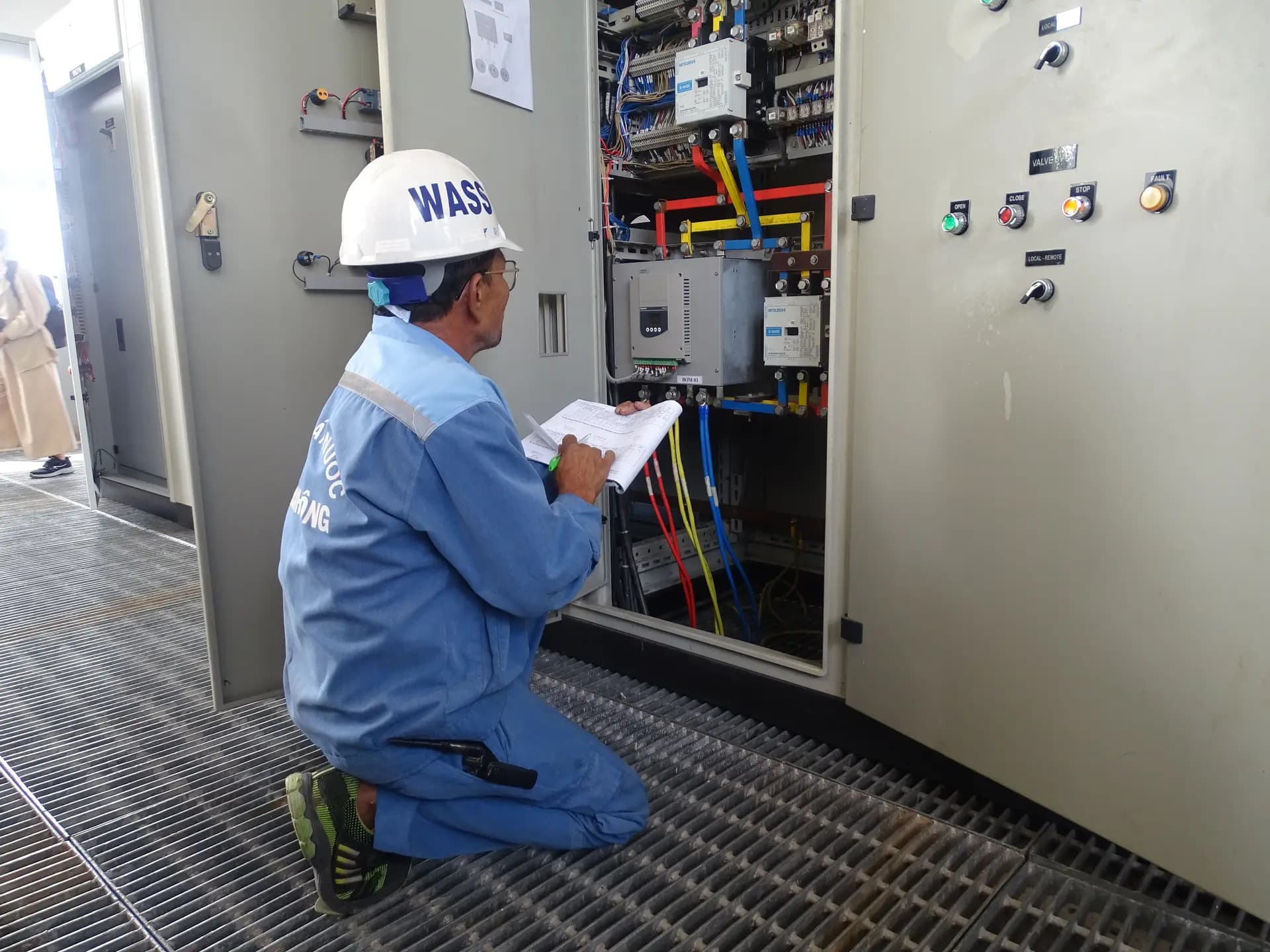
Substation and MCC Engineer
Protection settings, relay tests and an inrush trip on a new feeder.

Commissioning Engineer
Loop checks, I/O checkout, SAT and a punch list on a plant that is nearly ready.
Electrical Design Engineer
Load list, single-line diagram, cable sizing and a late design change.
- Engineering job simulations
- Free courses
- Browse jobs
- Virtual work experience in the UK
- Job simulation questions
Content reviewed 19 Oct 2026; UK context added 21 Oct 2026. Practice, not employment.
Questions
Quick answers
What is lock-out and tag-out?
Lock-out and tag-out isolates every energy source before work, locks and tags it, then verifies zero energy by attempting a start and testing with suitable instruments. Electrical, hydraulic, pneumatic, mechanical and thermal sources are all included.
How do you fault-find an electrical machine?
Work methodically: read the schematic, predict the expected readings, measure under operation, then confirm the cause. For example, an insulation tester can show a winding to earth fault that points to the motor rather than the drive.
What is safe isolation?
It is a documented sequence to prove a circuit is dead before touching it: identify, isolate, secure, test the tester, test the circuit and test the tester again. Follow your site rules and the safe work practice standard for your region.
What is root cause analysis?
It is finding the underlying reason a fault happened so that it does not recur, rather than only replacing the failed part. The simulation asks you to write one from an incident file.
What does a maintenance electrical engineer do each shift?
They handle work orders, breakdowns and planned maintenance, record findings and escalate repeat failures. Clear notes at handover matter as much as the repair.
Which tools do I need to know?
A multimeter, an insulation tester, a clamp meter, a thermal camera and the plant's work order system. In EDWartens Lab's MCC and panel exercises you take readings with virtual versions of these.
Can new starters apply for maintenance roles?
Entry routes include apprenticeships and graduate schemes and vary by employer, so check each advertisement. A documented fault finding and root cause example is useful to talk through in an interview.
Is a virtual fault-finding exercise useful?
It builds the habit of predicting readings and documenting cause. It does not build hands-on test skill, so it complements supervised practice and does not replace it.
Do I need to be a qualified electrician?
No. The simulation teaches the order of work, the paperwork and the safety rules, but it does not make you authorised to work on live equipment. Always follow the rules of your own employer and country.
Is the factory a real one?
No. Kelbridge Foods is a made-up company and the site is simulated. The documents, tests and situations follow what a junior maintenance engineer meets.
How long does it take?
The free week is about ten hours over five days. The full Premium edition runs over twenty working days and about thirty to forty hours, at your own pace.
Which equipment brands does it use?
None. The content is vendor-neutral, so it applies to any plant that follows the same standards.
What do I get at the end?
A work record with scores by task and skill, which shows on your EDWartens profile under Work experience, marked as a job simulation.
Is the Maintenance Electrical Engineer job simulation free?
Yes, to start. Days 1 to 5 are free. The certificate (£14.99) and the Premium edition (£53.99) are optional, and both prices include VAT.
Does it count as work experience?
No. It is a training project at a simulated company, not employment, an internship or a placement. A job simulation is a realistic training project at a simulated company. It is not employment, an internship or a work placement, and it is not a job offer. Hours are active hours the learner logged on EDWartens UK.
A job simulation is a realistic training project at a simulated company. It is not employment, an internship or a work placement, and it is not a job offer. Hours are active hours the learner logged on EDWartens UK.
Start the Maintenance Electrical Engineer job simulation today
Days 1 to 5 are free. No card to start. Practice, not employment.