Free course · Process control
Siemens TIA Portal PID Compact and Analog Processing
This free course teaches closed-loop control on a Siemens S7-1200 or S7-1500: on/off, three-point and PID control, reading P, I and D as gain, reset time and rate time, scaling analog signals with NORM_X and SCALE_X, configuring and tuning PID_Compact in a cyclic interrupt, and proving it on a tank simulation. It suits UK control technicians and engineers in water, food and drink and process plants, and helps with control and instrumentation roles.
Siemens TIA Portal PID Compact and Analog Processing is a free online intermediate Process control course with 7 modules, about 5 hours of video lessons. Learning is free; an optional verifiable certificate costs £19 including VAT when you pass the final exam. Last updated 28 October 2026.
Free to learn. Verifiable certificate £19 when you pass the final exam (optional, VAT included).
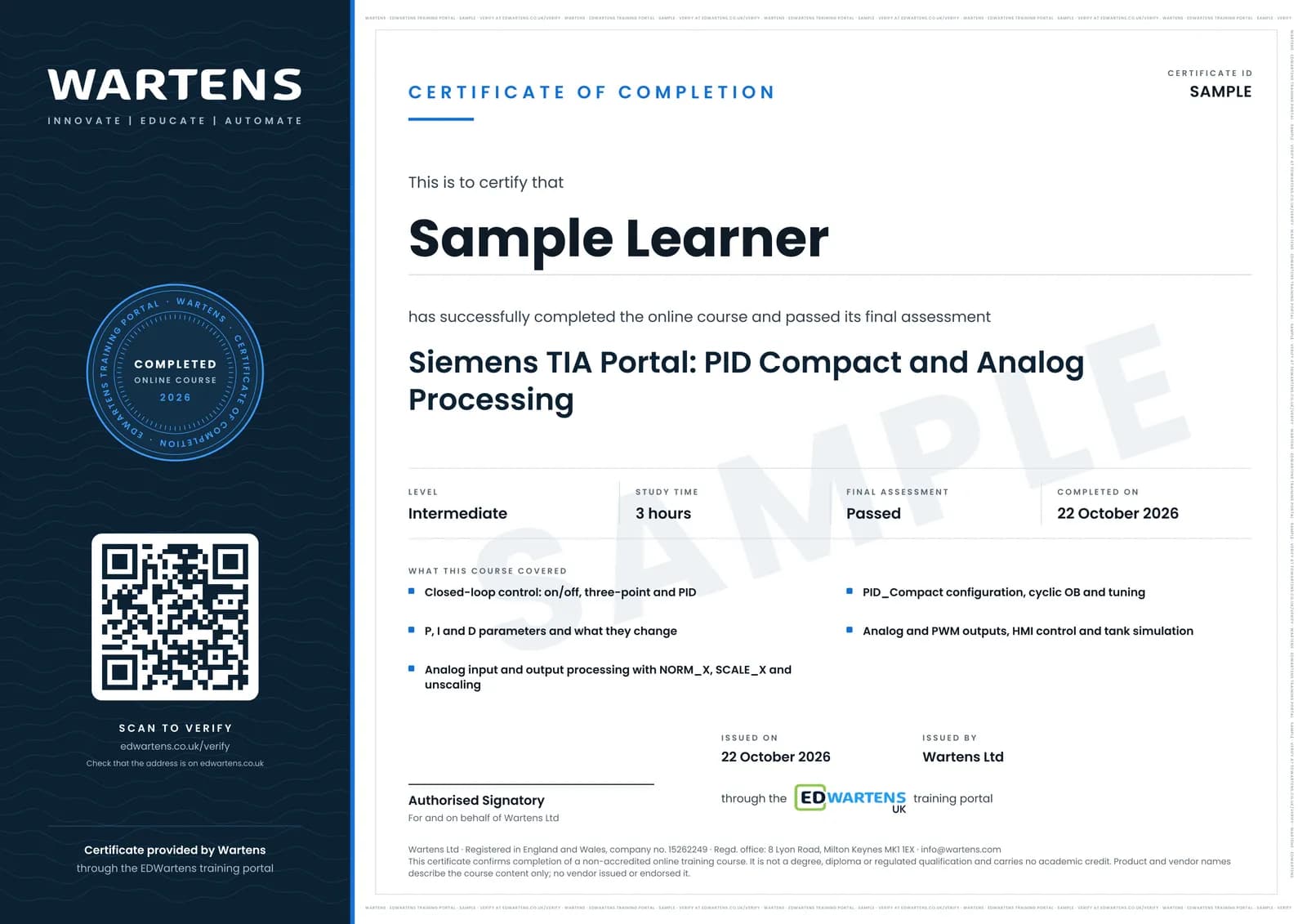
Sample certificate. Optional, issued when you pass the final exam.
- Level
- Intermediate
- Modules
- 7
- Video
- 5 hours
- Price
- Free
Video time only: reading the notes, the quizzes and the final exam take extra time, at your own pace.
Outcome
What you will be able to do
Explain why a loop needs a controller and what P, I and D do, scale analog inputs and outputs, place and configure PID_Compact in a cyclic OB, tune it with pretuning and fine tuning, choose between analog and PWM outputs, and run it against an HMI and a tank simulation.
- Explain on/off, three-point and PID control and when each fits
- Read P, I and D as gain, reset time and rate time
- Scale analog inputs with NORM_X and SCALE_X and outputs the other way
- Configure PID_Compact in a cyclic interrupt OB and run it
- Pretune and fine-tune a loop and judge the result
- Choose analog or PWM output and control the loop from an HMI
Software
The current TIA Portal trial (21 days) with S7-PLCSIM, on 64-bit Windows 11 Pro or Enterprise; Factory I/O (30-day trial) for the level scene
Hardware
None. The tank simulation and Factory I/O stand in for the plant.
Syllabus
7 modules
Each module has video lessons, notes and a short quiz. The final exam closes the course.
- Why Closed-Loop Control, and What P, I and D Mean2 lessons
- Analog Input Processing: NORM_X and SCALE_X1 lessonLab
- Analog Output Processing: Unscaling1 lesson
- PID_Compact: Placing, Configuring and Running It2 lessons
- Tuning PID_Compact, and Analog versus PWM Output2 lessonsLab
- Tank Simulation, HMI Control and Factory I/O Level Control3 lessonsLab
- Final Assessment1 lesson
How it works
How this course works
- Watch the video lessonsOne module at a time, at your own pace.
- Take the module quizA short quiz at the end of each module shows what stuck.
- Keep your notesWrite in My notes beside each module and ask the trainer if you are stuck.
- Practise in the labOptionalTry a task from the module in the EDWartens Lab, in your browser.
- Sit the final examPass it once you have been through the modules.
- Certificate, if you want oneOptionalPaid, and only after you pass. Anyone can check it online.
EDWartens Lab
Practise this in the EDWartens Lab
Calibrate a 4 to 20 mA transmitter, tune a level or flow loop and read the trend in the Lab's process simulator.
Works alongside Siemens TIA Portal PID Compact and Analog Processing. The Lab is process control practice in your browser: no install, no hardware, free to use. Sign in as a learner and it opens with your account.
Levels to try with this course
PRC-02 · Process lab
Loop check
Open in the lab (opens in a new tab)Electrical lab
Commission the 4-20 mA level loop
Open in the lab (opens in a new tab)PRC-04 · Process lab
Tune the level loop
Open in the lab (opens in a new tab)
Optional. Skip it whenever you like: it never blocks your progress or your certificate.
Why practise in a lab
Technical work is judged on what you can do: wiring, commissioning, finding a fault. Doing a task yourself teaches more than watching it a second time, and a lab lets you try it safely before you meet real equipment. It does not replace working on real hardware.
- Practise safely, so a mistake costs nothing.
- The lab checks your work like a site test, so you know when it is right.
- Free, in your browser, with nothing to install.
Certificate
An optional certificate when you pass
Learning is free. Pass the final exam and you can have a certificate for £19, including VAT, with a number employers can check online. It records that you completed a free online course; it is not a regulated qualification or a CPD certificate.
- Your name, the course, its study time and your final exam score
- A unique certificate number and a QR code to its verification page
- Issued by Wartens Ltd; add it to your LinkedIn profile in one click
- Pay now or after you pass: it is issued the moment you pass the final
Credits
Who made the lessons
The video lessons belong to their creators. EDWartens wrote the study plan, notes, quizzes and the final exam.
- Hegamurl
the TIA Portal PID and closed-loop control series
- Instrumentation Tools
the Factory I/O tank level control lesson
Jobs
Jobs this course can lead to
The skills in this course are used in instrumentation and process control work, for example as a control systems engineer, an instrumentation engineer and a PLC programmer. No course can promise a job, and employers also look for experience, so read what live adverts ask for.
Pay: Production and process engineers (SOC 2125, which includes control and instrumentation engineers) had a median of £48,700 a year, full-time, in April 2026. Source: ONS, Annual Survey of Hours and Earnings 2026 (provisional). Checked 28 Oct 2026.
Questions
About this course
Last reviewed 28 October 2026.
Is PID tuning an everyday skill for UK controls roles?
Do I need a plant or tank to practise?
What does the £19 certificate show?
Is TIA Portal free?
What does the Siemens TIA Portal PID Compact and Analog Processing course cover?
Where does Siemens TIA Portal PID Compact and Analog Processing start and where does it end?
How long is Siemens TIA Portal PID Compact and Analog Processing?
Can I practise Siemens TIA Portal PID Compact and Analog Processing in the browser?
Do I need a real process?
Is this the same as the generic PID course on this site?
Is the course really free?
What certificate do I get, and is it a Siemens qualification?
Who made the video lessons?
How long does the course take?
What software do I need?
Want a live class and career support?
The Professional Module is five live days of Siemens PLC, HMI and SCADA with an instructor, then career sessions with our engineers and a CPD certificate.