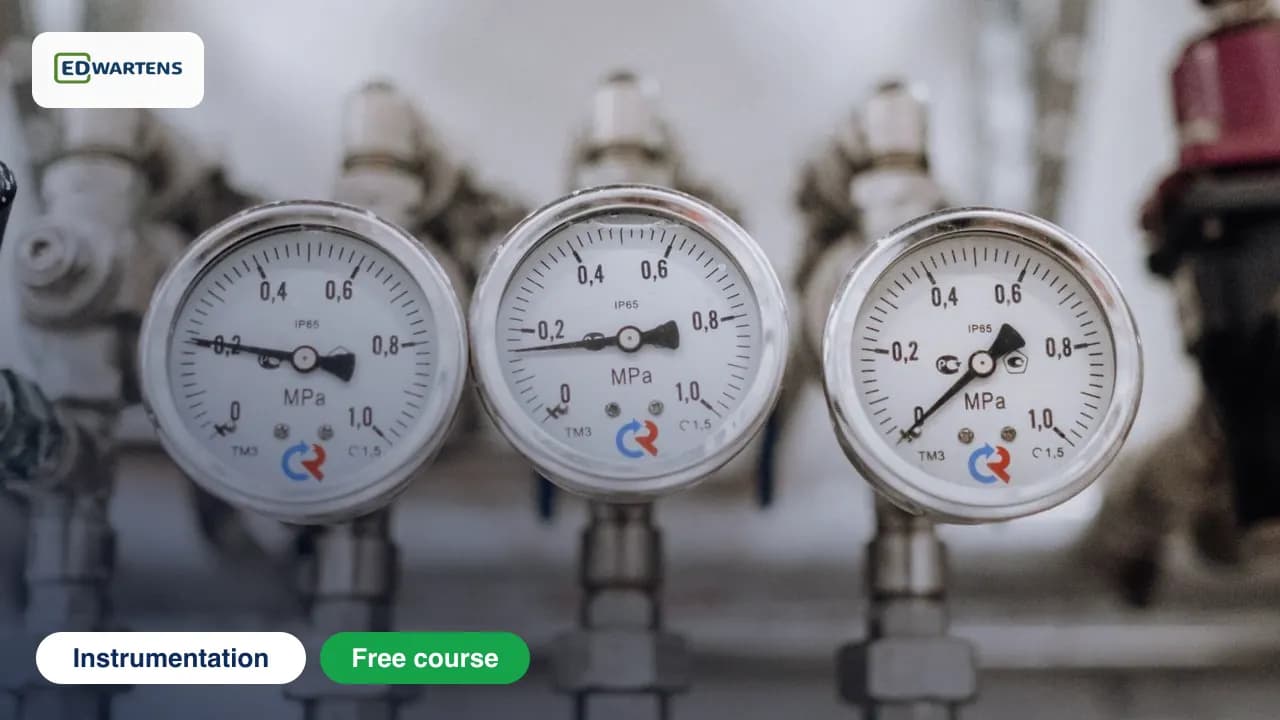
Free course · Instrumentation
Industrial Instrumentation and Process Control
This free beginner course teaches industrial instrumentation and process control: control loops, pressure, level, flow and temperature measurement, 4-20 mA loops, HART, control valves, P&IDs and calibration. It suits UK technicians, electricians, apprentices and graduates heading for process industries such as water, chemicals, food and drink, pharma and energy. It helps with instrument technician, C&I technician and maintenance technician roles. Practice tasks can be done on paper, and a multimeter and loop calibrator make the loop modules hands-on.
Industrial Instrumentation and Process Control is a free online beginner Instrumentation course with 15 modules, about 16 hours of video lessons. Learning is free; an optional verifiable certificate costs £19 including VAT when you pass the final exam. Last updated 28 October 2026.
Free to learn. Verifiable certificate £19 when you pass the final exam (optional, VAT included).
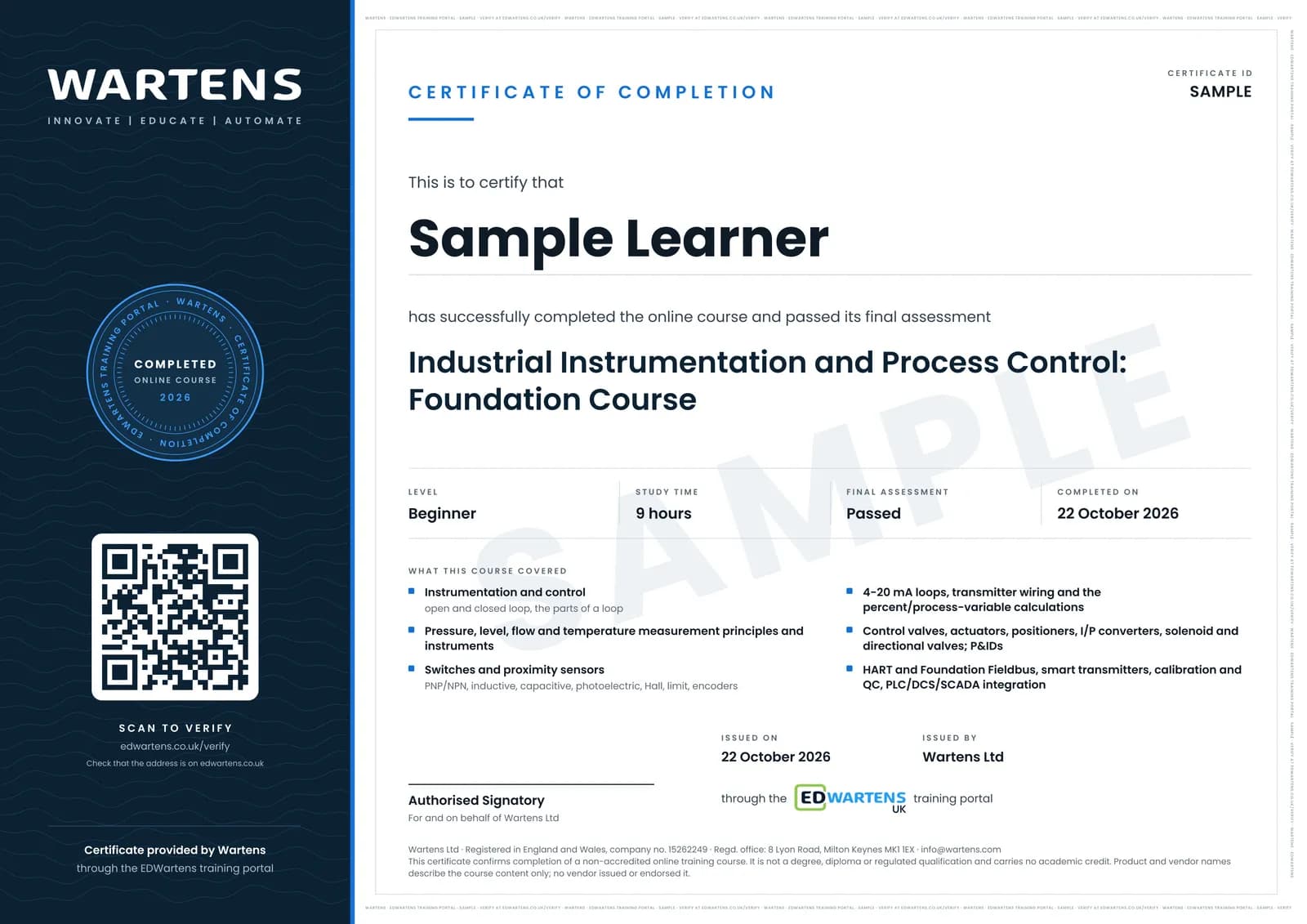
Sample certificate. Optional, issued when you pass the final exam.
- Level
- Beginner
- Modules
- 15
- Video
- 16 hours
- Price
- Free
Video time only: reading the notes, the quizzes and the final exam take extra time, at your own pace.
Outcome
What you will be able to do
Explain instrumentation and control, describe the working principle of the common pressure, level, flow and temperature instruments, wire and read switches and proximity sensors, explain and calculate 4-20 mA loops both ways, describe control valves, actuators, positioners and I/P converters, read a P&ID, explain HART and Foundation Fieldbus, describe calibration and its records, and place every instrument in the PLC, DCS and SCADA loop.
- Tell open-loop from closed-loop and name every part of a control loop
- Explain absolute, gauge and differential pressure and the instruments that measure them
- Choose a level and a flow technology for a service and say why
- Read RTDs and thermocouples and check them with a meter
- Wire PNP and NPN sensors and limit switches to a PLC
- Calculate 4-20 mA to percent to process variable in both directions, including square-root flow
- Describe control valves, positioners, I/P converters and solenoid valves
- Read a P&ID, explain HART, describe calibration and follow a signal from field to screen
Software
None required.
Hardware
None required. A multimeter and any 4-20 mA transmitter or loop calibrator make the loop modules real.
Syllabus
15 modules
Each module has video lessons, notes and a short quiz. The final exam closes the course.
- What Instrumentation and Control Is2 lessons
- Pressure Measurement6 lessons
- Pressure Transmitters, Switches and Impulse Lines4 lessons
- Level Measurement6 lessons
- Flow Measurement10 lessons
- Temperature Measurement3 lessons
- Switches and Proximity Sensors10 lessons
- 4-20 mA Loops and Transmitter Wiring7 lessonsLab
- Percent and Process Variable Calculations4 lessons
- Control Valves, Actuators and Positioners10 lessonsLab
- Reading P&IDs3 lessonsLab
- HART, Fieldbus and Smart Transmitters6 lessons
- Calibration and Quality Control3 lessonsLab
- Instruments in the Loop: PLC, DCS and SCADA11 lessons
- Final Assessment1 lesson
How it works
How this course works
- Watch the video lessonsOne module at a time, at your own pace.
- Take the module quizA short quiz at the end of each module shows what stuck.
- Keep your notesWrite in My notes beside each module and ask the trainer if you are stuck.
- Practise in the labOptionalTry a task from the module in the EDWartens Lab, in your browser.
- Sit the final examPass it once you have been through the modules.
- Certificate, if you want oneOptionalPaid, and only after you pass. Anyone can check it online.
EDWartens Lab
Practise this in the EDWartens Lab
Calibrate a 4 to 20 mA transmitter, tune a level or flow loop and read the trend in the Lab's process simulator.
Works alongside Industrial Instrumentation and Process Control. The Lab is process control practice in your browser: no install, no hardware, free to use. Sign in as a learner and it opens with your account.
Levels to try with this course
PRC-01 · Process lab
Read the P&ID
Open in the lab (opens in a new tab)PRC-02 · Process lab
Loop check
Open in the lab (opens in a new tab)PRC-03 · Process lab
Calibrate a pressure transmitter
Open in the lab (opens in a new tab)PRC-05 · Process lab
Flow loop and control valve
Open in the lab (opens in a new tab)
Optional. Skip it whenever you like: it never blocks your progress or your certificate.
Why practise in a lab
Technical work is judged on what you can do: wiring, commissioning, finding a fault. Doing a task yourself teaches more than watching it a second time, and a lab lets you try it safely before you meet real equipment. It does not replace working on real hardware.
- Practise safely, so a mistake costs nothing.
- The lab checks your work like a site test, so you know when it is right.
- Free, in your browser, with nothing to install.
Certificate
An optional certificate when you pass
Learning is free. Pass the final exam and you can have a certificate for £19, including VAT, with a number employers can check online. It records that you completed a free online course; it is not a regulated qualification or a CPD certificate.
- Your name, the course, its study time and your final exam score
- A unique certificate number and a QR code to its verification page
- Issued by Wartens Ltd; add it to your LinkedIn profile in one click
- Pay now or after you pass: it is issued the moment you pass the final
Credits
Who made the lessons
The video lessons belong to their creators. EDWartens wrote the study plan, notes, quizzes and the final exam.
- Instrumentation Tools
the Instrumentation Tools principle, loop and calculation videos
- Instrumentation Academy
the animated instrumentation lectures
- Instrumentation Tools
the DCS course with HART protocol
Jobs
Jobs this course can lead to
The skills in this course are used in instrumentation and process control work, for example as an instrument technician, a C&I technician and a maintenance technician. No course can promise a job, and employers also look for experience, so read what live adverts ask for.
Pay: Production and process engineers (SOC 2125, which includes control and instrumentation engineers) had a median of £48,700 a year, full-time, in April 2026. Source: ONS, Annual Survey of Hours and Earnings 2026 (provisional). Checked 28 Oct 2026.
Questions
About this course
Last reviewed 28 October 2026.
Is this instrumentation course for engineers or technicians?
Do I need any equipment for the instrumentation course?
Which UK industries use these instrumentation skills?
What does the Industrial Instrumentation and Process Control course cover?
Where does Industrial Instrumentation and Process Control start and where does it end?
How long is Industrial Instrumentation and Process Control?
Can I practise Industrial Instrumentation and Process Control in the browser?
What is the HART protocol?
Which standard defines the symbols on a P&ID?
What does an instrumentation technician do, and what do they earn?
Do I need any equipment?
Which industries does this apply to?
Some source lessons are short animations. Is that enough?
Is the course really free?
What certificate do I get, and is it a vendor qualification?
Who made the video lessons?
Want a live class and career support?
The Professional Module is five live days of Siemens PLC, HMI and SCADA with an instructor, then career sessions with our engineers and a CPD certificate.