







Free job simulation · AI and data

Machine learning engineer job simulation: train a model and catch target leakage

A machine learning engineer job simulation is a guided work exercise where you prepare data, train and evaluate a model, and document what you found, including mistakes such as target leakage that make results look better than reality. It is practice evidence, not employment. This version follows a member cancellation model for a simulated fitness chain, and ends with a release pack.

You join Tarn Valley Data Science Ltd (simulated company), a applied machine learning consultancy in Leeds. A working day takes 30 to 45 minutes. Days 1 to 5 are free, about 3 to 4 hours in all. Premium continues to day 20, about 12 to 15 hours. It is practice, not employment.

Days 1 to 5 are free. You need a free account and no card. Create an account. Or try the 3-minute demo (opens in a new tab), with no account.

Free
5 days, 3 to 4 hours
A working day
30 to 45 minutes
Project documents
7
Certificate, optional
£14.99
Woman engineer working on a laptop at a mechatronics test rig with wiring harnesses and sensors

The project

You join Tarn Valley Data Science Ltd (simulated company)

Tarn Valley Data Science Ltd (simulated company) is a applied machine learning consultancy in Leeds. You help its team deliver a project for Pennine Fitness Clubs Ltd, at Member retention model for twelve clubs (ticket MLE-088).

You are the junior ML engineer on a member-cancellation model for a chain of fitness clubs. The Senior ML Engineer gives you a ticket, a training extract with planted problems, a plan with mistakes in it and a log of experiments, one of which scored 0.99. Over four weeks you count what is really in the data, prove where the too-good score came from, find that 97 percent accuracy is the baseline, choose a threshold with costs and a call capacity, handle a change request, and then deal with the model after release: a fairness gap, a changed door system, drift and a deletion request.

What you will do

  • Profile a dataset for a datasheet and review a training plan for leakage, splits and the wrong metric
  • Prove where a too-good AUC comes from and explain why 97 percent accuracy on 3 percent positives means nothing
  • Choose a threshold with a cost matrix and the capacity of the people who act on the list
  • Check a model by age band, write the model card honestly and refuse to hide a gap
  • Read monitoring after release, find the upstream change that caused drift, and hand over with numeric retrain triggers

The people you deal with

  • Head of Data Sciencecompany
  • Senior ML Engineercompany
  • Delivery Managercompany
  • Client Retention Managerclient
  • Client Operations Directorclient
  • Client Data Ownerclient
  • Platform Engineerclient
  • Client Compliance Leadclient

The company, client and site are fictional. The people are fictional too.

Look inside

What the simulator looks like

The workplace, your tickets, the documents and the team chat, as a learner sees them.

  • The workplace of the simulated company in the Machine Learning Engineer job simulation
    Start in the workplace, with the team around you.
  • The Today screen of the Machine Learning Engineer job simulation: the morning email and the day's tickets
    Today: the morning email and your tickets for the day.
  • The Work screen of the Machine Learning Engineer job simulation, listing tickets by day
    Work: every ticket, by day, with its status.
  • A ticket in the Machine Learning Engineer job simulation with its brief and acceptance points
    A ticket, written the way a colleague would write it.
  • A project document in the Machine Learning Engineer job simulation with number, revision and status
    A project document with its number, revision and status.
  • The Team screen of the Machine Learning Engineer job simulation with a chat open with an AI colleague
    Ask a colleague. They are AI colleagues: they help you think, they do not hand out answers.

Screenshots from the simulator. Company, people and data are fictional and always labelled as simulated.

Meet the team

The colleagues you work with

You can read their messages and ask them questions. They are AI colleagues with names, roles and faces, always labelled as simulated. They help you think a ticket through; they do not hand out its answer.

  • Portrait of Ingrid Mortlock, an AI colleague (simulated)Ingrid MortlockHead of Data ScienceSimulated colleague, company side
  • Portrait of Rahul Menon, an AI colleague (simulated)Rahul MenonSenior ML EngineerSimulated colleague, company side
  • Portrait of Owen Pugh, an AI colleague (simulated)Owen PughDelivery ManagerSimulated colleague, company side
  • Portrait of Rosemary Quayle, an AI colleague (simulated)Rosemary QuayleClient Compliance LeadSimulated colleague, client side
  • Portrait of Bethan Rees, an AI colleague (simulated)Bethan ReesClient Retention ManagerSimulated colleague, client side
  • Portrait of Malcolm Tindall, an AI colleague (simulated)Malcolm TindallClient Operations DirectorSimulated colleague, client side
  • Portrait of Sapna Trivedi, an AI colleague (simulated)Sapna TrivediClient Data OwnerSimulated colleague, client side
  • Portrait of Joss Pennington, an AI colleague (simulated)Joss PenningtonPlatform EngineerSimulated colleague, client side

Fictional people, with simulated faces.

What you get

What you walk away with

Build and check a member cancellation model: datasheet, leakage, metrics, thresholds, fairness and a release pack.

Roles to look for

  • Machine Learning Engineer
  • Junior Data Scientist
  • Applied Machine Learning Engineer
  • Data Scientist

1378 live openings on the UK jobs board, checked 15 Nov 2026. See the jobs

Your proof

  • Your work pack, as a PDF and a zip, with your documents, timesheet and skills before and after.
  • A certificate anyone can verify. Optional, and included in Premium.
  • An entry on your EDWartens profile under Work experience, marked as a job simulation.
  • A work record with your skill scores, with Premium.

What you can talk about at interview

  • You can explain how you traced a score of 0.99 to leakage and what you changed.
  • You can describe why accuracy misleads when only a few per cent of cases are positive.
  • In Premium, you can walk through a threshold chosen from a cost matrix, a fairness check by age band and a release pack.

Day by day

Your 5 free days, and the project they build

Each working day takes 30 to 45 minutes: clock in, a morning meeting, your tickets, an end-of-day report, clock out. Do a day at a time or several in one sitting. On day 1 your manager checks what you know and plans your learning. Every ticket is checked, and you see the model answer after it.

Member cancellation model

For Pennine Fitness Clubs Ltd (fictional)

Pennine Fitness Clubs wants a monthly list of the members most likely to cancel, short enough for four people to phone and right often enough to be worth the calls. This project, ticket MLE-088, builds the model honestly: counted data, no leakage, a threshold from costs and capacity, a fair model card and monitoring after release.

In scope for you

  • Count what is really in the member data and review the training plan
  • Prove where the 0.99 score came from
  • Choose the threshold from a cost matrix and the call capacity
  • Check results by age band and write the model card and risk note
  • Read drift after release and handle a deletion request
  • Deliver the release pack

You hand over

  • Datasheet for the member datasetDatasheet for datasets
  • Leakage analysis of the 0.99 experimentExperiment analysis
  • Model card reviewModel card reviewPremium
  • Impact note for a change requestChange controlPremium
  • Risk note: Map, Measure, Manage, GovernAI risk notePremium
  • Release pack for the member cancellation modelRelease packPremium
Milestones in the free days

  1. By day 3Data counted, plan reviewed, 0.99 explained, trained without leakageMember cancellation model
  2. By day 597 % accuracy understood, metric and threshold chosen, EXP-017 recordedMember cancellation model

Tickets, day by day

  1. Day 1

    2 tickets
    • Induction: team standards for machine learningQuiz
    • Datasheet: count what is really in members.csvTable
  2. Day 2

    2 tickets
    • Review the feature spec and training planDocument review
    • Lab: data health check on the customer tableHand-in
  3. Day 3

    2 tickets
    • EXP-015: prove where the 0.99 comes fromCalculation
    • Lab: train and evaluate without leakageHand-in
  4. Day 4

    2 tickets
    • What does 97 % accuracy mean on 3 % positives?Calculation
    • "97 % is excellent. Switch it on tomorrow, and use deep learning."Decision
  5. Day 5

    2 tickets
    • Lab: choose the metric and the thresholdHand-in
    • EXP-017 record and end-of-week statusWriting

On day 5 you clock out and your manager does a final review with you, and your work pack is ready: the free days, in about 3 to 4 hours.

Premium: days 6 to 20about 12 to 15 hours with the free days

After day 5 the project goes on with a change request, site work, faults, a handover and a capstone reviewed by an engineer. Your manager also checks in on days 5, 10 and 15, and the final review comes after day 20.

  1. By day 10Cost threshold set, model card reviewed, CR-02 handled, overfitting tunedMember cancellation model
  2. By day 15Door system change measured, drift read, fairness checked by age bandMember cancellation model
  3. By day 20Risk note and deletion request handled, pull request reviewed, release pack deliveredMember cancellation model

See the Premium plan

  1. Day 6

    1 ticket
    • Choose the threshold with the cost matrix and the call capacityTable
  2. Day 7

    1 ticket
    • Review the draft model card v1.2Document review
  3. Day 8

    1 ticket
    • Impact note for change request CR-02Writing
  4. Day 9

    1 ticket
    • Lab: overfitting, tune the treeHand-in
  5. Day 10

    1 ticket
    • Experiment log: gaps and candidatesTable
  6. Day 11

    1 ticket
    • Measure the door system change in the training fileCalculation
  7. Day 12

    1 ticket
    • Drift after release: list size, recall, precisionCalculation
  8. Day 13

    1 ticket
    • Lab: fairness checkHand-in
  9. Day 14

    1 ticket
    • Results by age band on our own modelCalculation
  10. Day 15

    1 ticket
    • "Leave the age slice out of the board report"Decision
  11. Day 16

    2 tickets
    • Risk note: Map, Measure, Manage, GovernWriting
    • A member asks us to delete her dataDecision
  12. Day 17

    1 ticket
    • Review pull request 31: the v1.2 training pipelineDocument review
  13. Day 18

    1 ticket
    • Capstone: the release pack for the member cancellation modelHand-in
  14. Day 19

    1 ticket
    • Handover note to the platform teamWriting
  15. Day 20

    1 ticket
    • A conversation about your own workViva

Your workplace

Where you work, and with what

You work in a technology office: Tarn Valley Data Science (simulated company), Studio floor, Leeds. It is a 3D room with your colleagues in it.

Hours and rhythm

Days, 09:00 to 17:30, Monday to Friday, with flexible home days agreed with your buddy (simulated)

  • 09:00 team stand-up at the ticket board
  • 09:15 read Rahul's morning email and your tickets
  • 13:30 experiment review with Rahul
  • 17:00 update your tickets and the experiment log

You clock in and out of every day. The simulated clock runs faster between events, so a day takes 30 to 45 minutes of real time.

Machines and equipment

Real lab machines stand in the workplace, and the hands-on tickets point to the matching EDWartens Lab exercise. In the UK edition you do the lab exercise yourself, tick a checklist and hand in your notes and figures. It is a self-review hand-in. The lab does not mark you or send us a result.

Systems and kit

Data science ticket tracker (simulated). Each piece of work is a ticket with a number such as MLE-088. You read it, do the work, hand it in and Rahul reviews it against the team standards.

PPE on site: Staff pass worn visibly, Laptop screen lock when you leave your desk, Headphones for calls in the open area.

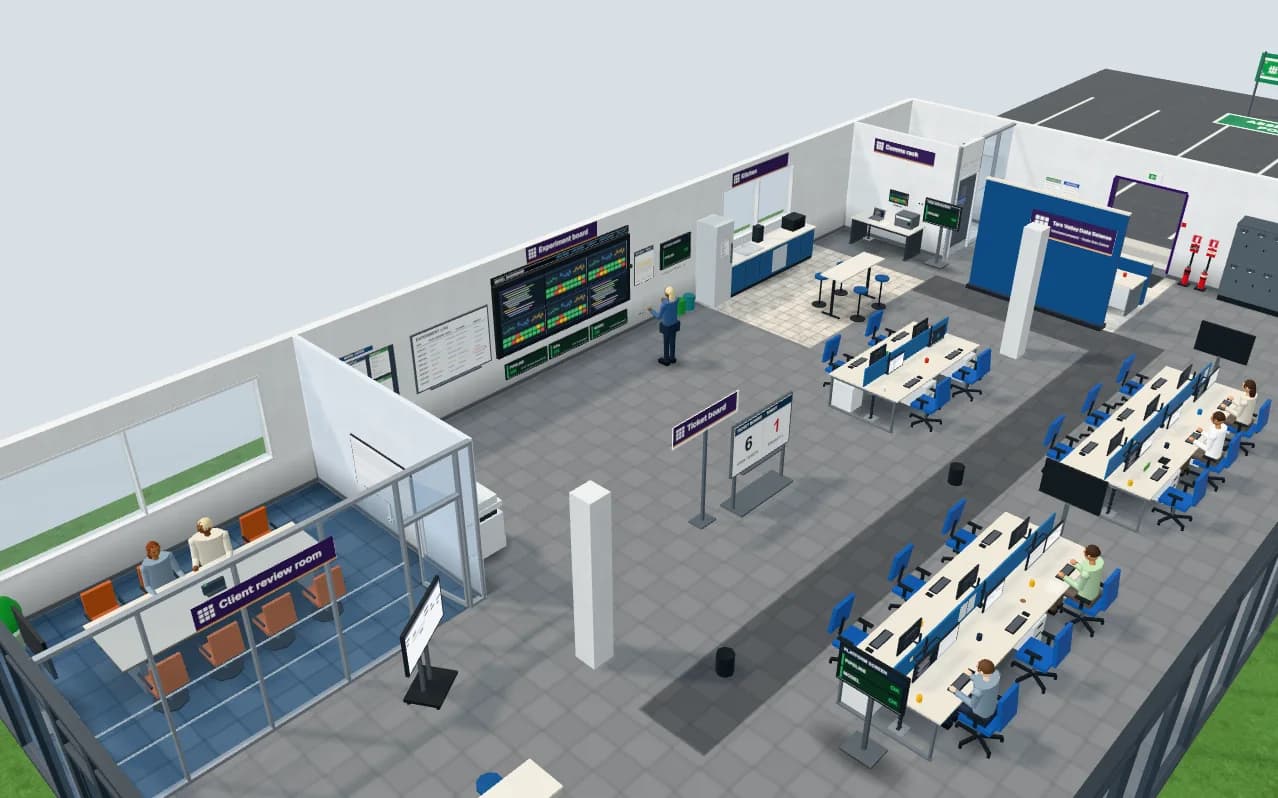
The 3D workplace of the simulated company in the Machine Learning Engineer job simulation
The simulated workplace you walk around. The company and the people are fictional.

Skills checked

The skills your manager checks

On day 1 you rate yourself on about eight skills for the role, from never done it to could teach it. Your manager then asks two short "show me" questions on the skills you rated highest. The same skills are rated again at the final review, so you see a before and after.

  • Evaluation and metrics
  • AI governance and documentation
  • Machine learning modelling
  • Written communication
  • Applying standards
  • Data cleaning and quality
  • Working with clients and stakeholders
  • Analysis and statistics

A "How to do this" panel opens on tickets that use a skill you rated low. Where you have shown you know a skill, the help stays folded away, and you can open it any time.

Real documents

The documents you will work with

Each one has a title block with a number, a revision, a status and who prepared, checked and approved it, the way a project document does. You read them, check them and write your own, and what you hand in becomes a controlled document too. Everything is kept in your work pack.

  • MLE-TKT-088

    Ticket MLE-088: churn model v1 for the retention team

    Rev ATicket

  • MLE-STD-001

    Data science team standards (one page)

    Rev CStandard

  • MLE-FRM-001

    Problem framing: member cancellation within 30 days

    Rev AProblem framing

  • MLE-DSH-001

    Datasheet for the member snapshot dataset

    Rev 0.2Datasheet

  • MLE-FSP-001

    Feature specification and training plan v0.4

    Rev AFeature spec

  • MLE-EXP-001

    Experiment log

    Rev CExperiment log

  • MLE-ARC-001

    Training and scoring flow

    Rev APipeline diagram

Documents that arrive in Premiumchange requests, records, handover
  • MLE-MCD-001

    Model card v1.2: member cancellation model (EXP-017)

    Rev AModel cardPremium

  • MLE-CHG-002

    Change request CR-02: predict cancellation within 60 days and add the Family plan

    Rev AChange requestPremium

  • MLE-FRM-001

    Problem framing: member cancellation within 60 days (model v2)

    Rev BProblem framingPremium

  • MLE-PCN-014

    Platform change notice PCN-14: door system upgrade

    Rev AChange noticePremium

  • MLE-MON-001

    Monitoring plan and weekly monitoring file

    Rev AMonitoring planPremium

  • MLE-PRQ-031

    Pull request 31: training pipeline for model v1.2

    Rev APull requestPremium

  • MLE-HOV-001

    Release and handover pack requirements

    Rev AHandover indexPremium

  • MLE-EXP-001

    Experiment log, with the tree-depth runs

    Rev DExperiment logPremium

  • MLE-REL-001

    Model release approval record (blank)

    Rev ARelease approval recordPremium

Tools

In the industry, and here

Tools in the industry and what you use here
In the industryHere
Python with scikit-learn and a notebookYour own notebook or spreadsheet on the downloaded files; every answer can be found with either
Experiment tracking (run ids, parameters, metrics)A numbered experiment log document and the experiment record you write
Model cards, datasheets and a risk registerReviewed documents with numbers and revisions
Monitoring dashboard and ticket trackerA weekly monitoring file and numbered tickets in the inbox

Standards

The standards the work follows

  • CRISP-DM
  • Model Cards for Model Reporting
  • NIST AI RMF 1.0

In the UK

The Machine Learning Engineer role in a UK setting

Who employs this kind of engineer: Data science teams in retail, finance, health, energy, leisure and the public sector, plus applied AI consultancies.

Where: Roles are advertised across the UK, with larger groups in London, Manchester, Edinburgh, Cambridge, Bristol and Leeds, and many are hybrid or remote. This is context, not a statement about vacancies.

UK standards and regulations to know about

  • UK GDPR and the Data Protection Act 2018

    The rules for personal data. The ICO publishes guidance, including on AI and data protection.

  • Equality Act 2010

    Protected characteristics such as age matter when a model affects people, which is why the fairness check by age band is in the project.

  • ICO guidance on AI and data protection

    Explains fairness, transparency and accountability for AI that uses personal data.

  • Model cards

    A common way to document what a model is for, how it was tested and where it fails.

These are named so that you recognise them. A job simulation does not teach them as a qualification, the tasks use simplified data, and you should always read the current edition of anything you rely on.

Your proof, optional

A certificate you can verify

The free days are free. The graded, verifiable certificate is an optional extra, and it is included in Premium.

  • A graded, verifiable certificate with your score and band
  • A public verification page and QR code
  • The details to list it on LinkedIn under Licences & certifications, ready to copy
  • Issued by WARTENS LTD. It is a training certificate, not an accredited qualification, and the company is simulated

Optional: £14.99 including VAT, once you pass.

Sample

Job Simulation Certificate

Your name

completed the Machine Learning Engineer job simulation at Tarn Valley Data Science Ltd (simulated company). Your score and band are shown on the real certificate.

Number
EDW-JS-0000
Issued by
WARTENS LTD

Not an accredited qualification. A verification page and QR code are printed on the real certificate.

Premium

Want the full project, reviewed by an engineer?

Premium runs to day 20, about 12 to 15 hours in all, and includes the graded certificate. Your free days carry over, and nothing you did is lost.

£53.99 including VAT, one payment. If you have bought the certificate, you pay £39.00.

  • Working days 6 to 20 (about 12 to 15 hours in all): change requests, site work, faults and handover
  • A capstone deliverable reviewed by an engineer
  • An AI viva on your own work
  • The graded certificate and a work record PDF with your skill scores

Prepare

Free courses and labs that get you ready

Linked from the tickets that need them. You can read them before you start.

Free courses

A course that goes with this role

AI Module

A paid, self-paced course in AI and machine learning for industry: 83 lessons, 5 graded projects and career sessions. It is a separate product: you do not need it to finish the job simulation, and it does not lead to a job. The certificate is a certificate of completion, not a regulated qualification.

Price
£2,688 including VAT (£2,240 + VAT); or start with a £100 deposit
Format
Self-paced online, 12 months' access

About the Machine Learning Engineer role

Why your first score is too good

Target leakage happens when training data contains information that will not be available at prediction time. The model looks excellent in validation and fails in production.

In the simulation an experiment reports a score of 0.99, and you prove where it comes from. You then retrain without leakage in the hands-on exercise and see the honest figure. Fitting preprocessing only on training data, checking that each feature exists at prediction time and splitting carefully are the habits being drilled.

Write down the proof, not just the fix, so a reviewer can see how you found it.

Metrics tied to cost, not to a headline number

When only a small share of members cancel, a model that says nobody will cancel looks highly accurate and is useless. The simulation makes you work through that case with accuracy on rare positives.

You then choose a threshold with a cost matrix and the capacity of the team who call members, so the list the model produces is one people can act on. The costs are the learner's own table, and no figure is invented for you.

The decision is written down with its numbers, so that others can check it.

The model card and the risk note

A model card says what a model is for, what data it learned from, how it performed and where it should not be used. Reviewing a draft card, you check it against the numbers.

A fairness check by age band may show a gap, and a manager may suggest leaving it out of the board report. The correct response is to report it. You also write a risk note using the Map, Measure, Manage and Govern functions of the NIST AI Risk Management Framework, and handle a member's request to delete her data.

After release: drift and retrain triggers

Models decay when the world changes. A door system upgrade changes a feature in the training file, and the monitoring shows list size, recall and precision moving.

You find the upstream change that caused the drift and hand over with numeric retrain triggers. Reviewing a pull request for the training pipeline shows the engineering side of the role. The documents include a monitoring plan and an experiment log you keep tidy.

Retrain triggers written as numbers are easy to check later, which is why the handover asks for them.

Going further with run-to-failure data

For an engineering flavour, public run-to-failure datasets are a good next step after this simulation. Predictive maintenance is one of the most common machine learning projects in industry.

The AI Workbench lab and the linked free courses cover machine learning with Python and predictive maintenance. The related roles are the data analyst, the computer vision engineer and the LLM engineer.

Keep the model card, the leakage proof and the threshold decision. They are specific, checkable pieces of work, and a reviewer can read them in minutes to see how you think about evidence.

Questions

Quick answers

What is target leakage?

It happens when training data contains information that will not be available at prediction time, so the model looks excellent in validation and fails in production. Reviewers find it easier to forgive a modest honest score than a perfect score that falls apart.

How do you detect data leakage?

Check for features derived from the target, confirm each feature exists at prediction time, and fit preprocessing on training data only. A pipeline helps enforce the last step.

What does an ML engineer do day to day?

They prepare data, train and evaluate models, document decisions and move models into use. The simulation covers data checks, training, evaluation, documentation and monitoring.

What should an ML portfolio project include?

A clear problem, honest validation, a metric chosen for the business cost, failure analysis and a short model card. Reviewers read these in minutes, so keep them short and checkable.

Is a machine learning job simulation worth it?

As practice, yes. As proof of experience, no. The strongest evidence is a documented project where you caught a problem such as leakage.

What maths and coding do I need?

Python and basic statistics. In the simulation every answer can be found with a notebook or with a spreadsheet on the downloaded files.

What is the difference between an ML engineer and a data scientist?

Data scientists tend to focus on analysis and modelling, and ML engineers on reliable training and deployment. Titles overlap, so check the job post.

What do machine learning engineers earn in the UK?

UK advertisements for machine learning engineers show a median salary of £65,000, with the middle half between £48,750 and £87,500, over the six months to 19 October 2026. This covers UK IT vacancies only, and pay in other countries varies.

Source: ITJobsWatch, Machine Learning Engineer (UK IT vacancies) (opens in a new tab), checked 19 Oct 2026.

Do I need to code?

No. The tasks are checked as numbers, decisions and writing, and the hands-on exercise is done in EDWartens Lab. Python helps with the CSV files, but a spreadsheet works for every calculation.

Is this a real company and a real model?

No. Tarn Valley Data Science and Pennine Fitness Clubs are made-up, the data is synthetic and generated with planted problems. The documents, tickets and situations follow what a junior ML engineer meets on a real project.

How long does it take?

The free week is about ten hours of work spread over five days. The full Premium edition runs over twenty working days and roughly thirty to forty hours, at your own pace.

Which libraries or cloud do I have to use?

None. The content is vendor-neutral. The answers are checked as numbers, so any tool that can count and rank works.

What do I get at the end?

A work record with your scores by task and skill, which shows on your EDWartens profile under Work experience, marked as a job simulation.

Is the Machine Learning Engineer job simulation free?

Yes, to start. Days 1 to 5 are free. The certificate (£14.99) and the Premium edition (£53.99) are optional, and both prices include VAT.

Does it count as work experience?

No. It is a training project at a simulated company, not employment, an internship or a placement. A job simulation is a realistic training project at a simulated company. It is not employment, an internship or a work placement, and it is not a job offer. Hours are active hours the learner logged on EDWartens UK.

A job simulation is a realistic training project at a simulated company. It is not employment, an internship or a work placement, and it is not a job offer. Hours are active hours the learner logged on EDWartens UK.

Start the Machine Learning Engineer job simulation today

Days 1 to 5 are free, about 3 to 4 hours. No card to start. Practice, not employment.

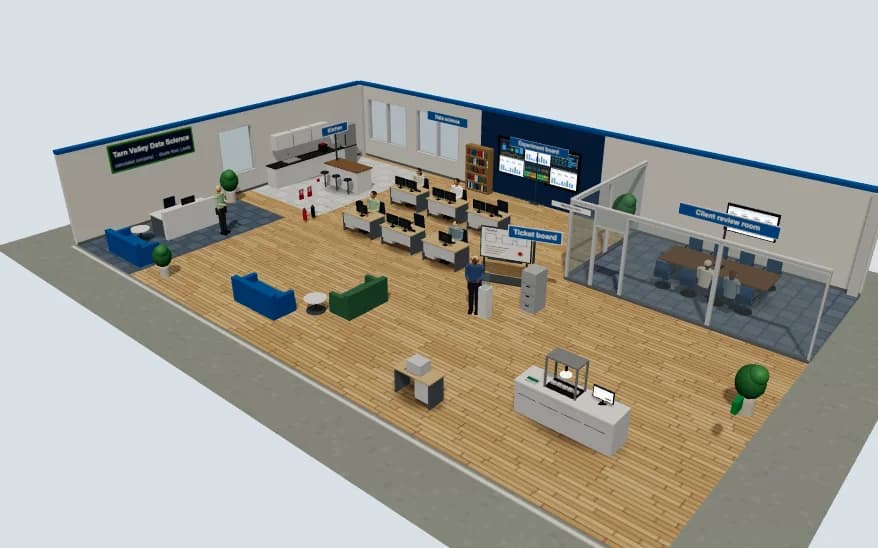
A corner of the simulated workplace in the Machine Learning Engineer job simulation