
Free course · AI and machine learning
ISO 42001 and AI Governance
The standard customers have started asking for by name: what an AI management system is, ISO/IEC 42001 clause by clause from context and leadership through the clause 6.1.2 risk assessment and the clause 6.1.4 impact assessment to documented information, the Annex A controls on policy, roles, resources, lifecycle, data, use and third parties, operation, internal audit, management review and certification, the NIST AI RMF and the OECD principles, training data and intellectual property, and the EU AI Act obligations a supplier is asked to evidence.
Free to learn. Verifiable certificate £19 when you pass the final exam (optional, VAT included).
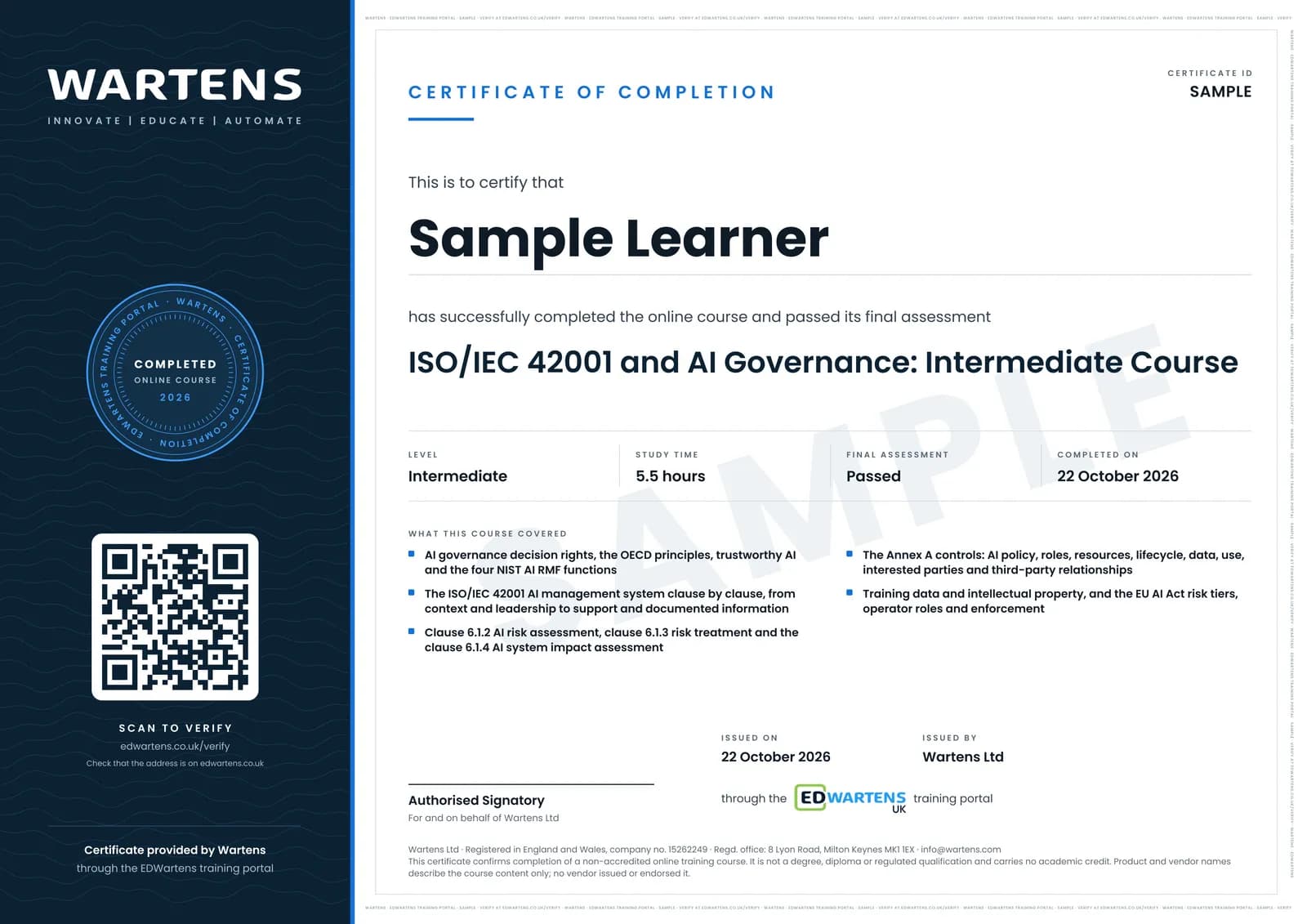
Sample certificate. Optional, issued when you pass the final exam.
- Level
- Intermediate
- Modules
- 13
- Video
- 9 hours
- Price
- Free
Outcome
What you will be able to do
Scope an AIMS and write an AI policy top management can sign; build an AI system inventory that finds the entries nobody registered; run the clause 6.1.2 risk assessment against criteria you defined before any scoring, and record who accepted the residual risk; complete the clause 6.1.4 AI system impact assessment on a system you already run; map the Annex A controls to what your organisation already does and hold the statement of applicability; assemble the documented information an auditor asks for first; and place a system in the correct EU AI Act risk tier and operator role.
- Scope an AIMS and write an AI policy that top management can sign and staff can follow
- Build an AI system inventory that turns up the tools nobody registered
- Run the clause 6.1.2 risk assessment against criteria set before any scoring, in both directions of risk
- Complete a clause 6.1.4 impact assessment for the people an AI system affects
- Map the Annex A controls to what you already do, and hold the statement of applicability
- Run operation, internal audit and management review, correct nonconformities, and prepare for certification (clauses 8 to 10)
- Place a system in the correct EU AI Act risk tier and name the operator role you hold
Software
None required. A spreadsheet is enough for the AI system inventory, the risk register and the impact assessment.
Hardware
None.
Syllabus
13 modules
Each module has video lessons, notes and a short quiz. The final exam closes the course.
- AI governance: principles, trustworthy AI and the NIST AI RMF4 lessons
- ISO/IEC 42001: the standard and the AI management system4 lessons
- Clause 4 and clause 5: scope, leadership and the AI policy4 lessons
- Roles, resources and the AI stack you have to govern4 lessons
- Clause 6.1.1: planning, risks and opportunities4 lessons
- Clause 6.1.2 and 6.1.3: AI risk assessment and risk treatment4 lessons
- Clause 6.1.4: the AI system impact assessment4 lessonsLab
- Clause 7: support, documented information and transparency4 lessons
- Annex A in operation: lifecycle, data, use and interested parties4 lessonsLab
- Training data, intellectual property and third-party AI4 lessons
- The EU AI Act: risk tiers, operator roles, deployer duties and penalties8 lessonsLab
- Clauses 8, 9 and 10: operation, audit, management review, improvement and certification5 lessons
- Final assessment0 lessons
How it works
How this course works
- Watch the video lessonsOne module at a time, at your own pace.
- Take the module quizA short quiz at the end of each module shows what stuck.
- Keep your notesWrite in My notes beside each module and ask the trainer if you are stuck.
- Practise in the labOptionalTry a task from the module in the EDWartens Lab, in your browser.
- Sit the final examPass it once you have been through the modules.
- Certificate, if you want oneOptionalPaid, and only after you pass. Anyone can check it online.
EDWartens Lab
Practise this in the EDWartens Lab
See what an impact assessment asks about, by running a real fairness check on a model and removing personal data from a ticket export.
Works alongside ISO 42001 and AI Governance. The Lab is ai for industry practice in your browser: no install, no hardware, free to use. Sign in as a learner and it opens with your account.
Levels to try with this course
AIW-09 · AI Workbench
Fairness check
Open in the lab (opens in a new tab)AIW-10 · AI Workbench
Privacy first
Open in the lab (opens in a new tab)
Optional. Skip it whenever you like: it never blocks your progress or your certificate.
Why practise in a lab
Technical work is judged on what you can do: wiring, commissioning, finding a fault. Doing a task yourself teaches more than watching it a second time, and a lab lets you try it safely before you meet real equipment. It does not replace working on real hardware.
- Practise safely, so a mistake costs nothing.
- The lab checks your work like a site test, so you know when it is right.
- Free, in your browser, with nothing to install.
Certificate
An optional certificate when you pass
Learning is free. Pass the final exam and you can have a certificate for £19, including VAT, with a number employers can check online. It records that you completed a free online course; it is not a regulated qualification or a CPD certificate.
- Your name, the course, its study time and your final exam score
- A unique certificate number and a QR code to its verification page
- Issued by Wartens Ltd; add it to your LinkedIn profile in one click
- Pay now or after you pass: it is issued the moment you pass the final
Credits
Who made the lessons
The video lessons belong to their creators. EDWartens wrote the study plan, notes, quizzes and the final exam.
- Dr. David, Privacy & AI Educator
the AIGP certification masterclass lessons used for the framework layer: governance principles, trustworthy AI, the OECD principles, the NIST AI RMF, risk management, standing up a governance body, the AI tech stack, intellectual property and web scraping, and the EU AI Act tiers, operators and enforcement
- Hemang Doshi
the ISO/IEC 42001 implementation lectures that give the course its clause spine, from clause 4 to clause 7.5, including 6.1.2 risk assessment, 6.1.3 risk treatment and 6.1.4 impact assessment
- risk3sixty
the ISO Bytes walkthroughs of the Annex A controls: AI policy, AI roles, resources, impact assessment, the AI system lifecycle, data, information for interested parties, use, and third-party and customer relationships
Questions
About this course
Who is this course for?
Does this make me an AIGP or an ISO 42001 lead auditor?
What do I need before this course?
Do I need to buy a copy of ISO/IEC 42001?
What are the practice tasks?
Is the course really free?
What certificate do I get?
Who made the video lessons?
Want a live class and career support?
The Professional Module is five live days of Siemens PLC, HMI and SCADA with an instructor, then a resume session and a CPD certificate.