







Free job simulation · Automation and controls

Instrumentation engineer job simulation

An instrumentation engineer job simulation is practice at the measurement side of a process plant. You check datasheets and loop diagrams against the instrument index, calibrate and judge a transmitter from as-found data, size a control valve, check Ex nameplates for a hazardous area and review a safety function on a simulated solvent blending plant. It is practice, not employment or a certification.

You join Marlstone Process Engineering Ltd (simulated company), a process engineering contractor in Warrington. A working day takes 30 to 45 minutes. Days 1 to 5 are free, about 3 to 4 hours in all. Premium continues to day 20, about 12 to 15 hours. It is practice, not employment.

Days 1 to 5 are free. You need a free account and no card. Create an account. Or try the 3-minute demo (opens in a new tab), with no account.

Free
5 days, 3 to 4 hours
A working day
30 to 45 minutes
Project documents
10
Certificate, optional
£14.99
Gold-lit pipework and steel gantries of a process plant at Botlek, Rotterdam

The project

You join Marlstone Process Engineering Ltd (simulated company)

Marlstone Process Engineering Ltd (simulated company) is a process engineering contractor in Warrington. You help its team deliver a project for Quenby Solvents Ltd, at Solvent blend tank T-2100 and drum filling line (project QSB-520).

You are the junior instrumentation engineer on the instrumentation package of a solvent blending tank. The plant handles flammable liquids, so the hazardous area classification, the instrument index and the safety function matter. You check a vendor datasheet, work out a level transmitter range, judge a calibration, and decide what to do when a calibrator is out of date. Later the client raises the throughput, a flameproof device turns out to be in the wrong gas group, a safety transmitter is found out of tolerance and the client asks you to re-issue a SIL the calculation does not support. The skill is to be exact, to write down what you found, and to be impossible to hurry past a safety rule.

What you will do

  • Check vendor datasheets and loop diagrams against the index and the area classification
  • Calibrate and judge a transmitter from as-found and as-left data
  • Size a control valve and update the index when the process changes
  • Judge an Ex nameplate for a Zone 1 area and say no to an unsuitable device
  • Verify a safety function and refuse to re-issue a SIL the numbers do not support

The people you deal with

  • Lead Instrumentation Engineercompany
  • Project Managercompany
  • Instrument Techniciancompany
  • Process Engineercompany
  • Client Site Managerclient
  • Client Safety Officerclient
  • Client Ex Competent Personclient
  • Client Operations Managerclient
  • Instrument Vendor Supportvendor

The company, client and site are fictional. The people are fictional too.

Look inside

What the simulator looks like

The workplace, your tickets, the documents and the team chat, as a learner sees them.

  • The workplace of the simulated company in the Instrumentation Engineer job simulation
    Start in the workplace, with the team around you.
  • The Today screen of the Instrumentation Engineer job simulation: the morning email and the day's tickets
    Today: the morning email and your tickets for the day.
  • The Work screen of the Instrumentation Engineer job simulation, listing tickets by day
    Work: every ticket, by day, with its status.
  • A ticket in the Instrumentation Engineer job simulation with its brief and acceptance points
    A ticket, written the way a colleague would write it.
  • A project document in the Instrumentation Engineer job simulation with number, revision and status
    A project document with its number, revision and status.
  • The Team screen of the Instrumentation Engineer job simulation with a chat open with an AI colleague
    Ask a colleague. They are AI colleagues: they help you think, they do not hand out answers.

Screenshots from the simulator. Company, people and data are fictional and always labelled as simulated.

Meet the team

The colleagues you work with

You can read their messages and ask them questions. They are AI colleagues with names, roles and faces, always labelled as simulated. They help you think a ticket through; they do not hand out its answer.

  • Portrait of Neil Armitage, an AI colleague (simulated)Neil ArmitageProject ManagerSimulated colleague, company side
  • Portrait of Hannah Ibbotson, an AI colleague (simulated)Hannah IbbotsonLead Instrumentation EngineerSimulated colleague, company side
  • Portrait of Dev Bakshi, an AI colleague (simulated)Dev BakshiInstrument TechnicianSimulated colleague, company side
  • Portrait of Sophie Dacre, an AI colleague (simulated)Sophie DacreProcess EngineerSimulated colleague, company side
  • Portrait of Joanne Gillies, an AI colleague (simulated)Joanne GilliesClient Safety OfficerSimulated colleague, client side
  • Portrait of Ron Fielding, an AI colleague (simulated)Ron FieldingClient Site ManagerSimulated colleague, client side
  • Portrait of Alan Cheetham, an AI colleague (simulated)Alan CheethamClient Ex Competent PersonSimulated colleague, client side
  • Portrait of Mehmet Aksoy, an AI colleague (simulated)Mehmet AksoyClient Operations ManagerSimulated colleague, client side

Fictional people, with simulated faces.

What you get

What you walk away with

Design, calibrate and prove the instrumentation for a solvent blend tank, including a hazardous area and a safety function.

Roles to look for

  • Instrumentation Engineer
  • C&I Engineer
  • Instrument Technician
  • Process Control Engineer

1616 live openings on the UK jobs board, checked 14 Nov 2026. See the jobs

Your proof

  • Your work pack, as a PDF and a zip, with your documents, timesheet and skills before and after.
  • A certificate anyone can verify. Optional, and included in Premium.
  • An entry on your EDWartens profile under Work experience, marked as a job simulation.
  • A work record with your skill scores, with Premium.

What you can talk about at interview

  • You can explain how you range a differential-pressure level transmitter and check an as-found calibration.
  • You can describe how you loop check an instrument and write a calibration summary with units.
  • In Premium, you can talk through a change impact note, a hazardous area nameplate check and a safety function verification.

Day by day

Your 5 free days, and the project they build

Each working day takes 30 to 45 minutes: clock in, a morning meeting, your tickets, an end-of-day report, clock out. Do a day at a time or several in one sitting. On day 1 your manager checks what you know and plans your learning. Every ticket is checked, and you see the model answer after it.

Blend tank T-2100 instrumentation package

For Quenby Solvents Ltd (fictional)

Quenby Solvents is installing a new solvent blend tank, T-2100, with overfill protection, a transfer pump and a control valve in a classified hazardous area. This project makes the instrumentation correct and provable: datasheets, index, calibration, loops and the safety function, ending in a design and test pack the maintenance team can take over.

In scope for you

  • Check datasheets, index entries and loop diagrams
  • Range, calibrate and judge transmitters from as-found data
  • Check Ex nameplates against the Zone 1 area
  • Update the instrument index and valve sizing for CR-01
  • Verify SIF-01 and refuse a SIL the numbers do not support

You hand over

  • Instrument index entriesInstrument index
  • As-found calibration error reviewAs-found calibration record
  • Loop diagram review for FIC-2101Loop diagram reviewPremium
  • Change impact note for CR-01Change impact assessmentPremium
  • SIF-01 PFDavg and SIL verificationSIL verificationPremium
  • Instrumentation design and test packDesign and test packPremium
Milestones in the free days

  1. By day 2Vendor datasheet checked, index entries completed, P&ID readBlend tank T-2100 instrumentation package
  2. By day 5PT-2102 calibrated and summarised, loop checkedBlend tank T-2100 instrumentation package

Tickets, day by day

  1. Day 1

    2 tickets
    • Plant induction: hazardous areas, references and safety functionsQuiz
    • Check the vendor datasheet for PT-2102Document review
  2. Day 2

    2 tickets
    • Complete the instrument index entriesTable
    • Read the P&ID in the process labHand-in
  3. Day 3

    2 tickets
    • Range of the differential-pressure level transmitterCalculation
    • Errors in the as-found calibration of PT-2102Table
  4. Day 4

    2 tickets
    • Calibrate a pressure transmitter in the process labHand-in
    • The calibrator whose certificate has expiredDecision
  5. Day 5

    2 tickets
    • Loop check in the process labHand-in
    • Summary note for the PT-2102 calibration recordWriting

On day 5 you clock out and your manager does a final review with you, and your work pack is ready: the free days, in about 3 to 4 hours.

Premium: days 6 to 20about 12 to 15 hours with the free days

After day 5 the project goes on with a change request, site work, faults, a handover and a capstone reviewed by an engineer. Your manager also checks in on days 5, 10 and 15, and the final review comes after day 20.

  1. By day 10Loop diagram reviewed, CR-01 impact and index changes writtenBlend tank T-2100 instrumentation package
  2. By day 15Ex nameplates checked, site acceptance run, SIF-01 verifiedBlend tank T-2100 instrumentation package
  3. By day 20Proof test decision made and the design and test pack deliveredBlend tank T-2100 instrumentation package

See the Premium plan

  1. Day 6

    1 ticket
    • Review the loop diagram for FIC-2101Document review
  2. Day 7

    1 ticket
    • Intrinsic safety entity check for TT-2103Calculation
  3. Day 8

    1 ticket
    • Change impact note for CR-01Writing
  4. Day 9

    1 ticket
    • Is the control valve still big enough?Calculation
  5. Day 10

    1 ticket
    • What changes in the instrument index for CR-01Table
  6. Day 11

    1 ticket
    • Check each nameplate against the Zone 1 areaTable
  7. Day 12

    2 tickets
    • A flameproof switch in the wrong gas groupDecision
    • Site acceptance and fault finding in the process labHand-in
  8. Day 13

    1 ticket
    • Flow loop and control valve in the process labHand-in
  9. Day 14

    1 ticket
    • Impact assessment: LT-2104 failed as-foundWriting
  10. Day 15

    1 ticket
    • Verify SIF-01: PFDavg and SILCalculation
  11. Day 16

    1 ticket
    • Can the proof test move to every two years?Decision
  12. Day 17

    1 ticket
    • Check the handover dossier indexDocument review
  13. Day 18

    1 ticket
    • Capstone: the instrumentation design and test packHand-in
  14. Day 19

    1 ticket
    • Note for the maintenance team taking overWriting
  15. Day 20

    1 ticket
    • A conversation about your own workViva

Your workplace

Where you work, and with what

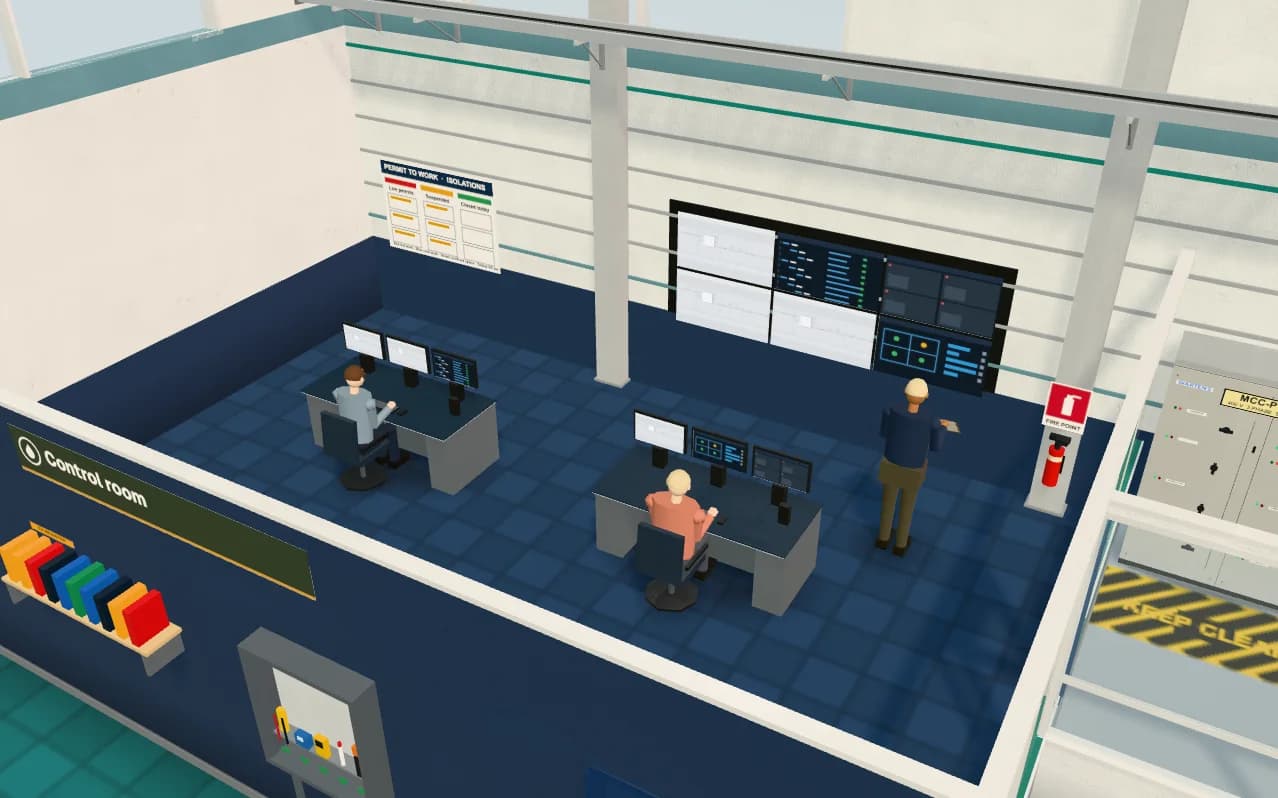
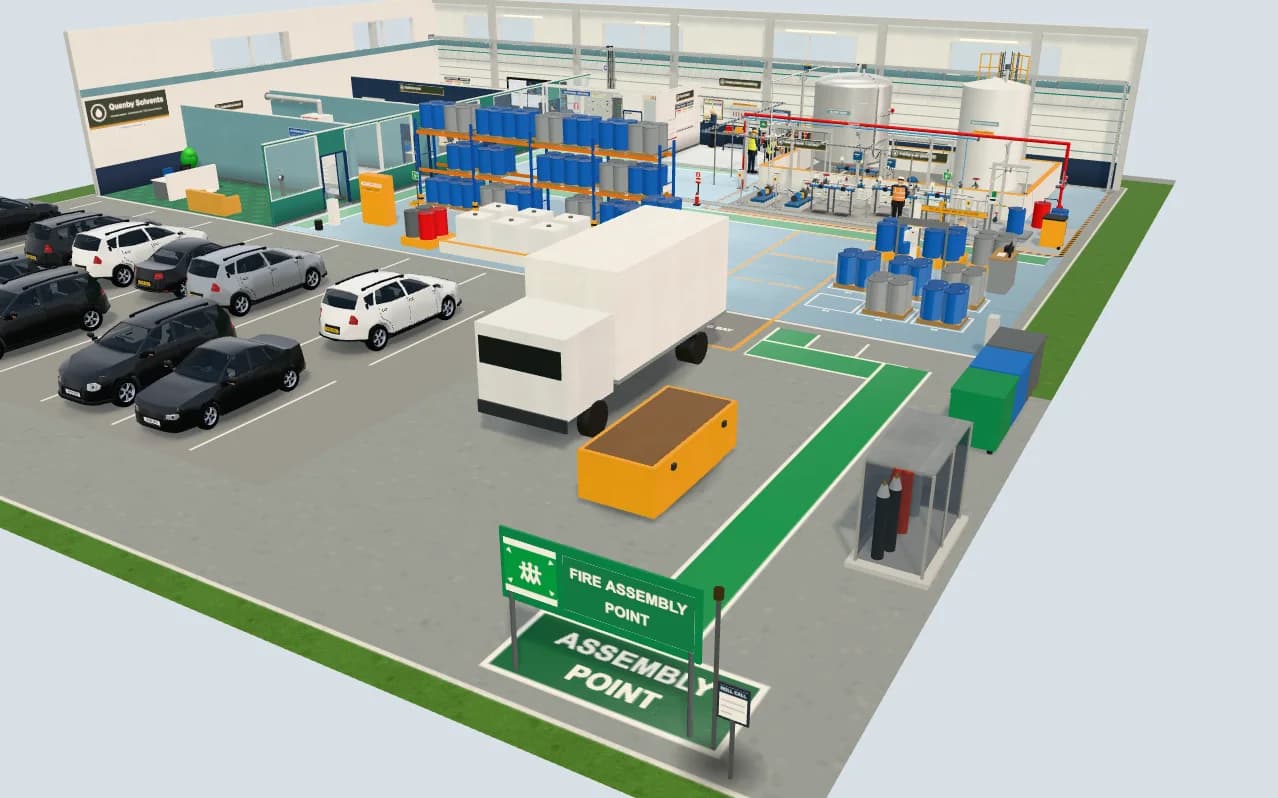
You work in a process plant with a control room: Quenby Solvents (simulated company), Solvent blend tank T-2100 and drum filling line. It is a 3D room with your colleagues in it.

Hours and rhythm

Days, 08:00 to 16:30, Monday to Friday, with site days in weeks two and three (simulated)

  • 08:15 team brief and tickets for the day
  • 08:30 permits checked with the safety officer on site days
  • 12:30 review slot with Hannah
  • 16:00 update the index, certificates and your tickets

You clock in and out of every day. The simulated clock runs faster between events, so a day takes 30 to 45 minutes of real time.

Machines and equipment

Real lab machines stand in the workplace, and the hands-on tickets point to the matching EDWartens Lab exercise. In the UK edition you do the lab exercise yourself, tick a checklist and hand in your notes and figures. It is a self-review hand-in. The lab does not mark you or send us a result.

The lab exercises for this role are listed under Prepare, further down.

Systems and kit

Project ticket tracker (simulated). Each job is a ticket such as QSB-214. You do the work, attach your data and units and hand it in for Hannah to review.

PPE on site: Safety boots, Hi-vis vest, Safety glasses, Anti-static clothing in hazardous areas, Ex-rated torch and phone in Zone 1.

The 3D workplace of the simulated company in the Instrumentation Engineer job simulation
The simulated workplace you walk around. The company and the people are fictional.

Skills checked

The skills your manager checks

On day 1 you rate yourself on about eight skills for the role, from never done it to could teach it. Your manager then asks two short "show me" questions on the skills you rated highest. The same skills are rated again at the final review, so you see a before and after.

  • Instruments and calibration
  • Safety and safe systems of work
  • Applying standards
  • Document and revision control
  • Written communication
  • Testing and acceptance
  • Reading specifications
  • Process control and tuning

A "How to do this" panel opens on tickets that use a skill you rated low. Where you have shown you know a skill, the help stays folded away, and you can open it any time.

Real documents

The documents you will work with

Each one has a title block with a number, a revision, a status and who prepared, checked and approved it, the way a project document does. You read them, check them and write your own, and what you hand in becomes a controlled document too. Everything is kept in your work pack.

  • QSB520-HSE-001

    Site rules: hazardous areas, calibration and safety systems

    Rev 1Site rules

  • QSB520-HAC-001

    Hazardous area classification and Ex marking guide

    Rev 2Area classification

  • QSB520-PID-001

    Process description and basic P&ID notes, blend tank T-2100

    Rev CProcess description

  • QSB520-INS-IDX-001

    Instrument index, blend tank T-2100

    Rev BInstrument index

  • QSB520-DS-PT-2102

    Instrument datasheet, PT-2102 pump discharge pressure transmitter

    Rev ADatasheet

  • QSB520-CAL-001

    Level transmitter data and calculation rules, LT-2100

    Rev 1Calculation data

  • QSB520-CAL-014

    As-found calibration record, PT-2102

    Rev 1Calibration record

  • QSB520-CAL-REF-001

    Reference equipment register

    Rev 3Register

  • QSB520-LCS-001

    Loop check procedure and acceptance

    Rev 1Loop check procedure

  • QSB520-SAT-001

    Site acceptance test, witnessed test script: blend tank loops and SIF-01

    Rev ASAT witnessed test script

Documents that arrive in Premiumchange requests, records, handover
  • QSB520-LD-FT-2101

    Loop diagram, flow loop FIC-2101

    Rev 1Loop diagramPremium

  • QSB520-IS-001

    Intrinsic safety loop data, TT-2103

    Rev 1IS entity dataPremium

  • QSB520-CV-001

    Control valve sizing data, FCV-2101

    Rev 1Valve sizingPremium

  • QSB520-INS-IDX-001

    Instrument index, change to Rev C (CR-01 data)

    Rev CInstrument indexPremium

  • QSB520-EX-REG-001

    Ex register, site inspection of the blend tank area

    Rev AEx registerPremium

  • QSB520-SIF-001

    Safety instrumented function SIF-01 specification and verification

    Rev 1SIF specificationPremium

  • QSB520-CAL-031

    Proof test and as-found calibration record, LT-2104

    Rev 1Calibration recordPremium

  • QSB520-HOV-001

    Handover dossier index, instrumentation

    Rev ADossier indexPremium

  • QSB520-SIF-002

    SIF-01 functional block diagram, tank T-2100 overfill protection

    Rev 1SIF block diagramPremium

  • QSB520-DS-LT-2104

    Instrument datasheet, LT-2104 tank level high-high transmitter (SIF-01)

    Rev 1DatasheetPremium

Tools

In the industry, and here

Tools in the industry and what you use here
In the industryHere
Instrument database and datasheet softwareThe index, datasheets and loop diagrams as documents you review and complete
Loop calibrator and pressure calibratorEDWartens Lab's calibration and loop check exercises
Valve sizing and SIL calculation toolsCalculations from the data sheets, with the working shown
Ex register and inspection recordsA table where you judge each nameplate against the area

Standards

The standards the work follows

  • ISA-5.1
  • ISA-5.4
  • IEC 60079-14
  • IEC 61511-1
  • IEC 60534-2-1

In the UK

The Instrumentation Engineer role in a UK setting

Who employs this kind of engineer: Process engineering contractors, water, chemical, pharmaceutical and energy operators, and the vendors and calibration teams that support them.

Where: Chemical and process sites cluster in places such as Teesside, Cheshire, the Humber and the Scottish central belt, but instrumentation work exists in every region. This is context, not a statement about vacancies.

UK standards and regulations to know about

  • BS EN 61511 and BS EN 61508

    Functional safety: safety instrumented systems for the process industry, and the general standard behind them.

  • DSEAR 2002 and the ATEX regulations

    The law on dangerous substances and explosive atmospheres, and on equipment for use in them. HSE publishes the DSEAR approved code of practice.

  • COMAH 2015

    Control of Major Accident Hazards: extra duties for sites holding large quantities of dangerous substances.

  • IEC 60079-14

    Selection and installation of equipment for explosive atmospheres.

Schemes to be aware of

  • CompEx

    A competence scheme for people who work on electrical and instrument equipment in potentially explosive atmospheres. Awareness only: this simulation does not lead to it.

These are named so that you recognise them. A job simulation does not teach them as a qualification, the tasks use simplified data, and you should always read the current edition of anything you rely on.

Your proof, optional

A certificate you can verify

The free days are free. The graded, verifiable certificate is an optional extra, and it is included in Premium.

  • A graded, verifiable certificate with your score and band
  • A public verification page and QR code
  • The details to list it on LinkedIn under Licences & certifications, ready to copy
  • Issued by WARTENS LTD. It is a training certificate, not an accredited qualification, and the company is simulated

Optional: £14.99 including VAT, once you pass.

Sample

Job Simulation Certificate

Your name

completed the Instrumentation Engineer job simulation at Marlstone Process Engineering Ltd (simulated company). Your score and band are shown on the real certificate.

Number
EDW-JS-0000
Issued by
WARTENS LTD

Not an accredited qualification. A verification page and QR code are printed on the real certificate.

Premium

Want the full project, reviewed by an engineer?

Premium runs to day 20, about 12 to 15 hours in all, and includes the graded certificate. Your free days carry over, and nothing you did is lost.

£53.99 including VAT, one payment. If you have bought the certificate, you pay £39.00.

  • Working days 6 to 20 (about 12 to 15 hours in all): change requests, site work, faults and handover
  • A capstone deliverable reviewed by an engineer
  • An AI viva on your own work
  • The graded certificate and a work record PDF with your skill scores

Prepare

Free courses and labs that get you ready

Linked from the tickets that need them. You can read them before you start.

Free courses

EDWartens Lab guides

The hands-on tickets point to these lab exercises. You do the exercise, tick the checklist and hand in your notes and figures. In the UK edition that is a self-review, and nothing is marked as passed on the lab's say-so.

A course that goes with this role

Professional Module

A paid course in PLC, HMI and WinCC SCADA programming with Siemens TIA Portal, taught live online by an instructor. It is a separate product: you do not need it to finish the job simulation, and it does not lead to a job. Its certificate is a certificate of completion, not a regulated qualification.

Price
£2,568 including VAT (£2,140 + VAT)
Format
Live online, five days, with self-paced modules after

About the Instrumentation Engineer role

Instrument index to loop diagram: how the documents chain together

The instrument index lists every instrument by tag. From it come datasheets, which define what is bought, and loop diagrams, which show how each loop is wired from field device to controller. Errors in one document flow into the next.

In the simulation you check a vendor datasheet for a pressure transmitter, complete index entries, review the loop diagram for a flow loop, and later update the index when a change request alters the process. ISA-5.1 gives the tag naming conventions you will see throughout.

Calibration: what as-found and as-left data tell you

Calibration compares an instrument against a more accurate reference at several points up and down its range. The as-found record shows how far it had drifted, and the as-left record shows what you leave behind.

You judge an as-found record with deliberate errors in it, calibrate a transmitter in an EDWartens Lab exercise and decide what to do when the calibrator's own certificate has expired. The last case is one where the right answer is not to carry on.

Treat the certificate and the reference equipment register as part of the evidence, not paperwork.

4 to 20 mA fault finding

A 4 to 20 mA signal puts the bottom of the range at 4 mA, not zero, so a reading near zero tells you the loop is broken. That live zero is why the standard works so well for diagnosis.

In the simulation you loop check in an EDWartens Lab exercise, test the intrinsic safety entity parameters for a temperature transmitter, and size a control valve with the data on its sheet. When a failed as-found result on a level transmitter arrives, you write an impact assessment instead of quietly adjusting it.

Hazardous areas and safety functions

IEC 60079-14 covers the selection and installation of equipment for explosive atmospheres. The project gives you a Zone 1 area and a table of nameplates to judge, including a flameproof switch in the wrong gas group, where the right decision is to refuse it.

IEC 61511-1 frames safety instrumented systems. You verify a safety function and decide whether a proof test interval can move, refusing to re-issue a safety integrity level that the numbers do not support.

Both cases reward the same habit: when the evidence does not support a claim, say so and write down why.

Where instrumentation leads

Instrumentation engineers move towards commissioning, process control and safety systems. Nearly every route needs comfortable P&ID reading and loop thinking, which is the core of this role.

The related roles, commissioning and SCADA, are the engineers who test and use the loops you document. The linked free courses cover calibration, control valves and P&ID reading.

Keep the loop diagram and the calibration record you produce. They are concrete examples to show in an interview, and they point clearly at the gaps you may want to study next.

Questions

Quick answers

What does an instrumentation engineer do?

They design, install and maintain instruments that measure and control industrial processes, producing instrument indexes, datasheets, loop diagrams and calibration records. Entry roles work under supervision and mostly on lists and records.

What is a loop diagram?

It is a drawing of one control loop showing the field device, wiring, junction boxes, I/O channel and controller or tag. It is used for installation, loop checks and fault finding.

How do you calibrate a pressure transmitter?

Compare its output with a known standard at several points across the range, upwards and downwards, to check accuracy and hysteresis, then adjust zero and span if needed. The standard should be clearly more accurate than the instrument, and your site procedure sets how much.

What is a control loop?

A sensor, a transmitter, a controller and a final control element, often a valve, working together to hold a process variable at its setpoint. A thermostat controlling a room is the everyday version.

What does 4 to 20 mA mean?

It is a standard analogue signal in which 4 mA is the bottom of the range and 20 mA is the top. A reading near zero signals a broken wire, which is why 4 mA is called the live zero.

Instrumentation or electrical engineering: which should I study?

Both feed the field. Instrumentation focuses on measurement and control loops, and electrical on power and distribution. Many graduate and entry-level roles accept either degree.

What do new starters do on day one in instrumentation?

Typically they update instrument lists and datasheets and support loop checks and calibration under supervision. The simulation starts with the same kind of tasks.

Which standard names instruments on a P&ID?

ISA-5.1 is the common standard for instrument symbols and identification. Check the edition your employer uses.

Do I need instrumentation experience first?

No. The simulation teaches the documents and the reasoning as you go. Some knowledge of 4 to 20 mA signals and basic maths helps.

Is the solvent plant real?

No. Marlstone Process Engineering and Quenby Solvents are made-up companies and the project is simulated. The documents, standards and situations follow what a junior instrumentation engineer meets.

How long does it take?

The free week is about ten hours over five days. The full Premium edition runs over twenty working days and about thirty-three hours, at your own pace.

Which instrument brands does it use?

None. The content is vendor-neutral, so it applies to any plant that follows the same standards.

What do I get at the end?

A work record with scores by task and skill, which shows on your EDWartens profile under Work experience, marked as a job simulation.

Is the Instrumentation Engineer job simulation free?

Yes, to start. Days 1 to 5 are free. The certificate (£14.99) and the Premium edition (£53.99) are optional, and both prices include VAT.

Does it count as work experience?

No. It is a training project at a simulated company, not employment, an internship or a placement. A job simulation is a realistic training project at a simulated company. It is not employment, an internship or a work placement, and it is not a job offer. Hours are active hours the learner logged on EDWartens UK.

A job simulation is a realistic training project at a simulated company. It is not employment, an internship or a work placement, and it is not a job offer. Hours are active hours the learner logged on EDWartens UK.

Start the Instrumentation Engineer job simulation today

Days 1 to 5 are free, about 3 to 4 hours. No card to start. Practice, not employment.

A corner of the simulated workplace in the Instrumentation Engineer job simulation