
Free course · Instrumentation
Hazardous Areas: Ex Equipment, Zones and Inspection
Work safely and competently with electrical and instrument equipment where gas, vapour or dust can explode: gas groups and temperature classes, zones and classification drawings, EPLs and Ex marking, Ex d, e, n, i, p, m, q and t, the intrinsic safety entity calculation, cable glands, IEC 60079-17 inspection, and permits and gas testing. It covers the knowledge base of CompEx units Ex01 to Ex04.
Free to learn. Verifiable certificate £19 when you pass the final exam (optional, VAT included).
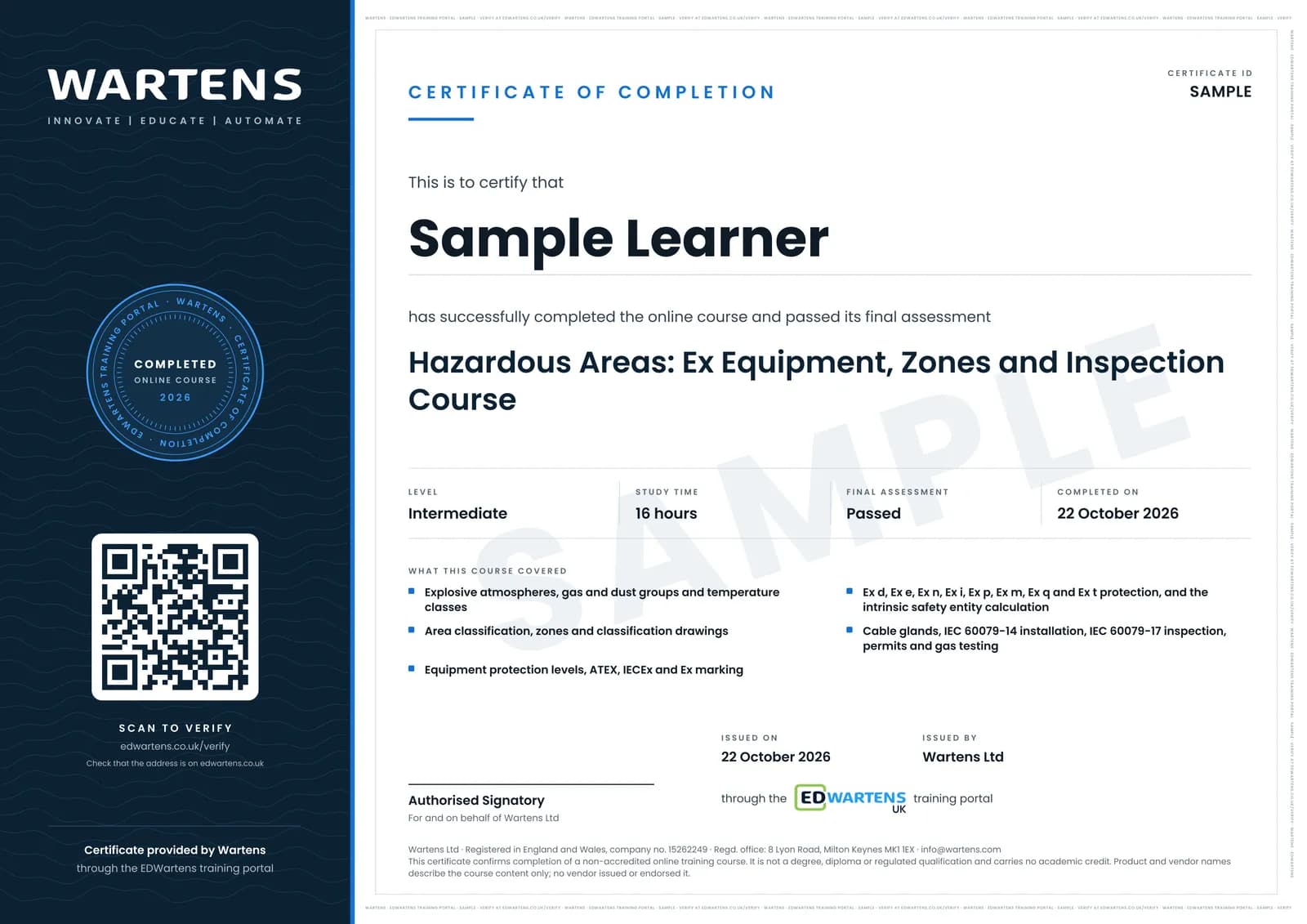
Sample certificate. Optional, issued when you pass the final exam.
- Level
- Intermediate
- Modules
- 12
- Video
- 23 hours
- Price
- Free
Outcome
What you will be able to do
Explain how an explosion starts and how each protection concept prevents one; place a gas or dust in its group and choose a temperature class; read and question a hazardous area classification drawing; decode an ATEX or IECEx marking and match equipment to its zone; inspect and reassemble Ex d and Ex e equipment correctly, including obstruction distances and the tE check on Ex e motors; carry out an intrinsic safety entity calculation and find a loop's longest cable; select cable glands and stopping plugs; plan visual, close and detailed inspections to IEC 60079-17 and record and close the faults; and plan permits and gas testing for work in a classified area.
- Place a gas or dust in its group and choose a temperature class below its ignition temperature
- Read zones 0, 1, 2 and 20, 21, 22 and question a classification drawing
- Decode ATEX and IECEx markings and match the EPL to the zone
- Inspect Ex d flame paths and obstruction distances, and Ex e terminations and motors
- Do an intrinsic safety entity calculation and find a loop's longest cable
- Select cable glands and stopping plugs for Ex d, Ex e and Ex i entries
- Plan visual, close and detailed inspections to IEC 60079-17 and close out the faults
- Plan permits and gas testing for work in a classified area
Software
A spreadsheet (Excel, Google Sheets or LibreOffice Calc) for the entity calculator and the inspection checklists. Vendor intrinsic safety loop calculators are useful optional checks.
Hardware
None. Photographs of Ex equipment from your own plant make the inspection practice real, but the notes give worked examples for every task.
Syllabus
12 modules
Each module has video lessons, notes and a short quiz. The final exam closes the course.
- Explosive atmospheres: the fire triangle, gas groups and temperature classes8 lessons
- Area classification: zones 0, 1, 2 and 20, 21, 2210 lessons
- Making the classification drawings: sources, ventilation and extents4 lessons
- EPLs, ATEX, IECEx and reading the marking plate11 lessons
- Ex d flameproof: flame paths, gaps, glands and maintenance6 lessons
- Ex e increased safety and Ex n3 lessons
- Ex i intrinsic safety: barriers, isolators and the entity calculation7 lessonsLab
- Ex p, Ex m, Ex q, Ex t and non-electrical equipment5 lessons
- Cable glands, cables and installation to IEC 60079-145 lessons
- Inspection and maintenance: IEC 60079-17 grades and checklists5 lessons
- Permits, gas testing and working safely in classified areas6 lessons
- Final Assessment2 lessons
How it works
How this course works
- Watch the video lessonsOne module at a time, at your own pace.
- Take the module quizA short quiz at the end of each module shows what stuck.
- Keep your notesWrite in My notes beside each module and ask the trainer if you are stuck.
- Practise in the labOptionalTry a task from the module in the EDWartens Lab, in your browser.
- Sit the final examPass it once you have been through the modules.
- Certificate, if you want oneOptionalPaid, and only after you pass. Anyone can check it online.
EDWartens Lab
Practise this in the EDWartens Lab
Check a 4 to 20 mA transmitter loop from the field to the PLC and fill in the loop check sheet, the same record an intrinsically safe loop needs.
Works alongside Hazardous Areas: Ex Equipment, Zones and Inspection. The Lab is process control practice in your browser: no install, no hardware, free to use. Sign in as a learner and it opens with your account.
Levels to try with this course
PRC-02 · Process lab
Loop check
Open in the lab (opens in a new tab)
Optional. Skip it whenever you like: it never blocks your progress or your certificate.
Why practise in a lab
Technical work is judged on what you can do: wiring, commissioning, finding a fault. Doing a task yourself teaches more than watching it a second time, and a lab lets you try it safely before you meet real equipment. It does not replace working on real hardware.
- Practise safely, so a mistake costs nothing.
- The lab checks your work like a site test, so you know when it is right.
- Free, in your browser, with nothing to install.
Certificate
An optional certificate when you pass
Learning is free. Pass the final exam and you can have a certificate for £19, including VAT, with a number employers can check online. It records that you completed a free online course; it is not a regulated qualification or a CPD certificate.
- Your name, the course, its study time and your final exam score
- A unique certificate number and a QR code to its verification page
- Issued by Wartens Ltd; add it to your LinkedIn profile in one click
- Pay now or after you pass: it is issued the moment you pass the final
Credits
Who made the lessons
The video lessons belong to their creators. EDWartens wrote the study plan, notes, quizzes and the final exam.
- BARTEC
the ExPP explosion protection awareness series: explosive atmospheres, explosion prevention, the fire triangle, area classification, protection concepts, gas groups, temperature codes, marking strings, roles, personnel competence, regulators and standards, certification, and IEC 60079-14 design, inspection, maintenance and testing; plus two short explosion protection basics lessons used in the final review
- Hazcon
the short lessons on zones 0, 1, 2, 20, 21 and 22, class and division against zones, dust atmospheres, temperature class against auto-ignition temperature, IECEx and reading IECEx markings, explosion proof against flameproof, pressure piling, Ex e, Ex p, intrinsic safety and IS grounding, and non-electrical equipment
- IndEx - Ex Professionals
the long webinars: Ex d in depth, Ex n parts 1 and 2, Ex q, Ex t, ingress protection, IP washers and glands, and Ex industry myths; the Aragas hazardous area classification webinars; and the Ex d test clips
- Jon Hichens insightEx
short lessons on T classes, IECEx, ATEX, flameproof Ex d, Ex m, cold flow in cables, the Annex C test and the 2024 installation standard
- Engineering Institute of Technology
the hour-long introduction to hazardous areas and their classification
- eFunda Engineers
designing hazardous area classification drawings
- Sigma-HSE
the short overview of hazardous area classification
- eFIXX
ATEX fundamentals for electrical installations
- GM International
the webinar comparing zener barriers and IS isolators
- The Reynolds Company
the TechTalk on intrinsic safety barriers, signal conditioners and entity parameters
- Phoenix Contact USA
the principle of intrinsic safety
- R. STAHL
frequently asked questions on intrinsically safe loops
- Beamex
running ATEX and IEC 60079 maintenance inspections from a mobile device
- US Chemical Safety Board (USCSB)
the safety video on the dangers of hot work
- Will On Safety
the introduction to permit to work systems
- HSE Insights
permit issuer and permit receiver responsibilities
- Forensics Detectors
what a bump test on a gas detector is
Questions
About this course
Who is this hazardous area course for?
Does this course prepare me for CompEx?
Which standards does it follow?
Do I need any software or equipment?
How long does the course take?
Is the course free to learn?
What certificate do I get?
What jobs does it lead to?
Want a live class and career support?
The Professional Module is five live days of Siemens PLC, HMI and SCADA with an instructor, then a resume session and a CPD certificate.