
Free job simulation · Electrical and energy
Data centre critical facilities engineer job simulation
A data centre critical facilities engineer job simulation is practice at running a live data hall safely. In a simulated hall you check rack, UPS and cooling capacity, work out battery runtime and PUE, review a method of procedure, and respond to a utility dip and a water leak alarm. It runs in a virtual hall, so nothing real is at risk. It is practice, not paid employment.
You join Tarnmoor Data Services Ltd (simulated company), a data centre operator in Reading. Days 1 to 5 are free, with about 8 h 20 min of tickets. Premium continues to day 20. It is practice, not employment.
Days 1 to 5 are free. You need a free account and no card. Create an account.
- Free days
- 1 to 5
- Free tickets
- about 8 h 20 min
- Project documents
- 10
- Certificate, optional
- £14.99
The project
You join Tarnmoor Data Services Ltd (simulated company)
Tarnmoor Data Services Ltd (simulated company) is a data centre operator in Reading. You help its team deliver a project for Selwyn Analytics Ltd, at Data hall DH-2, Tarnmoor Campus 1.
Tarnmoor Data Services runs data hall DH-2 for its tenants. You join the critical facilities team in week one, learn the hall's power and cooling limits, work out how long the batteries last, calculate the month's PUE and review a procedure before a rack is installed. Later, a utility dip leaves one UPS on battery, a tenant asks for three more racks, a vendor wants to skip a step at 04:40, a generator test is not what it seems and a leak alarm needs an honest message to the tenant.
What you will do
- Check rack, UPS and cooling capacity against the hall's limits
- Work out battery runtime and PUE from real meter and UPS data
- Review a method of procedure and refuse to skip a step
- Handle a utility dip, a generator test failure and a leak alarm
- Answer a tenant's capacity request honestly and in plain words
The people you deal with
- Critical Facilities Leadcompany
- Duty Managercompany
- Shift Techniciancompany
- Safety Officercompany
- Change Managercompany
- Tenant Operations Managerclient
- Tenant Capacity Plannerclient
- UPS Vendor Engineervendor
- Generator Vendor Engineervendor
The company, client and site are fictional. The people are fictional too.
Look inside
What the simulator looks like
The workplace, your tickets, the documents and the team chat, as a learner sees them.
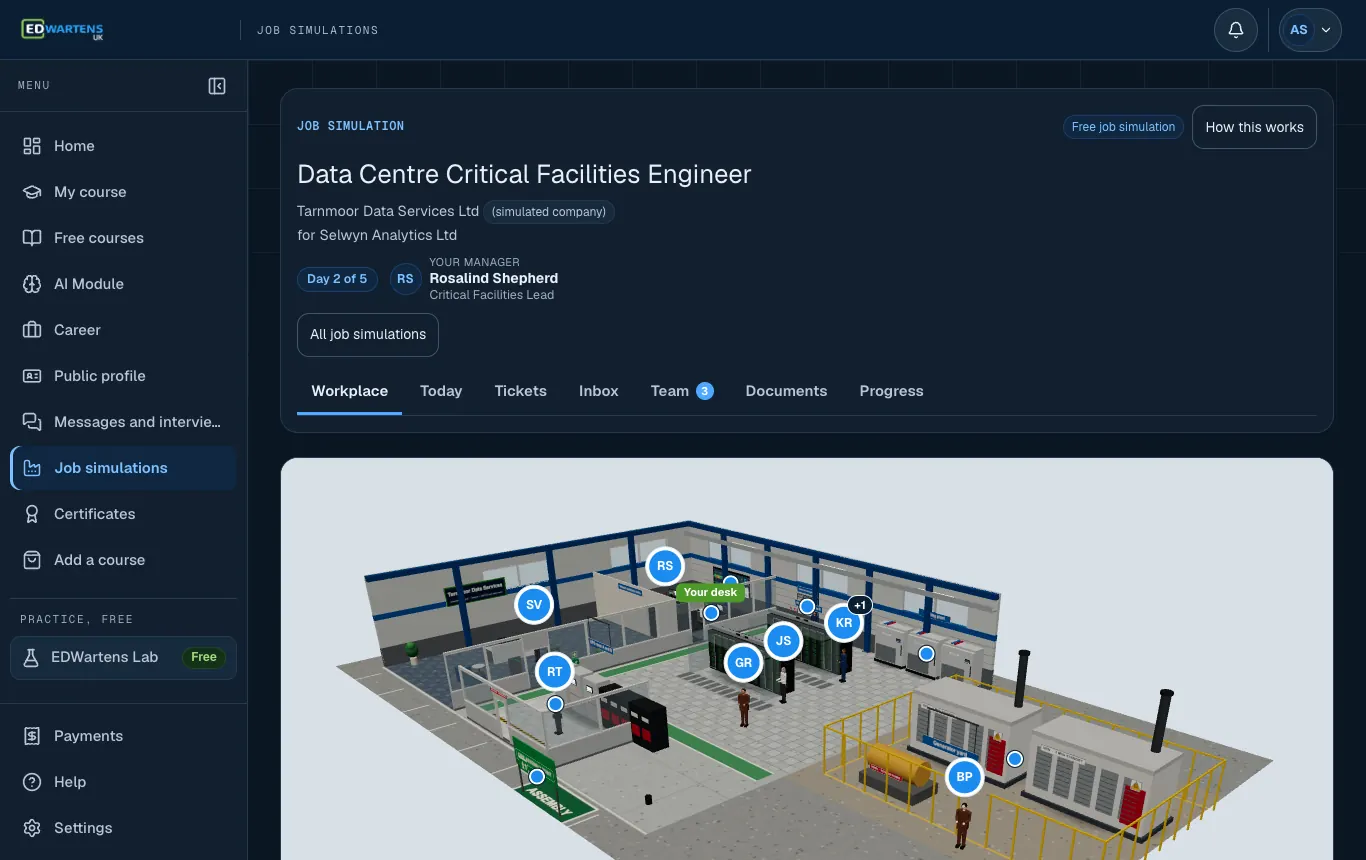
Start in the workplace, with the team around you. 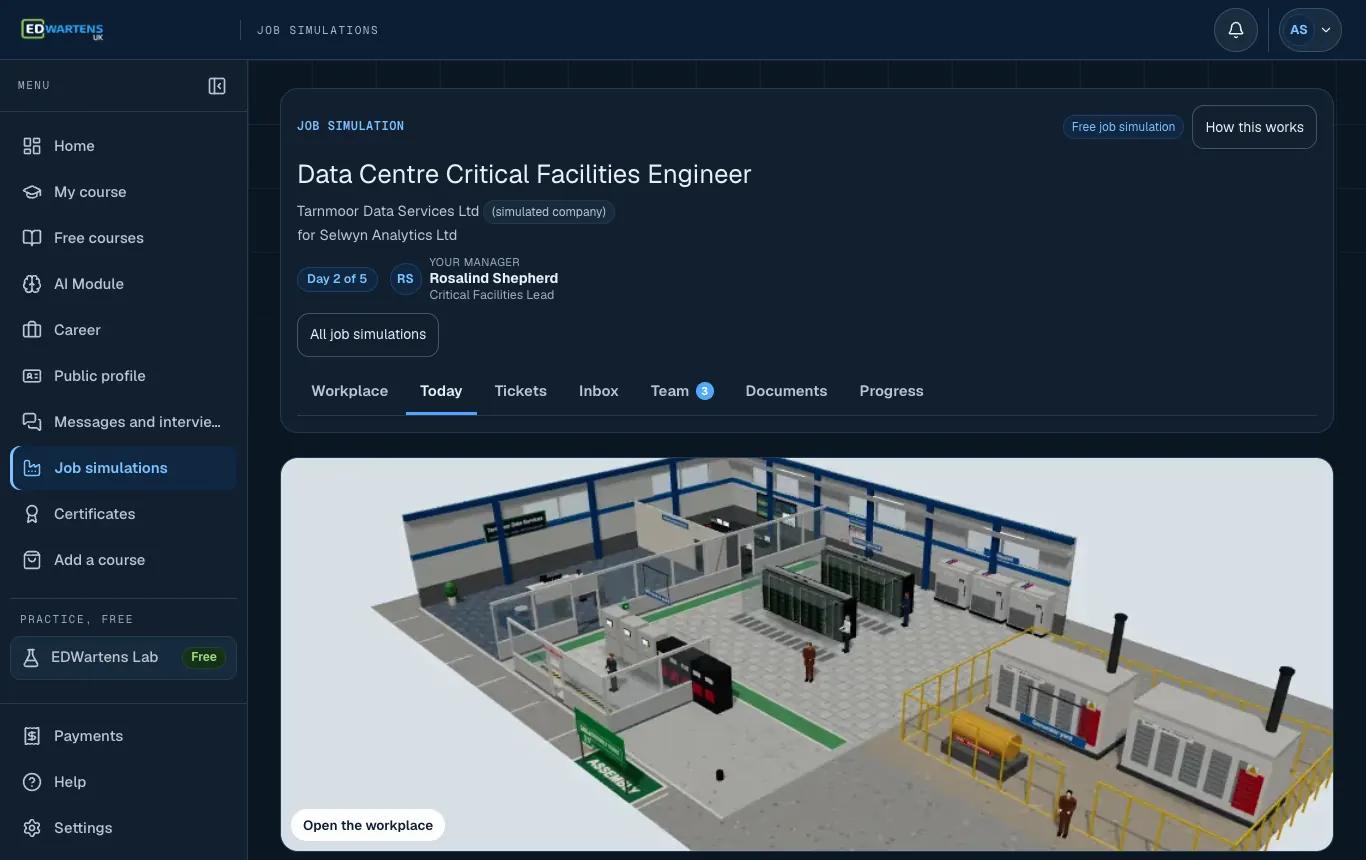
Today: the morning email and your tickets for the day. 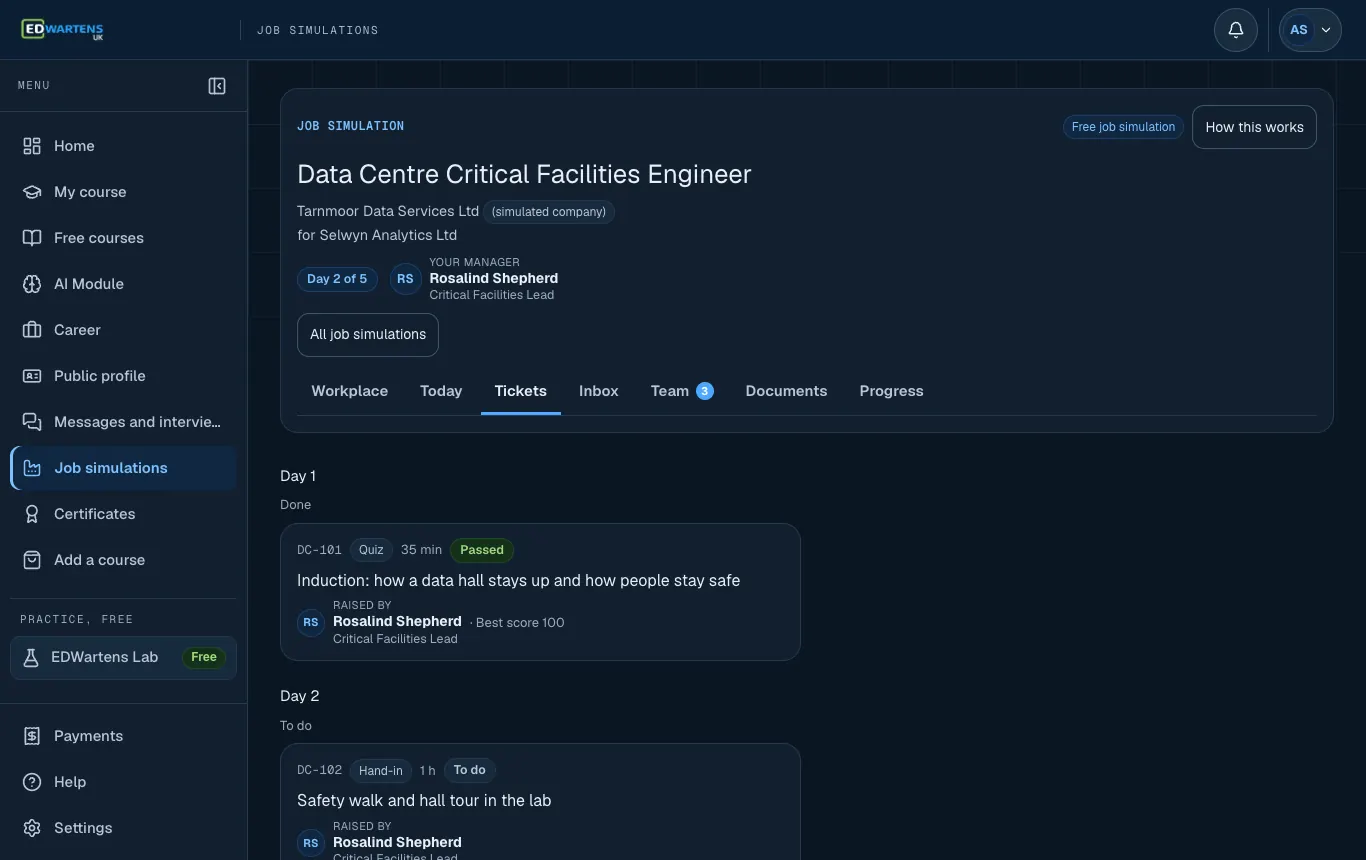
Work: every ticket, by day, with its status. 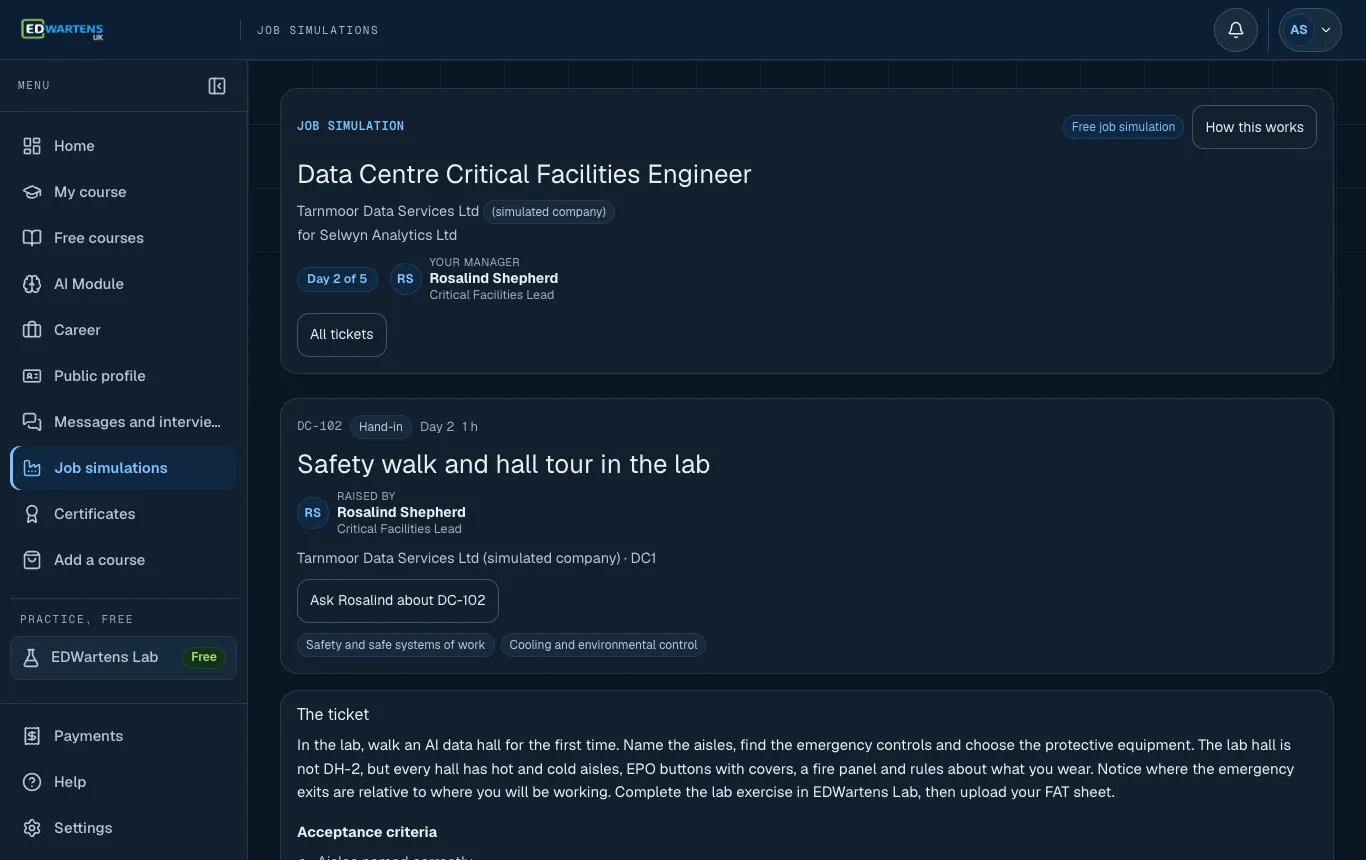
A ticket, written the way a colleague would write it. 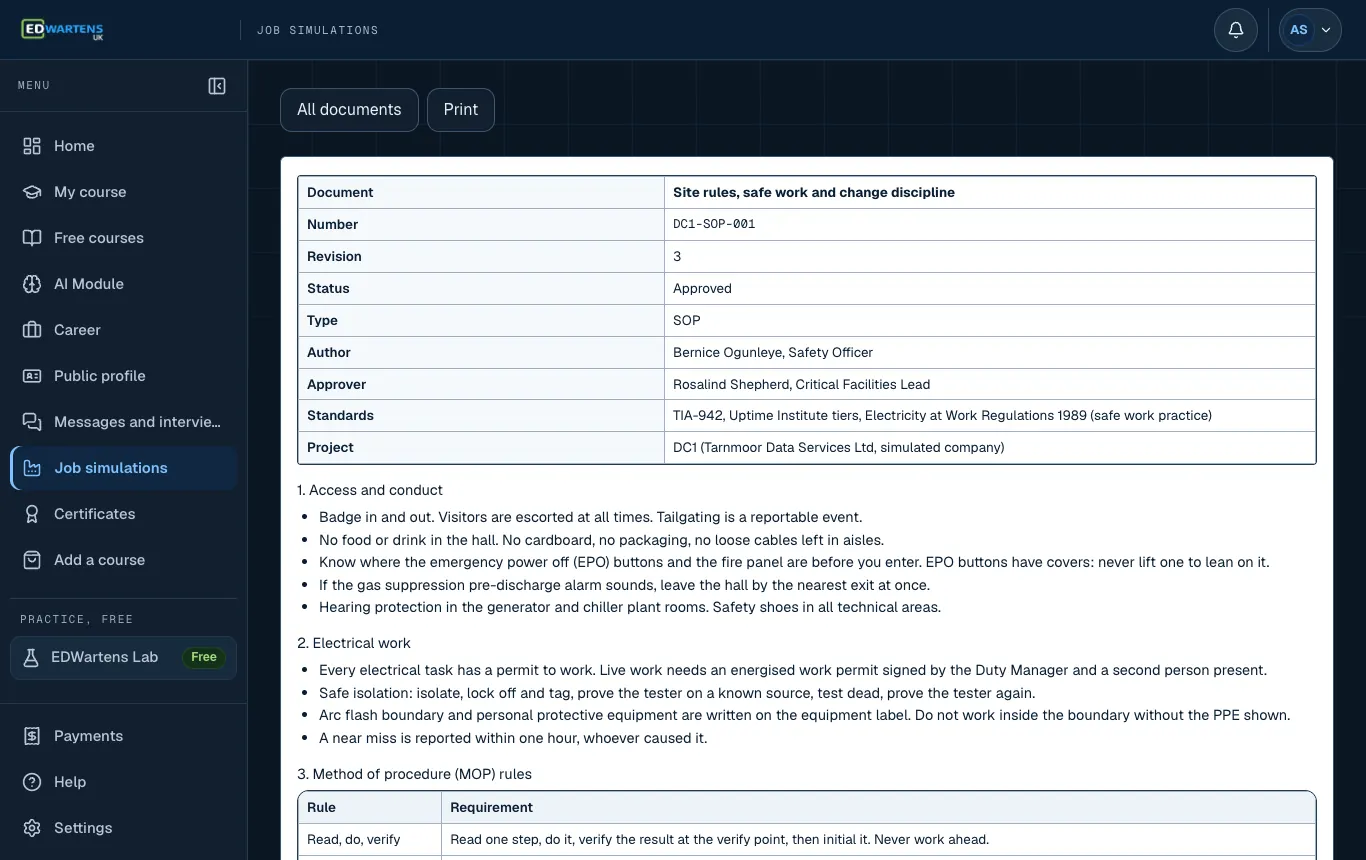
A project document with its number, revision and status. 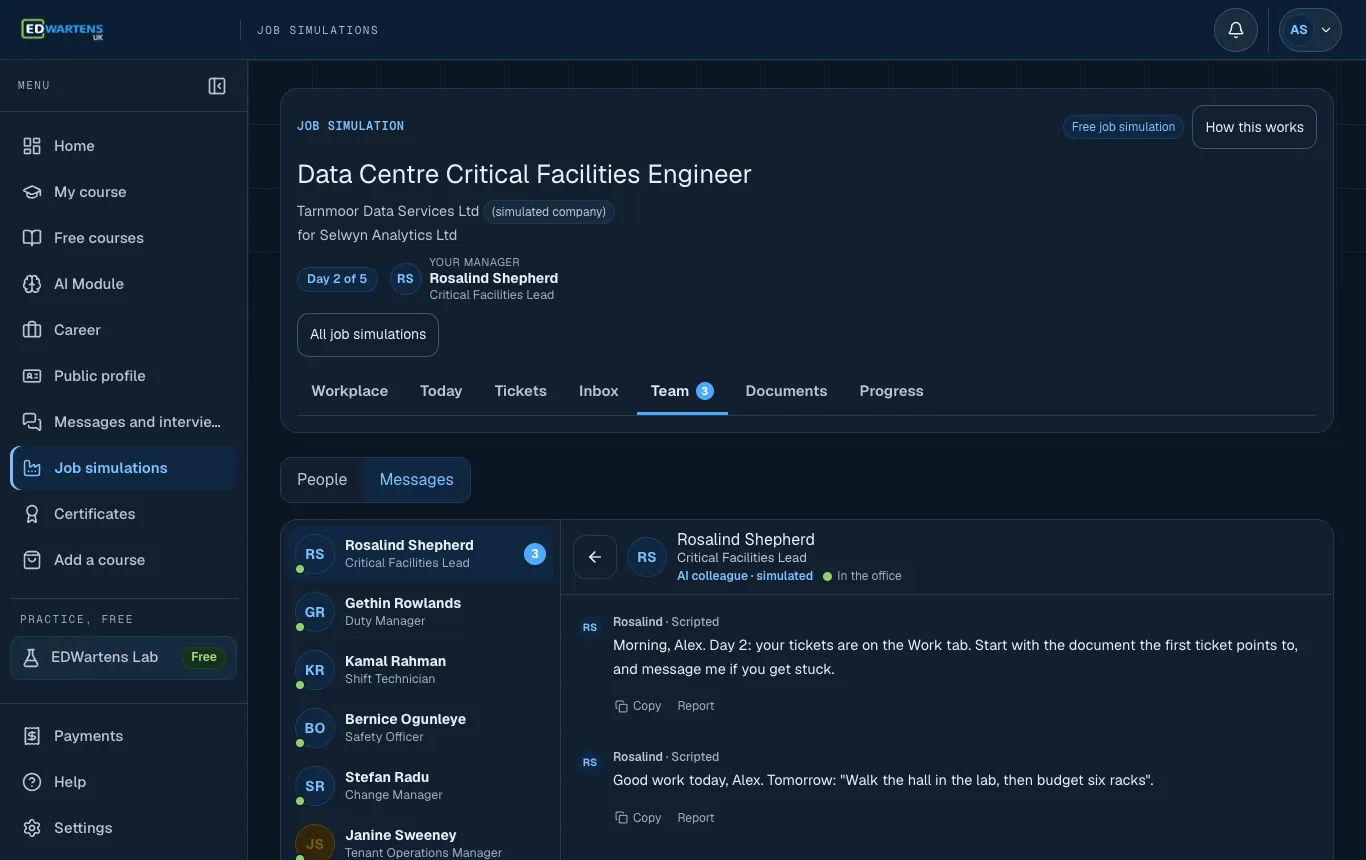
Ask a colleague. They are AI colleagues: they help you think, they do not hand out answers.


Screenshots from the simulator. Company, people and data are fictional. Portraits are AI-generated.
Meet the team
The colleagues you work with
You can read their messages and ask them questions. They are AI colleagues, clearly labelled. They help you think a ticket through; they do not hand out its answer.
- RSRosalind ShepherdCritical Facilities LeadSimulated colleague, company side
- KRKamal RahmanShift TechnicianSimulated colleague, company side
- GRGethin RowlandsDuty ManagerSimulated colleague, company side
- BOBernice OgunleyeSafety OfficerSimulated colleague, company side
- SRStefan RaduChange ManagerSimulated colleague, company side
- JSJanine SweeneyTenant Operations ManagerSimulated colleague, client side
- SVSasha VanceTenant Capacity PlannerSimulated colleague, client side
- RTRuairi TierneyUPS Vendor EngineerSimulated colleague, vendor
Fictional people. Portraits are AI-generated.
What you get
What you walk away with
Learn how a data hall stays up: power paths, battery runtime, PUE, procedures, changes and incident reports.
What you produce
Rack feed check: A and B path loading
Capacity calculation
UPS battery runtime calculation
Resilience calculation
Monthly PUE calculation from the meter readings
Efficiency report
Method of procedure review comments
Procedure review
Shift handover note
Operational record
Incident report: utility voltage dip
Incident reportPremium
Impact note for a tenant change request
Change controlPremium
Operational readiness pack for a new rack
CapstonePremium
Skills you practise
- UPS, generators and critical power
- Written communication
- Method statements and MOPs
- Applying standards
- Cooling and environmental control
- Safety and safe systems of work
- Document and revision control
- Root-cause analysis
Roles to look for
- Critical Facilities Engineer
- Data Centre Operations Engineer
- Data Centre Technician
- Mechanical and Electrical Technician (Data Centre)
2304 live openings on the UK jobs board, checked 24 Oct 2026. See the jobs
Your proof
- A certificate anyone can verify. Optional, and included in Premium.
- An entry on your EDWartens profile under Work experience, marked as a job simulation.
- A work record with your skill scores, with Premium.
Free courses that go with it
- Free course Data Centre Electrical and Critical Power
- Free course Data Centre Cooling, BMS and DCIM
- Free course Data Centre and MEP Testing and Commissioning (L1 to L5)
- Free course Energy Management and Energy Audit with ISO 50001
- Free course Health and Safety Foundations: HSWA 1974, RIDDOR and ISO 45001
What you can talk about at interview
- You can explain how long a UPS battery lasts under a given load and what you would check first.
- You can walk through how PUE is calculated from meter readings and what moves it.
- In Premium, you can describe an incident report from a utility dip and why you would not skip the verify step on a procedure.
Day by day
Days 1 to 5, ticket by ticket
Self-paced. A day opens when you hand in the previous day's tickets. Every ticket is checked, and you see the model answer after it.
Day 1
about 35 min- Induction: how a data hall stays up and how people stay safeQuiz · 35 min
Day 2
about 2 h 10 min- Safety walk and hall tour in the labHand-in · 1 h
- Six racks: does each feed carry the rack alone?Table · 1 h 10 min
Day 3
about 2 h 10 min- How long can the batteries carry the hall?Calculation · 1 h 10 min
- PUE for the month from the metersCalculation · 1 h
Day 4
about 1 h 20 min- Review MOP-0042 Rev 2Document review · 1 h 20 min
Day 5
about 2 h 5 min- A wrong breaker, no harm done, and a request for silenceDecision · 30 min
- Write tonight's shift handover noteWriting · 50 min
- One more 10 kW rack: what does cooling say?Calculation · 45 min
Premium: days 6 to 20about 22 h more
After day 5 the project goes on with a change request, site work, faults, a handover and a capstone reviewed by an engineer.
Day 6
about 1 h 30 min- Incident report: the 02:14 utility dipWriting · 1 h 30 min
Day 7
about 1 h 50 min- How much battery did the dip use, and how much was left?Calculation · 1 h 50 min
Day 8
about 1 h 15 min- Impact note for CHG-0136: three racks of 15 kWWriting · 1 h 15 min
Day 9
about 2 h- Re-run the capacity register for the requestCalculation · 2 h
Day 10
about 1 h 20 min- Which documents move after accepting one rack?Table · 1 h 20 min
Day 11
about 1 h 30 min- Review the vendor's MOP-0057 for UPS-BDocument review · 1 h 30 min
Day 12
about 40 min- 04:40: skip the final verify to beat the morning peak?Decision · 40 min
Day 13
about 1 h 15 min- Fix a hot aisle in the labHand-in · 1 h 15 min
Day 14
about 1 h 20 min- Monthly generator test: pass or fail each checkTable · 1 h 20 min
Day 15
about 1 h 15 min- Power event drill in the labHand-in · 1 h 15 min
Day 16
about 1 h 10 min- Written update to the tenant during a water leak alarmWriting · 1 h 10 min
Day 17
about 1 h 15 min- Rack power budget in the labHand-in · 1 h 15 min
Day 18
about 4 h- Capstone: operational readiness pack for the row F rackHand-in · 4 h
Day 19
about 1 h- Reply to the tenant: what can you give us?Writing · 1 h
Day 20
about 40 min- Viva: your critical facilities decisionsViva · 40 min
Real documents
The documents you will work with
Each one has a number, a revision and an approver, the way a project document does. You read them, check them and write your own.
DC1-SOP-001
Site rules, safe work and change discipline
Rev 3SOP
DC1-SLD-001
Power single-line diagram, hall DH-2 (A and B, 2N)
Rev 4SLD
DC1-CAP-001
Capacity register, hall DH-2
Rev 5Capacity register
DC1-CLG-001
Cooling schematic summary and set-points
Rev 2Cooling schematic
DC1-UPS-001
UPS and battery data
Rev BData sheet
DC1-ALM-001
Alarm list and escalation matrix
Rev 2Alarm list
DC1-MTR-001
Energy meter readings, 30 days (720 hours)
Rev AMeter readings
DC1-MOP-0042
Install rack R-F01 and connect the A and B feeds
Rev 2MOP
DC1-EOP-UPS-03
Emergency operating procedure: UPS on battery
Rev 3EOP
DC1-LOG-001
Shift handover log: format and sample
Rev AShift log
Documents that arrive in Premiumchange requests, records, handover
DC1-INC-0211
Event log: utility voltage dip at 02:14, hall DH-2
Rev AIncident logPremium
DC1-CHG-0136
Change request: tenant adds three racks of 15 kW in row F
Rev 0Change requestPremium
DC1-MOP-0057
Place UPS-B in maintenance bypass and replace power module PM-3
Rev 1MOPPremium
DC1-GEN-001
Generator and transfer switch monthly test log
Rev ATest logPremium
Tools
In the industry, and here
| In the industry | Here |
|---|---|
| BMS and EPMS for power and cooling | Event logs and meter tables, and EDWartens Lab's data centre exercises |
| DCIM capacity tools | The capacity register and calculation fields |
| Change management tickets and MOP templates | MOPs, change requests and impact notes in the documents |
| Excel capacity models | Worked calculations and your own working |
Standards
The standards the work follows
- TIA-942
- Uptime Institute tier concepts
- IEC 62040-3
- ASHRAE TC 9.9
- Electricity at Work Regulations 1989 (safe work practice)
In the UK
The Data Centre Critical Facilities Engineer role in a UK setting
Who employs this kind of engineer: Data centre operators and colocation providers, the facilities contractors who support them, and large organisations with their own halls.
Where: Data centres cluster around West London and the M4 corridor, Manchester, south Wales and increasingly other regions. This is context, not a statement about vacancies.
UK standards and regulations to know about
Electricity at Work Regulations 1989
The law on safe work with electrical systems. HSE guidance HSG85 explains safe working practices.
BS EN 50600
Information technology: data centre facilities and infrastructures, including power distribution and environmental control.
TIA-942 and Uptime Institute tiers
Widely used concepts for redundancy and availability, used here as ideas rather than as a certification.
Regulatory Reform (Fire Safety) Order 2005
The fire safety duties on non-domestic premises in England and Wales.
Schemes to be aware of
ECS card (Electrotechnical Certification Scheme)
The industry card that many UK electrotechnical employers and sites ask to see. It is linked to qualifications and a health and safety assessment. EDWartens does not issue it, and this simulation does not lead to it.
These are named so that you recognise them. A job simulation does not teach them as a qualification, the tasks use simplified data, and you should always read the current edition of anything you rely on.
Your proof, optional
A certificate you can verify
The free days are free. The graded, verifiable certificate is an optional extra, and it is included in Premium.
- A graded, verifiable certificate with your score and band
- A public verification page and QR code
- One-click add to LinkedIn as a licence or certification
- Issued by WARTENS LTD. It is a training certificate, not an accredited qualification, and the company is simulated
Optional: £14.99 including VAT, once you pass.
Job Simulation Certificate
Your name
completed the Data Centre Critical Facilities Engineer job simulation at Tarnmoor Data Services Ltd (simulated company). Your score and band are shown on the real certificate.
- Number
- EDW-JS-0000
- Issued by
- WARTENS LTD
Not an accredited qualification. A verification page and QR code are printed on the real certificate.
Prepare
Free courses and labs that get you ready
Linked from the tickets that need them. You can read them before you start.
Free courses
- Data Centre Electrical and Critical Power
- Data Centre Cooling, BMS and DCIM
- Data Centre and MEP Testing and Commissioning (L1 to L5)
- Electrical Safety at Work (UK): Safe Isolation, Lock-off and Arc Flash
- Health and Safety Foundations: HSWA 1974, RIDDOR and ISO 45001
- Excel for Engineers: Formulas, Data and Dashboards
- Energy Management and Energy Audit with ISO 50001
About the Data Centre Critical Facilities Engineer role
Anatomy of a method of procedure
A method of procedure, or MOP, is an approved step by step plan for a risky task. It lists the risks, the checks before each step, the roll-back route and who must be told. Data halls run on MOPs because a wrong breaker can stop a tenant's service.
You review a MOP for installing a rack and connecting its A and B feeds, and later review a vendor's MOP for placing a UPS in maintenance bypass. A 04:40 case asks whether to skip a final verification step to beat the morning peak. The answer is to refuse, and to say why.
N, N+1 and 2N: what redundancy means for the task
Redundancy describes how much spare capacity the power and cooling systems hold. An N+1 system survives the loss of one unit, and a 2N system holds two complete, independent paths.
Which one you have decides what you may do safely. The simulation uses a 2N power layout with A and B feeds. You check whether each feed can carry a rack alone, because maintenance on one side is only safe if the other can take the whole load.
A rule of thumb follows: never take a path out of service unless the other path can carry everything.
The first minutes of a UPS event
When utility power dips, the UPS carries the load on battery, and generators start. The engineer verifies the load, reads the alarms, follows the emergency operating procedure and escalates.
The project gives you an event log for a 02:14 dip. You write the incident report, work out how much battery the dip used and how much was left, and then handle a generator test and a water leak alarm, writing a clear update to the tenant while it is still happening.
Change request and capacity
Tenants ask for more capacity, and the answer must come from the capacity register, not from optimism. A request for three more racks sends you through power, cooling and space, and you decide which documents change and to which revision.
TIA-942, Uptime Institute tier concepts, IEC 62040-3 and ASHRAE TC 9.9 give the language for site design, UPS performance and thermal conditions. In the UK, the Electricity at Work Regulations 1989 frame safe work practice around live equipment.
Honest capacity answers, such as what can be given now and what needs more work, matter more than a quick yes.
Career path in mission-critical facilities
Shift engineers grow towards facilities leads, commissioning and mission-critical design. Use both spellings, data centre and data center, when you search, because advertisements use both.
The linked roles, electrical design and the solar and EV engineer, share electrical ideas. The free courses cover critical power, cooling and building management, and testing and commissioning.
Keep your reviewed MOP, your incident report and your capacity answer. They show procedure discipline and clear writing, two things hiring managers in critical facilities look for beyond technical knowledge.
Keep going
Related job simulations and courses

Electrical Design Engineer
Load list, single-line diagram, cable sizing and a late design change.

Solar PV and EV Charging Engineer
Size a PV array, test it to IEC 62446 and fit EV chargers on a limited supply.
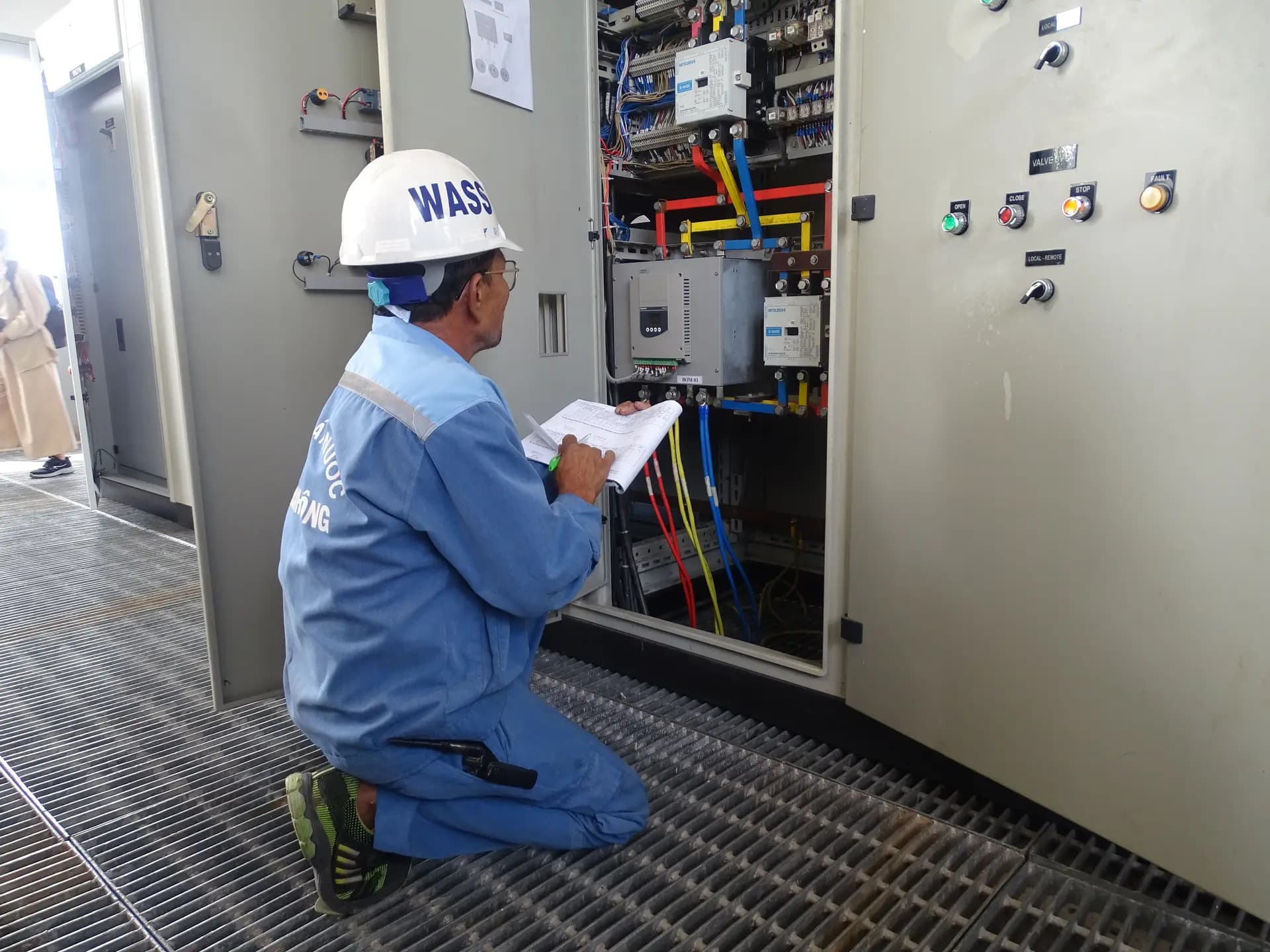
Substation and MCC Engineer
Protection settings, relay tests and an inrush trip on a new feeder.
- Engineering job simulations
- Free courses
- Browse jobs
- Virtual work experience in the UK
- Job simulation questions
Content reviewed 19 Oct 2026; UK context added 21 Oct 2026. Practice, not employment.
Questions
Quick answers
What does a critical facilities engineer do?
They run and maintain the power and cooling plant of a data centre, including switchgear, UPS, batteries, power distribution, generators and chillers. They manage change requests, risk assessments and MOPs, and run drills.
What is a MOP?
A method of procedure is a step by step, approved plan for a risky task, with its risks, roll-back steps and checks. Nobody should start a risky task in a live hall without one.
What is change control?
It is a process to request, assess, approve, schedule and record changes so live systems are not put at risk. The simulation makes you decide which documents must change after a request.
What happens in a UPS event?
The UPS may transfer to battery or bypass. The engineer verifies the load, checks alarms, follows the emergency operating procedure and escalates, and the simulation walks through one.
Do I need a degree to work in a data centre?
Advertisements vary. Senior roles ask for years in critical facilities, and some entry roles accept diplomas in electrical, electronics or communications. Check each advertisement.
What certifications help?
Check industry bodies such as the Uptime Institute and your UPS suppliers for current training. A job simulation is practice, not a certification.
What shift patterns apply in data centres?
Roles often cover 24 hour operation, so shift work is common. Check each advertisement for the pattern.
Can a simulation replace experience?
No. It shows procedure discipline, capacity thinking and clear writing, which you can discuss in an interview.
Do I need to know data centres already?
No. The documents teach what you need: 2N power, UPS runtime, PUE, MOPs and change control.
Which standards does it follow?
It follows the ideas of TIA-942, Uptime tier concepts, IEC 62040-3, ASHRAE TC 9.9, with safe work practice in line with the Electricity at Work Regulations 1989.
How long does the free week take?
About nine hours of active work over five working days.
What does the Premium edition add?
The full four-week project: the utility dip, the capacity request, a vendor MOP, the generator test and a leak alarm, a capstone pack reviewed by an engineer and an AI viva.
Is this a real job?
No. It is a job simulation at a simulated company. It is not employment.
Is the Data Centre Critical Facilities Engineer job simulation free?
Yes, to start. Days 1 to 5 are free. The certificate (£14.99) and the Premium edition (£53.99) are optional, and both prices include VAT.
Does it count as work experience?
No. It is a training project at a simulated company, not employment, an internship or a placement. A job simulation is a realistic training project at a simulated company. It is not employment, an internship or a work placement, and it is not a job offer. Hours are active hours the learner logged on EDWartens UK.
A job simulation is a realistic training project at a simulated company. It is not employment, an internship or a work placement, and it is not a job offer. Hours are active hours the learner logged on EDWartens UK.
Start the Data Centre Critical Facilities Engineer job simulation today
Days 1 to 5 are free. No card to start. Practice, not employment.