

Free course · Safety
Health and Safety Foundations: HSWA 1974, RIDDOR and ISO 45001
The daily work of a site health and safety adviser, set in UK law and built on the ISO 45001 management system: the Health and Safety at Work etc. Act 1974, HSE enforcement, RIDDOR, hazard identification and risk matrices, the hierarchy of controls, permits to work, work at height, confined spaces, lifting, fire, incident investigation and safety KPIs.
Free to learn. Verifiable certificate £19 when you pass the final exam (optional, VAT included).
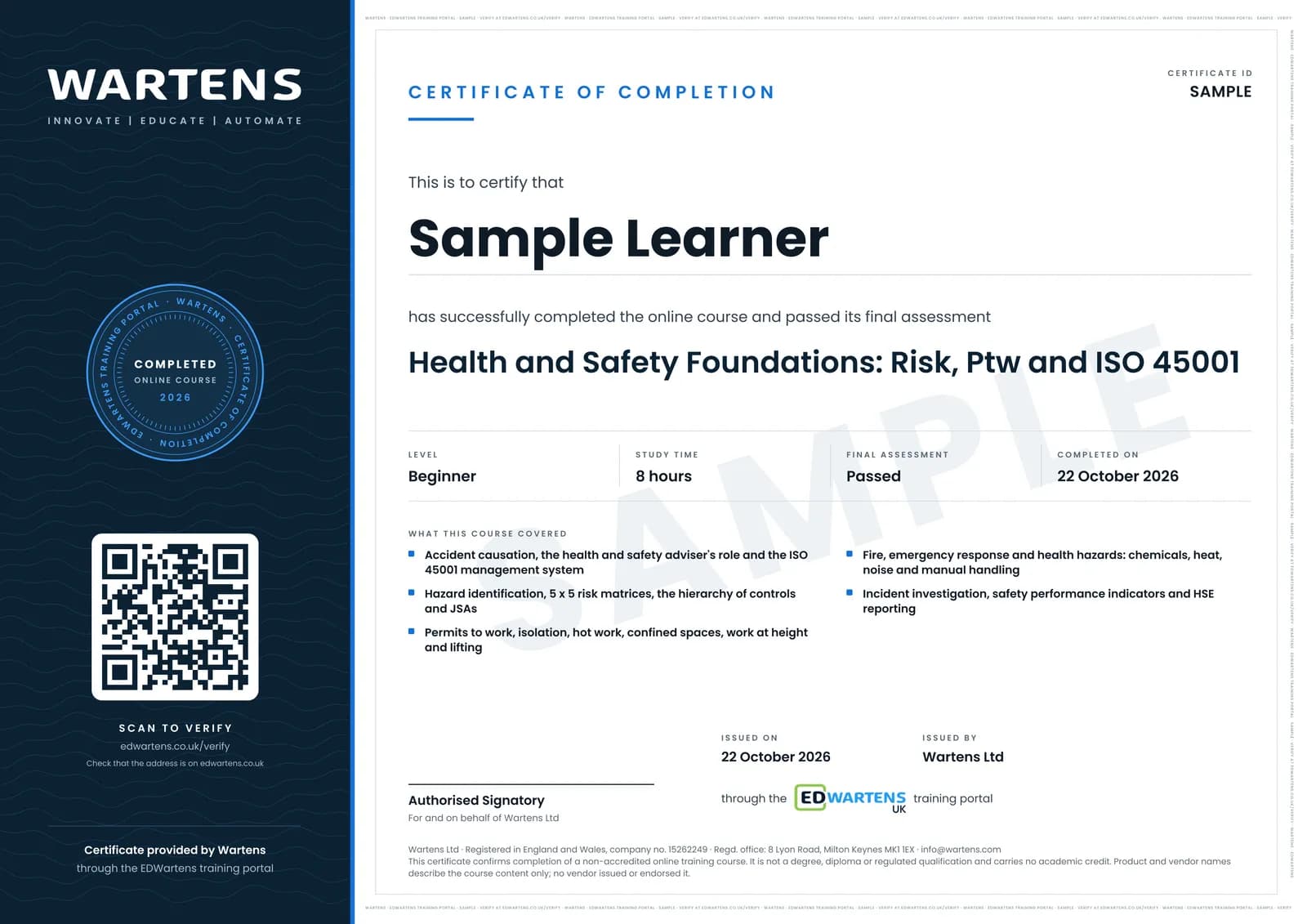
Sample certificate. Optional, issued when you pass the final exam.
- Level
- Beginner
- Modules
- 14
- Video
- 16 hours
- Price
- Free
Outcome
What you will be able to do
Explain why accidents happen and what a safety officer does; map ISO 45001 clauses 4 to 10 onto Plan-Do-Check-Act and run worker consultation; identify hazards and score risk on a 5 x 5 matrix; choose controls by the hierarchy and write a JSA; issue and close a permit to work with isolations, gas tests and a fire watch; plan work at height with a fall clearance calculation, a confined space entry with a rescue plan, and a crane lift with sling tensions; assess fire, chemical, heat and noise risks; investigate an incident to its root causes; calculate LTIFR and TRIR; and write an HSE report a manager can act on.
- Explain why accidents happen with the Swiss cheese and domino models, and what a safety officer does each day
- Map ISO 45001 clauses 4 to 10 onto Plan-Do-Check-Act and run worker consultation
- Identify hazards and score risk on a written 5 x 5 matrix, then choose controls in hierarchy order
- Write a JSA and issue, hand over and close a permit to work with isolations, gas tests and a fire watch
- Plan work at height with a fall clearance calculation, a confined space entry with rescue, and a crane lift
- Assess fire, chemical, heat, noise and manual handling risks
- Investigate an incident to its root causes and write strong corrective actions
- Calculate LTIFR and TRIR on a stated base, choose leading indicators and write an HSE report
Software
None required. A spreadsheet (Excel, Google Sheets or LibreOffice Calc) helps with the risk register and the KPI report.
Hardware
None.
Syllabus
14 modules
Each module has video lessons, notes and a short quiz. The final exam closes the course.
- The safety officer's job and why accidents happen2 lessons
- ISO 45001: structure, PDCA and worker participation3 lessons
- Hazard identification and risk assessment3 lessons
- Hierarchy of controls, JSA and method statements3 lessons
- Permit to work, isolation and hot work3 lessonsLab
- Working at height: ladders, scaffolds and fall arrest3 lessons
- Confined space entry3 lessons
- Lifting operations: lift plans, load charts and slings2 lessons
- Fire safety and emergency response4 lessons
- Health hazards: chemicals, heat, noise and manual handling3 lessons
- Incident investigation and root cause analysis3 lessons
- Inspections, audits and safety performance indicators3 lessons
- Safety leadership, culture and HSE reporting2 lessons
- Final Assessment1 lesson
How it works
How this course works
- Watch the video lessonsOne module at a time, at your own pace.
- Take the module quizA short quiz at the end of each module shows what stuck.
- Keep your notesWrite in My notes beside each module and ask the trainer if you are stuck.
- Practise in the labOptionalTry a task from the module in the EDWartens Lab, in your browser.
- Sit the final examPass it once you have been through the modules.
- Certificate, if you want oneOptionalPaid, and only after you pass. Anyone can check it online.
EDWartens Lab
Practise this in the EDWartens Lab
Carry out a safe isolation on a motor bucket with lock, tag and a permit, so a permit to work is something you have seen done.
Works alongside Health and Safety Foundations: HSWA 1974, RIDDOR and ISO 45001. The Lab is substation and mcc practice in your browser: no install, no hardware, free to use. Sign in as a learner and it opens with your account.
Levels to try with this course
MCC-02 · Substation and MCC lab
Safe isolation of an MCC bucket
Open in the lab (opens in a new tab)
Optional. Skip it whenever you like: it never blocks your progress or your certificate.
Why practise in a lab
Technical work is judged on what you can do: wiring, commissioning, finding a fault. Doing a task yourself teaches more than watching it a second time, and a lab lets you try it safely before you meet real equipment. It does not replace working on real hardware.
- Practise safely, so a mistake costs nothing.
- The lab checks your work like a site test, so you know when it is right.
- Free, in your browser, with nothing to install.
Certificate
An optional certificate when you pass
Learning is free. Pass the final exam and you can have a certificate for £19, including VAT, with a number employers can check online. It records that you completed a free online course; it is not a regulated qualification or a CPD certificate.
- Your name, the course, its study time and your final exam score
- A unique certificate number and a QR code to its verification page
- Issued by Wartens Ltd; add it to your LinkedIn profile in one click
- Pay now or after you pass: it is issued the moment you pass the final
Credits
Who made the lessons
The video lessons belong to their creators. EDWartens wrote the study plan, notes, quizzes and the final exam.
- Cengiz Turkoglu
James Reason's Swiss cheese model of accident causation
- Safety Toolbox Talk
Heinrich's domino theory and the accident pyramid
- SRM Safety Risk Management
the ISO 45001 clause walk-throughs on leadership and support
- Auditor Training Online (ATOL)
ISO 45001 clause 5.4, consultation and participation of workers
- Safeti
using a risk matrix with severity and likelihood, and reading safety data sheets
- Salus: Experts In Safety
the elements of a risk matrix
- NPTEL IIT Kharagpur
the university lectures on risk assessment terms, accident investigation and safety performance indicators
- Healthier Workforce Center
the hierarchy of controls
- Compassa eLearning
the hierarchy of controls as examiners ask it, and how open-book safety exams are answered
- HSEBox
job safety analysis and incident investigation and reporting
- Reynolds Training Services Ltd
what a permit to work system is
- Civil Aviation Safety Authority - Australia
the Piper Alpha disaster and the permit handover failure behind it
- USCSB
the investigation films on hot work hazards and confined space deaths
- Ally Safety
fall protection basics, fire extinguisher use and hazard communication with GHS
- ABCS Safety Training Inc.
fall clearance, arresting force and free fall distance in 3D animation
- XO Safety
supported scaffold safety
- Maritime NZ
an introduction to confined spaces
- Dräger Global
the process of a confined space entry with gas detection
- LiftRight Academy
reading a mobile crane load chart step by step
- The Lifting & Rigging Channel
how sling angles change load ratings
- HASpod
the five fire extinguisher types
- Fire Industry Association
an introduction to fire risk assessment
- Federal Safety Solutions
exit routes, emergency action plans and fire prevention plans
- What's Occ Doc?
assessing heat stress at work
- Provoking Safety
root cause analysis with the five whys
- RedRisks
LTIF and TRCF calculations
- Ron Alexander
calculating an injury rate on the 200,000-hour base
- Safe Work Australia
Professor Patrick Hudson on safety culture and leadership
Questions
About this course
Who is this HSE safety officer course for?
Is the course free to learn?
Does this course give me a NEBOSH or IOSH qualification?
What is ISO 45001 and how much of it does the course cover?
Which calculations does it teach?
Do I need any software?
How long does the course take?
Does it cover UK health and safety law?
Want a live class and career support?
The Professional Module is five live days of Siemens PLC, HMI and SCADA with an instructor, then a resume session and a CPD certificate.