
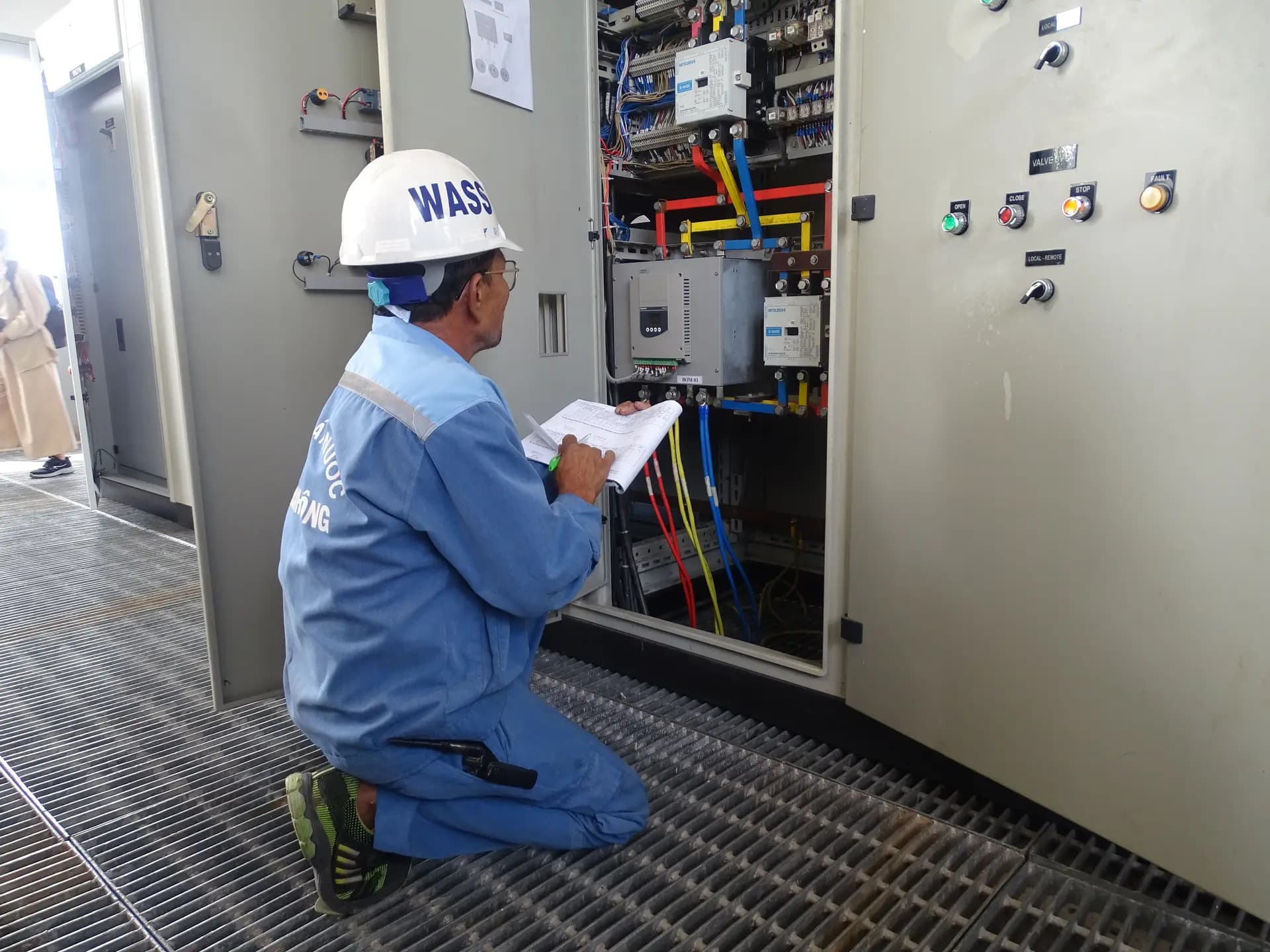
Free job simulation · Electrical and energy
Substation and MCC engineer job simulation
A substation and MCC engineer job simulation is practice at protection and motor control work. For a simulated glass works you size a current transformer, grade overcurrent relays, judge relay injection test results, trace why a transformer differential relay tripped on energisation and decide whether to energise with a permit open. It uses a virtual MCC, so no live equipment is touched. It is practice, not employment.
You join Hallowmere Power Engineering Ltd (simulated company), a electrical protection and commissioning contractor in Manchester. Days 1 to 5 are free, with about 11 h 50 min of tickets. Premium continues to day 20. It is practice, not employment.
Days 1 to 5 are free. You need a free account and no card. Create an account.
- Free days
- 1 to 5
- Free tickets
- about 11 h 50 min
- Project documents
- 7
- Certificate, optional
- £14.99
The project
You join Hallowmere Power Engineering Ltd (simulated company)
Hallowmere Power Engineering Ltd (simulated company) is a electrical protection and commissioning contractor in Manchester. You help its team deliver a project for Ravensdale Glass Works Ltd, at New 11 kV substation SS-2 and motor control centre MCC-3 (project SMC-700).
You are the junior engineer on the protection and commissioning team for a new substation and motor control centre. In four weeks you read the single-line diagram, size a current transformer, check the relay settings, grade the incomer against the transformer feeder and complete the MCC bucket schedule, and you refuse to load a settings file nobody has controlled. The client then swaps the transformer for a bigger one after procurement and you work out what it touches, including a fault level that outgrows the incomer breaker. A relay test fails because of a wrong time multiplier, a CT is found reversed at injection, and the differential relay trips on transformer inrush. You review the switching programme and, with the Authorised Person away, say no to energising with a permit open. The skill is to be exact and to protect people first.
What you will do
- Read a single-line diagram with relay function numbers and size a current transformer
- Set and grade overcurrent relays and set the instantaneous element above inrush
- Judge relay secondary-injection tests and find a reversed CT polarity
- Handle a larger transformer after procurement: currents, settings, fault level and breaker ratings
- Find why a differential relay tripped on energisation and refuse to energise with an open permit
The people you deal with
- Lead Protection and Commissioning Engineercompany
- Project Managercompany
- Site Supervisorcompany
- Client Electrical Managerclient
- Authorised Person (client)client
- Network Operator Engineervendor
- Transformer Supplier Engineervendor
The company, client and site are fictional. The people are fictional too.
Look inside
What the simulator looks like
The workplace, your tickets, the documents and the team chat, as a learner sees them.
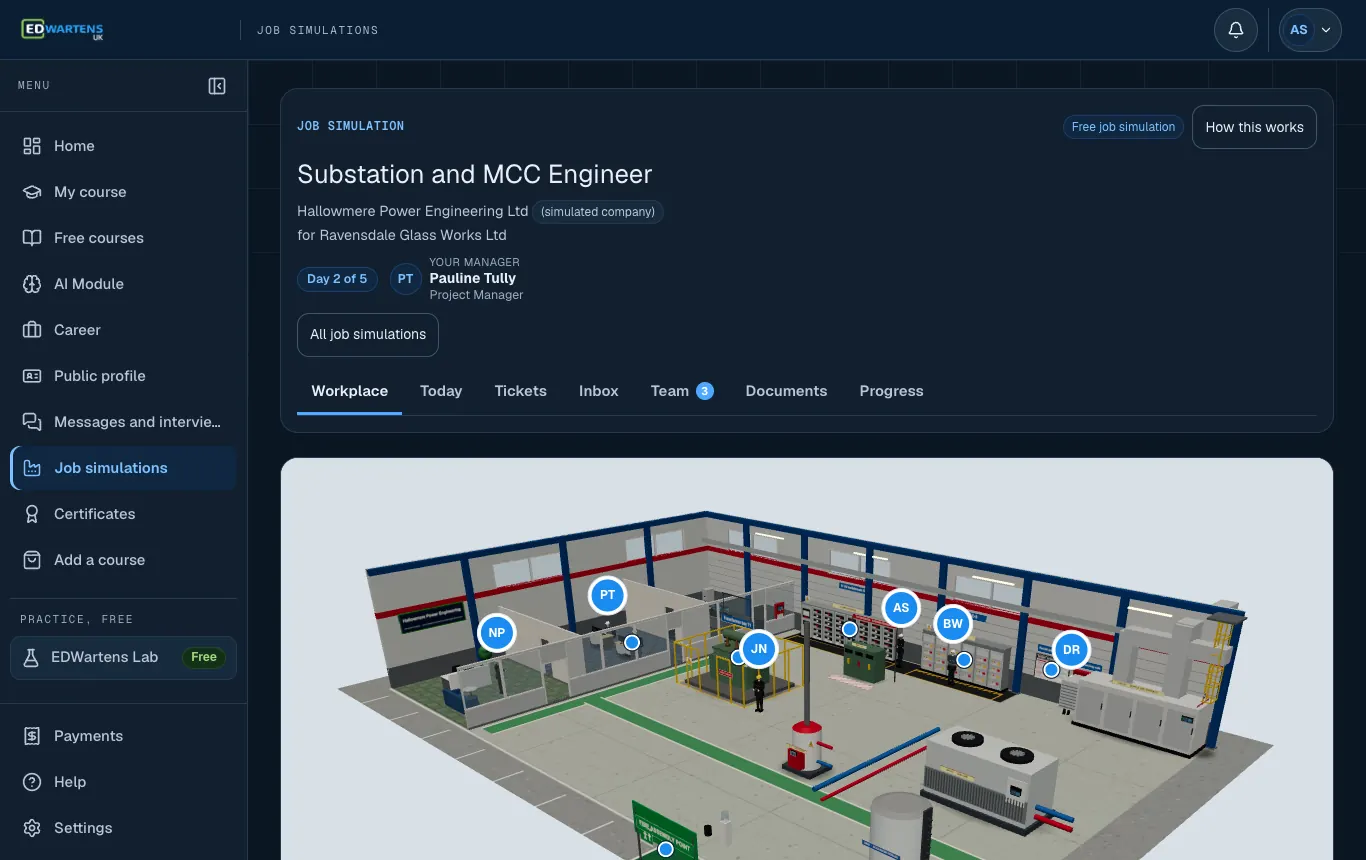
Start in the workplace, with the team around you. 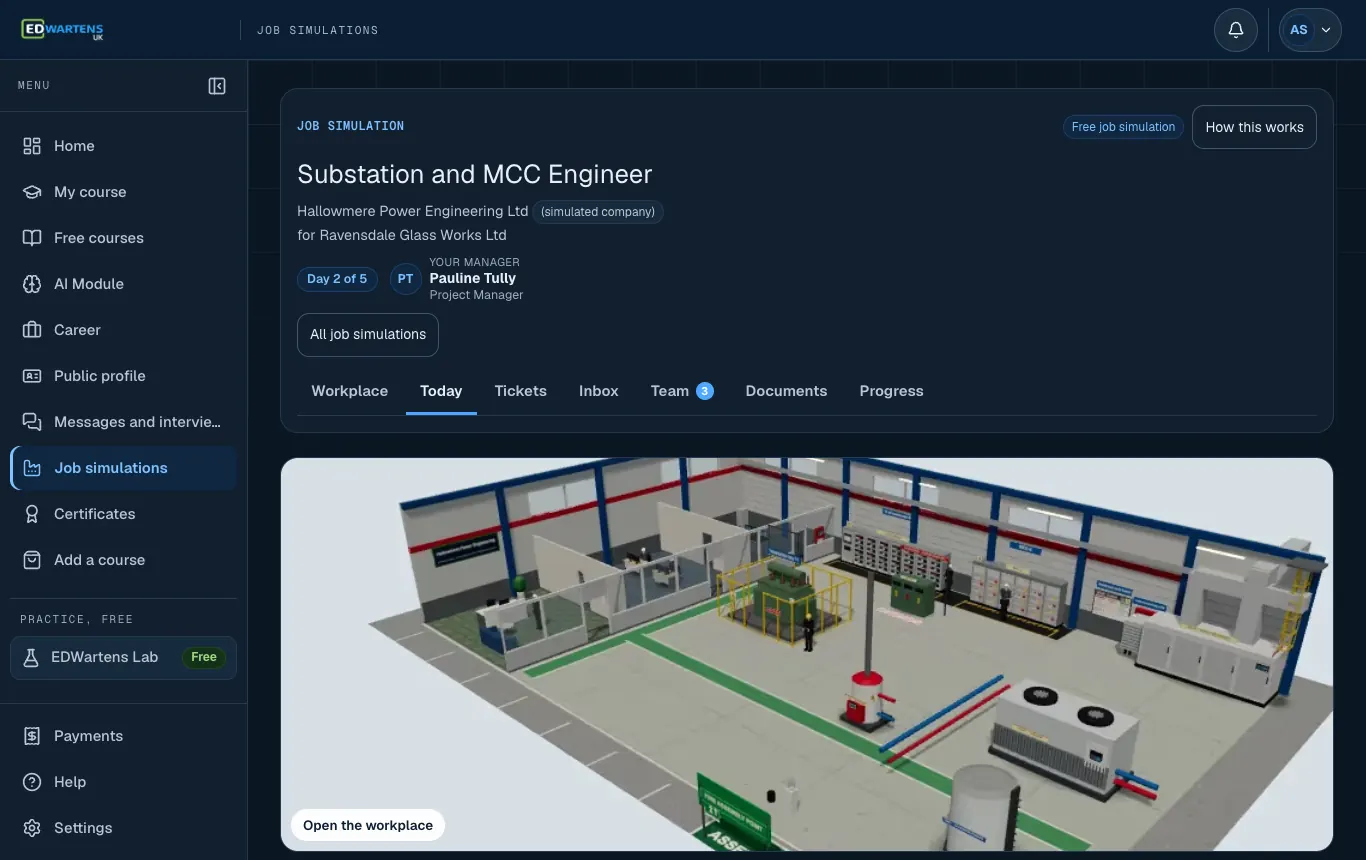
Today: the morning email and your tickets for the day. 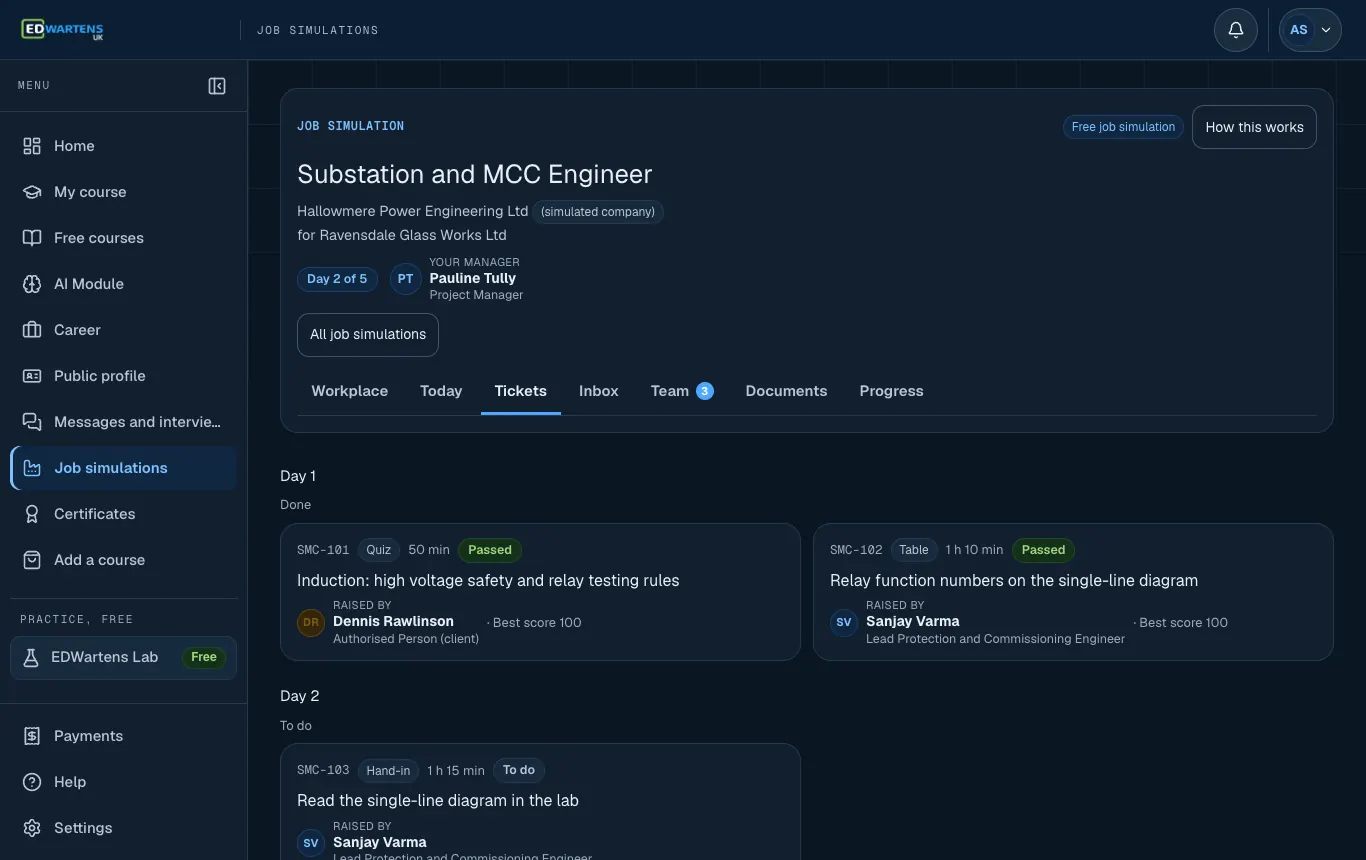
Work: every ticket, by day, with its status. 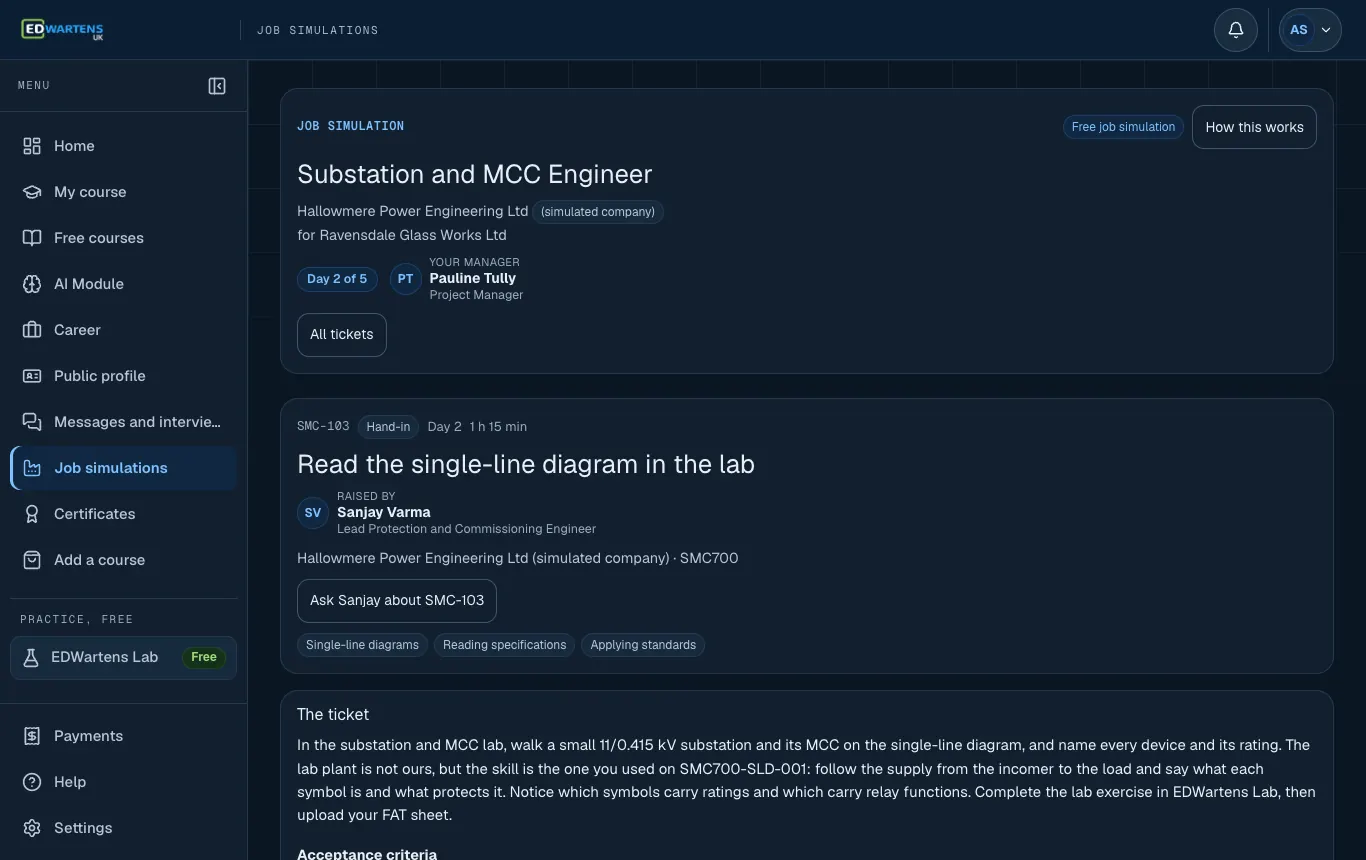
A ticket, written the way a colleague would write it. 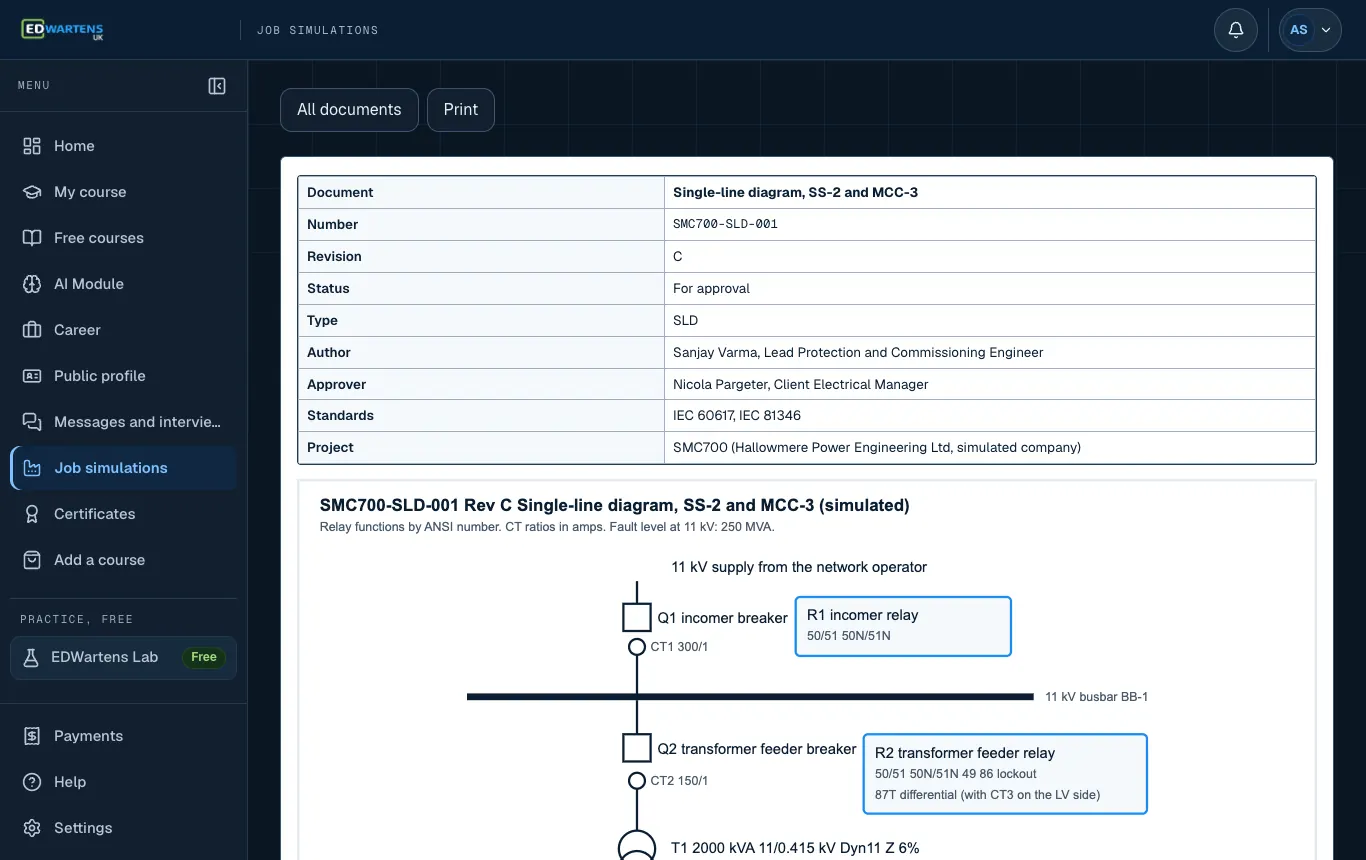
A project document with its number, revision and status. 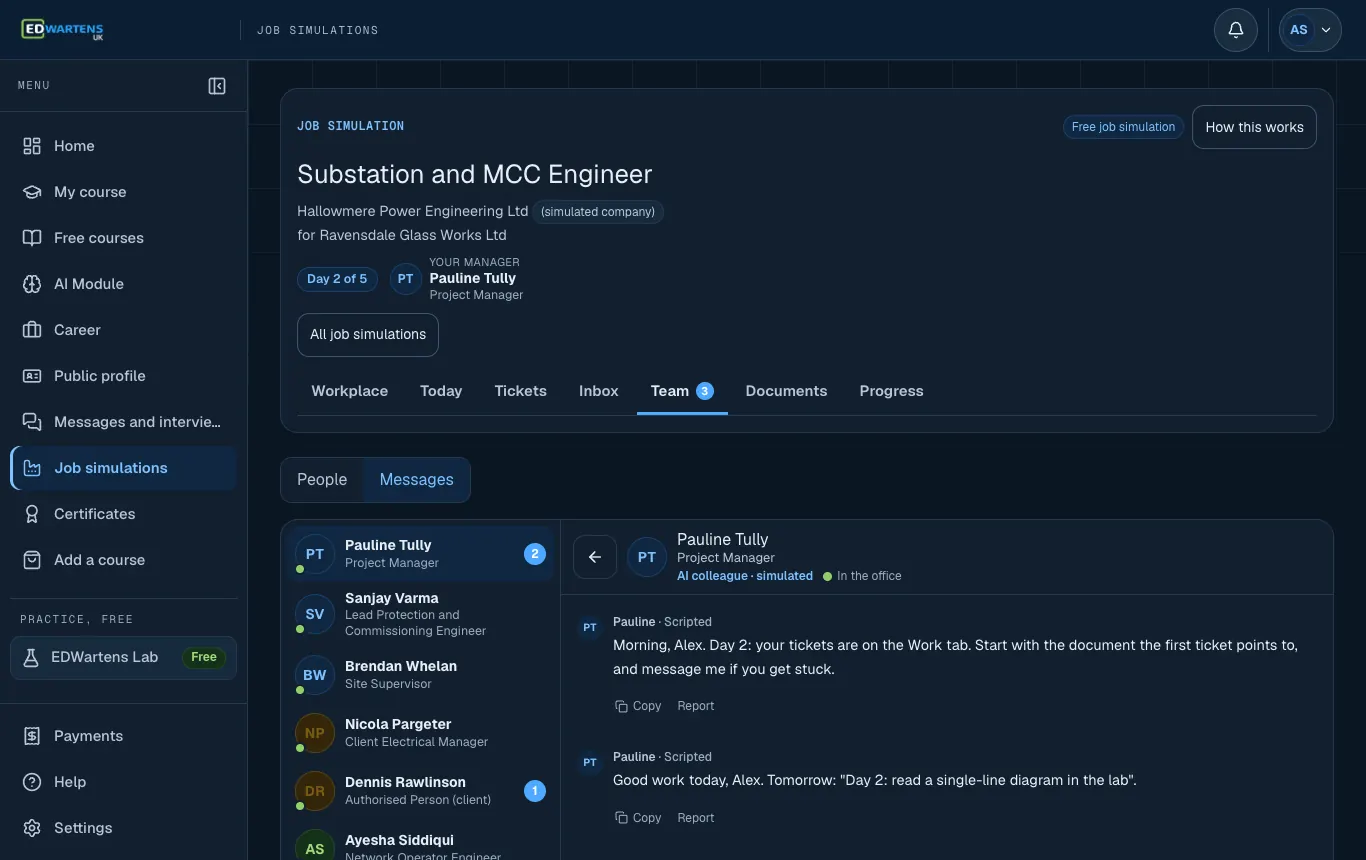
Ask a colleague. They are AI colleagues: they help you think, they do not hand out answers.


Screenshots from the simulator. Company, people and data are fictional. Portraits are AI-generated.
Meet the team
The colleagues you work with
You can read their messages and ask them questions. They are AI colleagues, clearly labelled. They help you think a ticket through; they do not hand out its answer.
- PTPauline TullyProject ManagerSimulated colleague, company side
- SVSanjay VarmaLead Protection and Commissioning EngineerSimulated colleague, company side
- BWBrendan WhelanSite SupervisorSimulated colleague, company side
- DRDennis RawlinsonAuthorised Person (client)Simulated colleague, client side
- NPNicola PargeterClient Electrical ManagerSimulated colleague, client side
- ASAyesha SiddiquiNetwork Operator EngineerSimulated colleague, vendor
- JNJaroslav NovakTransformer Supplier EngineerSimulated colleague, vendor
Fictional people. Portraits are AI-generated.
What you get
What you walk away with
Test protection and commissioning on an 11 kV substation and MCC, from CT sizing to a controlled energisation.
What you produce
Current transformer sizing and burden check
Protection calculation
Protection setting schedule check comments
Check record
Relay grading calculation R1 against R2
Protection calculation
MCC-3 bucket schedule
Schedule
Cover note for the protection setting schedule
Client note
Change impact note for the larger transformer
Change controlPremium
Switching programme review
Safety document checkPremium
Protection and commissioning pack
CapstonePremium
Skills you practise
- Protection and discrimination
- Applying standards
- Testing and acceptance
- Safety and safe systems of work
- Safe isolation and LOTO
- Document and revision control
- Working with clients and stakeholders
- Root-cause analysis
Roles to look for
- Protection and Commissioning Engineer
- Substation Commissioning Engineer
- Protection Test Engineer
- Electrical Commissioning Engineer
812 live openings on the UK jobs board, checked 24 Oct 2026. See the jobs
Your proof
- A certificate anyone can verify. Optional, and included in Premium.
- An entry on your EDWartens profile under Work experience, marked as a job simulation.
- A work record with your skill scores, with Premium.
Free courses that go with it
- Free course Protection Relays: Settings, Testing and Commissioning
- Free course Testing and Maintenance of Transformers and Switchgear
- Free course Substation Design: Layouts, Bus Schemes and Equipment
- Free course ETAP Power System Analysis: Load Flow, Short Circuit, Protection, Arc Flash and Stability
- Free course Electrical Safety at Work (UK): Safe Isolation, Lock-off and Arc Flash
What you can talk about at interview
- You can explain how you sized a current transformer for a protection relay and checked its burden.
- You can walk through grading an incomer relay against a transformer feeder.
- In Premium, you can describe a transformer change, a differential relay trip on inrush and why you would not energise with a permit open.
Day by day
Days 1 to 5, ticket by ticket
Self-paced. A day opens when you hand in the previous day's tickets. Every ticket is checked, and you see the model answer after it.
Day 1
about 2 h- Induction: high voltage safety and relay testing rulesQuiz · 50 min
- Relay function numbers on the single-line diagramTable · 1 h 10 min
Day 2
about 1 h 15 min- Read the single-line diagram in the labHand-in · 1 h 15 min
Day 3
about 2 h 40 min- Size the current transformer for relay R2Calculation · 1 h 20 min
- Check the protection setting schedule Rev ADocument review · 1 h 20 min
Day 4
about 2 h 45 min- Grade R1 against R2 at the maximum fault currentCalculation · 1 h 30 min
- Grade the incomer relay in the labHand-in · 1 h 15 min
Day 5
about 3 h 10 min- Complete the MCC-3 bucket scheduleTable · 1 h 30 min
- Load the file from the USB stick for tomorrow's inspection?Decision · 40 min
- Cover note for the protection setting scheduleWriting · 1 h
Premium: days 6 to 20about 22 h 35 min more
After day 5 the project goes on with a change request, site work, faults, a handover and a capstone reviewed by an engineer.
Day 6
about 1 h 20 min- Judge the R2 secondary-injection test resultsTable · 1 h 20 min
Day 7
about 1 h 30 min- The instantaneous setting on R2: above inrush, still seeing faultsCalculation · 1 h 30 min
Day 8
about 1 h 40 min- Change impact note: the 2500 kVA transformerWriting · 1 h 40 min
Day 9
about 1 h 20 min- LV fault level before and after the transformer changeCalculation · 1 h 20 min
Day 10
about 1 h 20 min- Check the setting schedule Rev B after the transformer changeDocument review · 1 h 20 min
Day 11
about 1 h- Matching factors for the transformer differential relayCalculation · 1 h
Day 12
about 1 h 50 min- Read the through-current injection on the differential relayTable · 1 h 10 min
- Flip the CT polarity in the relay settings?Decision · 40 min
Day 13
about 1 h 30 min- Commission a star-delta bucketHand-in · 1 h 30 min
Day 14
about 1 h 20 min- Why did the differential relay trip on energisation?Table · 1 h 20 min
Day 15
about 1 h 30 min- A motor that keeps tripping: find the cause in the MCCHand-in · 1 h 30 min
Day 16
about 1 h 20 min- Check the switching programme for the energisationDocument review · 1 h 20 min
Day 17
about 40 min- Energise tonight with a permit open and an earth unrecorded?Decision · 40 min
Day 18
about 4 h- Capstone: the protection and commissioning packHand-in · 4 h
Day 19
about 1 h 30 min- Safe isolation of an MCC bucket under permitHand-in · 1 h 30 min
Day 20
about 45 min- A conversation about your own workViva · 45 min
Real documents
The documents you will work with
Each one has a number, a revision and an approver, the way a project document does. You read them, check them and write your own.
SMC700-BOD-001
Basis of design and protection setting rules
Rev 2Basis of design
SMC700-SLD-001
Single-line diagram, SS-2 and MCC-3
Rev CSLD
SMC700-CTC-001
Current transformer data and burden check
Rev ACT calculation
SMC700-PSS-001
Protection setting schedule, relays R1 and R2
Rev AProtection setting schedule
SMC700-MCS-001
MCC-3 bucket schedule and starter rules
Rev AMCC schedule
SMC700-HSE-001
Site safety rules for the substation and MCC
Rev 3Safety procedure
SMC700-RSF-001
Relay settings register and the file found on site
Rev ASettings register
Documents that arrive in Premiumchange requests, records, handover
SMC700-TST-001
Relay R2 secondary-injection test report
Rev ARelay test reportPremium
SMC700-ECR-001
Client change: transformer T1 replaced by a larger unit
Rev AChange requestPremium
SMC700-PSS-001
Protection setting schedule, transformer replaced
Rev BProtection setting schedulePremium
SMC700-D87-001
Transformer differential commissioning data and through-current injection
Rev ARelay test reportPremium
SMC700-INR-001
Energisation event record: differential relay trip
Rev 1Event recordPremium
SMC700-SWP-001
Switching programme for the energisation of SS-2
Rev ASwitching programmePremium
SMC700-PTW-REG
Permit and earth register at 17:00 on D17
Rev 1Permit registerPremium
SMC700-HOV-001
Protection and commissioning handover requirements
Rev AHandover indexPremium
Tools
In the industry, and here
| In the industry | Here |
|---|---|
| Protection setting and coordination software | Settings and grading you calculate by hand from stated formulas |
| Relay secondary-injection test set | Test reports with measured values that you judge and explain |
| Single-line diagrams and MCC schedules | Documents you read, check and complete |
| Permit to work and switching programmes | Registers and programmes you review, and EDWartens Lab's MCC exercises for safe isolation and fault finding |
Standards
The standards the work follows
- IEC 60255-151
- IEC 61869-2
- IEC 61936-1
- IEC 61439-1
- EN 50110-1 (safe operation)
In the UK
The Substation and MCC Engineer role in a UK setting
Who employs this kind of engineer: Protection and commissioning contractors, industrial sites with their own high voltage systems, and the companies that build their switchgear.
Where: High voltage and protection work is spread across the UK, with demand wherever industry, networks or renewable generation are growing. This is context, not a statement about vacancies.
UK standards and regulations to know about
Electricity at Work Regulations 1989
The law on safe work with electrical systems. HSE guidance HSG85 explains safe working practices.
HSE guidance HSG85
Safe working practices on electrical systems, including authorisation of people.
Permit to work (HSE HSG250)
HSE guidance on permit-to-work systems for hazardous work, including isolations and hold points.
BS EN 61936-1 and BS EN 50110-1
Power installations above 1 kV, and the framework for the safe operation of electrical installations.
ENA engineering recommendations and the ESQCR 2002
Network connection rules, and the safety, quality and continuity regulations for network operators.
Schemes to be aware of
ECS card (Electrotechnical Certification Scheme)
The industry card that many UK electrotechnical employers and sites ask to see. It is linked to qualifications and a health and safety assessment. EDWartens does not issue it, and this simulation does not lead to it.
These are named so that you recognise them. A job simulation does not teach them as a qualification, the tasks use simplified data, and you should always read the current edition of anything you rely on.
Your proof, optional
A certificate you can verify
The free days are free. The graded, verifiable certificate is an optional extra, and it is included in Premium.
- A graded, verifiable certificate with your score and band
- A public verification page and QR code
- One-click add to LinkedIn as a licence or certification
- Issued by WARTENS LTD. It is a training certificate, not an accredited qualification, and the company is simulated
Optional: £14.99 including VAT, once you pass.
Job Simulation Certificate
Your name
completed the Substation and MCC Engineer job simulation at Hallowmere Power Engineering Ltd (simulated company). Your score and band are shown on the real certificate.
- Number
- EDW-JS-0000
- Issued by
- WARTENS LTD
Not an accredited qualification. A verification page and QR code are printed on the real certificate.
Prepare
Free courses and labs that get you ready
Linked from the tickets that need them. You can read them before you start.
Free courses
- Protection Relays: Settings, Testing and Commissioning
- Testing and Maintenance of Transformers and Switchgear
- Substation Design: Layouts, Bus Schemes and Equipment
- Electrical Safety at Work (UK): Safe Isolation, Lock-off and Arc Flash
- ETAP Power System Analysis: Load Flow, Short Circuit, Protection, Arc Flash and Stability
- Industrial Motor Control
- Variable Frequency Drives: Wiring, Programming, PLC and Network Control
- IEC 61850 Substation Automation: GOOSE, SCL and IEC 60870-5
EDWartens Lab guides
The hands-on tickets are finished in EDWartens Lab, then you record the figures and upload a FAT sheet or notes for checking. Nothing is marked as passed on the lab's say-so.
About the Substation and MCC Engineer role
Overcurrent settings worked through
An overcurrent relay is set with a pickup current, a time dial and often an instantaneous element. Relays must grade, so the one nearest the fault trips first and the upstream relay waits.
In the simulation you size the current transformer for a relay, grade one relay against another at the maximum fault current, and check a setting schedule for mistakes. A later task sets the instantaneous element above motor and transformer inrush while still seeing real faults.
Write the reason beside each setting, so a reviewer can follow your logic.
Relay test sheets: what is injected and what must happen
A secondary injection test applies currents and voltages to the relay's inputs and checks that it operates at the set values and times. The report records each point.
You judge a secondary injection report and a through-current injection on a differential relay, and find a reversed current transformer polarity. Deciding to flip the polarity in the relay settings instead of fixing the wiring is a case where the right answer is to refuse. IEC 60255-151 and IEC 61869-2 are the relay and current transformer standards behind the work.
Inrush trip diagnosis, step by step
When a transformer or motor is energised, a short surge of current flows, and relays set too tightly can trip. The project places a new feeder in that situation with a differential relay trip on energisation.
You read the event record and the commissioning data, work through the through-current, the matching factors and the trip, and decide what to change. Because the client has replaced a transformer with a larger one, currents, settings, fault level and breaker ratings all have to be rechecked.
What each part of an MCC bucket does
A motor control centre is a lineup of buckets, each housing the starter, protection and control for one motor. A bucket schedule says what is in each one.
You complete the bucket schedule, commission a star-delta bucket, and find the cause of a motor that keeps tripping. Safe isolation of a bucket under permit appears in an EDWartens Lab exercise, and a final case asks you to refuse to energise with a permit open and an earth unrecorded. IEC 61439-1 and EN 50110-1 sit behind the assembly and the safe operation.
Career path in protection and commissioning
Entry routes include relay tester, protection engineer and substation commissioning. Advertisements for these roles often ask for experience and credentials, so a simulation shows method, not site time.
The related roles, maintenance electrical and electrical design, are close neighbours. The free courses cover protection relays, transformers and switchgear, and substation layouts.
Keep your setting schedule, your injection test judgement and your trip diagnosis. They are specific, checkable examples of protection thinking, and they point at the standards and study areas you might add next.
Keep going
Related job simulations and courses

Maintenance Electrical Engineer
Work orders, safe isolation, fault finding and a root-cause report.

Electrical Design Engineer
Load list, single-line diagram, cable sizing and a late design change.

Engineering Project Coordinator
RAID log, status report, document register and a late vendor.
- Engineering job simulations
- Free courses
- Browse jobs
- Virtual work experience in the UK
- Job simulation questions
Content reviewed 19 Oct 2026; UK context added 21 Oct 2026. Practice, not employment.
Questions
Quick answers
What does a protection relay do?
It detects faults, such as overcurrent, and trips a breaker to isolate them. Engineers set and test relays.
What is relay testing?
It means injecting test currents and voltages to confirm the relay operates and trips correctly at the set values. Job advertisements mention microprocessor relay testing and end-to-end testing.
What is an MCC?
A motor control centre is an assembly that houses the starters, protection and control for several motors. Each starter sits in its own compartment, called a bucket.
Why can a motor start trip a feeder?
Motor inrush current can exceed the relay pickup or time settings. Settings must allow starting without losing protection, and the simulation uses an inrush trip on a new feeder.
What experience do substation testing roles ask for?
Advertisements list an electrical degree or technical qualification, often with several years of testing or commissioning experience, and credentials in some cases. Check each advertisement, because this varies.
What is IEC 61850?
It is a standard for communication in substations. Confirm its scope on the IEC site before relying on it.
What is the difference between a substation engineer and an MCC engineer?
Substation work covers protection and switchgear on the network side, and MCC work covers motor control inside plants. The simulation includes both.
Which UK rules apply to work on high voltage equipment?
Work on high voltage systems is covered by the Electricity at Work Regulations 1989 and HSE guidance such as HSG85. Employers normally authorise people in writing, require site-specific training and use permits to work. BS EN 50110-1 sets out the framework for safe operation. A simulation is not an authorisation.
Do I need to be a power engineer already?
No, but electrical fundamentals help. The simulation gives every formula it uses in the documents so that each answer can be worked out.
Is the glassworks a real one?
No. Ravensdale Glass Works and Hallowmere Power Engineering are made-up companies and the site is simulated. The documents, tests and situations follow what a junior protection and commissioning engineer meets.
Does it make me authorised to work on high voltage?
No. It teaches the order of work, the paperwork and the reasoning. Authorisation to work on HV equipment comes from your employer and local law, and always needs training on site.
How long does it take?
The free week is about twelve hours over five days. The full Premium edition runs over twenty working days and about thirty to forty hours, at your own pace.
What do I get at the end?
A work record with scores by task and skill, which shows on your EDWartens profile under Work experience, marked as a job simulation.
Is the Substation and MCC Engineer job simulation free?
Yes, to start. Days 1 to 5 are free. The certificate (£14.99) and the Premium edition (£53.99) are optional, and both prices include VAT.
Does it count as work experience?
No. It is a training project at a simulated company, not employment, an internship or a placement. A job simulation is a realistic training project at a simulated company. It is not employment, an internship or a work placement, and it is not a job offer. Hours are active hours the learner logged on EDWartens UK.
A job simulation is a realistic training project at a simulated company. It is not employment, an internship or a work placement, and it is not a job offer. Hours are active hours the learner logged on EDWartens UK.
Start the Substation and MCC Engineer job simulation today
Days 1 to 5 are free. No card to start. Practice, not employment.