
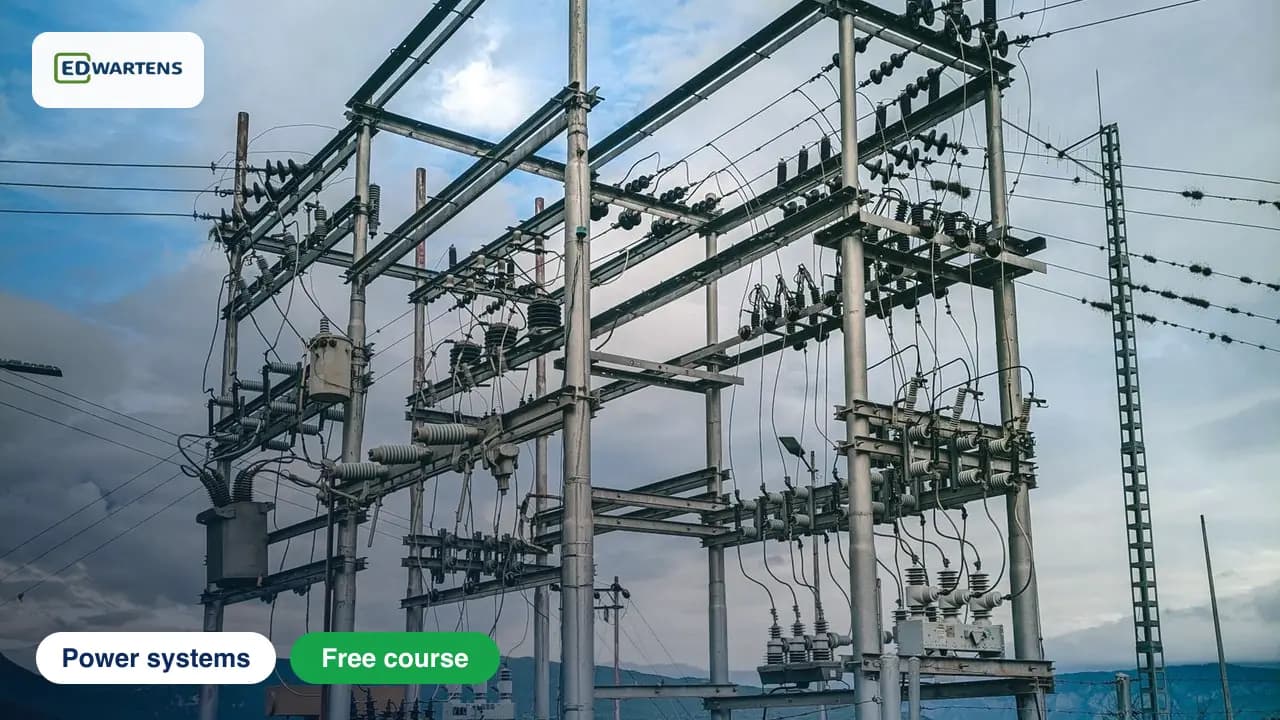
Free course · Power systems
Substation Design: Layouts, Bus Schemes and Equipment
Design a 33/11 kV or 132/33 kV substation on paper: substation types, single-line diagrams and bus schemes, equipment ratings, fault levels, BIL and creepage, clearances in plan and section, busbar sizing, earthing and shielding, battery and charger sizing, control panels and SCADA signals, cables and lighting, civil interfaces, and energisation.
Free to learn. Verifiable certificate £19 when you pass the final exam (optional, VAT included).
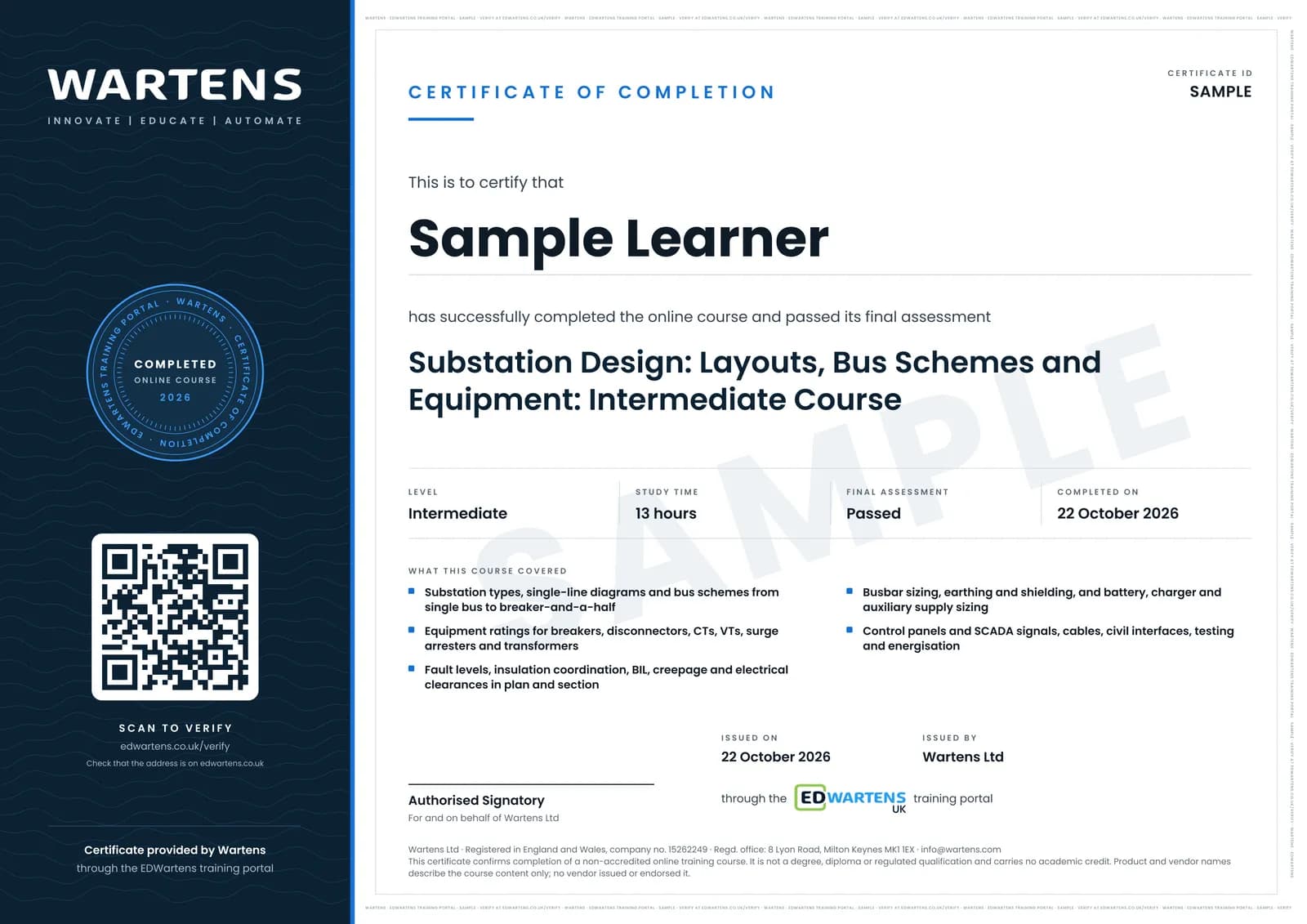
Sample certificate. Optional, issued when you pass the final exam.
- Level
- Intermediate
- Modules
- 14
- Video
- 19 hours
- Price
- Free
Outcome
What you will be able to do
Classify substations and choose between AIS and GIS; draw single-line diagrams and choose a bus scheme with reasons; rate circuit breakers, disconnectors, CTs, VTs, surge arresters and power transformers; calculate bus fault levels; choose BIL and creepage; set out clearances in plan and section; size busbars for current, short-time withstand and force; estimate earth grid resistance and shield the yard with masts; size the battery, charger and auxiliary transformer; write a SCADA signal list and a cable schedule; size yard lighting; give the civil team their inputs; and plan testing and energisation.
- Choose between AIS, GIS and hybrid substations for a site, and draw the single-line diagram
- Compare single, sectionalised, main and transfer, double bus, breaker-and-a-half and ring schemes
- Rate breakers, disconnectors, CTs, VTs, surge arresters and transformers from the fault level
- Choose BIL and creepage, and set clearances and heights in plan and section
- Size busbars for continuous current, short-time withstand and short-circuit force
- Size the substation battery, charger and auxiliary transformer from a duty cycle
- Write the SCADA signal list, cable schedule and civil inputs, and plan energisation
Software
A spreadsheet (LibreOffice Calc is free) for the calculations. A free 2D drafting tool such as LibreCAD or QElectroTech for the single-line diagram and layout; AutoCAD (free student licence) is useful but not required. Google Earth for site context.
Hardware
None.
Syllabus
14 modules
Each module has video lessons, notes and a short quiz. The final exam closes the course.
- Substation types: AIS, GIS, outdoor and indoor, by voltage3 lessons
- Single-line diagrams and bus schemes9 lessonsLab
- Switching equipment: circuit breakers and disconnectors, and how to rate them7 lessonsLab
- Instrument transformers, surge arresters and power transformers8 lessons
- Short-circuit levels and insulation coordination: BIL and creepage2 lessonsLab
- Electrical clearances and layout, in plan and section5 lessons
- Busbar and conductor sizing11 lessons
- Substation earthing (overview) and shielding against direct strokes3 lessons
- Auxiliary AC and DC systems: battery and charger sizing5 lessons
- Control and relay panels, and the SCADA interface4 lessons
- Cable trenches, cable schedules and yard lighting6 lessons
- Civil interfaces: foundations, fencing, drainage and fire walls4 lessons
- Testing, energisation and the design-review checklist3 lessons
- Final Assessment1 lesson
How it works
How this course works
- Watch the video lessonsOne module at a time, at your own pace.
- Take the module quizA short quiz at the end of each module shows what stuck.
- Keep your notesWrite in My notes beside each module and ask the trainer if you are stuck.
- Practise in the labOptionalTry a task from the module in the EDWartens Lab, in your browser.
- Sit the final examPass it once you have been through the modules.
- Certificate, if you want oneOptionalPaid, and only after you pass. Anyone can check it online.
EDWartens Lab
Practise this in the EDWartens Lab
Read the single line diagram, then isolate, lock and tag a motor bucket in the Lab's substation and MCC room.
Works alongside Substation Design: Layouts, Bus Schemes and Equipment. The Lab is substation and mcc practice in your browser: no install, no hardware, free to use. Sign in as a learner and it opens with your account.
Levels to try with this course
MCC-01 · Substation and MCC lab
Read the single-line diagram
Open in the lab (opens in a new tab)MCC-06 · Substation and MCC lab
Fault level and breaker check
Open in the lab (opens in a new tab)
Optional. Skip it whenever you like: it never blocks your progress or your certificate.
Why practise in a lab
Technical work is judged on what you can do: wiring, commissioning, finding a fault. Doing a task yourself teaches more than watching it a second time, and a lab lets you try it safely before you meet real equipment. It does not replace working on real hardware.
- Practise safely, so a mistake costs nothing.
- The lab checks your work like a site test, so you know when it is right.
- Free, in your browser, with nothing to install.
Certificate
An optional certificate when you pass
Learning is free. Pass the final exam and you can have a certificate for £19, including VAT, with a number employers can check online. It records that you completed a free online course; it is not a regulated qualification or a CPD certificate.
- Your name, the course, its study time and your final exam score
- A unique certificate number and a QR code to its verification page
- Issued by Wartens Ltd; add it to your LinkedIn profile in one click
- Pay now or after you pass: it is issued the moment you pass the final
Credits
Who made the lessons
The video lessons belong to their creators. EDWartens wrote the study plan, notes, quizzes and the final exam.
- Gaurav J - TheElectricalGuy
the Substation and Switchgear lessons: what a substation is for, classification of substations, AIS versus GIS, reading single-line diagrams, the 33/11 kV and 132/33 kV SLDs, bus bar arrangements, the bus coupler, live and dead tank breakers, auto-reclosing duty, disconnector parameters, short-time and peak currents, CT parameters, the five vital clearances, AIS versus GIS selection, substation grounding and how it is tested, why control circuits use DC, the MV switchgear control compartment, switchgear monitoring, high-voltage testing of MV switchgear, and the equipment quick revision used before the final
- CMTEQ
the Substation Components series: power transformers, tap changers, circuit breakers, busbars, lightning arresters, disconnectors and earth switches, CTs and VTs, neutral earthing resistors, the objectives of protection, and the 132 kV switchyard single-line diagram
- Electrical Thunderbolt
busbar sizing and selection to IEC, ANSI and IEEE (parts 1 to 9) and busbar sag calculation, voltage transformer sizing and selection, substation earthing design to IEEE 80 (part 1), and substation cable sizing and selection (parts 1 to 5)
- DC Engineering
the Substation Configurations lessons on radial, ring bus and breaker-and-a-half arrangements
- ELECTRICAL TECHNOLOGY and INDUSTRIAL PRACTICE
the Substation design series lessons on the specification of a substation, facilities and basic layout guidelines, and auxiliary power
- Commonwealth Associates, Inc
insulation coordination explained: protecting substation assets from surges and lightning
- Dr. David Lubkeman
the Power System Transients lecture on an insulation and surge arrester example
- stephen brooks
substation clearances, and substation cable trays (https://www.youtube.com/watch?v=ghjm_VEclmU)
- George Flew
substation lightning protection with the IEEE 998 rolling sphere method
- Electrical Superintendent
substation battery chargers: charger functions and components, and the typical DC control system layout (https://www.youtube.com/watch?v=AayQVHAan2Q)
- Circuit Masterclass
a step-by-step VRLA battery sizing calculation for a substation, and the bay control unit in a substation (https://www.youtube.com/watch?v=8fntEEPo0mg)
- Sacademicus
an introduction of the substation to civil and structural engineers
- Annai Teresa Ec
the design procedure for substation equipment foundations
- BESA Research
transformer fire wall requirements and fire protection solutions
- SA Power Networks
how a substation is built from scratch, as a time-lapse of the civil and electrical works
- Keentel Engineering
transformer commissioning and its testing guide
Questions
About this course
Who is this substation design course for?
What do I need to know before starting?
Do I need AutoCAD or ETAP?
Which standards does the course follow?
How is this different from the IEC 61850 Substation Automation course?
How long does the course take?
Is the course free, and what certificate do I get?
What jobs does it lead to?
Want a live class and career support?
The Professional Module is five live days of Siemens PLC, HMI and SCADA with an instructor, then a resume session and a CPD certificate.