







Free job simulation · Electrical and energy

Mechanical maintenance engineer job simulation

A mechanical maintenance engineer job simulation is practice at keeping machinery running safely. In a simulated board and packaging mill you place vibration readings in zones, work out shaft alignment corrections, judge a cavitating pump, isolate a hydraulic press that stores energy, plan a lift and write a bearing failure root cause analysis. It uses documents and calculations, so nothing real is at risk. It is practice, not employment.

You join Wyreside Board and Packaging Ltd (simulated company), a corrugated board and carton converter, maintenance department in Preston. A working day takes 30 to 45 minutes. Days 1 to 5 are free, about 3 to 4 hours in all. Premium continues to day 20, about 12 to 15 hours. It is practice, not employment.

Days 1 to 5 are free. You need a free account and no card. Create an account. Or try the 3-minute demo (opens in a new tab), with no account.

Free
5 days, 3 to 4 hours
A working day
30 to 45 minutes
Project documents
10
Certificate, optional
£14.99
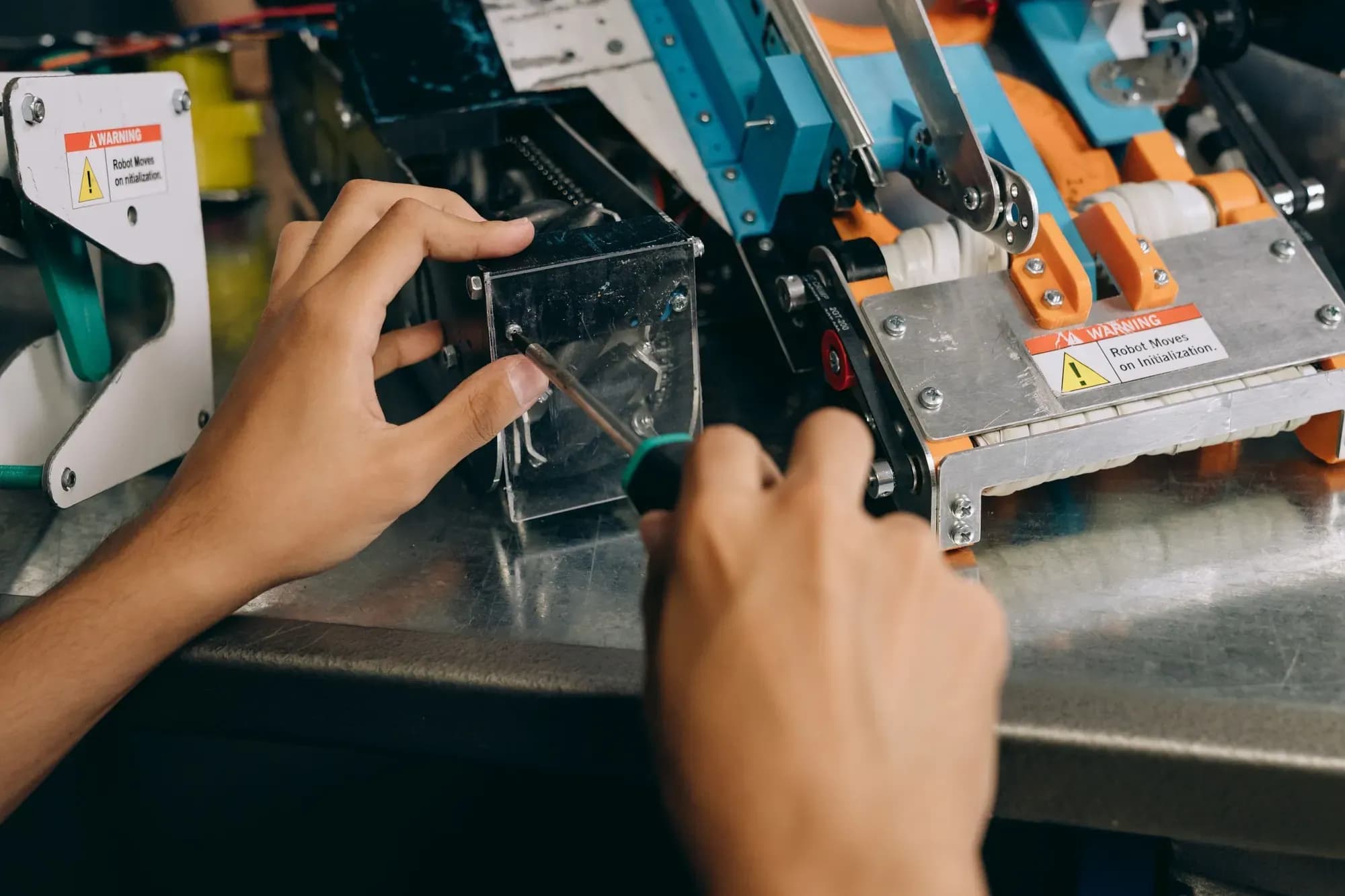
Hands using a screwdriver on the mechanism of a machine beside a robot warning label

The project

You join Wyreside Board and Packaging Ltd (simulated company)

Wyreside Board and Packaging Ltd (simulated company) is a corrugated board and carton converter, maintenance department in Preston. You help its team deliver a project for Wyreside production department, at Converting hall, line CL-3 and utilities (cooling water, hydraulics).

You are the junior maintenance engineer at a board and packaging mill. In four weeks you place a vibration round in its zones, work out a laser alignment, check a lubrication schedule, judge a rattling pump and a belt drive, read an oil report and refuse to leave a guard off. Then a hydraulic baler leaks with stored energy in an accumulator, a crane is past its examination, the only cooling water pump seizes for the third time and a gearbox overheats at night. You write the change, the root cause analysis and the method statement, and hand over a condition-monitoring plan. The skill is to be safe first, evidence-based second, and useful to production third.

What you will do

  • Place vibration and temperature readings in their zones and act on them
  • Work out laser alignment corrections and belt drive checks
  • Isolate a hydraulic press with an accumulator in the correct order
  • Plan a motor lift, check the examination record and refuse an unsafe one
  • Write a root cause analysis and hand over a condition-monitoring plan

The people you deal with

  • Maintenance Managercompany
  • Senior Maintenance Fittercompany
  • Reliability Techniciancompany
  • Maintenance Plannercompany
  • Health and Safety Advisorcompany
  • Stores Controllercompany
  • Production Managerclient
  • Shift Team Leaderclient
  • Hydraulic Service Engineervendor
  • Lifting Equipment Engineervendor

The company, client and site are fictional. The people are fictional too.

Look inside

What the simulator looks like

The workplace, your tickets, the documents and the team chat, as a learner sees them.

  • The workplace of the simulated company in the Mechanical Maintenance Engineer job simulation
    Start in the workplace, with the team around you.
  • The Today screen of the Mechanical Maintenance Engineer job simulation: the morning email and the day's tickets
    Today: the morning email and your tickets for the day.
  • The Work screen of the Mechanical Maintenance Engineer job simulation, listing tickets by day
    Work: every ticket, by day, with its status.
  • A ticket in the Mechanical Maintenance Engineer job simulation with its brief and acceptance points
    A ticket, written the way a colleague would write it.
  • A project document in the Mechanical Maintenance Engineer job simulation with number, revision and status
    A project document with its number, revision and status.
  • The Team screen of the Mechanical Maintenance Engineer job simulation with a chat open with an AI colleague
    Ask a colleague. They are AI colleagues: they help you think, they do not hand out answers.

Screenshots from the simulator. Company, people and data are fictional and always labelled as simulated.

Meet the team

The colleagues you work with

You can read their messages and ask them questions. They are AI colleagues with names, roles and faces, always labelled as simulated. They help you think a ticket through; they do not hand out its answer.

  • Portrait of Helen Tattersall, an AI colleague (simulated)Helen TattersallMaintenance ManagerSimulated colleague, company side
  • Portrait of Delroy Tulloch, an AI colleague (simulated)Delroy TullochSenior Maintenance FitterSimulated colleague, company side
  • Portrait of Aisha Yardley, an AI colleague (simulated)Aisha YardleyReliability TechnicianSimulated colleague, company side
  • Portrait of Ruth Stanhope, an AI colleague (simulated)Ruth StanhopeMaintenance PlannerSimulated colleague, company side
  • Portrait of Ewa Szymanski, an AI colleague (simulated)Ewa SzymanskiHealth and Safety AdvisorSimulated colleague, company side
  • Portrait of Barry Sutcliffe, an AI colleague (simulated)Barry SutcliffeStores ControllerSimulated colleague, company side
  • Portrait of Naveen Thakrar, an AI colleague (simulated)Naveen ThakrarProduction ManagerSimulated colleague, client side
  • Portrait of Craig Wragg, an AI colleague (simulated)Craig WraggShift Team LeaderSimulated colleague, client side

Fictional people, with simulated faces.

What you get

What you walk away with

Run a month in a mill maintenance team: condition monitoring, alignment, stored energy, lifting and a root cause analysis.

Roles to look for

  • Mechanical Maintenance Engineer
  • Maintenance Fitter
  • Multi-skilled Maintenance Engineer (mechanical bias)
  • Reliability Technician

4479 live openings on the UK jobs board, checked 15 Nov 2026. See the jobs

Your proof

  • Your work pack, as a PDF and a zip, with your documents, timesheet and skills before and after.
  • A certificate anyone can verify. Optional, and included in Premium.
  • An entry on your EDWartens profile under Work experience, marked as a job simulation.
  • A work record with your skill scores, with Premium.

What you can talk about at interview

  • You can explain how you placed vibration readings in zones and why the limit depends on the machine.
  • You can walk an interviewer through isolating a hydraulic press with an accumulator, step by step.
  • In Premium, you can talk through a root cause analysis you wrote and a lift you refused because of an overdue examination.

Day by day

Your 5 free days, and the project they build

Each working day takes 30 to 45 minutes: clock in, a morning meeting, your tickets, an end-of-day report, clock out. Do a day at a time or several in one sitting. On day 1 your manager checks what you know and plans your learning. Every ticket is checked, and you see the model answer after it.

Converting hall condition monitoring plan

For Wyreside production department (fictional)

The converting hall depends on the cooling water loop, the reel drives and the baler, and the only cooling water pump, P-204, keeps failing. This project puts condition checks in place, keeps stored-energy work safe, finds the real cause of the P-204 failures and hands over a condition-monitoring plan the maintenance team can run.

In scope for you

  • Place condition round readings in their zones and act on them
  • Check alignment, belt drives and the lubrication schedule
  • Isolate baler BP-2 safely, accumulator included
  • Plan lifts and refuse unsafe work on guards and cranes
  • Write the root cause analysis for P-204 and the condition-monitoring plan

You hand over

  • Condition round zone and action listVibration round report
  • Gearbox oil analysis noteOil analysis note
  • A closed work order with findingsWork order close-out (CMMS)
  • Root cause analysis of a bearing failureRCA reportPremium
  • Method statement and risk assessmentRAMSPremium
  • Condition-monitoring planCondition-monitoring planPremium
Milestones in the free days

  1. By day 3First condition round placed and alignment worked outConverting hall condition monitoring plan
  2. By day 5Gearbox oil note, guard decision and first work order closedConverting hall condition monitoring plan

Tickets, day by day

  1. Day 1

    2 tickets
    • Induction: isolation, stored energy and lifting rulesQuiz
    • Condition round: zone, action and temperature statusTable
  2. Day 2

    2 tickets
    • Laser alignment: tolerance and foot correctionsCalculation
    • Check the draft lubrication scheduleDocument review
  3. Day 3

    2 tickets
    • P-204 is rattling like gravelDecision
    • Belt drive checks on extraction fan F-310Calculation
  4. Day 4

    1 ticket
    • Gearbox GB-301: oil analysis noteWriting
  5. Day 5

    2 tickets
    • The guard is off and a lorry is waitingDecision
    • Close out work order WO-2026-021774Writing

On day 5 you clock out and your manager does a final review with you, and your work pack is ready: the free days, in about 3 to 4 hours.

Premium: days 6 to 20about 12 to 15 hours with the free days

After day 5 the project goes on with a change request, site work, faults, a handover and a capstone reviewed by an engineer. Your manager also checks in on days 5, 10 and 15, and the final review comes after day 20.

  1. By day 10Baler isolated, guarding checked, coupling change raisedConverting hall condition monitoring plan
  2. By day 15Lift plan, crane record, P-204 root cause and the night gearbox callConverting hall condition monitoring plan
  3. By day 20Spares, bearing life, method statement and monitoring plan deliveredConverting hall condition monitoring plan

See the Premium plan

  1. Day 6

    1 ticket
    • Isolate baler BP-2: put the steps in orderTable
  2. Day 7

    1 ticket
    • Hose spraying, 40 bales to goDecision
  3. Day 8

    1 ticket
    • Check the PUWER guarding assessmentDocument review
  4. Day 9

    1 ticket
    • Change request: spacer coupling on P-204Writing
  5. Day 10

    1 ticket
    • NPSH available for P-204, clean and fouledCalculation
  6. Day 11

    1 ticket
    • Lift plan loads for the M-301 motor changeCalculation
  7. Day 12

    1 ticket
    • The crane has never dropped anythingDecision
  8. Day 13

    1 ticket
    • Root cause analysis: P-204 bearing failureWriting
  9. Day 14

    1 ticket
    • 02:40: gearbox GB-301 at 96 degreesDecision
  10. Day 15

    1 ticket
    • Re-order points for the critical sparesTable
  11. Day 16

    1 ticket
    • How long should the 6309 bearing last?Calculation
  12. Day 17

    1 ticket
    • Method statement and risk assessment: BP-2 accumulatorWriting
  13. Day 18

    1 ticket
    • Capstone: condition-monitoring plan for the converting hallHand-in
  14. Day 19

    1 ticket
    • Reliability of P-204: MTBF, availability and costCalculation
  15. Day 20

    1 ticket
    • A conversation about your own workViva

Your workplace

Where you work, and with what

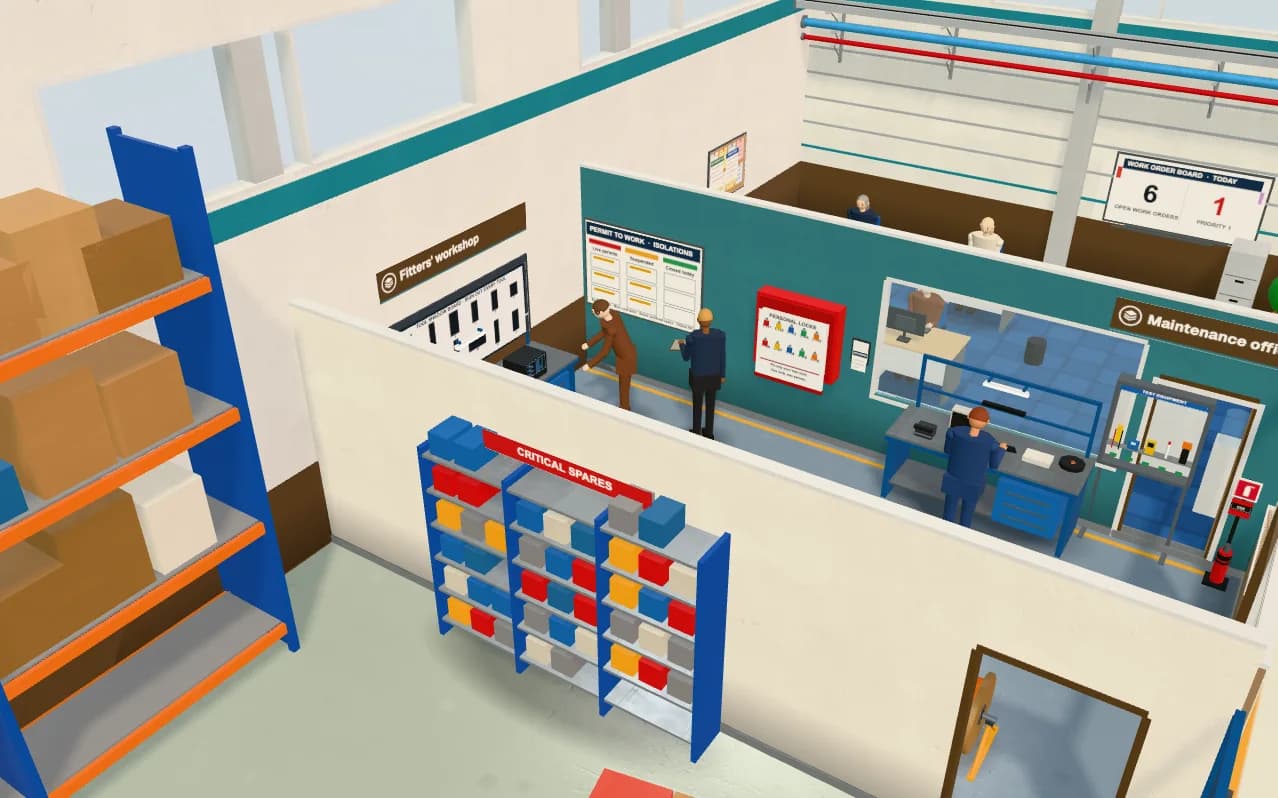
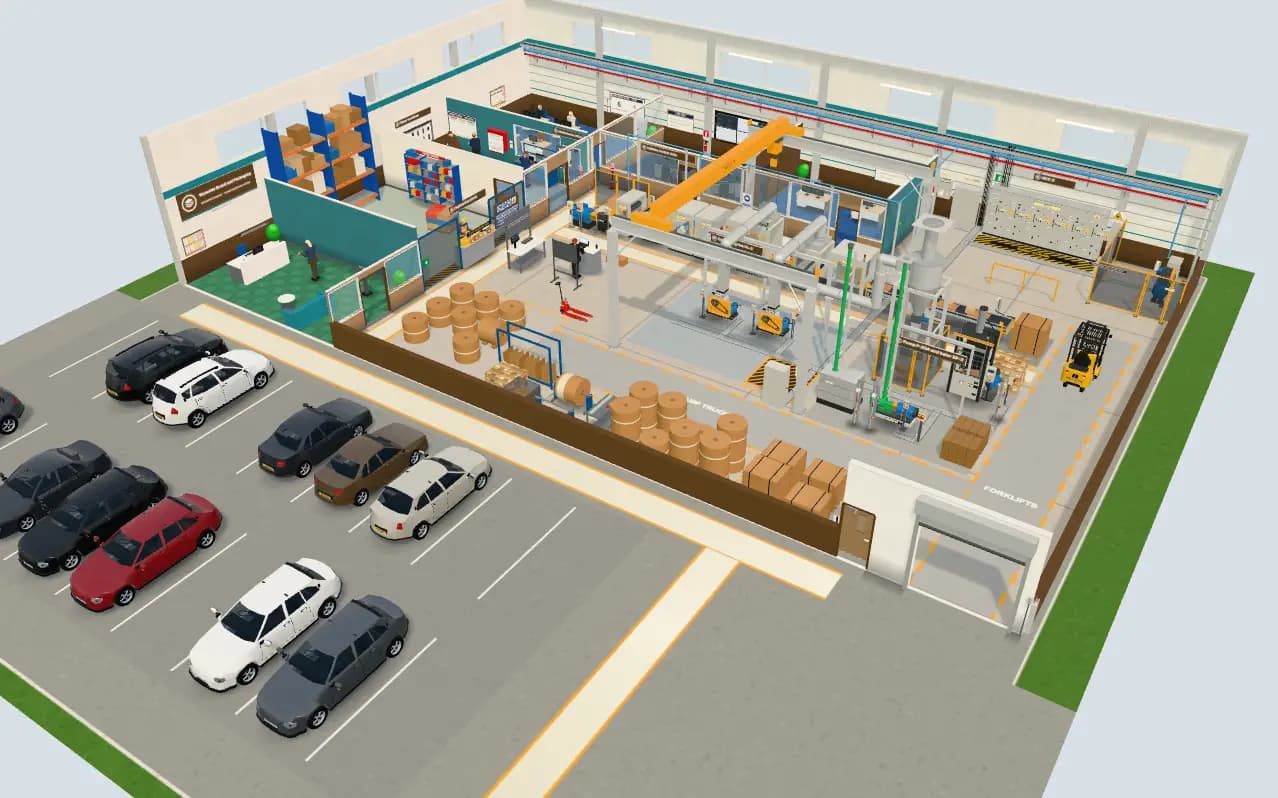
You work in a plant floor with a workshop and offices: Wyreside Board and Packaging (simulated company), Converting hall and utilities. It is a 3D room with your colleagues in it.

Hours and rhythm

Days, 07:00 to 15:30, Monday to Friday (simulated)

  • 07:00 toolbox talk in the workshop
  • 07:15 work orders handed out from the board
  • 15:00 close out your work orders in the CMMS
  • 15:15 handover to the late shift fitter

You clock in and out of every day. The simulated clock runs faster between events, so a day takes 30 to 45 minutes of real time.

Machines and equipment

Real lab machines stand in the workplace, and the hands-on tickets point to the matching EDWartens Lab exercise. In the UK edition you do the lab exercise yourself, tick a checklist and hand in your notes and figures. It is a self-review hand-in. The lab does not mark you or send us a result.

Systems and kit

CMMS (simulated). Every job is a work order: you open it, record what you found, the time and the parts, and close it. Ruth reads every close-out.

PPE on site: Safety boots, Hi-vis jacket and overalls, Safety glasses, with a face shield for hydraulic work, Ear defenders in the converting hall, Hard hat in the crane bay.

The 3D workplace of the simulated company in the Mechanical Maintenance Engineer job simulation
The simulated workplace you walk around. The company and the people are fictional.

Skills checked

The skills your manager checks

On day 1 you rate yourself on about eight skills for the role, from never done it to could teach it. Your manager then asks two short "show me" questions on the skills you rated highest. The same skills are rated again at the final review, so you see a before and after.

  • Mechanical maintenance
  • Safety and safe systems of work
  • Machinery safety and guarding
  • Condition monitoring (vibration, thermography, oil)
  • Written communication
  • Risk assessment
  • Root-cause analysis
  • Lubrication

A "How to do this" panel opens on tickets that use a skill you rated low. Where you have shown you know a skill, the help stays folded away, and you can open it any time.

Real documents

The documents you will work with

Each one has a title block with a number, a revision, a status and who prepared, checked and approved it, the way a project document does. You read them, check them and write your own, and what you hand in becomes a controlled document too. Everything is kept in your work pack.

  • WBP-HSE-001

    Machinery safety rules, isolation and lifting

    Rev 4Safety procedure

  • WBP-CMR-041

    Condition monitoring round, week 41: readings and limits

    Rev 1Condition monitoring report

  • WBP-ALN-007

    Laser alignment report, pump P-204 and motor M-204

    Rev AAlignment report

  • WBP-LUB-000

    Lubricant register and relubrication rules

    Rev 2Lubrication standard

  • WBP-LUB-014

    Lubrication schedule, converting hall, draft

    Rev ALubrication schedule

  • WBP-PMP-204

    Pump P-204 datasheet and duty readings

    Rev AEquipment datasheet

  • WBP-FAN-310

    Extraction fan F-310: drive data and belt inspection sheet

    Rev 1Equipment datasheet

  • WBP-OIL-0412

    Oil analysis report, gearbox GB-301

    Rev 1Oil analysis

  • WBP-LOG-009

    Your notes from the F-310 belt change, day 5

    Rev 1Shift log

  • WBP-VIB-001

    Vibration measurement points: pump P-204 and motor M-204

    Rev AMeasurement point drawing

Documents that arrive in Premiumchange requests, records, handover
  • WBP-HYD-003

    Baler BP-2: hydraulic circuit data and isolation points

    Rev BHydraulic schematic and SOPPremium

  • WBP-RA-022

    PUWER guarding assessment, infeed of line CL-3

    Rev ARisk assessmentPremium

  • WBP-MOC-001

    Management of change: coupling on pump P-204

    Rev AChange requestPremium

  • WBP-PMP-204

    Pump P-204 datasheet, coupling changed

    Rev BEquipment datasheetPremium

  • WBP-CAL-031

    Pump P-204 suction conditions and NPSH check

    Rev ACalculation sheetPremium

  • WBP-LFT-011

    Lift plan: replace motor M-301 in bay 2

    Rev ALift planPremium

  • WBP-RCA-027

    Incident file: P-204 drive-end bearing failure

    Rev ARCA evidencePremium

  • WBP-SPR-001

    Critical spares list and re-order rule

    Rev BSpare parts listPremium

  • WBP-PM-001

    Preventive maintenance plan, converting hall, revised after RCA-027

    Rev BPM planPremium

  • WBP-CMP-001

    Condition monitoring plan: requirements

    Rev ACapstone briefPremium

  • WBP-HOV-001

    Maintenance handover pack requirements

    Rev AHandover indexPremium

  • WBP-TPL-001

    Root cause analysis worksheet: fishbone and 5 whys (blank)

    Rev ARCA templatePremium

Tools

In the industry, and here

Tools in the industry and what you use here
In the industryHere
Vibration meter, thermal camera, laser alignment kit, grease gunReadings, reports and alignment numbers given in documents that you check and calculate from
CMMS work orders and close-out notesWork orders and close-out notes as documents and tickets
Permits, isolation procedures, lift plans and risk assessmentsDraft procedures to review and method statements to write
Spreadsheets for spares, reliability and bearing lifeTables and calculations you complete and have checked

Standards

The standards the work follows

  • PUWER 1998
  • LOLER 1998
  • ISO 20816-3 (vibration severity)
  • BS EN ISO 4413 (hydraulics, basics)
  • BS EN ISO 14120 and 14119 (guards and interlocks)
  • ISO 281 (bearing life)

In the UK

The Mechanical Maintenance Engineer role in a UK setting

Who employs this kind of engineer: Paper, board and packaging mills, process and manufacturing plants, and rotating-equipment service companies.

Where: Industrial regions such as the North West, Yorkshire, the Midlands, Scotland and the South West have many sites with mechanical maintenance and reliability teams. This is context, not a statement about vacancies.

UK standards and regulations to know about

  • PUWER 1998

    The Provision and Use of Work Equipment Regulations: equipment must be suitable, maintained and safe to use. HSE guidance L22 explains them.

  • LOLER 1998

    Lifting Operations and Lifting Equipment Regulations: planning, supervising and examining lifting operations.

  • PSSR 2000

    Pressure Systems Safety Regulations: relevant to hydraulic accumulators and other stored-pressure equipment.

  • BS EN ISO 4413

    Safety requirements for hydraulic systems. Basics only in this simulation.

These are named so that you recognise them. A job simulation does not teach them as a qualification, the tasks use simplified data, and you should always read the current edition of anything you rely on.

Your proof, optional

A certificate you can verify

The free days are free. The graded, verifiable certificate is an optional extra, and it is included in Premium.

  • A graded, verifiable certificate with your score and band
  • A public verification page and QR code
  • The details to list it on LinkedIn under Licences & certifications, ready to copy
  • Issued by WARTENS LTD. It is a training certificate, not an accredited qualification, and the company is simulated

Optional: £14.99 including VAT, once you pass.

Sample

Job Simulation Certificate

Your name

completed the Mechanical Maintenance Engineer job simulation at Wyreside Board and Packaging Ltd (simulated company). Your score and band are shown on the real certificate.

Number
EDW-JS-0000
Issued by
WARTENS LTD

Not an accredited qualification. A verification page and QR code are printed on the real certificate.

Premium

Want the full project, reviewed by an engineer?

Premium runs to day 20, about 12 to 15 hours in all, and includes the graded certificate. Your free days carry over, and nothing you did is lost.

£53.99 including VAT, one payment. If you have bought the certificate, you pay £39.00.

  • Working days 6 to 20 (about 12 to 15 hours in all): change requests, site work, faults and handover
  • A capstone deliverable reviewed by an engineer
  • An AI viva on your own work
  • The graded certificate and a work record PDF with your skill scores

About the Mechanical Maintenance Engineer role

Vibration zones and bearing temperature, worked through

Overall vibration velocity in mm/s rms is a first screen for rotating machinery. ISO 20816-3 gives general guidance by machine group and by how rigid the support is, with four zones from A (as new) to D (severe enough to cause damage). The same reading can be acceptable on one machine and a warning on another.

In the simulation you place six readings from a monthly round in their zones, give the action for each and judge the housing temperature against alert and alarm limits. Then you use each machine's own baseline to set better alert levels.

Laser alignment: offset, angle and shims

Misalignment loads the bearings and the coupling. A laser report gives the offset at the coupling and the angle between shafts. From those you work out the offset at the motor feet and the shims to remove or add, then check them against a tolerance that depends on speed.

The project gives you a pump and motor at 1480 rpm and a soft foot reading. Curing soft foot first is part of the answer, because the numbers are wrong if the foot moves when the bolt is tightened.

Cavitation and NPSH: why a hot pump rattles

A centrifugal pump cavitates when the pressure at the impeller eye falls below the vapour pressure of the liquid. NPSH available must stay above NPSH required by a margin. Hot water has a high vapour pressure, so the margin is small and a blocked strainer can remove it.

You calculate NPSH available with a clean and a fouled strainer, decide what to tell the shift when a pump rattles like gravel, and see why closing the suction valve is the wrong cure.

Stored energy, guarding and lifting in UK practice

Hydraulic accumulators keep a circuit pressurised after the pump stops, and a raised platen can fall. PUWER 1998 requires isolation from every source of energy for maintenance, so the order of steps matters: stop, make the load safe, lock with your own lock, prove, discharge and read zero.

You put the isolation steps of a baler in order, refuse a request to find a leak with cardboard, review a guarding assessment for planted faults and decide what to do when a crane is past its LOLER thorough examination.

Bearing failure root cause and the handover

A bearing that fails three times in 17 months is a system problem. The project gives you an incident file, a bearing life calculation and a reliability calculation, and asks for a root cause analysis with owners and dates. You look at the evidence first and the fix second, which is what a reliability engineer expects.

The capstone is a condition-monitoring plan for six critical assets, with techniques, limits, responses and a first-month calendar. A viva checks that you can explain your own work.

Questions

Quick answers

What does a mechanical maintenance engineer do?

They keep pumps, fans, gearboxes, hydraulic systems and lifting equipment working by planned maintenance, fault finding and condition monitoring, and they record what they find so the next shift can carry on. They also work safely around stored energy, guarding and lifting.

What is shaft alignment and why does it matter?

It is lining up the centrelines of two coupled shafts. Misalignment loads the bearings and the coupling and shortens their life, so it is measured, usually with a laser, and corrected with shims and sideways moves.

What is cavitation in a pump?

Vapour bubbles form when the pressure at the impeller inlet falls below the liquid's vapour pressure and then collapse, pitting the impeller and damaging bearings. It usually sounds like gravel and is a suction side problem.

What is stored energy and why is stopping the pump not enough?

Energy can remain after the power is off, for example in a hydraulic accumulator, a raised platen or a loaded spring. Isolation means every source is made safe, locked and proved at zero.

What are PUWER and LOLER?

They are UK regulations from 1998. PUWER covers the safe provision and use of work equipment, including guarding, maintenance and isolation. LOLER covers lifting equipment, including planning of lifts and thorough examination.

Do I need a 3D lab for this?

No. The work is mechanical, so you use reports, drawings and calculations, and compare your answers with worked solutions.

Do I need to be a fitter or a mechanical engineer?

No. The simulation teaches the order of work, the numbers and the safety rules, but it does not make you authorised to work on machinery. Always follow the rules of your own employer and country.

Is the mill a real one?

No. Wyreside Board and Packaging is a made-up company and the site is simulated. The documents, readings and situations follow what a junior maintenance engineer meets.

How long does it take?

The free week is about nine hours over five days. The full Premium edition runs over twenty working days and about thirty-two hours, at your own pace.

Does it use a 3D lab?

No. The work is mechanical, so you work from reports, drawings and data, and calculate the answers yourself. Every calculation shows its working afterwards.

What do I get at the end?

A work record with scores by task and skill, which shows on your EDWartens profile under Work experience, marked as a job simulation.

Is the Mechanical Maintenance Engineer job simulation free?

Yes, to start. Days 1 to 5 are free. The certificate (£14.99) and the Premium edition (£53.99) are optional, and both prices include VAT.

Does it count as work experience?

No. It is a training project at a simulated company, not employment, an internship or a placement. A job simulation is a realistic training project at a simulated company. It is not employment, an internship or a work placement, and it is not a job offer. Hours are active hours the learner logged on EDWartens UK.

A job simulation is a realistic training project at a simulated company. It is not employment, an internship or a work placement, and it is not a job offer. Hours are active hours the learner logged on EDWartens UK.

Start the Mechanical Maintenance Engineer job simulation today

Days 1 to 5 are free, about 3 to 4 hours. No card to start. Practice, not employment.

A corner of the simulated workplace in the Mechanical Maintenance Engineer job simulation