Free course · Maintenance
Pumps, Compressors and Rotating Equipment
This free course teaches the machinery side of a process plant: how centrifugal pumps build head, pump and system curves, NPSH and cavitation, affinity laws and pump selection, API 610 pumps, positive displacement pumps, mechanical seals and API 682 plans, bearings, alignment and soft foot. It suits UK mechanical, maintenance and reliability engineers in oil and gas, chemicals, water and manufacturing. It helps with rotating equipment engineer and maintenance engineer roles. Equipment is shown in the lessons, so you need none of your own.
Pumps, Compressors and Rotating Equipment is a free online intermediate Maintenance course with 14 modules, about 23 hours of video lessons. Learning is free; an optional verifiable certificate costs £19 including VAT when you pass the final exam. Last updated 28 October 2026.
Free to learn. Verifiable certificate £19 when you pass the final exam (optional, VAT included).
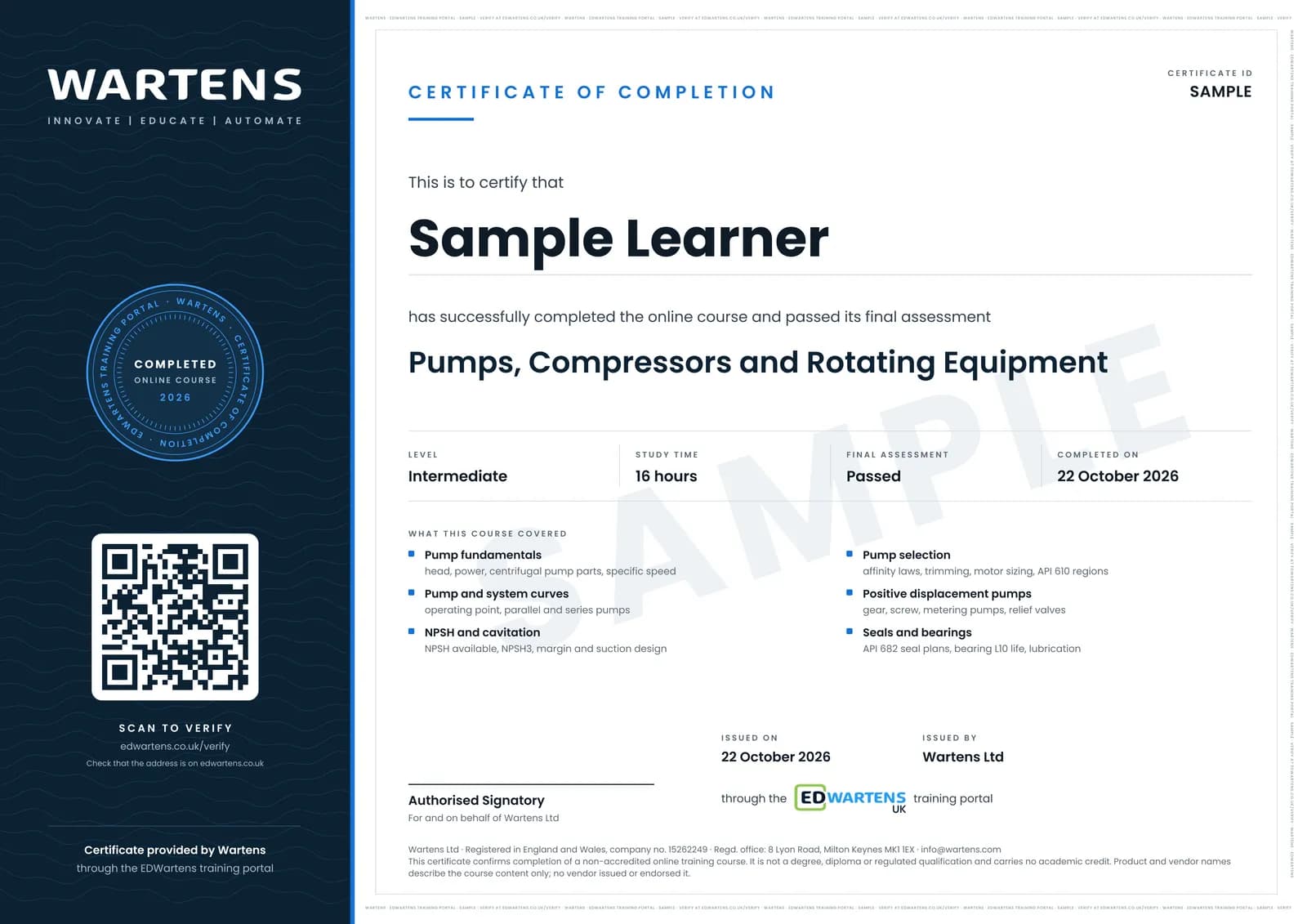
Sample certificate. Optional, issued when you pass the final exam.
- Level
- Intermediate
- Modules
- 14
- Video
- 23 hours
- Price
- Free
Video time only: reading the notes, the quizzes and the final exam take extra time, at your own pace.
Outcome
What you will be able to do
Convert between pressure and head and work hydraulic and shaft power; draw a system curve and find the operating point, including pumps in parallel and series; calculate NPSH available and judge the margin against NPSH3; apply the affinity laws and impeller trimming and select a pump and motor; check a selection against the API 610 operating regions and read its datasheet; size gear and metering pumps; choose a seal arrangement and API 682 piping plan; estimate bearing life and choose a lubricant; correct alignment at the feet and allow for thermal growth; work compressor discharge temperature, staging and surge margin; and commission, test and troubleshoot a pump against ISO 9906.
- Convert pressure to head, work hydraulic and shaft power, and read a centrifugal pump's parts and curves
- Build a system curve and find the operating point for one pump and for pumps in parallel and series
- Calculate NPSH available and judge the margin against NPSH3 at the worst case
- Apply the affinity laws and impeller trimming, select a pump and size its motor for end-of-curve power
- Check a selection against API 610 operating regions and choose an API 682 seal arrangement and plan
- Estimate bearing L10 life, choose a lubrication method and read an oil analysis
- Find soft foot and pipe strain, correct alignment at the feet and set thermal growth targets
- Work compressor discharge temperature, staging and surge margin, and accept a pump test to ISO 9906
Software
A spreadsheet (LibreOffice Calc is free) for system curves, NPSH, power and alignment calculations. A free online pump selection tool such as Grundfos Product Center is used to read real pump curves; it runs in a browser and needs no licence.
Hardware
None. Pumps, seals, alignment tools and compressors are shown in the lessons; you do not need your own.
Syllabus
14 modules
Each module has video lessons, notes and a short quiz. The final exam closes the course.
- Rotating equipment in a plant: machine families, the engineer's job and the standards7 lessons
- Centrifugal pumps: parts, how the impeller makes head, and specific speed6 lessons
- Pump curves, system curves and the operating point5 lessons
- NPSH and cavitation: NPSH available, NPSH3 and margin5 lessons
- Affinity laws, impeller trimming and selecting a pump6 lessons
- API 610 process pumps: pump types, design rules and the datasheet5 lessons
- Positive displacement pumps: gear, screw, lobe, diaphragm and plunger3 lessons
- Mechanical seals and API 682 seal arrangements and piping plans4 lessons
- Bearings and lubrication: rolling element and hydrodynamic bearings8 lessons
- Installation and shaft alignment: baseplates, soft foot, pipe strain and couplings7 lessons
- Compressors 1: compression basics and reciprocating compressors7 lessons
- Compressors 2: screw and centrifugal compressors, surge and anti-surge control8 lessons
- Commissioning, performance testing and troubleshooting4 lessons
- Final assessment1 lesson
How it works
How this course works
- Watch the video lessonsOne module at a time, at your own pace.
- Take the module quizA short quiz at the end of each module shows what stuck.
- Keep your notesWrite in My notes beside each module and ask the trainer if you are stuck.
- Sit the final examPass it once you have been through the modules.
- Certificate, if you want oneOptionalPaid, and only after you pass. Anyone can check it online.
Certificate
An optional certificate when you pass
Learning is free. Pass the final exam and you can have a certificate for £19, including VAT, with a number employers can check online. It records that you completed a free online course; it is not a regulated qualification or a CPD certificate.
- Your name, the course, its study time and your final exam score
- A unique certificate number and a QR code to its verification page
- Issued by Wartens Ltd; add it to your LinkedIn profile in one click
- Pay now or after you pass: it is issued the moment you pass the final
Credits
Who made the lessons
The video lessons belong to their creators. EDWartens wrote the study plan, notes, quizzes and the final exam.
- Ruhrpumpen Group
the pump maker's short courses on system curves, NPSH and suction specific speed, selecting the right pump, curve shape and head rise to shutoff, API 610 editions, positive displacement pumps, start-up and troubleshooting, and performance testing of API 610 pumps
- Siewert Equipment
the webinars on centrifugal pump hydraulic fundamentals, mechanical seal fundamentals and mechanical seal piping plans
- Hydraulic Institute
the pump fundamentals shorts: rotodynamic against positive displacement, pump components, operating point, specific gravity, motors and alternative drivers
- HardHat Engineer
the centrifugal pump series: working principle, types, parts, API 610 pump types, curves and cavitation
- The Engineering Mindset
centrifugal pump basics and the long session on centrifugal compressors
- Mat Integrity
API 610 classifications, components, OH1 against OH2, and pump bearing housing lubrication
- PSG, a Dover Company
determining NPSH available and the affinity law for pump speed
- Griswold
the affinity law for impeller trimming
- Grundfos
quick pump sizing by application in Grundfos Product Center
- UNICEF Solar Hub
a walk-through of pump selection in Grundfos Product Center
- Core Engineering
pump curve against system curve with a worked example
- MECH 241 - Fluid Mechanics I
the university lecture on net positive suction head
- Laney Machine Tech
positive displacement pump types and hydrodynamic bearings
- JAES Company
how mechanical seals and packing work
- EagleBurgmann
the seal maker's animation of mechanical seal functionality
- The Engineers Post
bearing types and how they work
- Rotor Dynamics 101
tilting pad bearings
- AmarinthPumps
filling an oil-lubricated bearing bracket correctly
- Lubrication Explained
oil viscosity fundamentals
- Spectro Scientific
pump oil analysis
- Acoem USA
couplings explained for shaft alignment
- Rexnord MCS
installing a grid coupling
- LUDECAINC
soft foot checks and corrections and the five-step alignment procedure
- SAIT Millwright
pipe strain, soft foot and rough alignment from a millwright school
- SKF Maintenance Products
a full laser shaft alignment demonstration
- Atlas Copco Compressor Technique
the short chapters on piston and rotary screw compressors
- Ariel Corporation
a look inside a reciprocating gas compressor
- Howden
reciprocating and screw compressor animations
- Kimray Inc
an overview of a natural gas compressor station
- Vibration, dynamics and noise
vibration and pulsation issues in reciprocating compressor systems
- RATS-Rotating and Turbomachinery Society
the technical session on reciprocating compressor capacity control
- ROTARYCOMPTECH
how an oil-flooded rotary screw compressor works
- FS-Elliott
how a centrifugal compressor works
- Solar Turbines
how a centrifugal gas compressor works
- ECAS
anti-surge control in gas compressors
- AESSEAL
dry gas seal hydrodynamic grooves
- Sulzer
commissioning of a pump
- RedVectorOnline
analysing pump vibrations, as the bridge to the vibration courses
- Energy Industry Training (EIT)
the introduction to rotating equipment in oil and gas that opens the course
- LynxE - Your New Learning Experience
the introduction to compressor types
Jobs
Jobs this course can lead to
The skills in this course are used in maintenance engineer and technician work, for example as a rotating equipment engineer, a maintenance engineer and a reliability engineer. No course can promise a job, and employers also look for experience, so read what live adverts ask for.
Browse Electrical and maintenance technicians jobs
4,479 jobs live on the UK board
Browse Multi-skilled maintenance engineer jobs
675 jobs live on the UK board
Pay: Metal working production and maintenance fitters (SOC 5223, which includes automation maintenance technicians) had a median of £41,942 a year, full-time, in April 2026. Electrical service and maintenance mechanics (SOC 5246) had £44,785. Source: ONS, Annual Survey of Hours and Earnings 2026 (provisional). Checked 28 Oct 2026.
Questions
About this course
Last reviewed 28 October 2026.
Is this enough to become a rotating equipment engineer in the UK?
Do I need pumps or tools to practise?
Are API standards used in UK plants?
What does the Pumps, Compressors and Rotating Equipment course cover?
Where does Pumps, Compressors and Rotating Equipment start and where does it end?
How long is Pumps, Compressors and Rotating Equipment?
What is a pumps and compressors course?
Who is this rotating equipment course for, and what do I need to know first?
Do I need any software for the pump selection course?
Is the course free to learn, and how long does it take?
Which standards does the course follow?
What certificate do I get, and how is it verified?
Does the course teach vibration analysis?
What jobs does this lead to, including in the Gulf?
Want a live class and career support?
The Professional Module is five live days of Siemens PLC, HMI and SCADA with an instructor, then career sessions with our engineers and a CPD certificate.