Vendor-neutralFree
Electrical
Electrical Fundamentals for Technicians: Volts to Multimeter to Drawings
- Free
- Beginner
- 14 h
- 14 modules

Free courses
Can you become an electrician online? Not by online study alone. The National Careers Service lists a college course, an apprenticeship, or the Experienced Worker Assessment for people already working as electricians (checked 28 October 2026). These 21 free courses give you the knowledge for that route: BS 7671 wiring regulations, inspection and testing, motor control, design and safety. A certificate is optional (£19 including VAT).
Showing 12 of 21 courses
Electrical
Electrical
Electrical
Practise as you learn
The EDWartens Lab runs in your browser, with nothing to install. It is a practice environment, not the vendors' own software.
Three courses follow UK standards and practice. They are the ones to start with if you work in the UK.
Our page on the 18th Edition and Amendment 4 explains what is free here and what is a paid qualification.
Checked 28 October 2026
The National Careers Service lists four routes: a college course to build knowledge before an apprenticeship or trainee role, an apprenticeship with an electrical company or through the armed forces, the Experienced Worker Assessment for people already working as electricians without a Level 3 qualification, and direct application with experience and relevant qualifications from a related career. Entry requirements are set by the college or employer; the profile mentions 4 or 5 GCSEs at grades 9 to 4, including English and maths, for a college course and 5 GCSEs for an advanced apprenticeship. Read the electrician job profile for the current detail.
None of these free courses replaces a route. They help you learn the theory first, and the 18th Edition and BS 7671 page shows which parts of the standard are free to learn and which exam is paid.
Be clear about this before you start, because the search results for free electrical courses are mostly paid ones.
Routes into electrical work in the UK are an apprenticeship or a college qualification, and schemes and employers set their own requirements. Ask them what they accept.
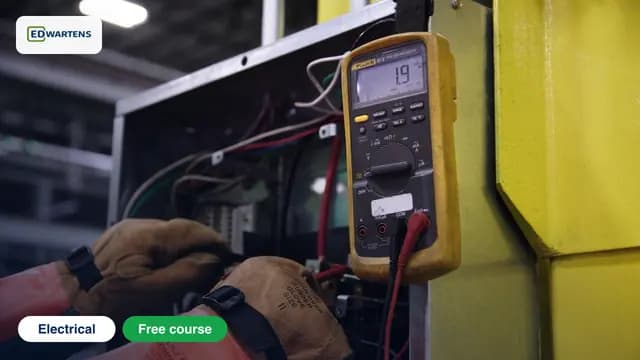
The EDWartens Lab has free simulators for the practical side: a multimeter, electrical wiring and motor control. They are practice, not a substitute for supervised work on live equipment.
Take one course at a time and finish its final exam before the next. The wiring regulations course is about 25 hours of study, and the inspection and testing course has 8 modules, so a few evenings a week gets through either in weeks, not days. Keep a short log of what you learned and what you practised in the Lab. It is useful evidence for an interview, an apprenticeship application or your college tutor.
Questions
Last reviewed 28 October 2026.
Next steps