Free course · Electrical
Electrical Control Panel Design, Building and Testing
This free course teaches control panel design and building: naming the parts of a PLC panel, choosing relays, contactors, overloads and terminals, reading PLC wiring diagrams, matching PNP and NPN sensors, workmanship rules, cooling, and a factory acceptance test. It is taught around UL 508A, a North American standard, so UK builders should also learn BS EN 61439 and BS EN 60204-1. It helps with panel builder and electrical technician roles.
Electrical Control Panel Design, Building and Testing is a free online beginner Electrical course with 9 modules, about 9 hours of video lessons. Learning is free; an optional verifiable certificate costs £19 including VAT when you pass the final exam. Last updated 28 October 2026.
Free to learn. Verifiable certificate £19 when you pass the final exam (optional, VAT included).
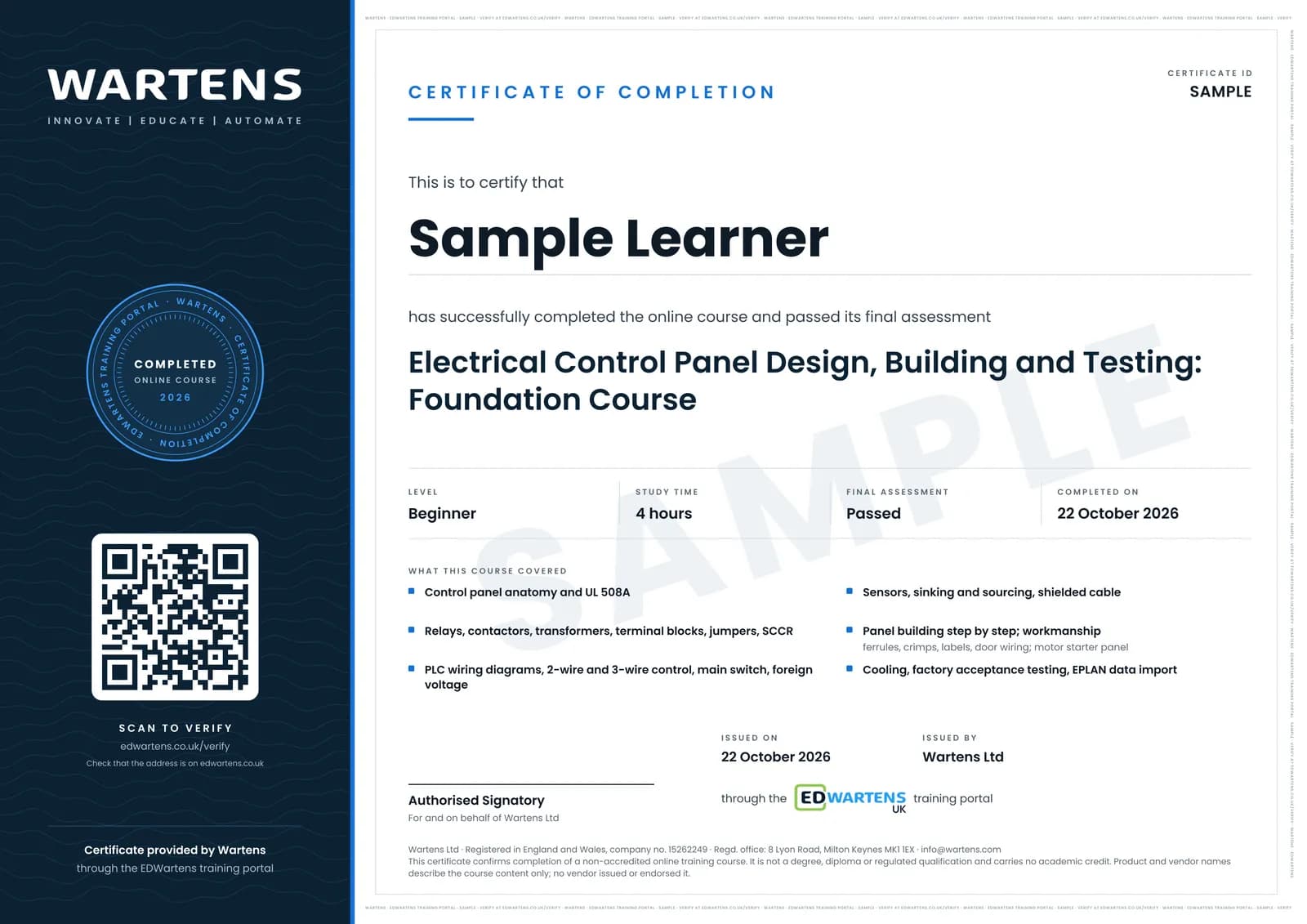
Sample certificate. Optional, issued when you pass the final exam.
- Level
- Beginner
- Modules
- 9
- Video
- 9 hours
- Price
- Free
Video time only: reading the notes, the quizzes and the final exam take extra time, at your own pace.
Outcome
What you will be able to do
Identify every part of a control panel, explain relays, contactors, transformers, terminal blocks and SCCR, read a PLC wiring diagram, wire 2-wire and 3-wire control, match sensors to inputs, build a panel from layout to test, apply workmanship rules, cool a panel and run a factory acceptance test.
- Name every part of a PLC control panel and what UL 508A covers
- Choose relays, contactors, overloads, transformers and terminal blocks, and state the SCCR
- Read a PLC wiring diagram and wire 2-wire and 3-wire control
- Match PNP and NPN sensors to sinking and sourcing inputs and shield cables
- Build a panel from tools and hole cutting to wiring and testing
- Apply workmanship rules: ferrules, crimps, labels, door wiring
- Size cooling and run a three-part factory acceptance test
Software
None.
Hardware
None required; a small enclosure and components make it hands-on.
Syllabus
9 modules
Each module has video lessons, notes and a short quiz. The final exam closes the course.
- What a Control Panel Is3 lessons
- Components6 lessons
- Diagrams and Control Circuits5 lessonsLab
- Sensors, Commons and Noise2 lessonsLab
- Building a Panel Step by Step6 lessons
- Workmanship8 lessons
- Motor Starter Panel Build1 lessonLab
- Cooling, FAT and Design Data5 lessonsLab
- Final Assessment1 lesson
How it works
How this course works
- Watch the video lessonsOne module at a time, at your own pace.
- Take the module quizA short quiz at the end of each module shows what stuck.
- Keep your notesWrite in My notes beside each module and ask the trainer if you are stuck.
- Practise in the labOptionalTry a task from the module in the EDWartens Lab, in your browser.
- Sit the final examPass it once you have been through the modules.
- Certificate, if you want oneOptionalPaid, and only after you pass. Anyone can check it online.
EDWartens Lab
Practise this in the EDWartens Lab
Wire a panel to a schedule in the Lab, test it and pass the factory acceptance test.
Works alongside Electrical Control Panel Design, Building and Testing. The Lab is control panel build practice in your browser: no install, no hardware, free to use. Sign in as a learner and it opens with your account.
Levels to try with this course
Electrical lab
Commission the transfer-pump starter
Open in the lab (opens in a new tab)Electrical lab
Commission the sorting station sensors
Open in the lab (opens in a new tab)Electrical lab
Commission the star-delta fan starter
Open in the lab (opens in a new tab)Electrical lab
Fault-find the outfeed conveyor starter
Open in the lab (opens in a new tab)
Optional. Skip it whenever you like: it never blocks your progress or your certificate.
Why practise in a lab
Technical work is judged on what you can do: wiring, commissioning, finding a fault. Doing a task yourself teaches more than watching it a second time, and a lab lets you try it safely before you meet real equipment. It does not replace working on real hardware.
- Practise safely, so a mistake costs nothing.
- The lab checks your work like a site test, so you know when it is right.
- Free, in your browser, with nothing to install.
Certificate
An optional certificate when you pass
Learning is free. Pass the final exam and you can have a certificate for £19, including VAT, with a number employers can check online. It records that you completed a free online course; it is not a regulated qualification or a CPD certificate.
- Your name, the course, its study time and your final exam score
- A unique certificate number and a QR code to its verification page
- Issued by Wartens Ltd; add it to your LinkedIn profile in one click
- Pay now or after you pass: it is issued the moment you pass the final
Credits
Who made the lessons
The video lessons belong to their creators. EDWartens wrote the study plan, notes, quizzes and the final exam.
- RealPars
the Electrical Control Panel Basics series
- Tim Wilborne
the Control Panel Building series
Jobs
Jobs this course can lead to
The skills in this course are used in electrical design and control panel work, for example as a control panel builder, an electrical technician and an electrical design engineer. No course can promise a job, and employers also look for experience, so read what live adverts ask for.
Pay: Electrical engineers (SOC 2123) had a median of £63,136 a year, full-time, in April 2026. Source: ONS, Annual Survey of Hours and Earnings 2026 (provisional). Checked 28 Oct 2026.
Questions
About this course
Last reviewed 28 October 2026.
Is UL 508A used in the UK?
Do I need to build a panel to take the course?
Can I wire a live panel after this course?
What does the Electrical Control Panel Design, Building and Testing course cover?
Where does Electrical Control Panel Design, Building and Testing start and where does it end?
How long is Electrical Control Panel Design, Building and Testing?
Can I practise Electrical Control Panel Design, Building and Testing in the browser?
What is UL 508A?
What is SCCR on a control panel, and does every panel need one?
Is this only for UL 508A (US) panels?
Do I need tools?
Is this safe to practise at home?
Is the course really free?
What certificate do I get, and is it a UL or vendor qualification?
Who made the video lessons?
How long does the course take?
PLC foundations
Take it with

Want a live class and career support?
The Professional Module is five live days of Siemens PLC, HMI and SCADA with an instructor, then career sessions with our engineers and a CPD certificate.