

Free course · Electrical
Wiring Regulations in Practice: BS 7671 and IEC 60364
The UK wiring regulations an electrical designer, inspector or site engineer works to every day, BS 7671:2018+A4:2026, taught with the IEC 60364 method behind it: the structure of the standard, earthing arrangements, automatic disconnection and Zs, RCD types, overcurrent protection and selectivity, cable sizing with correction factors, voltage drop and the CPC check, AFDDs and SPDs, bathrooms, PV, EV charging and batteries, inspection and testing, and certificates and condition reports.
Free to learn. Verifiable certificate £19 when you pass the final exam (optional, VAT included).
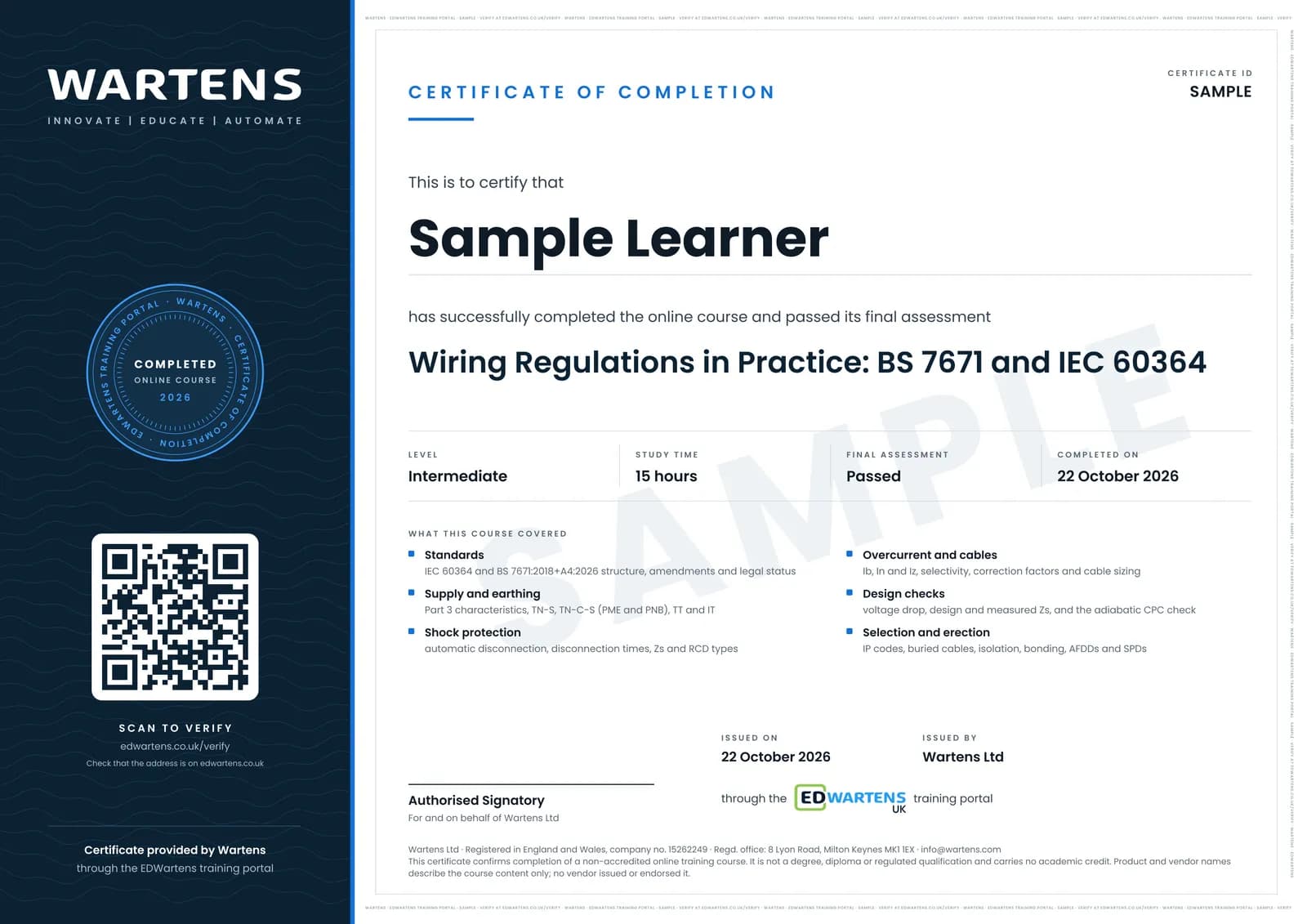
Sample certificate. Optional, issued when you pass the final exam.
- Level
- Intermediate
- Modules
- 14
- Video
- 25 hours
- Price
- Free
Outcome
What you will be able to do
Find the regulation that answers a design or testing question; identify the earthing arrangement and record the supply characteristics; check automatic disconnection with Zs and choose RCD types; select protective devices with Ib <= In <= Iz and check breaking capacity; size cables with correction factors for hot climates and grouping; check voltage drop, Zs and the CPC; apply the rules for wiring systems, isolation, bonding, AFDDs, SPDs and special locations; carry out and record initial verification; code a condition report; and design a three-phase sub-main end to end.
- Find the Part and regulation of BS 7671 or IEC 60364 that answers a design, installation or testing question
- Identify TN-S, TN-C-S (PME and PNB), TT and IT supplies and record Ze, fault current and maximum demand
- Check automatic disconnection with Zs and choose the right RCD type and rating for each circuit
- Coordinate devices and cables with Ib, In and Iz, check breaking capacity and selectivity
- Size cables with ambient, grouping and insulation correction factors
- Prove voltage drop, design Zs and the protective conductor with the adiabatic equation
- Apply the rules for bathrooms, solar PV, EV charging, AFDDs, SPDs and the new A4 chapters on batteries and PoE
- Carry out and record initial verification, complete an EIC and code an EICR with C1, C2, C3 and FI
Software
A spreadsheet (LibreOffice Calc is free) for the Zs, cable sizing and voltage drop sheets you build in the modules. A copy of BS 7671 or IEC 60364 is not needed to learn: the notes paraphrase the rules and give the formulas, but real design and certification work must use the edition your project or authority names.
Hardware
None. Test instruments are shown in the videos; you do not need one.
Syllabus
14 modules
Each module has video lessons, notes and a short quiz. The final exam closes the course.
- How wiring regulations work: IEC 60364, BS 7671 and Amendment 42 lessons
- Fundamental principles, supply characteristics and earthing arrangements5 lessons
- Protection against electric shock: ADS, disconnection times and Zs3 lessons
- RCDs: additional protection, RCD types and leakage3 lessons
- Overcurrent protection, fault current and selectivity2 lessons
- Cable sizing: current-carrying capacity and correction factors3 lessonsLab
- Voltage drop, the Zs design check and the CPC thermal check4 lessonsLab
- Selection and erection: wiring systems, isolation, switching and bonding4 lessons
- Fire and surge: thermal effects, AFDDs and SPDs4 lessons
- Special locations and new technology: bathrooms, PV, EV charging, batteries and PoE5 lessonsLab
- Inspection and testing: initial verification step by step6 lessons
- Certificates and condition reports: EIC, MEIWC and EICR coding4 lessons
- IEC 60364 around the world, Gulf utility rules and a sub-main designed end to end3 lessons
- Final assessment1 lesson
How it works
How this course works
- Watch the video lessonsOne module at a time, at your own pace.
- Take the module quizA short quiz at the end of each module shows what stuck.
- Keep your notesWrite in My notes beside each module and ask the trainer if you are stuck.
- Practise in the labOptionalTry a task from the module in the EDWartens Lab, in your browser.
- Sit the final examPass it once you have been through the modules.
- Certificate, if you want oneOptionalPaid, and only after you pass. Anyone can check it online.
EDWartens Lab
Practise this in the EDWartens Lab
Size a cable with correction factors, check the voltage drop and fault-find an EV charger, the checks a wiring design and an inspection rely on.
Works alongside Wiring Regulations in Practice: BS 7671 and IEC 60364. The Lab is substation and mcc practice in your browser: no install, no hardware, free to use. Sign in as a learner and it opens with your account.
Levels to try with this course
MCC-03 · Substation and MCC lab
Size a motor circuit
Open in the lab (opens in a new tab)SEV-07 · Solar and EV lab
EV charger fault: a car will not charge
Open in the lab (opens in a new tab)
Optional. Skip it whenever you like: it never blocks your progress or your certificate.
Why practise in a lab
Technical work is judged on what you can do: wiring, commissioning, finding a fault. Doing a task yourself teaches more than watching it a second time, and a lab lets you try it safely before you meet real equipment. It does not replace working on real hardware.
- Practise safely, so a mistake costs nothing.
- The lab checks your work like a site test, so you know when it is right.
- Free, in your browser, with nothing to install.
Certificate
An optional certificate when you pass
Learning is free. Pass the final exam and you can have a certificate for £19, including VAT, with a number employers can check online. It records that you completed a free online course; it is not a regulated qualification or a CPD certificate.
- Your name, the course, its study time and your final exam score
- A unique certificate number and a QR code to its verification page
- Issued by Wartens Ltd; add it to your LinkedIn profile in one click
- Pay now or after you pass: it is issued the moment you pass the final
Credits
Who made the lessons
The video lessons belong to their creators. EDWartens wrote the study plan, notes, quizzes and the final exam.
- SparkyNinja
the 18th Edition Training Series episodes on the introduction, Part 1, Part 3, Chapters 41, 42, 43 and 46, Sections 521 and 522 and Part 6, and the lessons on Type AC RCDs, DC leakage and AFDDs
- GSH Electrical
the lessons on earthing arrangements, maximum demand, the earth fault loop and its temperature factor, 80 percent Zs values, gas pipe bonding, premature collapse, AFDDs, fitting an SPD, bathroom zones, bidirectional devices, dead and live testing, RCD testing, and completing EICs and Minor Works certificates
- John Ward (jwflame)
calculating maximum earth fault loop impedance and the Section 722 EV charging earthing arrangements
- eFIXX
the complete guide to RCDs and the walk-through of what is inside Amendment 4
- LEARN ELECTRICS
PNB and PME earthing under Amendment 4, selectivity and coordination, the voltage drop masterclass, and EICR condition and observation codes
- NICEIC
the summary of the key changes in BS 7671 Amendment 4
- Sparky Help
the guide to cable sizing calculations and the adiabatic check of the protective conductor
- Broughton's Electrical Group Ltd
the introduction to cable sizing calculations to BS 7671
- chriskitcher
the worked cable calculation
- Modecsoft Ltd
the webinar on solar PV design to BS 7671 Section 712
- ETAP Software
low-voltage cable capacity, sizing and protection against electric shock to IEC standards
- Electrical Engineers Academy
circuit breaker and cable sizing calculations as practised under the DEWA regulations
- Electrical Stuff
the differences between the Abu Dhabi and DEWA regulations
Questions
About this course
Which edition does it cover, and is Amendment 3 included?
What is this wiring regulations course?
Who is the BS 7671 and IEC 60364 course for?
Is the course free to learn?
Does the course cover BS 7671 Amendment 4?
Is this the City and Guilds 2382 18th Edition qualification?
How long does the course take?
What certificate do I get, and how is it verified?
Want a live class and career support?
The Professional Module is five live days of Siemens PLC, HMI and SCADA with an instructor, then a resume session and a CPD certificate.