
Free course · Electrical
Electrical Fundamentals for Technicians: Volts to Multimeter to Drawings
The electrical basics every technician needs, in the order you use them: charge, voltage, current and resistance; Ohm's and Kirchhoff's laws; AC and DC, single and three phase; power, energy and power factor; the multimeter and CAT ratings; cables, fuses, breakers, earthing and RCDs; IEC and NEMA symbols and schematics; relays, contactors and motors; safe isolation; and a fault-finding walkthrough.
Free to learn. Verifiable certificate £19 when you pass the final exam (optional, VAT included).
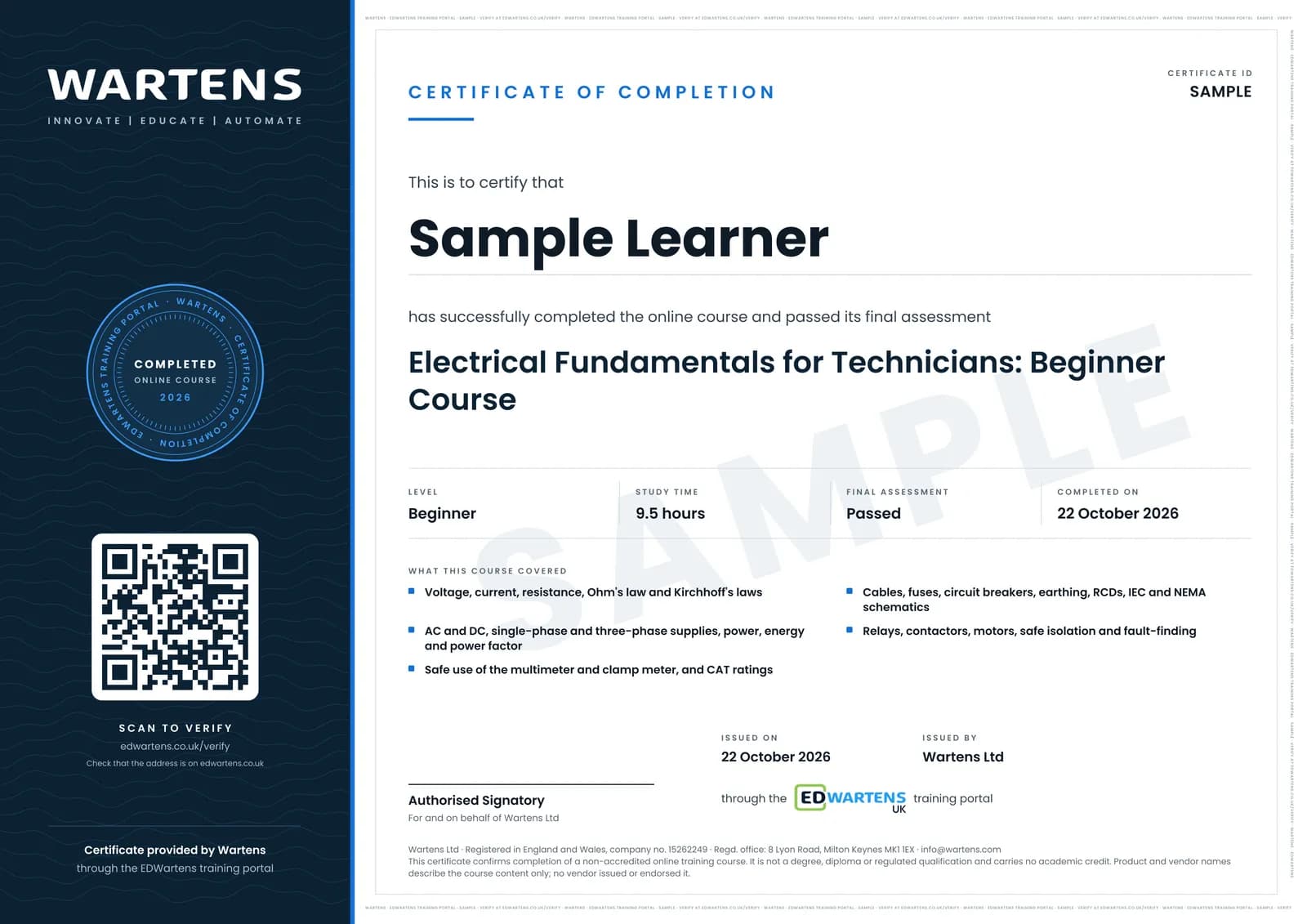
Sample certificate. Optional, issued when you pass the final exam.
- Level
- Beginner
- Modules
- 14
- Video
- 14 hours
- Price
- Free
Outcome
What you will be able to do
Explain charge, voltage, current and resistance; solve circuits with Ohm's and Kirchhoff's laws; tell AC from DC and work with RMS, single-phase and three-phase quantities; calculate power, energy and power factor; use a multimeter safely and choose one by its CAT rating; explain how cables, fuses, circuit breakers, earthing and RCDs protect people and equipment; read IEC and NEMA schematics; explain relays, contactors and induction motors; follow a safe isolation and prove-dead procedure; and find a fault logically with a drawing and a meter.
- Explain voltage, current, resistance and charge, and use Ohm's law
- Solve series and parallel circuits and check readings with Kirchhoff's laws
- Work with AC, RMS, single-phase and three-phase supplies
- Calculate power, energy in kWh and power factor
- Use a multimeter safely and choose one by its CAT rating
- Check cables, fuses and breakers, and explain earthing and RCDs
- Read IEC and NEMA symbols, schematics and a start-stop circuit
- Isolate and prove dead safely, and find faults with a drawing and a meter
Software
None. A calculator, and a spreadsheet if you like one for the energy and cable exercises.
Hardware
None required. A multimeter rated CAT III 600 V or better, a battery and a few resistors make the practice tasks more real; never use it on mains circuits until you have been trained and are supervised.
Syllabus
14 modules
Each module has video lessons, notes and a short quiz. The final exam closes the course.
- What electricity is: charge, voltage and current3 lessons
- Resistance, Ohm's law, series and parallel circuits4 lessons
- Kirchhoff's laws and voltage dividers3 lessons
- Power, energy and efficiency3 lessons
- AC and DC, and single-phase supplies4 lessons
- Three-phase power and power factor4 lessons
- The multimeter: volts, amps, ohms, continuity and CAT ratings4 lessons
- Cables, fuses and circuit breakers4 lessons
- Earthing, earth faults and RCDs5 lessons
- Symbols and reading schematics: IEC and NEMA3 lessonsLab
- Relays, contactors and motors in brief4 lessonsLab
- Safe isolation: lock out, tag and prove dead3 lessonsLab
- Fault-finding walkthrough2 lessonsLab
- Final Assessment1 lesson
How it works
How this course works
- Watch the video lessonsOne module at a time, at your own pace.
- Take the module quizA short quiz at the end of each module shows what stuck.
- Keep your notesWrite in My notes beside each module and ask the trainer if you are stuck.
- Practise in the labOptionalTry a task from the module in the EDWartens Lab, in your browser.
- Sit the final examPass it once you have been through the modules.
- Certificate, if you want oneOptionalPaid, and only after you pass. Anyone can check it online.
EDWartens Lab
Practise this in the EDWartens Lab
Read a single-line diagram, isolate a motor bucket the safe way and find a fault from your readings, the habits every technician needs.
Works alongside Electrical Fundamentals for Technicians: Volts to Multimeter to Drawings. The Lab is substation and mcc practice in your browser: no install, no hardware, free to use. Sign in as a learner and it opens with your account.
Levels to try with this course
MCC-01 · Substation and MCC lab
Read the single-line diagram
Open in the lab (opens in a new tab)MCC-02 · Substation and MCC lab
Safe isolation of an MCC bucket
Open in the lab (opens in a new tab)MCC-08 · Substation and MCC lab
Find a fault in the MCC
Open in the lab (opens in a new tab)PLC-01 · PLC lab
Motor start/stop with overload
Open in the lab (opens in a new tab)
Optional. Skip it whenever you like: it never blocks your progress or your certificate.
Why practise in a lab
Technical work is judged on what you can do: wiring, commissioning, finding a fault. Doing a task yourself teaches more than watching it a second time, and a lab lets you try it safely before you meet real equipment. It does not replace working on real hardware.
- Practise safely, so a mistake costs nothing.
- The lab checks your work like a site test, so you know when it is right.
- Free, in your browser, with nothing to install.
Certificate
An optional certificate when you pass
Learning is free. Pass the final exam and you can have a certificate for £19, including VAT, with a number employers can check online. It records that you completed a free online course; it is not a regulated qualification or a CPD certificate.
- Your name, the course, its study time and your final exam score
- A unique certificate number and a QR code to its verification page
- Issued by Wartens Ltd; add it to your LinkedIn profile in one click
- Pay now or after you pass: it is issued the moment you pass the final
Credits
Who made the lessons
The video lessons belong to their creators. EDWartens wrote the study plan, notes, quizzes and the final exam.
- The Engineering Mindset
the core lessons: how electricity works, voltage, current, Ohm's law, series and parallel circuits, resistors, AC and DC, RMS, single-phase and split-phase supplies, three-phase electricity and its calculations, power factor, the kilowatt hour, the multimeter and the clamp meter, fuses and current, why circuit breakers do not protect people, the ground wire and ground faults, relays and induction motors
- Chris Guyatt
reading electrical drawings on a real control panel, how a relay appears in a schematic, fault-finding control panels, and why beginners should master schematics first
- RealPars
the lessons on circuit breakers, contactors and industrial electrical troubleshooting
- ElectroBOOM
the lesson on the lumped model and Kirchhoff's circuit laws
- The Organic Chemistry Tutor
worked problems on Kirchhoff's current law, and on electric power and the cost of electricity in kWh
- ALL ABOUT ELECTRONICS
the lesson on Kirchhoff's voltage law
- Techquickie
the short explainer on volts, amps and watts
- Fluke Corporation
the short lesson on what CAT ratings are and why they matter
- Electrician U
the lesson on what multimeter CAT ratings mean
- Craig Michaud- Electrical Instructor
the lesson on voltage drop calculations
- Gaurav J - TheElectricalGuy
the guide to earthing systems: TT, TN-S, TN-C, TN-C-S and IT
- eFIXX
the lesson on what a residual current device is and how it works
- The Maintenance Factory
the lesson on basic electrical symbols
- betechnical.ca
the comparison of NEMA and IEC schematic symbols and drawings
- Safelyio
the electrical lockout/tagout procedure lesson
- Martindale Electric
the step-by-step safe isolation procedure with a voltage indicator and proving unit
- GSH Electrical
the demonstration of safe isolation of a single-phase consumer unit
Questions
About this course
Who is this course for?
Is this an electrician's licence or a recognised electrical qualification?
Does it follow British practice?
Do I need a multimeter or any equipment?
Is the course really free?
What certificate do I get?
How long does the course take?
What is the project?
What should I take next?
Want a live class and career support?
The Professional Module is five live days of Siemens PLC, HMI and SCADA with an instructor, then a resume session and a CPD certificate.