
Free course · Electrical
ETAP Power System Analysis: Load Flow, Short Circuit, Protection, Arc Flash and Stability
Free ETAP course for electrical engineers: load flow, short circuit, protection and arc flash studies. Learning is free; the certificate is optional and paid.
Free to learn. Verifiable certificate £19 when you pass the final exam (optional, VAT included).
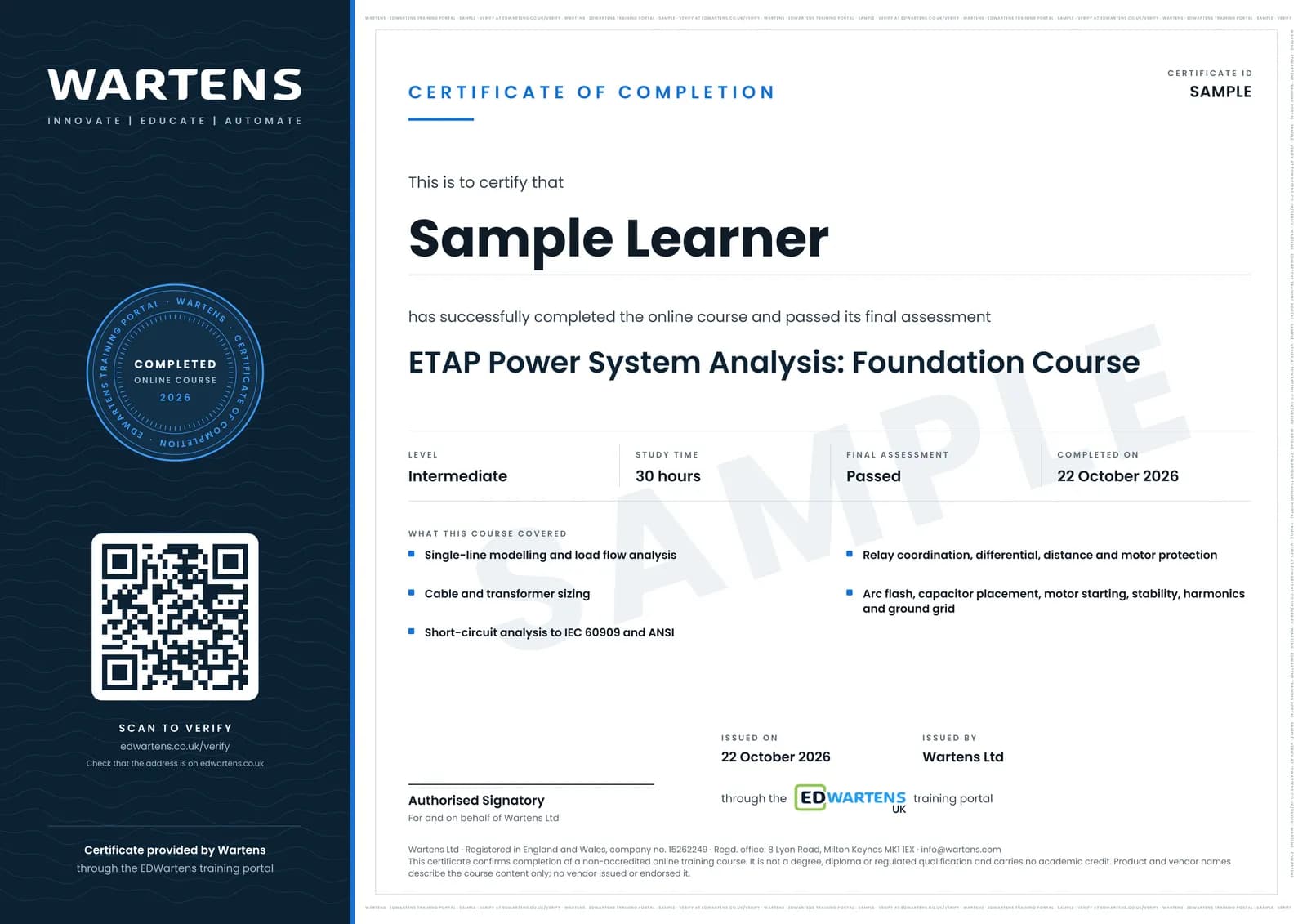
Sample certificate. Optional, issued when you pass the final exam.
- Level
- Intermediate
- Modules
- 15
- Video
- 37 hours
- Price
- Free
Outcome
What you will be able to do
Build a single-line diagram in ETAP with correctly modelled sources, transformers, cables, motors and loads, run and interpret load flow, short-circuit, protection coordination, arc flash, motor starting, transient stability, harmonic and ground-grid studies, size cables, transformers, capacitor banks and breakers from the results, and produce the reports a consultant or utility expects.
- Model a network in ETAP with nameplate data and run load flow
- Size cables and transformers and use tap changers
- Run IEC 60909 and ANSI short circuit and select breakers by device duty
- Set and coordinate overcurrent, differential, distance and motor protection in Star view
- Run arc flash, capacitor placement, motor starting, stability and harmonic studies
- Design a substation earthing grid to IEEE 80
Software
ETAP (demo, student or licensed release; any recent version)
Hardware
None required.
Syllabus
15 modules
Each module has video lessons, notes and a short quiz. The final exam closes the course.
- ETAP, the Studies and the Interface5 lessons
- Single-Line Diagram and Component Modelling7 lessonsLab
- The PowerRibbon Interface, Shortcuts and Auto-Build5 lessons
- Load Flow Analysis16 lessons
- Cable Sizing, Transformer Sizing and Tap Changers11 lessons
- Short-Circuit Analysis (IEC 60909 and ANSI)17 lessonsLab
- Relay Setting and Overcurrent Coordination20 lessonsLab
- Differential, Distance, Busbar and Motor Protection12 lessons
- Arc Flash Analysis11 lessons
- Capacitor Banks and Power Factor Improvement5 lessonsLab
- Motor Modelling and Motor Starting17 lessons
- Transient Stability and Motor Re-acceleration19 lessons
- Harmonic Analysis and Filters9 lessons
- Earthing and Ground Grid Design6 lessons
- Final Assessment1 lesson
How it works
How this course works
- Watch the video lessonsOne module at a time, at your own pace.
- Take the module quizA short quiz at the end of each module shows what stuck.
- Keep your notesWrite in My notes beside each module and ask the trainer if you are stuck.
- Practise in the labOptionalTry a task from the module in the EDWartens Lab, in your browser.
- Sit the final examPass it once you have been through the modules.
- Certificate, if you want oneOptionalPaid, and only after you pass. Anyone can check it online.
EDWartens Lab
Practise this in the EDWartens Lab
Do by hand what ETAP automates: read a single-line diagram, find a fault level, grade a relay and correct power factor.
Works alongside ETAP Power System Analysis: Load Flow, Short Circuit, Protection, Arc Flash and Stability. The Lab is substation and mcc practice in your browser: no install, no hardware, free to use. Sign in as a learner and it opens with your account.
Levels to try with this course
MCC-01 · Substation and MCC lab
Read the single-line diagram
Open in the lab (opens in a new tab)MCC-06 · Substation and MCC lab
Fault level and breaker check
Open in the lab (opens in a new tab)MCC-05 · Substation and MCC lab
Grade the incomer relay
Open in the lab (opens in a new tab)MCC-07 · Substation and MCC lab
Correct the power factor
Open in the lab (opens in a new tab)
Optional. Skip it whenever you like: it never blocks your progress or your certificate.
Why practise in a lab
Technical work is judged on what you can do: wiring, commissioning, finding a fault. Doing a task yourself teaches more than watching it a second time, and a lab lets you try it safely before you meet real equipment. It does not replace working on real hardware.
- Practise safely, so a mistake costs nothing.
- The lab checks your work like a site test, so you know when it is right.
- Free, in your browser, with nothing to install.
Certificate
An optional certificate when you pass
Learning is free. Pass the final exam and you can have a certificate for £19, including VAT, with a number employers can check online. It records that you completed a free online course; it is not a regulated qualification or a CPD certificate.
- Your name, the course, its study time and your final exam score
- A unique certificate number and a QR code to its verification page
- Issued by Wartens Ltd; add it to your LinkedIn profile in one click
- Pay now or after you pass: it is issued the moment you pass the final
Credits
Who made the lessons
The video lessons belong to their creators. EDWartens wrote the study plan, notes, quizzes and the final exam.
- Electrical Design Engineering
the free ETAP course, lectures 1 to 71
- Muwaffaq Usman
the ETAP zero-to-hero course
- Smart Educare
the ETAP study tutorials with manual calculations
- Power System Experts
the ETAP lecture series on modelling and short circuit
- ETAP Software
the official ETAP basics and productivity videos
Questions
About this course
Is ETAP used in industry?
Which standard is used for arc flash calculations?
What is IEC 60909?
Do I need an ETAP licence?
Is this a power-systems theory course?
Which industries use these studies?
Is the course really free?
What certificate do I get, and is it a vendor qualification?
Who made the video lessons?
How long does the course take?
Power systems and electrical design
Take it with
Want a live class and career support?
The Professional Module is five live days of Siemens PLC, HMI and SCADA with an instructor, then a resume session and a CPD certificate.