Free course · Power systems
Data Centre Electrical and Critical Power
This free course teaches the electrical side of data centres: the power path from grid to rack, tiers and redundancy, UPS and generator sizing, rack current, kVA and kW calculations, load flow, short-circuit and arc flash studies, PUE, and what AI GPU racks change. It suits UK electrical engineers and technicians, and helps with data centre electrical engineer, critical power and design roles on the sector's large London-area campuses.
Data Centre Electrical and Critical Power is a free online intermediate Power systems course with 9 modules, about 9 hours of video lessons. Learning is free; an optional verifiable certificate costs £19 including VAT when you pass the final exam. Last updated 28 October 2026.
Free to learn. Verifiable certificate £19 when you pass the final exam (optional, VAT included).
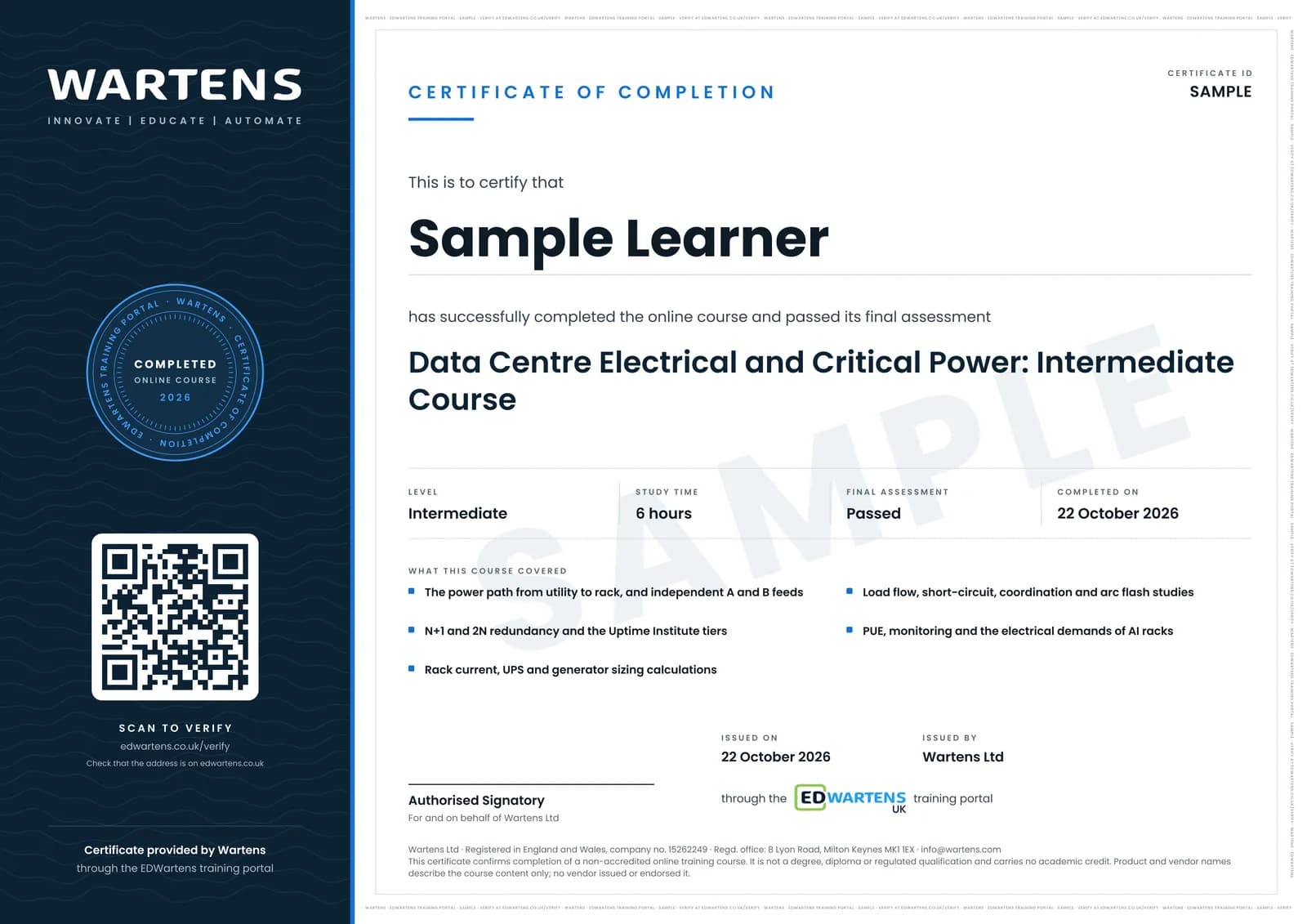
Sample certificate. Optional, issued when you pass the final exam.
- Level
- Intermediate
- Modules
- 9
- Video
- 9 hours
- Price
- Free
Video time only: reading the notes, the quizzes and the final exam take extra time, at your own pace.
Outcome
What you will be able to do
Trace the power path from utility to rack and explain each piece of equipment; compare N, N+1 and 2N redundancy and the Uptime Institute tiers; size UPS and cable current from rack loads; explain the load flow, short-circuit, coordination and arc flash studies a data centre needs; calculate PUE and find where power is lost; describe electrical monitoring and DCIM; and explain what high-density AI racks change in the electrical design.
- Trace data centre power from the utility to the rack
- Compare N, N+1 and 2N redundancy and the Uptime Institute tiers
- Calculate rack current, kVA and kW for single and three-phase feeds
- Size UPS and generators for a 2N design
- Explain load flow, short-circuit, coordination and arc flash studies
- Calculate PUE and reduce electrical losses
- Find hidden single points of failure and read arc flash labels safely
- Explain what AI GPU racks change in electrical design
Software
None required. ETAP is shown in the lessons; a spreadsheet is enough for the calculations.
Hardware
None.
Syllabus
9 modules
Each module has video lessons, notes and a short quiz. The final exam closes the course.
- How a data centre works, from grid to rack2 lessonsLab
- Tiers, standards and redundancy3 lessonsLab
- Power fundamentals and calculations3 lessonsLab
- UPS, generators and the power train4 lessonsLab
- The data centre electrical power system in depth1 lesson
- Power studies, arc flash and the digital twin4 lessons
- Efficiency and PUE2 lessonsLab
- Monitoring, BMS and the AI data centre3 lessons
- Final Assessment1 lesson
How it works
How this course works
- Watch the video lessonsOne module at a time, at your own pace.
- Take the module quizA short quiz at the end of each module shows what stuck.
- Keep your notesWrite in My notes beside each module and ask the trainer if you are stuck.
- Practise in the labOptionalTry a task from the module in the EDWartens Lab, in your browser.
- Sit the final examPass it once you have been through the modules.
- Certificate, if you want oneOptionalPaid, and only after you pass. Anyone can check it online.
EDWartens Lab
Practise this in the EDWartens Lab
Lose a power feed, find a hot spot and read cooling and power loads against limits in the Lab's data-centre simulator.
Works alongside Data Centre Electrical and Critical Power. The Lab is data-centre power and cooling practice in your browser: no install, no hardware, free to use. Sign in as a learner and it opens with your account.
Levels to try with this course
DC-01 · AI Data Centre lab
Safety walk and hall tour
Open in the lab (opens in a new tab)DC-03 · AI Data Centre lab
Rack power budget
Open in the lab (opens in a new tab)DC-08 · AI Data Centre lab
Power event drill
Open in the lab (opens in a new tab)DC-05 · AI Data Centre lab
PUE from a month of meters
Open in the lab (opens in a new tab)
Optional. Skip it whenever you like: it never blocks your progress or your certificate.
Why practise in a lab
Technical work is judged on what you can do: wiring, commissioning, finding a fault. Doing a task yourself teaches more than watching it a second time, and a lab lets you try it safely before you meet real equipment. It does not replace working on real hardware.
- Practise safely, so a mistake costs nothing.
- The lab checks your work like a site test, so you know when it is right.
- Free, in your browser, with nothing to install.
Certificate
An optional certificate when you pass
Learning is free. Pass the final exam and you can have a certificate for £19, including VAT, with a number employers can check online. It records that you completed a free online course; it is not a regulated qualification or a CPD certificate.
- Your name, the course, its study time and your final exam score
- A unique certificate number and a QR code to its verification page
- Issued by Wartens Ltd; add it to your LinkedIn profile in one click
- Pay now or after you pass: it is issued the moment you pass the final
Credits
Who made the lessons
The video lessons belong to their creators. EDWartens wrote the study plan, notes, quizzes and the final exam.
- MEP Academy
short lessons on how data centres work, power flow, redundancy, electrical systems, UPS and AI data centres
- ETAP Software
the digital twin, DC arc flash, critical power and eSCADA lessons for data centres
- GogoTraining
the Fundamentals of Data Center Power lessons on power, calculations and circuit breakers
- TEQNYAT
the data centre design and operations course episodes on standards and certifications
- Bryce Anderson
the lesson BMS Data Centre Design
- Engineering and Donuts
the lesson Part 2: Power Distribution for Data Centers and UPS
- EngineersIreland
the lesson The Electrical Power System
- IEEE Young Professionals
the lesson Energy Efficient Data Center Power Design
- MSP TV
the lesson The Secret Formula for Data Centre Electrical Power Distribution
- RagingWire Data Centers
the lesson RagingWire Dallas TX1 Data Center Virtual Tour
Jobs
Jobs this course can lead to
The skills in this course are used in power, renewable energy and data centre work, for example as a data centre electrical engineer, a critical power engineer and an electrical design engineer. No course can promise a job, and employers also look for experience, so read what live adverts ask for.
Pay: Electrical engineers (SOC 2123) had a median of £63,136 a year, full-time, in April 2026. Source: ONS, Annual Survey of Hours and Earnings 2026 (provisional). Checked 28 Oct 2026.
Questions
About this course
Last reviewed 28 October 2026.
Do I need electrical qualifications to take it?
Does it cover UK standards?
Is this enough to get a job as a data centre electrical engineer?
What does the Data Centre Electrical and Critical Power course cover?
Where does Data Centre Electrical and Critical Power start and where does it end?
How long is Data Centre Electrical and Critical Power?
Can I practise Data Centre Electrical and Critical Power in the browser?
Who is this course for?
Why data centres?
How long does the course take?
What is the project?
Do I need ETAP?
Does this lead to an Uptime Institute or CDCP certification?
Is the course really free?
What certificate do I get?
Want a live class and career support?
The Professional Module is five live days of Siemens PLC, HMI and SCADA with an instructor, then career sessions with our engineers and a CPD certificate.