
How we vet engineers
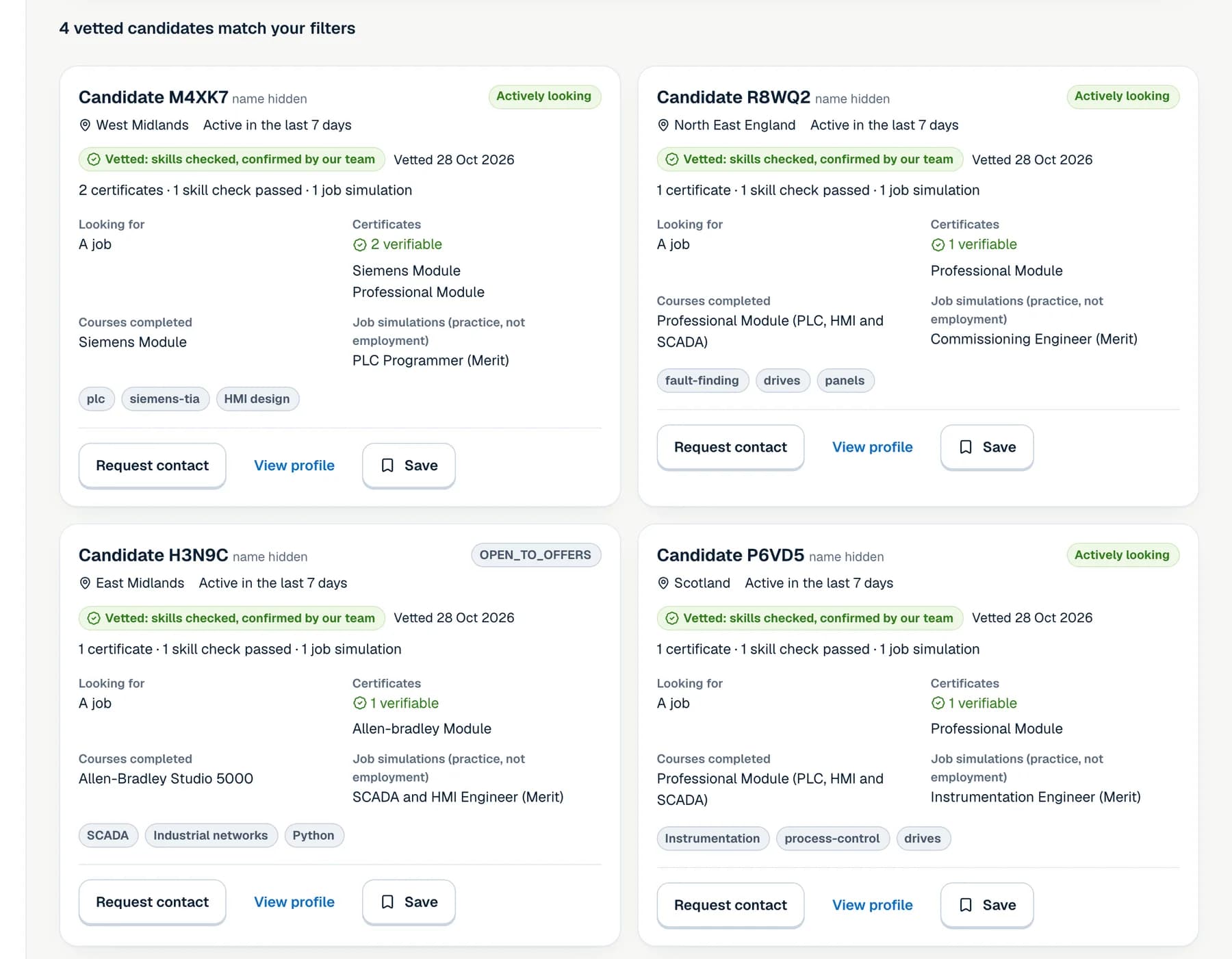
Vetted means EDWartens staff checked evidence of your engineering skills: certificates we issued, assessments and simulations you passed, and a skill check. It is not an identity, reference, background, right-to-work or DBS check, and it is not a job guarantee.
Last updated 28 October 2026. The full standard is below.

Evidence, a skill check, then a person decides
- 01EvidenceCertificates we issued, assessments and simulations you passed, and projects that passed marking.
- 02A skill check20 questions in 25 minutes and one written scenario, which AI marks first.
- 03Staff reviewA named member of our staff reviews the evidence and decides, normally within 5 working days. The AI never decides.
- 04VettedOnly then can you appear in the talent pool employers search, and only if you choose.

What Vetted does not check
Employers must do these themselves. Vetted is about skills evidence, and nothing else.
- An identity check
- A reference check
- A criminal record (DBS) check
- A right-to-work check
- A guarantee of a job, an interview or a hire
The details of each stage are in the standard below. Employers: how to use the talent search.
In short
- Vetted is about skills evidence. It is free and never depends on buying a course.
- You need evidence, a passed skill check and a staff review.
- AI marks one written answer and writes a summary for staff. A person decides.
- If you do not pass, you can retake, ask for a person to review, and appeal.
- Employers must check identity, references and right to work themselves.
1. What Vetted means
Vetted means EDWartens staff checked evidence of your engineering skills. The evidence is listed below. We give a Vetted badge only when that evidence, a passed skill check and a staff review all agree.
We use the word "Vetted" only to mean this. If we ever change the standard, this page changes first and the date at the top shows when.
2. The seven stages
Your profile shows where you are on a ladder of seven stages. Each one has a plain test.
- Joined. Your account is set up.
- Profile ready. You have added a CV, at least one target role, your region and your own statement about permission to work.
- In training. You have started a course.
- Certified. You have earned a certificate, or completed a course.
- Skills checked. You have passed a skill check, a job simulation, or a course final assessment.
- Vetted. A member of our staff has reviewed your evidence and confirmed it.
- Hired. You have told us you started a new job.
Only the sixth stage, Vetted, lets you appear in the employer talent pool. Applying to jobs never needs it.
3. What counts as evidence
We count evidence we can check ourselves:
- Certificates EDWartens issued to you, which anyone can check on our certificate checker.
- Course final assessments you passed, and practical projects that passed marking. AI makes a first-pass mark on a project and our staff can review and change it.
- Job simulations you completed to the pass mark. A job simulation is practice, not employment.
- Skill checks you passed (section 4).
- Where you have used the EDWartens Lab, your lab results. These are optional and never required.
Skills you list yourself are shown as self-declared. They help employers read your profile, but they are not evidence and do not count towards Vetted.
For each skill we show a level: Foundation, Practitioner or Advanced. The level comes from the evidence behind it, using a fixed rule, not from opinion. A certificate is not a regulated qualification.
4. The skill check
There is one skill check for each family of work, such as PLC and automation, electrical or instrumentation.
- 20 multiple-choice questions, drawn at random from our approved question bank for that track and spread across easy and hard. You have 25 minutes. Our system marks them and shuffles the answer options.
- One written scenario, such as a fault to diagnose or a small design task, chosen at random from a short list for that track. AI marks it first, against the marking guide below, and gives a score out of 10 and feedback.
- Pass marks: 70% or more on the multiple-choice questions, and 6 out of 10 or more on the scenario. You need both.
- Retakes: one every 7 days for each track.
The marking guide for the scenario
The AI marks the engineering in your answer. It looks at whether you:
- identify the likely cause, or choose a sound design;
- put safety and isolation first where they matter;
- take the steps in a sensible order and say how you would check each one;
- state your assumptions and what you could not tell from the information given.
It does not mark spelling, grammar or style, and it is not told your name, nationality, age or anything else about you. It sees your answer and the scenario. Read more on AI transparency.
A pass gives you a public page at a verify code, showing your name, the track, the date and the words "skills checked". It shows no score unless you choose to show it.
5. Staff review
When you submit for vetting, a member of staff sees:
- your evidence list, with the dates and links;
- a short summary written by AI from that evidence only, in three to five neutral sentences, which staff can ignore;
- your profile and your CV.
The reviewer can do one of three things:
- Approve. You become Vetted.
- Ask for more evidence. We tell you what is missing.
- Reject, with a written reason. We email you the reason.
The reviewer is a named member of EDWartens staff who is able to disagree with the AI and with the marks, and to change them. We log who decided, on what evidence, on what date and against which version of this standard. We review a sample of decisions to check they are consistent.
We can remove a Vetted badge if we find the evidence was false, or if the standard changes and your evidence no longer meets it. We log the removal and tell you why. You can appeal it.
6. What Vetted does not check
Vetted is not any of the following. Employers must do these themselves:
- An identity check.
- A reference check.
- A criminal record (DBS) check.
- A right-to-work check. Employers must check right to work before anyone starts work. The Home Office guide and code of practice changed on 1 October 2026 (checked 28 October 2026).
- A check of qualifications from other bodies, or of employment history.
- A judgement of character, or of whether someone is a good fit for a particular employer.
Vetted is not a promise of a job, an interview or a hire, and employers make their own decisions.
7. How long it takes
We aim to review a submission within 5 working days. The skill check result is shown straight away. If we need more evidence we tell you what and the clock starts again when you send it.
8. If the result is not yet, and appeals
A "not yet" result is not a ban. It can stop you appearing in the employer talent pool, so we treat it as a decision that matters and give you these routes:
- Feedback on your answers, and the date you can retake.
- Ask for a human review. A member of staff looks at your answers and the AI's marking, hears anything you want to add, and can change the result. You can ask from the result page.
- Appeal a rejected review. You can appeal once, in writing, and a different member of staff looks at it where we can.
- Complain. Use our complaints procedure. You can also complain to the Information Commissioner's Office about how we used your data.
9. Adjustments
If you need extra time, assistive technology or another format for the skill check, tell us before you start at info@wartens.com. We will agree what to change with you. Asking for an adjustment never counts against you.
10. The record we keep
So that we can show a Vetted badge is deserved, we keep the evidence list we reviewed, the marks, the reviewer, the date and the version of this standard. Your skill-check answers are kept for 12 months after the result so you can ask for a review, then deleted or made anonymous. See the recruitment privacy notice for every retention period.
We review this standard at least once a year, and whenever we change how the skill check or the review works.
Common questions
Is there a UK job board that verifies engineers' skills?
On EDWartens UK, yes, in one specific sense: our team checks evidence of an engineer's skills (certificates we issued, assessments and simulations passed, a skill check) and then shows a Vetted badge, so an employer can read the evidence behind a profile. It is a skills-evidence check only. It is not an identity, reference, background or right-to-work check, and it does not guarantee a job. We cannot say what every other service does, so compare what each one checks.
Is Vetted a background check?
No. Vetted means we checked evidence of your skills. We do not check identity, references, criminal records, employment history or right to work. Employers do those checks themselves.
Do I have to be Vetted to apply for a job?
No. Anyone with an account can apply to jobs. Being Vetted only affects whether you can appear in the talent pool that employers search.
Does it cost anything?
No. The skill check, staff review and the Vetted badge are free, and we never charge jobseekers. Nothing depends on buying a course.
What if I do not pass the skill check?
You see feedback and the date you can retake it (once every 7 days for each track). You can also ask for a person to review the result.
Who decides?
A named member of EDWartens staff makes every Vetted decision. AI marks one written answer and writes a short summary for staff, but it never decides.
Related pages
- AI transparency: every AI feature and how to contest it
- Jobseeker terms
- Employer and recruiter terms
- Recruitment privacy notice
Wartens Ltd, trading as EDWartens UK. Version of 28 October 2026. Questions about this page: info@wartens.com. All legal pages.