
Free course · Electrical
Diesel Generators: AMF, ATS and Synchronising
Diesel generating sets from the engine and alternator to the panel: ISO 8528 ratings, excitation and the AVR, governors and droop, DSE, ComAp, DEIF and Woodward controller concepts, automatic mains failure sequences and timers, transfer switches and neutral switching, synchronising and check-sync, kW and kVAr load sharing, multi-set and mains paralleling, generator protection by ANSI number, sizing and derating, commissioning, maintenance and troubleshooting, ending in an AMF and two-set synchronising scheme.
Free to learn. Verifiable certificate £19 when you pass the final exam (optional, VAT included).
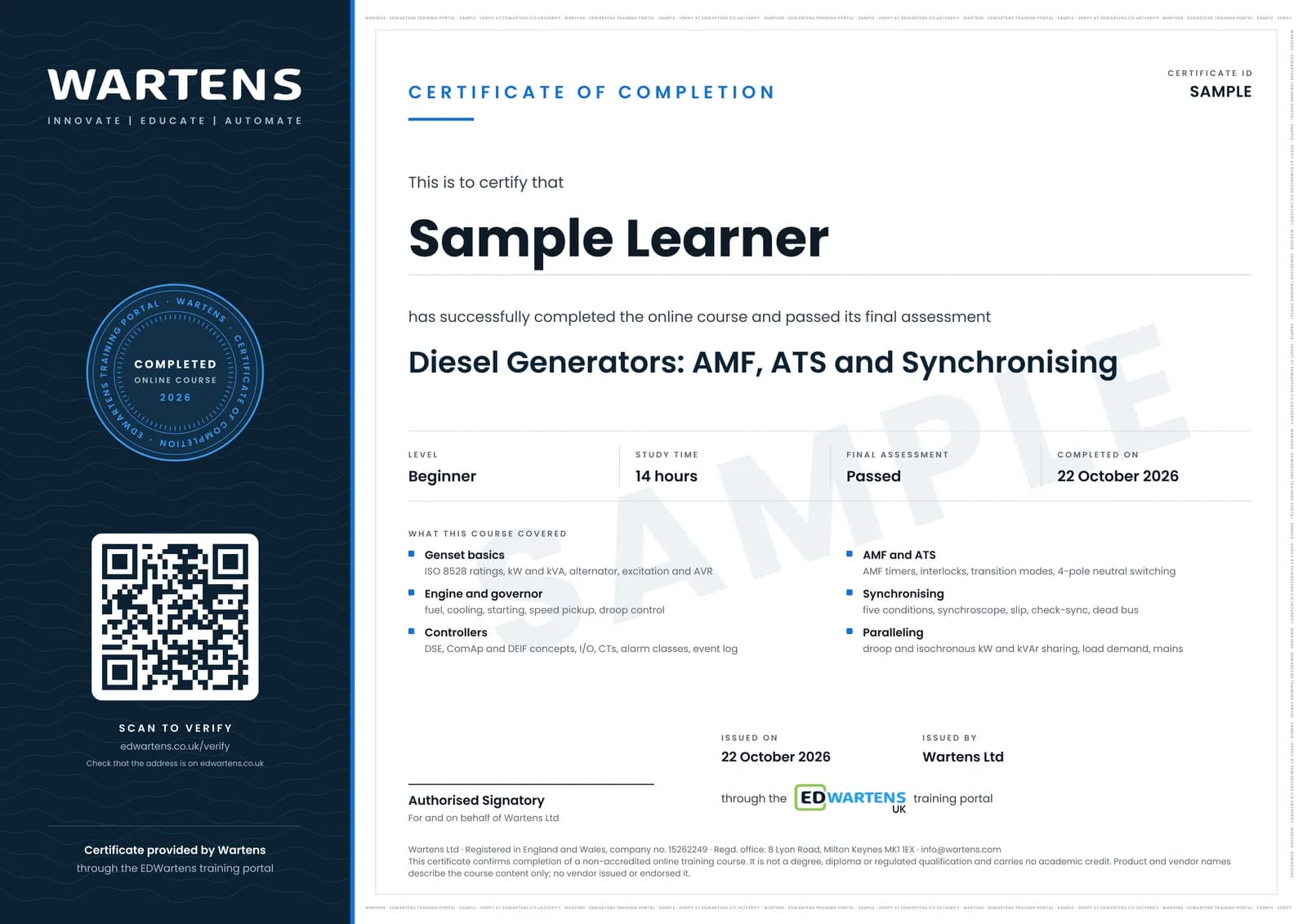
Sample certificate. Optional, issued when you pass the final exam.
- Level
- Beginner
- Modules
- 14
- Video
- 29 hours
- Price
- Free
Outcome
What you will be able to do
Rate and size a generating set for its duty; explain how the alternator, AVR, engine and governor hold voltage and frequency; configure the I/O and alarms of a genset controller; write and time an AMF sequence; choose an ATS type, transition and pole count; synchronise sets by hand or automatically and check the result; predict load sharing from droop settings; set up load demand and mains paralleling modes; explain each protection function; plan commissioning and maintenance; troubleshoot common faults; and design an AMF and synchronising scheme a commissioning engineer can test.
- Rate a generating set under ISO 8528-1 and check a load profile against the 70 percent average limit
- Explain brushless excitation, PMG and shunt AVR supplies, and estimate fault current from X''d
- Calculate governor droop, no-load speed and magnetic pickup frequency, and choose droop or isochronous control
- Configure a genset controller's I/O, CT ratio and alarm classes using DSE, ComAp, DEIF or Woodward concepts
- Write and time an AMF sequence and choose the ATS transition, pole count and rating
- Synchronise sets with a synchroscope or automatic synchroniser and set check-sync windows
- Predict kW and kVAr sharing, set load demand thresholds and run sets in parallel with the mains
- Set generator protection by ANSI number, size for motor starting, plan maintenance and troubleshoot faults
Software
A spreadsheet (LibreOffice Calc is free) for the sizing, droop and timer sheets. Optional: a free controller configuration tool from the controller maker (DSE Configuration Suite, ComAp InteliConfig or DEIF Utility Software) to open a sample configuration; the course does not need any controller hardware.
Hardware
None. Generating sets, panels and controllers are shown in the videos. Real work on a set or panel needs a competent person and the site's permit and isolation rules.
Syllabus
14 modules
Each module has video lessons, notes and a short quiz. The final exam closes the course.
- How a diesel generating set works and how it is rated4 lessons
- The alternator, excitation and the automatic voltage regulator5 lessons
- The diesel engine, its systems and the speed governor3 lessons
- Generator controllers: DSE, ComAp, DEIF and Woodward concepts9 lessons
- Automatic mains failure: sequence, timers and panel wiring2 lessonsLab
- Transfer switches: types, transitions, neutral switching and ratings8 lessons
- Synchronising generators: conditions, synchroscopes and check-sync3 lessons
- Load sharing: droop, isochronous control and kVAr sharing5 lessons
- Paralleling systems: multi-set plants, mains parallel and load demand5 lessons
- Generator protection, earthing and circulating currents4 lessonsLab
- Sizing, derating and installing a generating set4 lessons
- Commissioning, load testing and maintenance of gensets4 lessonsLab
- Troubleshooting and the capstone AMF and synchronising scheme2 lessonsLab
- Final assessment1 lesson
How it works
How this course works
- Watch the video lessonsOne module at a time, at your own pace.
- Take the module quizA short quiz at the end of each module shows what stuck.
- Keep your notesWrite in My notes beside each module and ask the trainer if you are stuck.
- Practise in the labOptionalTry a task from the module in the EDWartens Lab, in your browser.
- Sit the final examPass it once you have been through the modules.
- Certificate, if you want oneOptionalPaid, and only after you pass. Anyone can check it online.
EDWartens Lab
Practise this in the EDWartens Lab
Start, stop, reverse and protect a motor in the Lab's motor control simulator.
Works alongside Diesel Generators: AMF, ATS and Synchronising. The Lab is substation and mcc practice in your browser: no install, no hardware, free to use. Sign in as a learner and it opens with your account.
Levels to try with this course
MCC-01 · Substation and MCC lab
Read the single-line diagram
Open in the lab (opens in a new tab)MCC-05 · Substation and MCC lab
Grade the incomer relay
Open in the lab (opens in a new tab)DC-08 · AI Data Centre
Power event drill
Open in the lab (opens in a new tab)
Optional. Skip it whenever you like: it never blocks your progress or your certificate.
Why practise in a lab
Technical work is judged on what you can do: wiring, commissioning, finding a fault. Doing a task yourself teaches more than watching it a second time, and a lab lets you try it safely before you meet real equipment. It does not replace working on real hardware.
- Practise safely, so a mistake costs nothing.
- The lab checks your work like a site test, so you know when it is right.
- Free, in your browser, with nothing to install.
Certificate
An optional certificate when you pass
Learning is free. Pass the final exam and you can have a certificate for £19, including VAT, with a number employers can check online. It records that you completed a free online course; it is not a regulated qualification or a CPD certificate.
- Your name, the course, its study time and your final exam score
- A unique certificate number and a QR code to its verification page
- Issued by Wartens Ltd; add it to your LinkedIn profile in one click
- Pay now or after you pass: it is issued the moment you pass the final
Credits
Who made the lessons
The video lessons belong to their creators. EDWartens wrote the study plan, notes, quizzes and the final exam.
- saVRee
the animated explanation of a diesel generating set and its parts
- The Engineering Mindset
AC generator basics: how rotation and a magnetic field make three-phase voltage
- Cummins
the Integrated Power Systems series: power system overview, paralleling control, generator protection, load demand, transfer switch functions, transition modes, bypass switches and withstand and closing ratings
- Cummins Power Generation
ISO 8528 and EPA generator set ratings by duty class
- Jim Pytel
the full lectures on synchronous generators, loaded synchronous generators and generator synchronization
- Anscience
the animation of an alternator's exciter, PMG and AVR
- Gaurav J - TheElectricalGuy
how generators keep voltage stable through excitation control
- MarEngBase
the English lessons on the AVR (error-operated and practical arrangement), diesel and electronic governors, and load sharing with a simulator
- Mahindra Powerol
fuel system preventive maintenance on diesel generators
- Deep Sea Electronics Ltd
the official training videos on DSE Configuration Suite: reading, changing and writing a module's configuration
- ComAp
the official tutorials on starting with an InteliLite controller, configuring I/O and ECU communication on InteliGen and InteliSys, and reading history records
- Woodward, Inc.
getting started with the easYgen-3000XT controller and its toolkit
- DEIF - global supplier of energy control solutions
configuring an application on the AGC-4 controller
- United Tech Power Inc.
a walk-through of the DSE7320 MKII front panel on a working set
- Ignatius Variath
the AMF control system explanation and the panel tutorial on AMF and ATS schematics, protection and electro-mechanical interlocks
- Eaton
automatic transfer switch fundamentals and grounding and bonding of generator sources with transfer switches
- Electrician U
the difference between manual and automatic transfer switches and how they work
- ASCO Power Technologies
application considerations for closed transition transfer switches
- BTCInstrumentation
synchronizing AC generators with sync lamps
- Jubaili Bros
the webinars on the basics of synchronization, synchronization with the DSE8610, genset ratings, engine and alternator derating, and installation considerations
- RealPars
speed droop in power control
- HIMT
V. R. Venkatesan's lectures on the purpose of governor droop and on AVR droop and power factor
- benzblogs Vlogs
voltage and speed biasing with the DSE8610 and troubleshooting a set that fails to stop
- Consulting-Specifying Engineer
the webinar on specifying generator set paralleling controls
- Romero Engineering Company
reverse power protection basics and voltage-restrained versus voltage-controlled overcurrent protection
- Mirus International Inc
the webinar on preventing circulating current in parallel generator applications
- WellandTV
the overview of ISO 8528-5 performance classes
- MahindraPowerol IBService
generator preventive maintenance
- JOT POWER
preventive maintenance of a genset
- Woodstock Power Company
the step-by-step generator maintenance guide and the explanation of wet stacking and its prevention
Questions
About this course
What is this diesel generator course?
Who is the generator synchronising and AMF course for?
Does the course teach DSE, ComAp or DEIF controller programming?
Is the diesel generator course free to learn?
Which standards does the course cover?
How long does the course take?
Is it useful for generator jobs in the Gulf, Nigeria and Pakistan?
What certificate do I get, and how is it verified?
Want a live class and career support?
The Professional Module is five live days of Siemens PLC, HMI and SCADA with an instructor, then a resume session and a CPD certificate.