Free course · Electrical
Data Centre and MEP Testing and Commissioning (L1 to L5)
This free course teaches how a data centre and its critical MEP systems are proved before go-live: turning an OPR into acceptance criteria, commissioning levels L0 to L5, test scripts, FAT and SAT, electrical pre-functional tests, UPS, generator and ATS testing with load banks, heat load tests, liquid cooling, and an integrated systems test. It suits UK electrical and mechanical engineers, and helps with commissioning engineer and data centre technician roles.
Data Centre and MEP Testing and Commissioning (L1 to L5) is a free online intermediate Electrical course with 14 modules, about 18 hours of video lessons. Learning is free; an optional verifiable certificate costs £19 including VAT when you pass the final exam. Last updated 28 October 2026.
Free to learn. Verifiable certificate £19 when you pass the final exam (optional, VAT included).
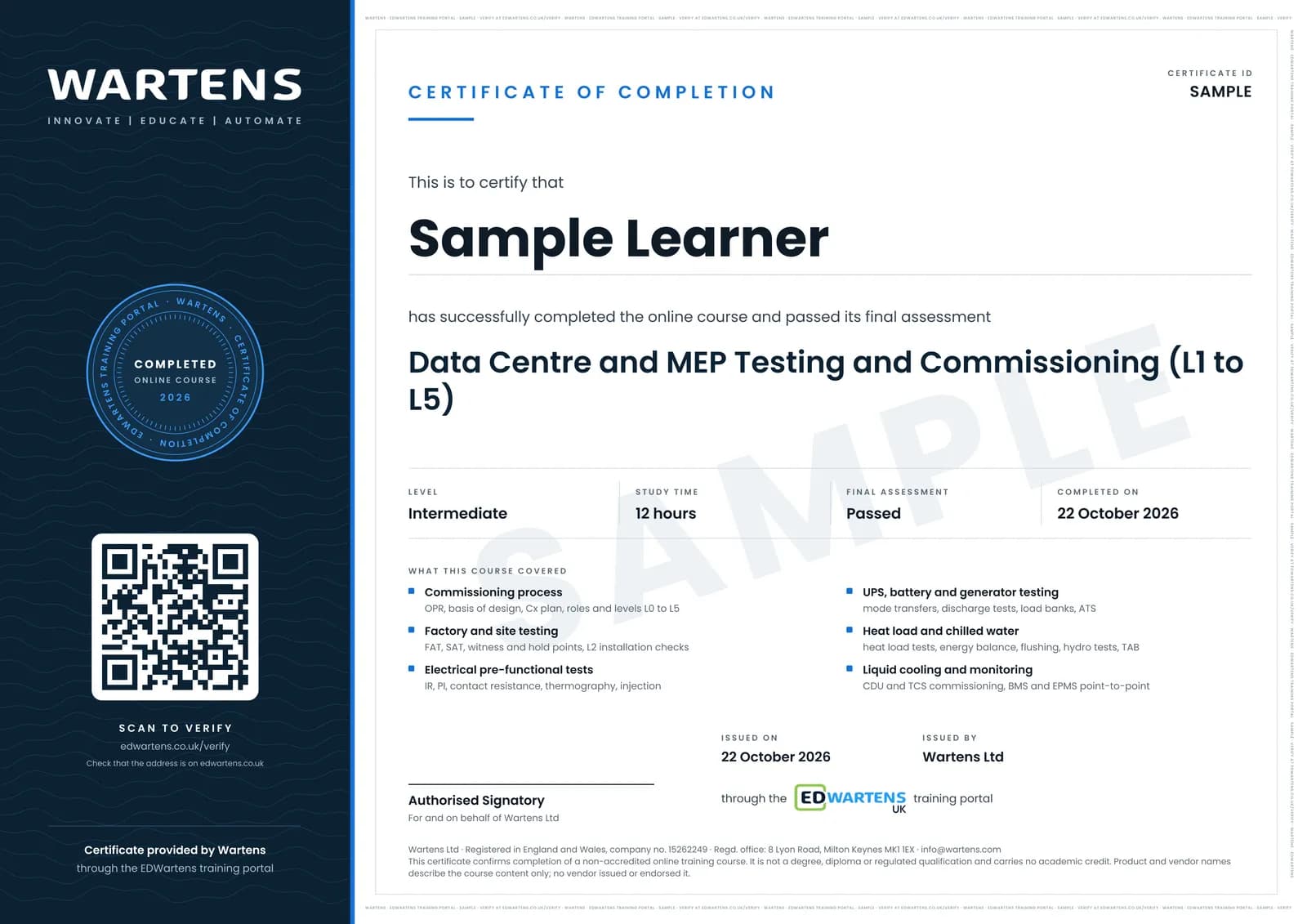
Sample certificate. Optional, issued when you pass the final exam.
- Level
- Intermediate
- Modules
- 14
- Video
- 18 hours
- Price
- Free
Video time only: reading the notes, the quizzes and the final exam take extra time, at your own pace.
Outcome
What you will be able to do
Explain the commissioning process and who does what; turn an OPR into measurable acceptance criteria; plan commissioning levels L1 to L5 and write test scripts with prerequisites, expected results and sign-offs; witness a FAT and run a SAT; read insulation resistance, polarisation index, contact resistance and thermography results; check protection by secondary and primary injection; test UPS modes, batteries, generators and ATS with load banks; run a heat load test and close its energy balance; supervise chilled water and liquid cooling flushing, hydro tests and TAB; run BMS and EPMS point-to-point checks; plan and witness an integrated systems test; and manage the issues log, punch list, training and handover.
- Turn an OPR into measurable acceptance criteria and plan commissioning levels L0 to L5
- Write test scripts with prerequisites, expected results, abort criteria and sign-offs
- Witness a FAT, run L2 installation checks and a site acceptance test
- Read insulation resistance, PI, contact resistance and thermography results, and check protection by injection
- Test UPS transfers and batteries, generators, ATS and paralleling with load banks
- Run a heat load test, close the energy balance, and supervise flushing, hydro tests and TAB
- Commission CDUs and liquid cooling loops, and run BMS and EPMS point-to-point checks
- Plan a black building integrated systems test and close issues and punch lists on evidence
Software
A spreadsheet (LibreOffice Calc is free) for test scripts, the issues log and the calculations, and a PDF reader for the free GSA Commissioning Guide. No commissioning software is required: commercial commissioning platforms hold the same scripts, checklists and issues as the spreadsheet templates used here.
Hardware
None. Test instruments, load banks and analysers are shown in the lessons; you do not need your own.
Syllabus
14 modules
Each module has video lessons, notes and a short quiz. The final exam closes the course.
- Commissioning explained: process, OPR, basis of design and roles4 lessons
- Commissioning levels L0 to L5, the Cx plan and test scripts4 lessons
- FAT, SAT and installation checks (L1 and L2)3 lessons
- Electrical pre-functional tests: insulation, contact resistance, torque and thermography1 lesson
- Switchgear protection: secondary and primary injection2 lessons
- UPS and battery testing2 lessonsLab
- Generators, ATS and load bank testing4 lessonsLab
- Heat load testing and load banks in the data hall1 lessonLab
- Chilled water systems: flushing, hydro test, water treatment and TAB2 lessons
- Liquid cooling: CDUs, technology cooling loops and commissioning3 lessons
- BMS and EPMS: point-to-point checks, sequences and alarms2 lessons
- Integrated systems testing (L5) and the black building test2 lessonsLab
- Issues log, punch list, training and handover4 lessonsLab
- Final assessment1 lesson
How it works
How this course works
- Watch the video lessonsOne module at a time, at your own pace.
- Take the module quizA short quiz at the end of each module shows what stuck.
- Keep your notesWrite in My notes beside each module and ask the trainer if you are stuck.
- Practise in the labOptionalTry a task from the module in the EDWartens Lab, in your browser.
- Sit the final examPass it once you have been through the modules.
- Certificate, if you want oneOptionalPaid, and only after you pass. Anyone can check it online.
EDWartens Lab
Practise this in the EDWartens Lab
Lose a power feed, find a hot spot and read cooling and power loads against limits in the Lab's data-centre simulator.
Works alongside Data Centre and MEP Testing and Commissioning (L1 to L5). The Lab is data-centre power and cooling practice in your browser: no install, no hardware, free to use. Sign in as a learner and it opens with your account.
Levels to try with this course
DC-01 · AI Data Centre lab
Safety walk and hall tour
Open in the lab (opens in a new tab)DC-04 · AI Data Centre lab
Cooling hot spot
Open in the lab (opens in a new tab)DC-08 · AI Data Centre lab
Power event drill
Open in the lab (opens in a new tab)DC-06 · AI Data Centre lab
Replace a failed part from a ticket
Open in the lab (opens in a new tab)
Optional. Skip it whenever you like: it never blocks your progress or your certificate.
Why practise in a lab
Technical work is judged on what you can do: wiring, commissioning, finding a fault. Doing a task yourself teaches more than watching it a second time, and a lab lets you try it safely before you meet real equipment. It does not replace working on real hardware.
- Practise safely, so a mistake costs nothing.
- The lab checks your work like a site test, so you know when it is right.
- Free, in your browser, with nothing to install.
Certificate
An optional certificate when you pass
Learning is free. Pass the final exam and you can have a certificate for £19, including VAT, with a number employers can check online. It records that you completed a free online course; it is not a regulated qualification or a CPD certificate.
- Your name, the course, its study time and your final exam score
- A unique certificate number and a QR code to its verification page
- Issued by Wartens Ltd; add it to your LinkedIn profile in one click
- Pay now or after you pass: it is issued the moment you pass the final
Credits
Who made the lessons
The video lessons belong to their creators. EDWartens wrote the study plan, notes, quizzes and the final exam.
- Laminar Projects
the short introduction to commissioning in data centres that opens the course
- Siemens Knowledge Hub
how to ensure a successful data center commissioning
- Broma Engineering
the step-by-step walk through the data centre commissioning process
- Smart Buildings Academy
working with a commissioning authority, and the practical point-to-point checkout session
- Five Nines
the five levels of data center commissioning, used again as the final recap
- Keentel Engineering
the L1 to L5 testing guide
- Gareth Knight
the step-by-step commissioning process of a data centre
- AABC, ACG, EMA: Leaders in Building Performance
the commissioning authority sessions on the data centre commissioning process, electrical systems in mission critical facilities, TAB of a hyperscale data centre, controls verification with test and balance, and operational readiness
- Simple Engineer | Civil Engineering Simplified
what a factory acceptance test is, simply explained
- Roger Altman
what a switchgear factory acceptance test contains
- Power ai
the commissioning procedure for a 400 V switchboard, used as the SAT model
- Electrology
why primary current injection testing is essential
- Testing Tech Tips
testing breaker trip units against their published curves
- Sarah Rocap
performing a UPS transfer in a critical data center
- Jim Pytel
battery discharge characteristics
- Custodian Data Centres
generator testing in an operating data centre
- Woodstock Power Company
generator load bank testing: the basics and the steps
- Parker Systems
load bank basics and the equipment used
- Data Center Revolution Media
load banks, liquid cooling and heat load testing for AI data centres
- MEP Engineering Tutorials
the method statement for hydrostatic pressure testing of chilled water pipework
- Open Compute Project
preparing technology cooling system row manifolds for commissioning, and the panel on cleaning and commissioning the TCS
- Infrastructure Masons
designing, building and commissioning liquid-cooled data centres
- NGD
a real black building test at a data centre
- Efficienergi Consulting
the long testing and commissioning training for L1 to L5 data centre infrastructure
- Jason Schroeder
what a punch list is in construction
- Everything Architecture
construction closeout
- SP Home Run Inc.
common data center commissioning mistakes
Jobs
Jobs this course can lead to
The skills in this course are used in power, renewable energy and data centre work, for example as a commissioning engineer, a data centre technician and a test engineer. No course can promise a job, and employers also look for experience, so read what live adverts ask for.
Pay: Electrical engineers (SOC 2123) had a median of £63,136 a year, full-time, in April 2026. Source: ONS, Annual Survey of Hours and Earnings 2026 (provisional). Checked 28 Oct 2026.
Questions
About this course
Last reviewed 28 October 2026.
Do I need my own test instruments?
Is this enough to become a commissioning engineer in the UK?
Can I carry out live tests after this course?
What does the Data Centre and MEP Testing and Commissioning (L1 to L5) course cover?
Where does Data Centre and MEP Testing and Commissioning (L1 to L5) start and where does it end?
How long is Data Centre and MEP Testing and Commissioning (L1 to L5)?
Can I practise Data Centre and MEP Testing and Commissioning (L1 to L5) in the browser?
What is data centre commissioning?
What are the L1 to L5 commissioning levels?
Who is this commissioning course for?
Do I need software or test equipment?
Is the course free to learn, and how long does it take?
Which standards and guides does the course follow?
What certificate do I get, and how is it verified?
Who is this course for?
Want a live class and career support?
The Professional Module is five live days of Siemens PLC, HMI and SCADA with an instructor, then career sessions with our engineers and a CPD certificate.