
Free course · Electrical
Electrical Safety at Work (UK): Safe Isolation, Lock-off and Arc Flash
Work safely on and near electrical equipment under UK law: how shock and arc flash injure, risk assessment, the Electricity at Work Regulations 1989, HSE guidance HSR25, HSG85 and GS38, safe isolation, lock-off under PUWER regulation 19, BS EN 50110-1 roles, arc-flash incident energy with IEEE 1584 as an international method, arc-rated PPE to IEC 61482, live working only when justified, and permits to work.
Free to learn. Verifiable certificate £19 when you pass the final exam (optional, VAT included).
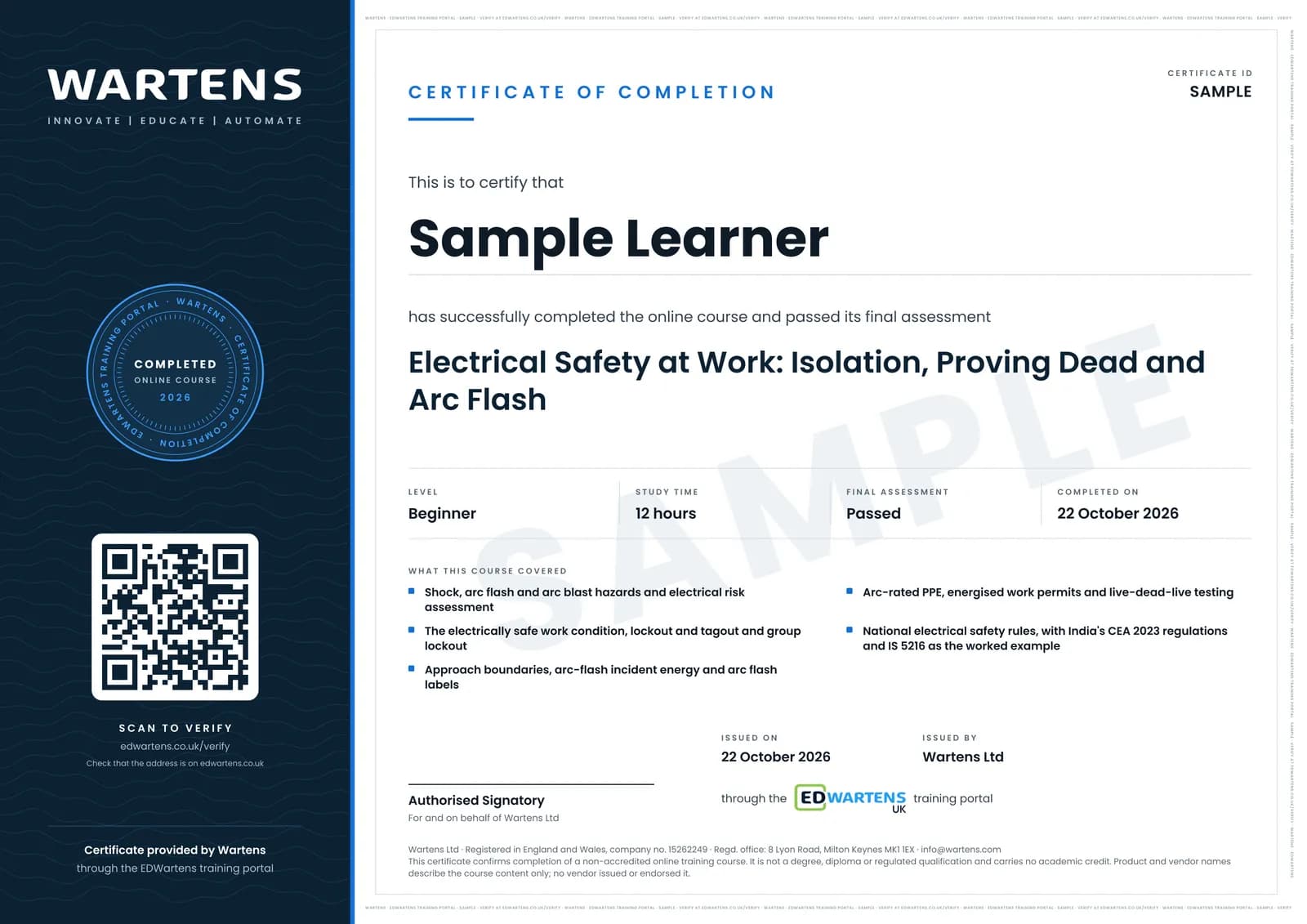
Sample certificate. Optional, issued when you pass the final exam.
- Level
- Beginner
- Modules
- 12
- Video
- 18 hours
- Price
- Free
Outcome
What you will be able to do
Explain how shock, burns, arc flash and arc blast injure; write a task-based electrical risk assessment under the Management of Health and Safety at Work Regulations 1999; carry out and write up the safe isolation procedure (identify, isolate, secure, prove-test-prove) with GS38 test equipment; set out a lock-off procedure under PUWER regulation 19, including group lock-off and handover; decide safe working distances and barriers near live parts; scale an arc-flash incident energy with the IEEE 1584 idea and find the arc flash boundary; choose and inspect arc-rated PPE to IEC 61482 and read an arc-flash label; decide whether live working is justified under regulation 14 and complete a permit; apply the Electricity at Work Regulations, HSR25 and RIDDOR; and audit, investigate and brief on electrical safety.
- Work out a body current from voltage and resistance and explain shock, burns, arc flash and arc blast
- Write a task-based risk assessment under the Management of Health and Safety at Work Regulations 1999
- Carry out safe isolation: identify, isolate, secure and prove-test-prove with GS38 test equipment
- Set out a lock-off procedure under PUWER regulation 19, including group lock-off and handover
- Choose barriers and safe distances near live parts, knowing the Electricity at Work Regulations set no fixed LV distances
- Scale an arc-flash incident energy with the IEEE 1584 idea and choose arc-rated PPE to IEC 61482
- Decide whether live working is justified under regulation 14 and complete a permit to work
- Explain EAWR 1989, HSR25, BS EN 50110-1 competence roles and RIDDOR, then plan an audit and an investigation
Software
None required. A spreadsheet (Excel, Google Sheets or LibreOffice Calc) helps with the incident energy scaling and the project. The HSE guidance used in the course (HSR25, HSG85, GS38, HSG250) can be read free on hse.gov.uk.
Hardware
None. A two-pole voltage indicator with proving unit, a lock-off kit and a warning notice make the practice tasks more real, but every task can be done on paper.
Syllabus
12 modules
Each module has video lessons, notes and a short quiz. The final exam closes the course.
- How electricity injures: shock, burns, arc flash and arc blast4 lessons
- Risk assessment for electrical work under UK law6 lessons
- Safe isolation: identify, isolate, secure and prove dead7 lessonsLab
- Lock-off and LOTO: procedure, devices, group lock-off and handover7 lessonsLab
- Working near live parts: danger zones, barriers and safe distances4 lessons
- Arc-flash incident energy: the IEEE 1584 idea, hand estimate against software5 lessons
- Arc-rated PPE (IEC 61482), arc-flash labels and PPE inspection4 lessons
- Live working: when it is justified (EAWR regulation 14) and permits to work5 lessons
- Test instruments: GS38, CAT ratings and prove-test-prove7 lessonsLab
- UK law and competence: EAWR, HSR25, PUWER and RIDDOR5 lessons
- Safety audits, incident investigation and toolbox talks7 lessons
- Final Assessment1 lesson
How it works
How this course works
- Watch the video lessonsOne module at a time, at your own pace.
- Take the module quizA short quiz at the end of each module shows what stuck.
- Keep your notesWrite in My notes beside each module and ask the trainer if you are stuck.
- Practise in the labOptionalTry a task from the module in the EDWartens Lab, in your browser.
- Sit the final examPass it once you have been through the modules.
- Certificate, if you want oneOptionalPaid, and only after you pass. Anyone can check it online.
EDWartens Lab
Practise this in the EDWartens Lab
Isolate a motor bucket step by step, with lock, tag and a prove-test-prove check, before you ever touch live equipment.
Works alongside Electrical Safety at Work (UK): Safe Isolation, Lock-off and Arc Flash. The Lab is substation and mcc practice in your browser: no install, no hardware, free to use. Sign in as a learner and it opens with your account.
Levels to try with this course
MCC-01 · Substation and MCC lab
Read the single-line diagram
Open in the lab (opens in a new tab)MCC-02 · Substation and MCC lab
Safe isolation of an MCC bucket
Open in the lab (opens in a new tab)MCC-06 · Substation and MCC lab
Fault level and breaker check
Open in the lab (opens in a new tab)
Optional. Skip it whenever you like: it never blocks your progress or your certificate.
Why practise in a lab
Technical work is judged on what you can do: wiring, commissioning, finding a fault. Doing a task yourself teaches more than watching it a second time, and a lab lets you try it safely before you meet real equipment. It does not replace working on real hardware.
- Practise safely, so a mistake costs nothing.
- The lab checks your work like a site test, so you know when it is right.
- Free, in your browser, with nothing to install.
Certificate
An optional certificate when you pass
Learning is free. Pass the final exam and you can have a certificate for £19, including VAT, with a number employers can check online. It records that you completed a free online course; it is not a regulated qualification or a CPD certificate.
- Your name, the course, its study time and your final exam score
- A unique certificate number and a QR code to its verification page
- Issued by Wartens Ltd; add it to your LinkedIn profile in one click
- Pay now or after you pass: it is issued the moment you pass the final
Credits
Who made the lessons
The video lessons belong to their creators. EDWartens wrote the study plan, notes, quizzes and the final exam.
- Schneider Electric
the lesson "Electrical Safety Basic Training for Non-Electricians"
- Science ABC
the lesson "Current Vs Voltage: How Much Current Can Kill You?"
- Electrical Safety UK Ltd
the lessons "Arc Flash - explained!", "Arc Flash Calculations - An essential tool for the designer", "2025 Arc Flash Risk Assessments & Studies" and 1 more
- Work Safe Queensland
the lesson "Arc flash safety film"
- Health and Safety Executive
the lesson "Health and safety risk assessment and management"
- iHasco
the lesson "What is the difference between hazard and risk?"
- HeatSpring
the lessons "What are the Hierarchy of Risk Controls in Electrical Work?", "Working Safely on Energized Equipment - Restricted Approach, Limited Approach & Arc Flash"
- Safeti
the lesson "HIERARCHY of CONTROL Health and Safety"
- Martindale Electric
the lesson "Safe Isolation Procedure"
- eFIXX
the lessons "Safe Isolation: Are You Doing It Right?", "SAFE ISOLATION & LOCK OFF KIT - Electricians’ toolbox essential"
- LEARN ELECTRICS
the lesson "SAFE ISOLATION PROCEDURE for Electrical Circuits. Why we do it, how we do it."
- Sparkipeat
the lesson "Safe Isolation Procedure"
- Mark The Sparky Allison
the lesson "Lock off UK electrician. Safe isolation applying locks"
- Artisan Electrics
the lesson "Safe Isolation Procedure Lock out Tag out UK - Electrician Life"
- TRADESAFE
the lesson "Group Lockout Tagout Explained"
- UK Power Networks
the lesson "Working near electricity cables"
- Brainfiller (Jim Phillips, P.E.)
the lessons "Arc Flash Studies Simplified", "2018 IEEE 1584 Update - Introduction to the Changes"
- PowerStudies, Inc.
the lesson "The Current Q & A: What is an Incident Energy Analysis?"
- Herzig Engineering
the lesson "How to Read Arc Flash Labels (The Secrets of these Safety Stickers)"
- Lineman's Testing Laboratories of Canada Limited
the lesson "How to Inspect Your Electrical Rubber Gloves in the Field"
- Reynolds Training Services Ltd
the lesson "What is a permit to work system?"
- Hioki E.E. Corporation
the lesson "What are CAT (Category) ratings in multimeters and other instruments? -CAT II III IV"
- Electrical Safety First
the lesson "GS38 Explained"
- Kewtechcorp
the lesson "GS38 Test Leads"
- Acutest Test Equipment Supply, Service & Training
the lesson "Martindale VIPD138-S Voltage Indicator and Proving Unit Kit"
- LearningLounge
the lesson "Trailer - An Introduction to the Electricity at Work Regulations"
- ELECTRICAL INSTALLATION SERVICES
the lesson "Is Electrical Testing a Legal Requirement? Electrical inspection and testing"
- Career & Life Skills
the lesson "Electrical Safety at Work"
- StepChangeInSafety
the lesson "Effective Toolbox Talks"
- Provoking Safety
the lesson "Explaining Root cause analysis using the 5 whys technique"
- Grace Technologies
the lesson "Webinar VOD"
Questions
About this course
Who is this electrical safety course for?
Is this competence or authorised person training?
Which law and standards does it cover?
Do I need software or test equipment?
How long does the course take?
Is the course really free?
What certificate do I get?
Will it help me get work?
Want a live class and career support?
The Professional Module is five live days of Siemens PLC, HMI and SCADA with an instructor, then a resume session and a CPD certificate.