
Free course · Electrical
Electrical Estimating: Quantity Take-off, Costing and BOQ
Turn a set of electrical drawings into a priced bill of quantities: read the drawings and specification, take off points, cables by route length, containment, boards, luminaires, earthing and lightning protection, apply labour units and wastage, build rates from material, labour, plant, overheads and margin, lay out the BOQ in Excel, compare tenders, and value variations through to the final account.
Free to learn. Verifiable certificate £19 when you pass the final exam (optional, VAT included).
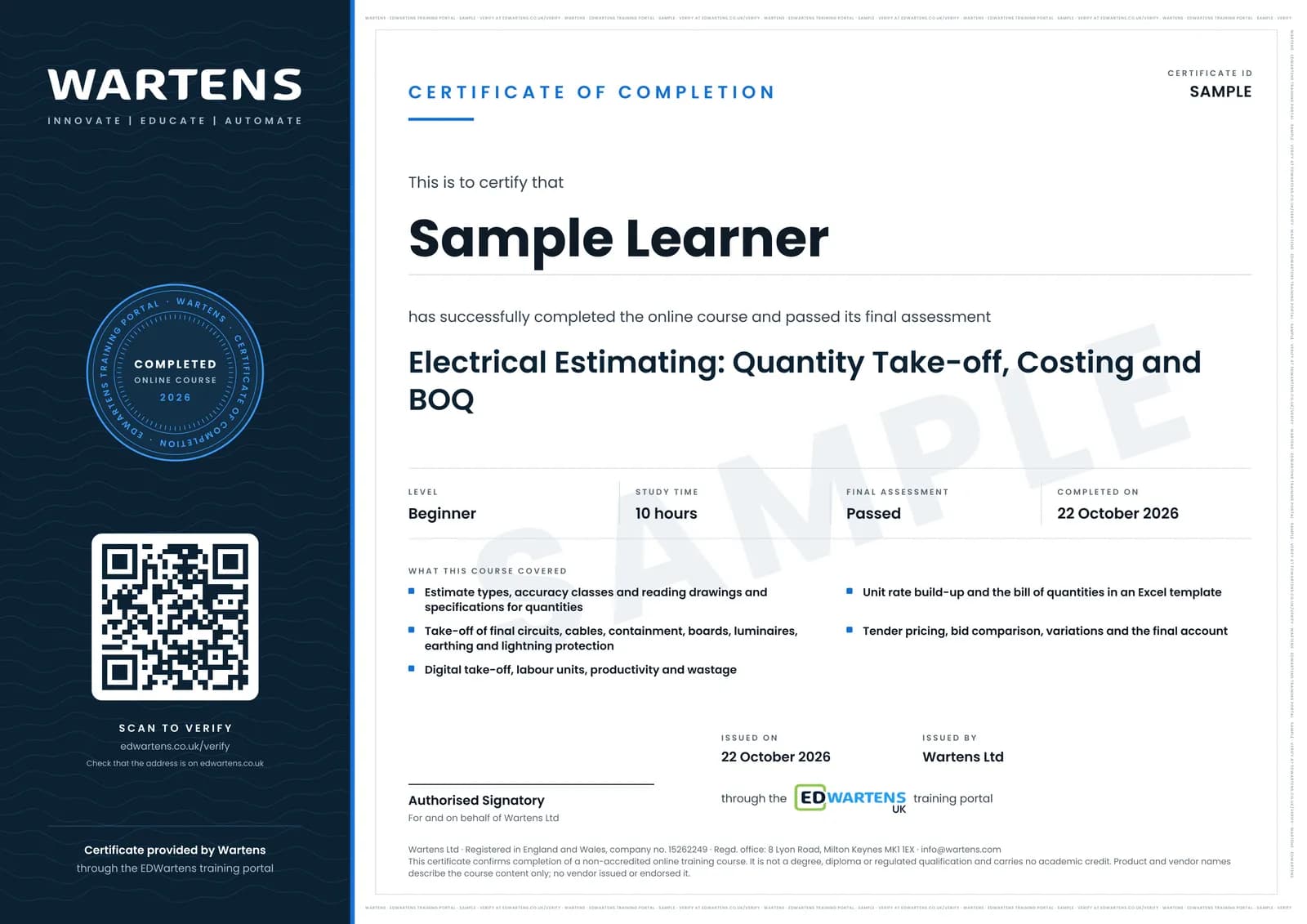
Sample certificate. Optional, issued when you pass the final exam.
- Level
- Beginner
- Modules
- 14
- Video
- 15 hours
- Price
- Free
Outcome
What you will be able to do
Explain the types and accuracy classes of estimate and where the estimator sits in a tender; read drawings, schedules and specifications for quantities; take off final circuits by points and wiring, cables by route length with allowances, containment with fittings and supports, boards, panels and luminaires, earthing, lightning protection and small ELV items, by hand and on a PDF; convert quantities into labour hours and apply wastage; build unit rates from material, labour, plant, overheads and margin in cost units; lay out a bill of quantities to a standard method of measurement in an Excel template with checks; price and compare tenders on a like-for-like basis; use spreadsheets and AI only as checking aids; and value variations, interim valuations and the final account.
- Explain estimate types and accuracy classes, and where the estimator sits in a tender
- Read drawings, schedules and specifications for the items that drive quantity and cost
- Take off final circuits by points and wiring, and cables and feeders by route length with allowances
- Measure containment with fittings and supports, and count boards, luminaires, earthing and lightning protection
- Measure on a PDF with a calibrated scale, and convert quantities into labour hours with wastage
- Build unit rates from material, labour, plant, overheads and margin, priced in cost units
- Lay out a bill of quantities to a standard method of measurement in an Excel template with checks
- Compare tenders like for like, and value variations, interim valuations and the final account
Software
A spreadsheet: Excel, Excel for the web or LibreOffice Calc (free). A free PDF viewer with measuring tools, such as PDF-XChange Editor on Windows, for digital take-off. Bluebeam Revu and PlanSwift trials are optional.
Hardware
None. A printer and coloured highlighters help with manual take-off, but everything can be done on screen.
Syllabus
14 modules
Each module has video lessons, notes and a short quiz. The final exam closes the course.
- What an electrical estimate is and where it fits in a tender3 lessons
- Reading drawings and specifications for quantities3 lessons
- Final circuits: points, accessories and branch wiring3 lessons
- Cables and feeders: route lengths, allowances and the cable schedule3 lessons
- Containment: conduit, trunking, cable tray and ladder3 lessons
- Distribution boards, panels and lighting fixtures3 lessons
- Earthing, lightning protection and small ELV items3 lessons
- Digital take-off: Bluebeam, PlanSwift and PDF measuring3 lessons
- Labour units, productivity and wastage3 lessons
- Building the rate: material, labour, plant, overheads and margin3 lessons
- The BOQ: structure, measurement rules and an Excel template3 lessons
- Tender pricing, bid comparison and checking the estimate4 lessons
- After award: variations, valuations and the final account2 lessons
- Final Assessment1 lesson
How it works
How this course works
- Watch the video lessonsOne module at a time, at your own pace.
- Take the module quizA short quiz at the end of each module shows what stuck.
- Keep your notesWrite in My notes beside each module and ask the trainer if you are stuck.
- Sit the final examPass it once you have been through the modules.
- Certificate, if you want oneOptionalPaid, and only after you pass. Anyone can check it online.
Certificate
An optional certificate when you pass
Learning is free. Pass the final exam and you can have a certificate for £19, including VAT, with a number employers can check online. It records that you completed a free online course; it is not a regulated qualification or a CPD certificate.
- Your name, the course, its study time and your final exam score
- A unique certificate number and a QR code to its verification page
- Issued by Wartens Ltd; add it to your LinkedIn profile in one click
- Pay now or after you pass: it is issued the moment you pass the final
Credits
Who made the lessons
The video lessons belong to their creators. EDWartens wrote the study plan, notes, quizzes and the final exam.
- G4S Media House
the Electrical Estimation tutorials: what an estimate is, how the estimator works, and the power device and security device take-offs
- Plan and Spec
construction estimating and budgeting basics
- MEP Academy
the lessons on reading construction specifications, the general layout of a drawing set, labour rates with burden, and what to know before bidding commercial work
- QSplorer
quantity measurement tips from general notes, sections and details, the MEP checklist for electrical works, and a bid evaluation case study
- Tim Fairley
the complete step-by-step guide to electrical estimating, and the two lessons testing ChatGPT and AI take-off tools for estimators
- Vision InfoSoft
the branch circuit wiring, feeder and fixture take-off lessons
- Dr. Chau
the Electrical Estimation lessons on measuring wiring, panel board and lighting fixture take-off, Bluebeam tool chests, and pricing receptacle outlets with RSMeans data
- CANICE Quantity Surveying Made Easy
measuring electrical work with a rate build-up for cables, and preparing a project final account statement
- Shem Sessions
measuring cable tray, trunking and other electrical containment in Cubicost TME
- Managing Qs
cable tray, ladder and trunking explained for quantity surveyors
- Conest Software Systems
a cable tray take-off
- Axis Electricals
selecting down conductors for a lightning protection system
- Triple 7 Electrical
a Bluebeam take-off of power devices, power branch circuits and low-voltage items
- Brainbox Notion
the PlanSwift MEP take-off tutorial
- MikeHoltNEC
the electrical estimating lessons on labour units and unit prices
- Hard Hat
estimating electrical work and electrical labour
- Cost Engineering Professional
rate breakdown analysis, the step-by-step guide to preparing a BOQ, forming a BOQ in Excel, and variations in construction projects
- Awarded Bid
prime cost and provisional sums under NRM2
- Metroun Quantity Surveying
the short BOQ recap used in the final module
Questions
About this course
Who is this electrical estimating course for?
Is the course free to learn?
Which rates and methods of measurement does it use?
Do I need Bluebeam, PlanSwift or estimating software?
Does it teach electrical design or cable sizing?
Can I use ChatGPT or AI to estimate?
How long does the course take?
What certificate do I get?
Want a live class and career support?
The Professional Module is five live days of Siemens PLC, HMI and SCADA with an instructor, then a resume session and a CPD certificate.