
Free course · Condition monitoring
Machinery Fault Diagnosis and Condition Monitoring
The layer that separates a data collector from a diagnostician: what the analyser is doing to your data, how to choose Fmax, lines of resolution and averaging for the fault you are actually hunting, how to read the time waveform, the orbit and the shaft centreline beside the spectrum, how to measure sideband spacing and name the shaft that is modulating, how to place a rolling element bearing on the four stages of failure, and how to write the condition report a planner can schedule a job from.
Free to learn. Verifiable certificate £19 when you pass the final exam (optional, VAT included).
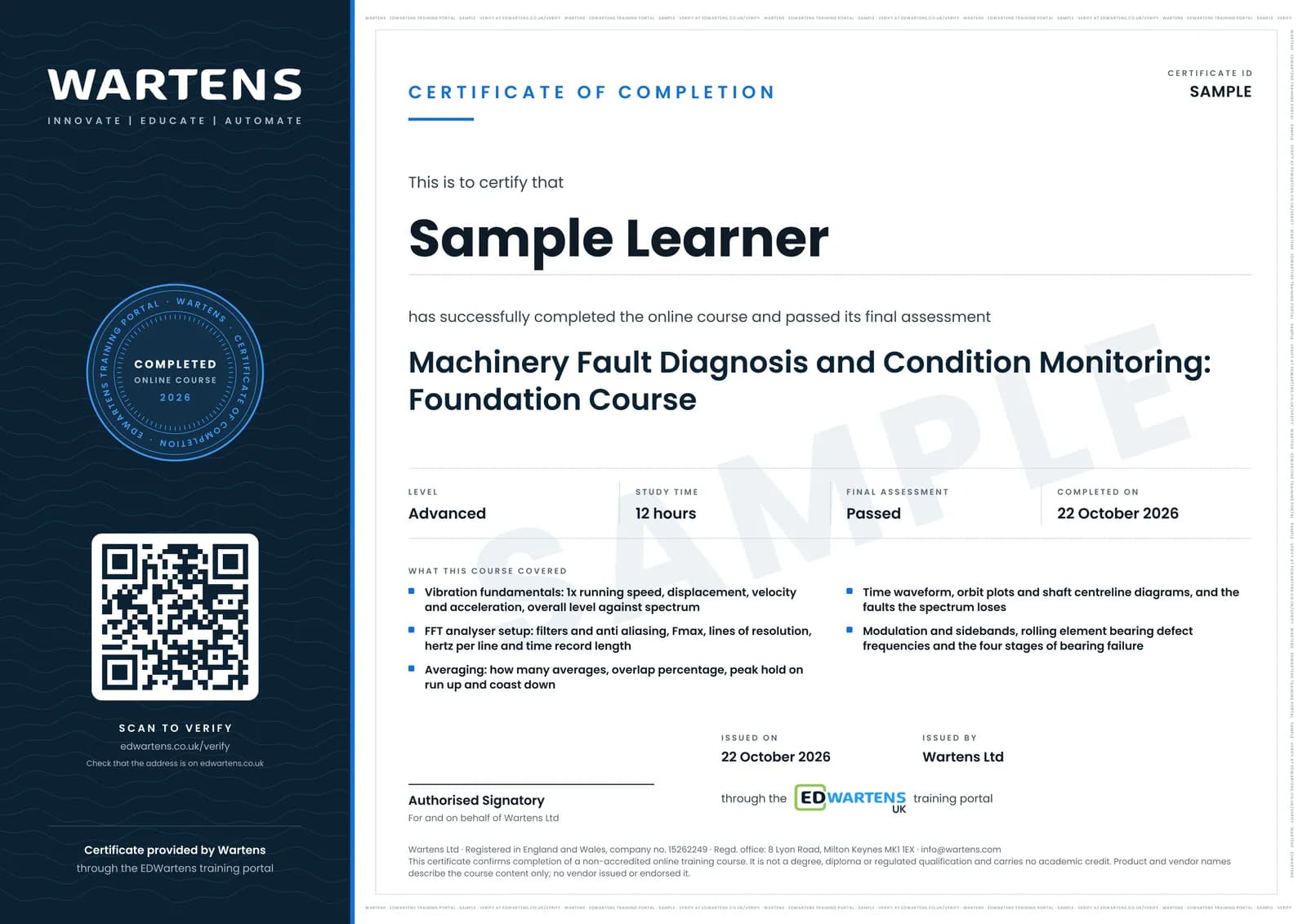
Sample certificate. Optional, issued when you pass the final exam.
- Level
- Advanced
- Modules
- 10
- Video
- 17 hours
- Price
- Free
Outcome
What you will be able to do
Set Fmax, lines of resolution and averaging for a stated fault and show the arithmetic; recognise a peak that is an artefact of the settings rather than a machine force; read a spectrum, a time waveform, an orbit and a shaft centreline together instead of one at a time; measure sideband spacing and name the shaft or component doing the modulating; identify a rolling element bearing defect, place it on the four stages and set the monitoring interval it justifies; and write a one page condition report that names the fault, the evidence and the action with a date.
- Choose Fmax, lines of resolution and averaging for the fault you are hunting, and show the arithmetic
- Spot a peak that is an artefact of the analyser settings rather than a real machine force
- Read the time waveform, the orbit and the shaft centreline alongside the spectrum
- Measure sideband spacing and name the shaft or component that is modulating the signal
- Identify a rolling element bearing defect and place it on the four stages of failure
- Write a condition report that names the fault, the evidence and the action with a date
Software
None required. A vibration analyser or data collector if your employer has one.
Hardware
None required. Access to one running machine, its nameplate and its bearing part numbers makes the practice tasks worth far more.
Syllabus
10 modules
Each module has video lessons, notes and a short quiz. The final exam closes the course.
- How vibration analysis finds a fault1 lesson
- Setting up the FFT analyser: filters, Fmax and resolution5 lessons
- Averaging: how many, how much overlap, when to hold the peak4 lessons
- What the spectrum hides: waveform, orbit and shaft centreline3 lessons
- Modulation and sidebands1 lesson
- Envelope, cepstrum and order analysis3 lessons
- Rolling element bearing faults2 lessons
- Fault signatures: unbalance, misalignment, cracked shaft and looseness4 lessons
- Phase, resonance, trending and the condition report4 lessons
- Final assessment0 lessons
How it works
How this course works
- Watch the video lessonsOne module at a time, at your own pace.
- Take the module quizA short quiz at the end of each module shows what stuck.
- Keep your notesWrite in My notes beside each module and ask the trainer if you are stuck.
- Sit the final examPass it once you have been through the modules.
- Certificate, if you want oneOptionalPaid, and only after you pass. Anyone can check it online.
Certificate
An optional certificate when you pass
Learning is free. Pass the final exam and you can have a certificate for £19, including VAT, with a number employers can check online. It records that you completed a free online course; it is not a regulated qualification or a CPD certificate.
- Your name, the course, its study time and your final exam score
- A unique certificate number and a QR code to its verification page
- Issued by Wartens Ltd; add it to your LinkedIn profile in one click
- Pay now or after you pass: it is issued the moment you pass the final
Credits
Who made the lessons
The video lessons belong to their creators. EDWartens wrote the study plan, notes, quizzes and the final exam.
- Mobius Institute
the short technique lessons behind modules 2 to 4: analyser settings, filters and the FFT, spectral resolution and its limits, averaging, overlap percentage, peak hold, time waveform analysis, orbit plots and the shaft centreline diagram
- Mobius Institute webinars
the long sessions the course is built around: the animated introduction to vibration analysis and its question and answer session, the modulation and sidebands session, and the bearing failure analysis session
- nptelhrd
8 lessons in "Envelope, cepstrum and order analysis", "Fault signatures: unbalance, misalignment, cracked shaft and looseness" and "Phase, resonance, trending and the condition report"
- Turbo mass
2 lessons in "Phase, resonance, trending and the condition report"
- Machinery Fault Diagnosis And Signal Processing
a lesson in "Phase, resonance, trending and the condition report"
Questions
About this course
Who is this course for?
Do I need an analyser or any software?
What should I know before I start?
Does this make me a certified vibration analyst?
Does it cover oil analysis, thermography and motor current analysis?
Is the course really free?
What certificate do I get?
Who made the video lessons?
Want a live class and career support?
The Professional Module is five live days of Siemens PLC, HMI and SCADA with an instructor, then a resume session and a CPD certificate.