
Free course · Condition monitoring
Reliability Engineering: RCM, Root Cause Analysis, Weibull
The reliability engineer's toolkit for plants, utilities and oil and gas: failure rate, MTBF and availability, failure patterns and the P-F curve, criticality, equipment FMECA, the seven questions of reliability-centred maintenance with task selection and failure-finding intervals, root cause analysis with 5 Whys, fishbones, logic trees and fault trees, Weibull analysis by hand and in Python, block diagrams, spares, bad actors, precision maintenance and KPIs.
Free to learn. Verifiable certificate £19 when you pass the final exam (optional, VAT included).
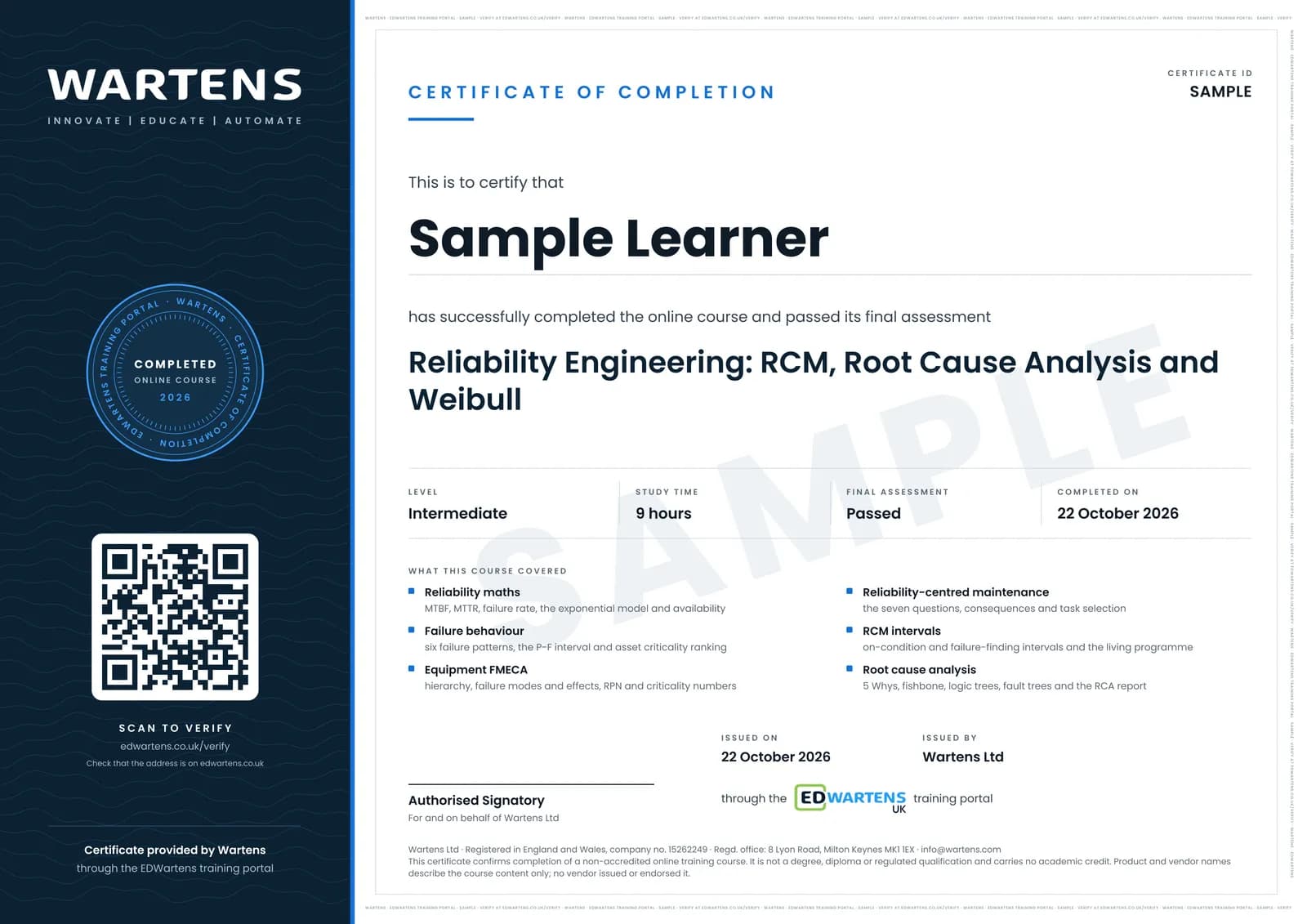
Sample certificate. Optional, issued when you pass the final exam.
- Level
- Intermediate
- Modules
- 15
- Video
- 17 hours
- Price
- Free
Outcome
What you will be able to do
Calculate MTBF, failure rate, reliability and availability from plant records; explain the six failure patterns and set inspection intervals from the P-F interval; rank assets by criticality; write an equipment FMECA; run an RCM analysis through the seven questions, choose tasks and default actions and calculate failure-finding intervals; lead a root cause analysis with 5 Whys, a fishbone, a logic tree and a fault tree; fit Weibull distributions with suspensions by hand and in Python and turn them into replacement and spares decisions; calculate system reliability from block diagrams; size spares with the Poisson model; find bad actors; and track a reliability programme with leading and lagging KPIs.
- Calculate MTBF, MTTR, failure rate, reliability and availability from plant failure records
- Explain the six failure patterns and set on-condition intervals from the P-F interval
- Rank assets by criticality and write an equipment FMECA with severity read first
- Run an RCM analysis through the seven questions and choose tasks and default actions
- Calculate failure-finding intervals for protective devices from MTBF and tolerable unavailability
- Lead a root cause analysis with 5 Whys, a fishbone, a logic tree and a fault tree
- Fit Weibull distributions with suspensions by hand and in Python and pick a replacement age
- Size spares with the Poisson model, find bad actors and track leading and lagging KPIs
Software
A spreadsheet (LibreOffice Calc is free) for the maths, the FMECA and the RCM worksheets. Python 3 with the free reliability and SciPy libraries for Weibull analysis (Google Colab runs it in a browser with nothing to install). Commercial RCM and life data tools are shown in some lessons but are not needed.
Hardware
None. Any laptop with a browser is enough.
Syllabus
15 modules
Each module has video lessons, notes and a short quiz. The final exam closes the course.
- What a reliability engineer does: failure, strategy and the numbers that matter3 lessons
- Reliability maths: failure rate, MTBF, the bathtub and the exponential model4 lessons
- Failure patterns, the P-F curve and asset criticality5 lessons
- Equipment FMEA and FMECA4 lessons
- RCM part 1: functions, functional failures, failure modes and effects4 lessons
- RCM part 2: consequences, task selection and default actions4 lessons
- Task intervals, failure-finding and the living RCM programme4 lessons
- Root cause analysis 1: defining the problem, 5 Whys and the fishbone4 lessons
- Root cause analysis 2: logic trees, fault trees and the RCA report5 lessons
- Weibull analysis 1: the distribution, probability plotting and median ranks3 lessons
- Weibull analysis 2: suspensions, Python and maintenance decisions4 lessons
- System reliability: block diagrams, redundancy and availability2 lessons
- Spares optimisation and bad actors3 lessons
- Precision maintenance, KPIs and running a reliability programme3 lessons
- Final assessment1 lesson
How it works
How this course works
- Watch the video lessonsOne module at a time, at your own pace.
- Take the module quizA short quiz at the end of each module shows what stuck.
- Keep your notesWrite in My notes beside each module and ask the trainer if you are stuck.
- Sit the final examPass it once you have been through the modules.
- Certificate, if you want oneOptionalPaid, and only after you pass. Anyone can check it online.
Certificate
An optional certificate when you pass
Learning is free. Pass the final exam and you can have a certificate for £19, including VAT, with a number employers can check online. It records that you completed a free online course; it is not a regulated qualification or a CPD certificate.
- Your name, the course, its study time and your final exam score
- A unique certificate number and a QR code to its verification page
- Issued by Wartens Ltd; add it to your LinkedIn profile in one click
- Pay now or after you pass: it is issued the moment you pass the final
Credits
Who made the lessons
The video lessons belong to their creators. EDWartens wrote the study plan, notes, quizzes and the final exam.
- RCM Training with Nancy Regan
the RCM in a Nutshell series: the airline origins of RCM, functions and operating context, functional failures and failure modes, failure effects, the decision diagram, consequences, default strategies, the living programme and case studies
- Engineering Presentations
the CMRP pillar 3 lessons on system reliability, MTTR, the P-F curve, predictive maintenance, asset criticality, FMEA, the seven RCM questions, fault tree analysis, reliability block diagrams, reliability growth models and lubricant films
- CQE Academy
failure rate, MTTF, MTBF, the bathtub curve and the exponential and Weibull distributions
- eMaint
MTBF, MTTF and MTTR as maintenance KPIs
- Noria
what a criticality analysis is and why it comes first
- UpKeep
a step-by-step guide to criticality analysis in maintenance
- RAMS Ready
the columns, limits and variants of an FMECA worksheet
- IsographSoftware
executing an FMECA inside an RCM study, and the webinar on RCM introduction and cost optimisation
- Master Reliability - FRAME-D
a deeper look at failure mode, effects and criticality analysis
- IBM Technology
what root cause analysis is and how it is run
- Lean Enterprise Institute
how the 5 Whys method is meant to be used
- EPM
the fishbone (Ishikawa) diagram with a worked example
- Skill Torque
root cause failure analysis in a maintenance setting
- Reliability Center Inc.
the PROACT logic tree method: basic failure analysis, solving chronic failures and the boiler feed pump case study
- Institute of Quality and Reliability
fault tree analysis, the Weibull distribution, probability plotting with median ranks, right-censored data and free open-source Weibull software
- Prelical Solutions LLC
the overview of Weibull analysis that opens the Weibull modules
- Cristian Rosa
reliability data analysis in Python
- PetroSkills
the webinar on using Weibull analysis to improve equipment reliability
- Phillip Slater
how to identify critical spare parts
- Energy Risk Engineering
building a critical spare parts management system
- ARMS Reliability
predicting optimal spare parts holding levels
- Maintenologist
precision maintenance and why it stops installing tomorrow's failures
- Limble
the maintenance KPIs that matter
Questions
About this course
What is this reliability engineering course?
Who is the reliability engineering course for?
Do I need any prerequisites or paid software?
Which standards does the course follow?
How long does the course take?
Is the course free, and what certificate do I get?
Does this course prepare me for the CMRP exam?
What job does reliability engineering lead to, and is it in demand in the Gulf?
Want a live class and career support?
The Professional Module is five live days of Siemens PLC, HMI and SCADA with an instructor, then a resume session and a CPD certificate.