Free course · Condition monitoring
Vibration Analysis Training
This free course teaches condition monitoring of rotating machines the way a route is walked: analyser set-up, reading spectra and time waveforms, separating unbalance, misalignment and looseness, staging bearing failures, applying ISO 10816 zones and ISO 1940 balance grades, and writing up a field balance. It suits UK maintenance technicians, reliability staff and engineers in manufacturing, power and water, and helps with condition monitoring roles, though it cannot promise one.
Vibration Analysis Training is a free online intermediate Condition monitoring course with 14 modules, about 12 hours of video lessons. Learning is free; an optional verifiable certificate costs £19 including VAT when you pass the final exam. Last updated 28 October 2026.
Free to learn. Verifiable certificate £19 when you pass the final exam (optional, VAT included).
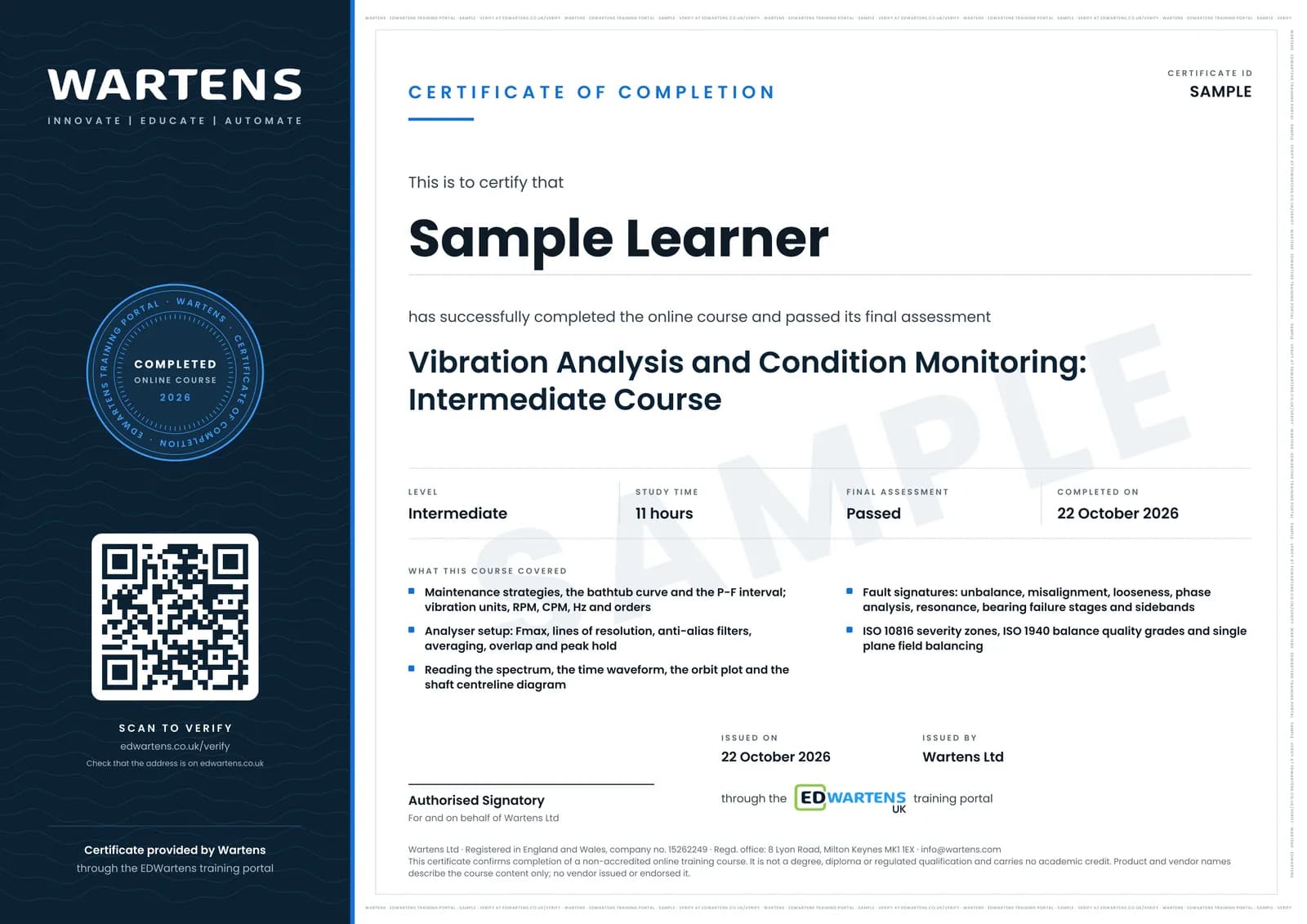
Sample certificate. Optional, issued when you pass the final exam.
- Level
- Intermediate
- Modules
- 14
- Video
- 12 hours
- Price
- Free
Video time only: reading the notes, the quizzes and the final exam take extra time, at your own pace.
Outcome
What you will be able to do
Set Fmax, lines of resolution and averages for a machine at a known running speed; read a spectrum peak by peak and name each one as 1x, a harmonic, sub-synchronous or non-synchronous; read a time waveform for impacting and truncation; separate unbalance, misalignment, looseness and resonance using 2x, axial amplitude and phase; place a rolling element bearing in one of the four failure stages and read its sidebands; apply ISO 10816 zones and ISO 1940 balance quality grades; run a single plane trial weight balance; and write the findings note a plant manager will act on.
- Set Fmax, lines of resolution and averages for a machine at a known running speed
- Read a spectrum peak by peak and name each one as 1x, a harmonic, sub-synchronous or non-synchronous
- Separate unbalance, misalignment and looseness using 1x, 2x, axial amplitude and phase readings
- Place a rolling element bearing in one of the four failure stages and say how much warning is left
- Apply ISO 10816 zones and ISO 1940 balance grades to call a machine acceptable, watch or stop
- Run a single plane field balance and write the findings note that gets the work approved
Software
None required. Any spectrum plot from your own plant reports is enough for the practice tasks.
Hardware
None. An accelerometer, tachometer and data collector are discussed and are not needed to finish the course.
Syllabus
14 modules
Each module has video lessons, notes and a short quiz. The final exam closes the course.
- Condition monitoring and the case for vibration3 lessons
- Vibration fundamentals: motion, frequency and amplitude3 lessons
- From time waveform to spectrum3 lessons
- Taking the measurement: sensor, mounting and technique4 lessons
- Routes, baselines and trending2 lessons
- Reading the displays: spectrum and time waveform2 lessons
- Unbalance2 lessons
- Misalignment, looseness and phase2 lessons
- Resonance, natural frequency and critical speed2 lessons
- Rolling element bearing faults2 lessons
- Modulation and sidebands2 lessons
- How good is good enough: ISO 10816 and ISO 19402 lessons
- Correcting unbalance: field balancing4 lessons
- Final assessment0 lessons
How it works
How this course works
- Watch the video lessonsOne module at a time, at your own pace.
- Take the module quizA short quiz at the end of each module shows what stuck.
- Keep your notesWrite in My notes beside each module and ask the trainer if you are stuck.
- Sit the final examPass it once you have been through the modules.
- Certificate, if you want oneOptionalPaid, and only after you pass. Anyone can check it online.
Certificate
An optional certificate when you pass
Learning is free. Pass the final exam and you can have a certificate for £19, including VAT, with a number employers can check online. It records that you completed a free online course; it is not a regulated qualification or a CPD certificate.
- Your name, the course, its study time and your final exam score
- A unique certificate number and a QR code to its verification page
- Issued by Wartens Ltd; add it to your LinkedIn profile in one click
- Pay now or after you pass: it is issued the moment you pass the final
Credits
Who made the lessons
The video lessons belong to their creators. EDWartens wrote the study plan, notes, quizzes and the final exam.
- Mega Technical Hub
maintenance strategies and the P-F curve, vibration fundamentals and amplitude units, spectrum reading, unbalance types, misalignment, phase analysis, resonance and the bump test, and the vibration limits and balance grades lessons, which use the older ISO 10816 and ISO 1940 names
- ADASH
the beginners series on sensors, the signal path, routes and terms, the trend and frequency analysis clips, the combination of two signals, the electric motor faults clip, the Secrets of imbalance series on heavy spot, phase and the rules that make a balance hold, and the on-site balancing guide
- Turbo mass
6 lessons in "From time waveform to spectrum", "Taking the measurement: sensor, mounting and technique" (2), "Reading the displays: spectrum and time waveform", "Rolling element bearing faults" and "Modulation and sidebands"
Jobs
Jobs this course can lead to
The skills in this course are used in maintenance engineer and technician work, for example as a condition monitoring technician, a vibration analyst and a maintenance engineer. No course can promise a job, and employers also look for experience, so read what live adverts ask for.
Browse Electrical and maintenance technicians jobs
4,479 jobs live on the UK board
Browse Multi-skilled maintenance engineer jobs
675 jobs live on the UK board
Pay: Metal working production and maintenance fitters (SOC 5223, which includes automation maintenance technicians) had a median of £41,942 a year, full-time, in April 2026. Electrical service and maintenance mechanics (SOC 5246) had £44,785. Source: ONS, Annual Survey of Hours and Earnings 2026 (provisional). Checked 28 Oct 2026.
Questions
About this course
Last reviewed 28 October 2026.
Does this make me a certified vibration analyst?
Do I need an analyser or sensors?
What does the £19 certificate show?
What does the Vibration Analysis Training course cover?
Where does Vibration Analysis Training start and where does it end?
How long is Vibration Analysis Training?
Who is this course for?
Is this the same as ISO 18436-2 Category I or II certification?
Is the course really free?
What certificate do I get?
Who made the video lessons?
How much maths does it need?
Can I do it if I have never worked in a plant?
Want a live class and career support?
The Professional Module is five live days of Siemens PLC, HMI and SCADA with an instructor, then career sessions with our engineers and a CPD certificate.