
Free course · Electrical
Protection Relays: Settings, Testing and Commissioning
Protection relays from the CT to the commissioning record: faults and zones, CTs and VTs, fuses and IDMT curves, overcurrent and earth-fault grading by hand, transformer differential and REF, distance, motor and generator protection, numerical relays and COMTRADE, then primary and secondary injection, trip-circuit and stability tests, and maintenance.
Free to learn. Verifiable certificate £19 when you pass the final exam (optional, VAT included).
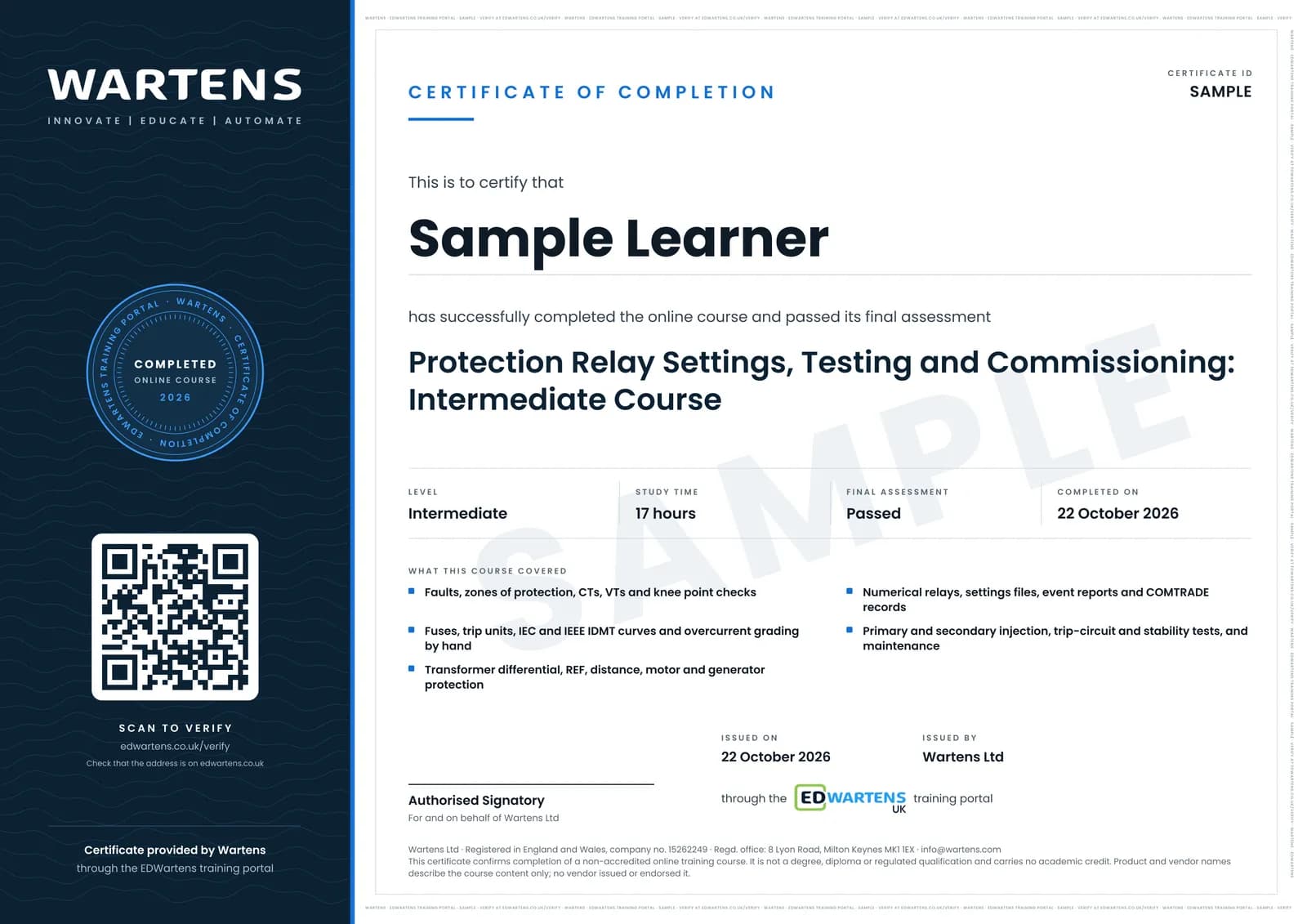
Sample certificate. Optional, issued when you pass the final exam.
- Level
- Intermediate
- Modules
- 13
- Video
- 24 hours
- Price
- Free
Outcome
What you will be able to do
Explain why power systems are protected and draw overlapping zones; calculate fault currents from fault levels; check a CT's class and knee point for its duty; read fuse, trip-unit and IDMT curves and calculate IEC and IEEE operating times; set and grade overcurrent and earth-fault relays by hand; set transformer differential and REF protection with ratio and vector compensation; set three-zone distance protection in secondary ohms; set motor and generator protection; manage settings files and read event reports and COMTRADE records; plan and interpret primary injection, CT excitation and secondary injection tests with expected times and tolerances; prove trip circuits and run stability tests; and plan relay maintenance at sensible intervals.
- Calculate fault currents from fault levels and draw overlapping zones of protection
- Check a protection CT's class and knee point against the voltage its duty needs
- Calculate IEC and IEEE inverse-time trip times and read fuse and LSIG trip-unit curves
- Set and grade overcurrent and earth-fault relays by hand with a stated margin
- Set transformer differential with ratio and vector compensation, and design a high-impedance REF scheme
- Set three-zone distance protection in secondary ohms, and motor and generator protection
- Manage relay settings files and read event reports and COMTRADE records
- Plan primary injection, CT excitation, secondary injection, trip-circuit and stability tests with expected results
Software
A spreadsheet (LibreOffice Calc is free) for the grading and test sheets. SEL ACSELERATOR QuickSet to see how settings are entered, and a COMTRADE viewer, are useful but optional. A relay test set is not required: every test is planned and its results worked on paper.
Hardware
None required. Access to a numerical relay and a secondary injection test set at work or college makes the testing modules far more useful.
Syllabus
13 modules
Each module has video lessons, notes and a short quiz. The final exam closes the course.
- Why protect: faults, zones, selectivity and speed2 lessonsLab
- CTs and VTs: ratio, class, knee point, polarity and saturation4 lessons
- Fuses, MCCB trip units and IDMT curves4 lessonsLab
- Overcurrent and earth-fault settings and grading by hand5 lessonsLab
- Transformer differential and restricted earth fault4 lessons
- Distance protection for lines: zones and reach5 lessons
- Motor and generator protection7 lessons
- Numerical relays: settings files, disturbance records and COMTRADE6 lessons
- Primary injection and CT tests: ratio, polarity and magnetising curve7 lessons
- Secondary injection: pick-up, timing and characteristic tests10 lessons
- Trip-circuit checks, stability tests and commissioning records5 lessons
- Relay maintenance, test intervals and faults commonly found4 lessons
- Final Assessment1 lesson
How it works
How this course works
- Watch the video lessonsOne module at a time, at your own pace.
- Take the module quizA short quiz at the end of each module shows what stuck.
- Keep your notesWrite in My notes beside each module and ask the trainer if you are stuck.
- Practise in the labOptionalTry a task from the module in the EDWartens Lab, in your browser.
- Sit the final examPass it once you have been through the modules.
- Certificate, if you want oneOptionalPaid, and only after you pass. Anyone can check it online.
EDWartens Lab
Practise this in the EDWartens Lab
Read the single line diagram, then isolate, lock and tag a motor bucket in the Lab's substation and MCC room.
Works alongside Protection Relays: Settings, Testing and Commissioning. The Lab is substation and mcc practice in your browser: no install, no hardware, free to use. Sign in as a learner and it opens with your account.
Levels to try with this course
MCC-01 · Substation and MCC lab
Read the single-line diagram
Open in the lab (opens in a new tab)MCC-06 · Substation and MCC lab
Fault level and breaker check
Open in the lab (opens in a new tab)MCC-05 · Substation and MCC lab
Grade the incomer relay
Open in the lab (opens in a new tab)
Optional. Skip it whenever you like: it never blocks your progress or your certificate.
Why practise in a lab
Technical work is judged on what you can do: wiring, commissioning, finding a fault. Doing a task yourself teaches more than watching it a second time, and a lab lets you try it safely before you meet real equipment. It does not replace working on real hardware.
- Practise safely, so a mistake costs nothing.
- The lab checks your work like a site test, so you know when it is right.
- Free, in your browser, with nothing to install.
Certificate
An optional certificate when you pass
Learning is free. Pass the final exam and you can have a certificate for £19, including VAT, with a number employers can check online. It records that you completed a free online course; it is not a regulated qualification or a CPD certificate.
- Your name, the course, its study time and your final exam score
- A unique certificate number and a QR code to its verification page
- Issued by Wartens Ltd; add it to your LinkedIn profile in one click
- Pay now or after you pass: it is issued the moment you pass the final
Credits
Who made the lessons
The video lessons belong to their creators. EDWartens wrote the study plan, notes, quizzes and the final exam.
- Romero Engineering Company
the Power System Protection and Control lessons: CT basics and saturation, calculating SEL and IEEE inverse-time trip times, overcurrent basics, neutral overcurrent of transformers, directional control, transformer differential TAP and compensation settings, harmonic restraint and blocking, restricted earth fault, distance protection, infeed, load encroachment, POTT, motor differential, trip event analysis, one-line and three-line drawings, breaker failure protection and symmetrical components
- OMICRONenergy
the Test Universe lessons (QuickCMC, Ramping, Overcurrent, State Sequencer, Advanced Differential, Advanced Distance, Annunciation Checker and XRIO test automation) and the CT Analyzer lessons on protection CT testing, multi-ratio CTs and remanence (playlist https://www.youtube.com/playlist?list=PLzmbZeI1bhu-bwtPfgxqAFE-LyK4DzX0h)
- NPTEL IIT Kharagpur
NPTEL Power System Protection lectures on current transformers, capacitor voltage transformers, overcurrent relay characteristics, overcurrent coordination, relay coordination with fuses and the numerical relaying concept
- IIT Roorkee July 2018
NPTEL Power System Protection and Switchgear lectures on the fundamentals of protective relaying, current-based relaying, distance protection of lines, transformer protection, induction motor protection, and testing, commissioning and maintenance of relays
- Hamada Diab
the Generator Protection Training Series (basics and earthing, 87G differential, reverse power, loss of field, thermal overload) and the Test Universe overcurrent module lesson on a Siemens 7SJ85
- Schweitzer Engineering Laboratories (SEL)
the ACSELERATOR QuickSet Device Manager overview, and setting SEL-751 overcurrent and time-overcurrent protection (https://www.youtube.com/watch?v=EtdRdL7Q1is)
- Testing Tech Tips
downloading and installing settings on SEL relays with ACSELERATOR QuickSet
- Power Globe
disturbance recorder analysis and the COMTRADE standard, and NERC PRC-005 protection system maintenance (https://www.youtube.com/watch?v=ciygSshMbr8)
- Doble Engineering
performing a current transformer excitation test
- Megger
performing a manual timing test on a protective relay
- TestGuy
circuit breaker electronic trip units explained
- Electrical Passionate
pre-close and post-close trip-circuit supervision, and calculating currents for a transformer REF stability test (https://www.youtube.com/watch?v=64P0_NgGq9w)
- Circuit Masterclass
protection zones and why they overlap
Questions
About this course
Who is this protection relay course for?
What do I need to know before starting?
Do I need a relay test set or software?
Which standards does it follow?
How is this different from the ETAP course?
How long does the course take?
Is the course free, and what certificate do I get?
What jobs does it lead to?
Want a live class and career support?
The Professional Module is five live days of Siemens PLC, HMI and SCADA with an instructor, then a resume session and a CPD certificate.