
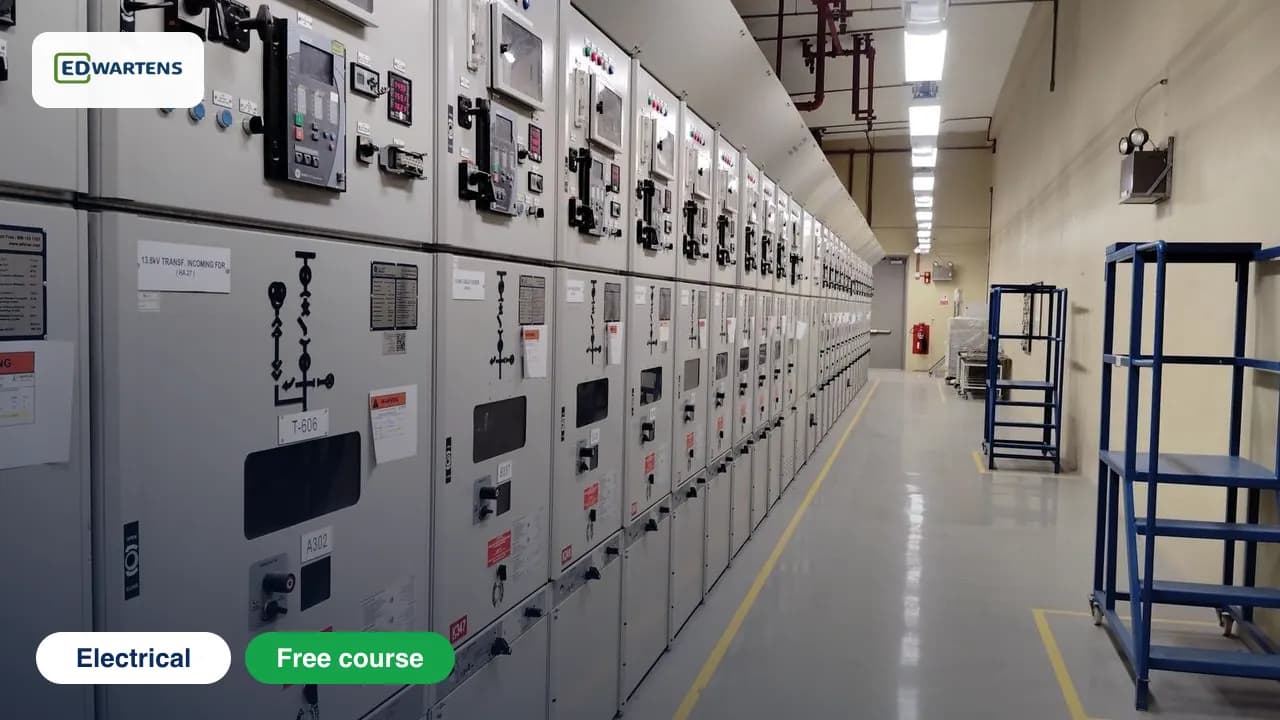
Free course · Electrical
Testing and Maintenance of Transformers and Switchgear
Run, read and record the field tests that keep transformers, breakers, cables, motors and batteries in service: insulation resistance and PI, winding resistance, turns ratio and vector group, tan delta and SFRA, oil and DGA, breaker timing and contact resistance, switchgear thermography, VLF cable tests, motor tests, earth resistance and battery capacity, then turn the results into a maintenance plan.
Free to learn. Verifiable certificate £19 when you pass the final exam (optional, VAT included).
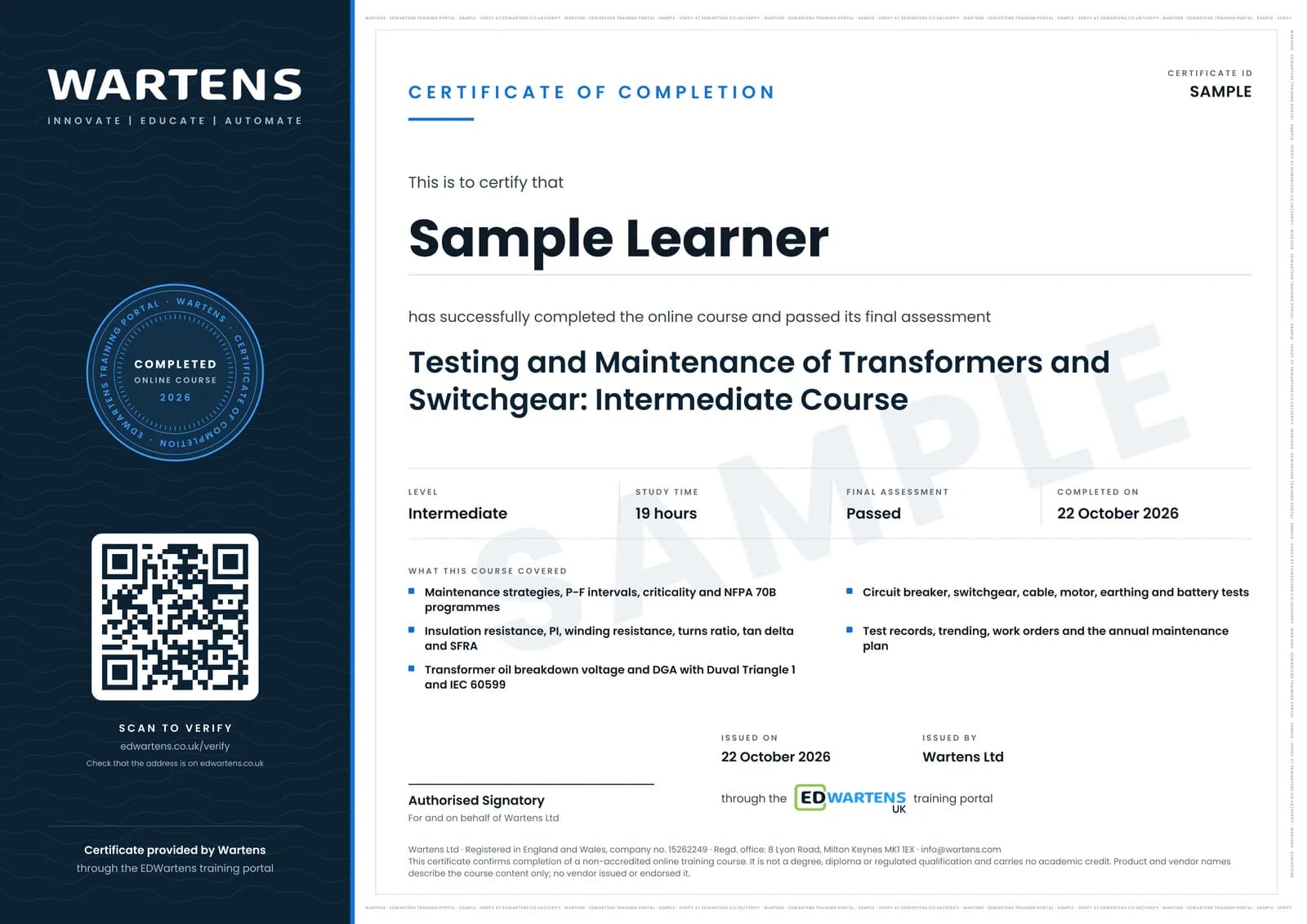
Sample certificate. Optional, issued when you pass the final exam.
- Level
- Intermediate
- Modules
- 13
- Video
- 26 hours
- Price
- Free
Outcome
What you will be able to do
Choose a maintenance strategy for each electrical asset and set intervals from P-F intervals and condition; run and interpret insulation resistance, DAR and PI tests with temperature correction; test transformer winding resistance, turns ratio, vector group and magnetising current; explain tan delta, capacitance and SFRA results; interpret oil breakdown voltage and DGA with Duval Triangle 1 and the IEC 60599 ratios; test circuit breaker contact resistance, timing, coil current, SF6 and vacuum integrity; maintain switchgear and MCCs with torque checks and thermography; test cables with insulation resistance, VLF and tan delta; test motors and look after bearings; measure earth resistance by fall of potential; maintain batteries and UPS; and turn test records into trends, work orders and an annual maintenance plan.
- Choose a maintenance strategy for each asset and set test intervals from the P-F interval and condition
- Run insulation resistance tests and calculate DAR and PI with temperature correction
- Test winding resistance, turns ratio, vector group and excitation current on a transformer
- Interpret tan delta, capacitance and SFRA results against their baselines
- Interpret oil breakdown voltage and DGA with Duval Triangle 1 and the IEC 60599 ratios
- Test circuit breaker contact resistance, timing, coil current, SF6 and vacuum integrity
- Maintain switchgear and MCCs with torque checks and thermography, and test cables, motors, earthing and batteries
- Turn test results into trends, prioritised work orders and an annual maintenance plan
Software
A spreadsheet (LibreOffice Calc is free) for test records, temperature corrections, Duval triangle percentages and trend lines. No test-set software is needed: every test is planned and its results worked on paper.
Hardware
None required. Access to an insulation tester, a micro-ohmmeter or a turns ratio tester at work or college makes the modules far more useful, but only under your site's safety rules and a permit to work.
Syllabus
13 modules
Each module has video lessons, notes and a short quiz. The final exam closes the course.
- Maintenance strategies: breakdown, preventive, predictive and RCM4 lessons
- Insulation resistance, PI and DAR with an insulation tester4 lessons
- Transformer tests: winding resistance, turns ratio, vector group and magnetising current9 lessons
- Tan delta and capacitance, and SFRA (concept)4 lessons
- Transformer oil: breakdown voltage and DGA interpretation (Duval triangle, IEC 60599)4 lessons
- Circuit breakers: contact resistance, timing, coil current, SF6 and vacuum checks7 lessons
- Switchgear and MCC preventive maintenance and torque checks2 lessonsLab
- Cables: insulation resistance, VLF and HV withstand, partial discharge (concept)4 lessons
- Motors: insulation, winding resistance, surge test (concept) and bearings8 lessonsLab
- Earth-resistance testing (fall of potential) and earth-continuity checks3 lessons
- Battery and UPS maintenance4 lessons
- Test records, trending and the annual maintenance plan1 lesson
- Final Assessment1 lesson
How it works
How this course works
- Watch the video lessonsOne module at a time, at your own pace.
- Take the module quizA short quiz at the end of each module shows what stuck.
- Keep your notesWrite in My notes beside each module and ask the trainer if you are stuck.
- Practise in the labOptionalTry a task from the module in the EDWartens Lab, in your browser.
- Sit the final examPass it once you have been through the modules.
- Certificate, if you want oneOptionalPaid, and only after you pass. Anyone can check it online.
EDWartens Lab
Practise this in the EDWartens Lab
Read the single line diagram, then isolate, lock and tag a motor bucket in the Lab's substation and MCC room.
Works alongside Testing and Maintenance of Transformers and Switchgear. The Lab is substation and mcc practice in your browser: no install, no hardware, free to use. Sign in as a learner and it opens with your account.
Levels to try with this course
MCC-02 · Substation and MCC lab
Safe isolation of an MCC bucket
Open in the lab (opens in a new tab)MCC-08 · Substation and MCC lab
Find a fault in the MCC
Open in the lab (opens in a new tab)
Optional. Skip it whenever you like: it never blocks your progress or your certificate.
Why practise in a lab
Technical work is judged on what you can do: wiring, commissioning, finding a fault. Doing a task yourself teaches more than watching it a second time, and a lab lets you try it safely before you meet real equipment. It does not replace working on real hardware.
- Practise safely, so a mistake costs nothing.
- The lab checks your work like a site test, so you know when it is right.
- Free, in your browser, with nothing to install.
Certificate
An optional certificate when you pass
Learning is free. Pass the final exam and you can have a certificate for £19, including VAT, with a number employers can check online. It records that you completed a free online course; it is not a regulated qualification or a CPD certificate.
- Your name, the course, its study time and your final exam score
- A unique certificate number and a QR code to its verification page
- Issued by Wartens Ltd; add it to your LinkedIn profile in one click
- Pay now or after you pass: it is issued the moment you pass the final
Credits
Who made the lessons
The video lessons belong to their creators. EDWartens wrote the study plan, notes, quizzes and the final exam.
- ElectroQC Hub
the Power Transformer Testing playlist on a 100 MVA transformer: nameplate, insulation resistance with and without the HV link, core insulation, winding resistance, turns ratio, vector group, excitation current, magnetic balance, short-circuit impedance, zero-sequence impedance, tan delta and capacitance, SFRA and dielectric frequency response
- Megger US
webinars on insulation resistance testing, transformer turns ratio best practice (https://www.youtube.com/watch?v=Q6dCoXA-xpc), power factor and DFR for insulation assessment (https://www.youtube.com/watch?v=kot_OkvL3F8) and practical VLF cable testing (https://www.youtube.com/watch?v=lDOwXagByV8)
- Megger
medium and high-voltage circuit breaker testing, VLF tan delta (https://www.youtube.com/watch?v=0aBUGgfNDIE) and partial discharge tests on cables (https://www.youtube.com/watch?v=U-UIcDAK3oM), partial discharge on surge testing with the Baker DX (https://www.youtube.com/watch?v=dBwVVWf_dR0), battery load testing practice (https://www.youtube.com/watch?v=INn6FO2WdUE) and running a battery discharge test (https://www.youtube.com/watch?v=XVqNf-Qrjjs)
- Megger Australia
a webinar on medium and high-voltage circuit breaker testing
- OMICRONenergy
circuit breaker testing with CIBANO 500 on medium and high-voltage breakers (https://www.youtube.com/watch?v=COvybldgmWw, https://www.youtube.com/watch?v=vCcvDZCJ6Ik) and the Basics of Rotating Machine Testing series: insulation resistance and PI, tan delta, voltage withstand, partial discharge and the Energy Talks overview (https://www.youtube.com/watch?v=-7tjscOg08w)
- AEMC Instruments
fall-of-potential earth resistance testing in full, and understanding ground resistance testing (https://www.youtube.com/watch?v=NP9Jbdi_k6s)
- Global Test Supply
a webinar with Megger on how ground testing keeps people safe: fall of potential, clamp-on and continuity testing
- Safety+Health YouTube channel
webinars on NFPA 70B and the maintenance of electrical equipment, and on building an electrical maintenance programme (https://www.youtube.com/watch?v=B_bneVLRNLc)
- Vector Power
understanding the 2023 edition of NFPA 70B
- Electrical Code Academy, Inc.
the NFPA 70B and NETA severity scales for electrical thermography
- GlobeCore company
the Duval triangle method for transformer diagnostics
- Oil Analysis
dissolved gas analysis interpretation
- Gulf Bio Analytical Group
dissolved gas analysis with a transformer oil gas analyser
- Motwane Manufacturing
the transformer oil breakdown voltage test procedure, demonstrated
- The Electrical Guy
vacuum circuit breaker maintenance and testing
- Electrical in Industry
SF6 gas testing for moisture, purity and decomposition products
- IPECLTD
what partial discharge is
- BakerInstrumentCo
surge tests on motor windings with the Baker DX
- TPC Training
a webinar on electric motor troubleshooting and maintenance techniques
- Electrical Superintendent
motor maintenance, and substation battery impedance testing (https://www.youtube.com/watch?v=q0RMYkSSFfE)
- ITM Instruments Inc.
a webinar on UPS and battery maintenance
- Reliability Centered Maintenance
what reliability-centred maintenance is
- Skill Torque
reliability-centred maintenance explained
- Engineering Presentations
the philosophy of reliability-centred maintenance
- Asset Insights
the three main maintenance strategies compared, used as the revision lesson before the final
Questions
About this course
Who is this transformer testing course for?
What do I need to know before starting?
Do I need test equipment or software?
Which standards does the course use?
How is this different from the Protection Relays course?
How long does the course take?
Is the course free, and what certificate do I get?
What jobs does it lead to?
Want a live class and career support?
The Professional Module is five live days of Siemens PLC, HMI and SCADA with an instructor, then a resume session and a CPD certificate.