

Free course · Energy
Energy Management and Energy Audit with ISO 50001
Energy management and energy auditing for plants and buildings: energy units and the electricity bill, the ISO 50001 energy management system clause by clause, energy reviews, EnPIs and baselines by regression and CUSUM, metering and IPMVP measurement and verification, the audit method and instruments, then motors, pumps and fans, compressed air, chillers and lighting, boilers and steam, and project economics in cost units.
Free to learn. Verifiable certificate £19 when you pass the final exam (optional, VAT included).
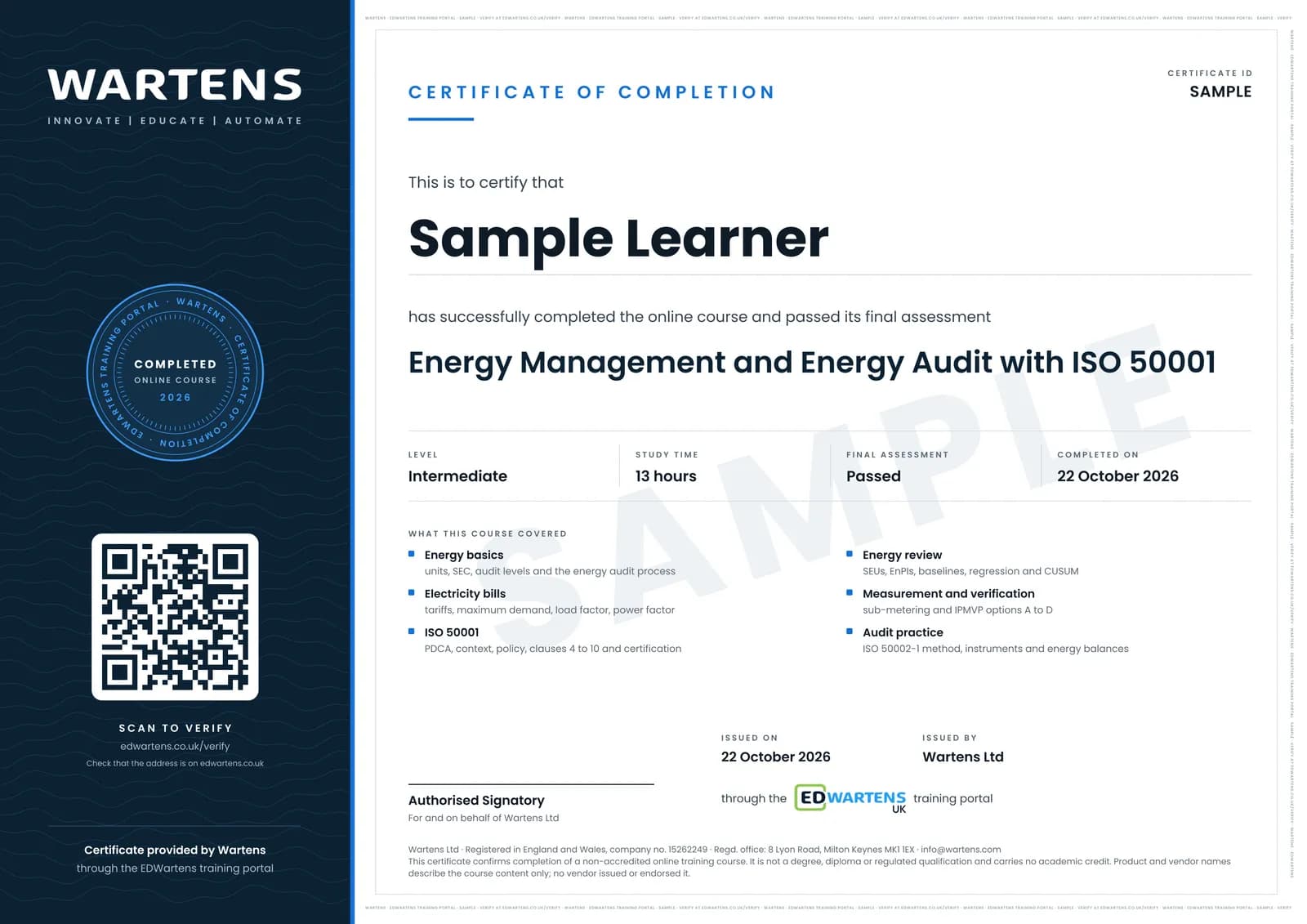
Sample certificate. Optional, issued when you pass the final exam.
- Level
- Intermediate
- Modules
- 15
- Video
- 20 hours
- Price
- Free
Outcome
What you will be able to do
Convert any site's energy into one unit and calculate specific energy consumption; read an industrial electricity bill and size power factor correction; build and audit an ISO 50001 energy management system from context and policy to management review; run an energy review, pick significant energy uses and set EnPIs and baselines by regression with CUSUM tracking; write an IPMVP measurement and verification plan; plan and carry out an energy audit with the right instruments; find and calculate savings in motors, pumps and fans, compressed air, chillers, lighting, boilers and steam; and rank measures by payback, NPV and IRR in a report management can act on.
- Convert electricity and fuel into GJ and toe and calculate specific energy consumption
- Read an industrial electricity bill and size power factor correction in kVAr
- Build an ISO 50001 energy management system from context and policy to management review
- Run an energy review, pick significant energy uses and set EnPIs and energy baselines
- Fit regression baselines, normalise energy and track savings with CUSUM charts
- Write an IPMVP measurement and verification plan and calculate avoided energy
- Plan an ISO 50002-1 energy audit and measure motors, pumps, fans, compressed air, chillers and boilers
- Rank energy conservation measures by payback, NPV and IRR in cost units and write the audit report
Software
A spreadsheet (LibreOffice Calc is free) for bills, regressions, CUSUM charts and project economics. The free US DOE MEASUR tool (desktop or measur.ornl.gov) for pump, fan, compressed air and steam calculations, and the free DOE 50001 Ready Navigator for the ISO 50001 steps. No paid software is needed.
Hardware
None. Any laptop with a browser is enough. Audit instruments (power analyser, flue gas analyser, thermal camera) are explained but not required.
Syllabus
15 modules
Each module has video lessons, notes and a short quiz. The final exam closes the course.
- Energy management and the energy audit: purpose, units and audit levels4 lessons
- Reading the electricity bill: tariffs, maximum demand, power factor and load factor3 lessonsLab
- ISO 50001 structure: PDCA, context, leadership and energy policy (clauses 1 to 5)5 lessons
- ISO 50001 planning: energy review, significant energy uses, EnPIs, baselines and action plans3 lessons
- ISO 50001 support, operation, performance evaluation, improvement and certification (clauses 7 to 10)6 lessons
- Energy baselines and EnPIs by regression, normalisation and CUSUM4 lessons
- Metering, monitoring and measurement and verification (IPMVP and ISO 50015)3 lessonsLab
- The energy audit method: planning, walk-through, instruments and the energy balance4 lessons
- Electric motors: efficiency classes, load estimation and replace or rewind decisions4 lessons
- Pumps and fans: system curves, affinity laws and flow control4 lessons
- Compressed air systems: generation, leaks, pressure and heat recovery4 lessons
- Chillers, cooling towers and lighting: measuring and improving efficiency6 lessons
- Boilers, steam and condensate: efficiency, combustion and losses5 lessons
- Energy project economics and the energy audit report5 lessonsLab
- Final assessment1 lesson
How it works
How this course works
- Watch the video lessonsOne module at a time, at your own pace.
- Take the module quizA short quiz at the end of each module shows what stuck.
- Keep your notesWrite in My notes beside each module and ask the trainer if you are stuck.
- Practise in the labOptionalTry a task from the module in the EDWartens Lab, in your browser.
- Sit the final examPass it once you have been through the modules.
- Certificate, if you want oneOptionalPaid, and only after you pass. Anyone can check it online.
EDWartens Lab
Practise this in the EDWartens Lab
Correct a plant's power factor and read a month of energy meters to see where the energy goes and which upgrade saves most.
Works alongside Energy Management and Energy Audit with ISO 50001. The Lab is substation and mcc practice in your browser: no install, no hardware, free to use. Sign in as a learner and it opens with your account.
Levels to try with this course
MCC-07 · Substation and MCC lab
Correct the power factor
Open in the lab (opens in a new tab)DC-05 · AI Data Centre
PUE from a month of meters
Open in the lab (opens in a new tab)
Optional. Skip it whenever you like: it never blocks your progress or your certificate.
Why practise in a lab
Technical work is judged on what you can do: wiring, commissioning, finding a fault. Doing a task yourself teaches more than watching it a second time, and a lab lets you try it safely before you meet real equipment. It does not replace working on real hardware.
- Practise safely, so a mistake costs nothing.
- The lab checks your work like a site test, so you know when it is right.
- Free, in your browser, with nothing to install.
Certificate
An optional certificate when you pass
Learning is free. Pass the final exam and you can have a certificate for £19, including VAT, with a number employers can check online. It records that you completed a free online course; it is not a regulated qualification or a CPD certificate.
- Your name, the course, its study time and your final exam score
- A unique certificate number and a QR code to its verification page
- Issued by Wartens Ltd; add it to your LinkedIn profile in one click
- Pay now or after you pass: it is issued the moment you pass the final
Credits
Who made the lessons
The video lessons belong to their creators. EDWartens wrote the study plan, notes, quizzes and the final exam.
- TNV Akademi
the ISO 50001:2018 clause-by-clause series: what the standard is, scope, terms, context, leadership, planning, support, operation, performance evaluation, improvement and the certification process
- BSI Group
the four-part ISO 50001 series: getting started, important terms, measuring performance and top ten tips
- Daniel Burke
choosing between ASHRAE level 1, 2 and 3 energy audits, and power factor penalties and correction strategies
- Kit Oung: Strategies for People, Planet, Profit
the basics of implementing ISO 50001:2018 and how to build an energy baseline
- Slipstream
what a demand charge is on an electricity bill
- aee
power factor penalties on energy bills
- Kenji Explains
regression analysis in a spreadsheet, used for energy baselines
- Bleed Electrical
energy action planning and CUSUM charts
- MrAfza79
a worked CUSUM lecture for energy management
- Energy Manager Support Services
interpreting a CUSUM chart
- GridPoint
how IPMVP energy savings are calculated
- EMSDGOVHK
selecting a suitable IPMVP M&V option
- ASHRAE RAL
the introduction to measurement and verification lecture
- Sustainability Education Academy
the energy auditing 101 webinar on the audit method
- Annette Gorelick
an ASHRAE level 1 walk-through audit
- Advanced Test Equipment Corp. (ATEC)
how to use a three-phase power analyser
- MRU Instruments
how a flue gas analyser works
- ABB Motors and Generators
why electric motor efficiency matters
- Siemens Knowledge Hub
IE4 motors and tools for selecting efficient motors
- Bureau of Energy Efficiency
replacing conventional motors with energy-efficient motors
- MissionMotivateMillionMinds-Prof.K.NagabhushanRaju
motor types, performance parameters and energy efficiency aspects
- The Engineering Mindset
pump curve basics and chiller COP, efficiency improvements and replacement savings
- ABB Drives US
the affinity laws and variable frequency drive savings
- SPEC e-Learn
centrifugal pump affinity laws and pump resizing
- Kevin Dorma Consulting
when a VFD is the right way to control centrifugal pump flow
- Better Buildings & Better Plants
the US DOE compressed air energy-saving tip
- Save on Energy
how compressed air projects save energy
- FS-Elliott
the hidden energy and life-cycle cost of compressed air
- Kaeser USA
compressed air fundamentals, air audits and heat recovery
- James Curnow
calculating energy savings for LED lighting
- Babu Thomas
energy saving in lighting systems
- Energy, Climate & Copper | Webinar Series
the webinar on calculating energy saving measures for indoor lighting
- InstMates
how flue gas oxygen affects boiler combustion and efficiency
- IIT Roorkee July 2018
the boiler performance lecture
- MEP Academy
how steam traps work
- WARE Boilers
a steam study of traps, condensate return and insulation
- ActOnEnergyBusiness
saving energy in process steam systems, and calculating payback for efficiency projects
- The Finance Storyteller
net present value and internal rate of return
- Ed Kaplan
payback and NPV applied to an HVAC system
- SustainSight
life-cycle costing
Questions
About this course
What is this energy audit and ISO 50001 course?
Who is the energy management course for?
Do I need any prerequisites or paid software?
Which standards does the energy audit course cover?
How long does the course take?
Is the course free, and what certificate do I get?
Does this course prepare me for the BEE energy manager and energy auditor exam or ISO 50001 auditor training?
What jobs does energy auditing lead to, and is it in demand in the Gulf?
Want a live class and career support?
The Professional Module is five live days of Siemens PLC, HMI and SCADA with an instructor, then a resume session and a CPD certificate.