

Free course · Safety
HAZOP and Process Safety Management
This free course teaches HAZOP and process safety management for oil, gas, chemical and refinery sites: why major accidents happen, hazard identification, reading P&IDs into nodes, HAZOP guidewords and deviations, risk matrices and ALARP, LOPA, bow-ties and management of change. It explains the UK COMAH Regulations beside the OSHA and CCPS frameworks. It suits UK process, chemical, instrument and safety engineers and graduates. It supports process safety work, but it does not qualify you to lead HAZOP studies.
HAZOP and Process Safety Management is a free online intermediate Safety course with 15 modules, about 22 hours of video lessons. Learning is free; an optional verifiable certificate costs £19 including VAT when you pass the final exam. Last updated 28 October 2026.
Free to learn. Verifiable certificate £19 when you pass the final exam (optional, VAT included).
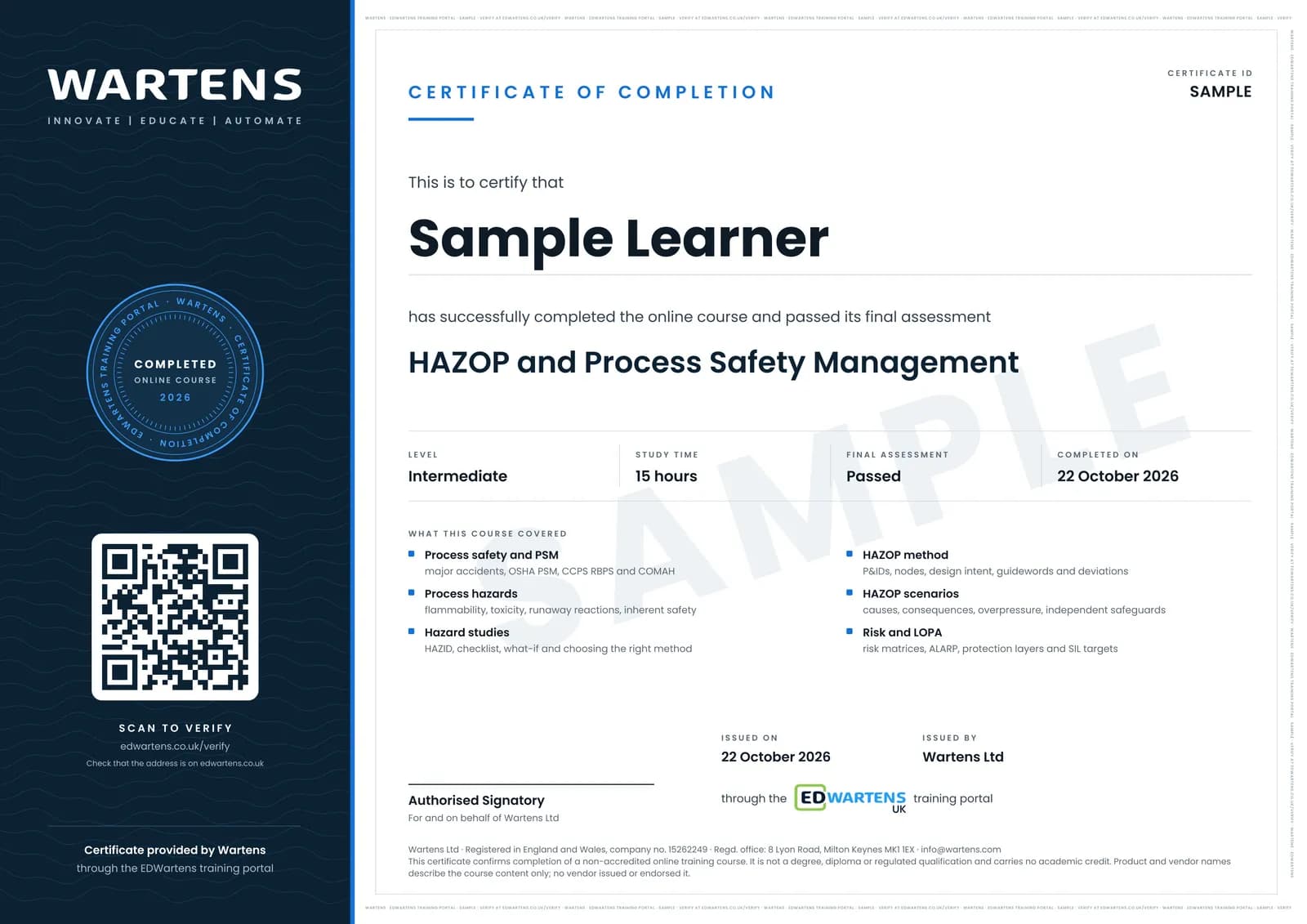
Sample certificate. Optional, issued when you pass the final exam.
- Level
- Intermediate
- Modules
- 15
- Video
- 22 hours
- Price
- Free
Video time only: reading the notes, the quizzes and the final exam take extra time, at your own pace.
Outcome
What you will be able to do
Explain why process safety is managed separately from personal safety; map a site's documents to the OSHA PSM and CCPS RBPS elements; judge fire, explosion, toxic and reactive hazards from data sheets; choose between HAZID, checklist, what-if and HAZOP; divide a P&ID into nodes with written design intent; generate deviations with guidewords and follow each through causes, consequences and independent safeguards; rank risk on a matrix and explain ALARP; plan, facilitate, record and close out a HAZOP; carry a scenario through LOPA to a SIL target; draw a bow-tie with real barriers; run management of change and a pre-startup safety review; learn from CSB investigations; and report API RP 754 process safety indicators.
- Explain how process safety differs from personal safety, using BP Texas City and other major accidents
- Map a site's documents to the 14 OSHA PSM elements and the CCPS risk based process safety pillars
- Judge fire, explosion, toxic and runaway hazards from safety data sheets and Le Chatelier's rule
- Choose between HAZID, checklist, what-if, HAZOP, FMEA and fault tree analysis for a given job
- Divide a P&ID into HAZOP nodes, write design intent and apply guidewords to find deviations
- Record causes, consequences and truly independent safeguards, and rank risk on a 5 by 5 matrix
- Carry a HAZOP scenario through LOPA to a SIL target and draw a bow-tie with real barriers
- Run management of change and PSSR, and learn from CSB investigations and API RP 754 indicators
Software
A spreadsheet (LibreOffice Calc is free) for the HAZOP worksheet, the risk matrix and the LOPA arithmetic, and a PDF reader for P&IDs. Commercial PHA software appears in some lessons but is not needed.
Hardware
None. Any laptop with a browser is enough. Access to a P&ID from your own plant makes the practice tasks real, if your employer allows it.
Syllabus
15 modules
Each module has video lessons, notes and a short quiz. The final exam closes the course.
- Process safety and why major accidents happen3 lessons
- Process safety management systems: OSHA PSM, CCPS RBPS and COMAH4 lessons
- Process hazards: fire, explosion, toxic release, runaway and overpressure4 lessons
- Choosing a hazard study: HAZID, checklist, what-if and HAZOP5 lessons
- Reading P&IDs and dividing a plant into HAZOP nodes4 lessonsLab
- The HAZOP method: parameters, guidewords and deviations4 lessons
- Causes, consequences and safeguards: overpressure and other scenarios8 lessons
- Risk ranking: severity, likelihood, risk matrices and ALARP4 lessons
- Running and recording a HAZOP: team, sessions, worksheet and close-out2 lessons
- Layers of protection analysis (LOPA): from HAZOP scenario to SIL target3 lessons
- Bow-tie analysis: threats, barriers and consequences on one page4 lessons
- Keeping the plant safe: management of change, PSSR and mechanical integrity4 lessons
- Learning from incidents: investigation, CSB case studies and process safety indicators4 lessons
- Capstone: HAZOP of a production separator node2 lessons
- Final assessment1 lesson
How it works
How this course works
- Watch the video lessonsOne module at a time, at your own pace.
- Take the module quizA short quiz at the end of each module shows what stuck.
- Keep your notesWrite in My notes beside each module and ask the trainer if you are stuck.
- Practise in the labOptionalTry a task from the module in the EDWartens Lab, in your browser.
- Sit the final examPass it once you have been through the modules.
- Certificate, if you want oneOptionalPaid, and only after you pass. Anyone can check it online.
EDWartens Lab
Practise this in the EDWartens Lab
Calibrate a 4 to 20 mA transmitter, tune a level or flow loop and read the trend in the Lab's process simulator.
Works alongside HAZOP and Process Safety Management. The Lab is process control practice in your browser: no install, no hardware, free to use. Sign in as a learner and it opens with your account.
Levels to try with this course
PRC-01 · Process lab
Read the P&ID
Open in the lab (opens in a new tab)
Optional. Skip it whenever you like: it never blocks your progress or your certificate.
Why practise in a lab
Technical work is judged on what you can do: wiring, commissioning, finding a fault. Doing a task yourself teaches more than watching it a second time, and a lab lets you try it safely before you meet real equipment. It does not replace working on real hardware.
- Practise safely, so a mistake costs nothing.
- The lab checks your work like a site test, so you know when it is right.
- Free, in your browser, with nothing to install.
Certificate
An optional certificate when you pass
Learning is free. Pass the final exam and you can have a certificate for £19, including VAT, with a number employers can check online. It records that you completed a free online course; it is not a regulated qualification or a CPD certificate.
- Your name, the course, its study time and your final exam score
- A unique certificate number and a QR code to its verification page
- Issued by Wartens Ltd; add it to your LinkedIn profile in one click
- Pay now or after you pass: it is issued the moment you pass the final
Credits
Who made the lessons
The video lessons belong to their creators. EDWartens wrote the study plan, notes, quizzes and the final exam.
- USCSB
the public CSB investigation videos: BP Texas City, T2 Laboratories, reactive hazards, Valero McKee (Fire from Ice), Philadelphia Energy Solutions, Husky Superior and LyondellBasell La Porte
- yousef shafiei
the OSHA PSM series: introduction, OSHA PSM against CCPS RBPS, process safety information, employee participation, operating procedures, PHA, inherently safer design, management of change, PSSR and mechanical integrity
- Icarus-ORM Academy
the HAZOP crash course and PHA lessons: what a HAZOP is, P&ID details, the overpressure scenarios, PSVs, BPCS against SIS, risk-based decisions, probability assessment and LOPA
- Promoting Safety Engineering
breaking P&IDs into nodes, node mark-up, preparing for and facilitating a HAZOP workshop (two sessions)
- IIT Roorkee July 2018
NPTEL Chemical Process Safety lectures on flammability, hazard identification and HAZOP, safety reviews and risk assessment, and bow-tie analysis
- Product Process People
HAZOP with practical examples and the LOPA crash course
- Risk Management Professionals, Inc. (RMPCorp)
common causes in HAZOP applications
- Six Sigma Development Solutions Inc.
the 14 elements of OSHA process safety management in overview
- iLearna
the difference between HAZID and HAZOP
- ProsTask
what-if analysis and hazard checklists
- Mohammad J P Golshani
how to define HAZOP nodes
- HAZOP Facilitator
looking up a HAZOP risk matrix
- Gemba Academy
what bow-tie analysis is
- Enablon
the bow-tie method explained
- Salus: Experts In Safety
risk assessment with bow-tie diagrams
- Pipeline and Hazardous Materials Safety Administration
a US regulator's session on LNG best practice and API RP 754 process safety performance indicators
- JOGI SafeTech
a HAZOP study training workshop used in the capstone
Jobs
Jobs this course can lead to
The skills in this course are used in quality and project engineering work, for example as a process safety engineer and a process engineer. No course can promise a job, and employers also look for experience, so read what live adverts ask for.
Questions
About this course
Last reviewed 28 October 2026.
Does this course qualify me to lead HAZOP studies?
Does the course cover UK process safety law such as COMAH?
What do I need before starting the HAZOP course?
What does the HAZOP and Process Safety Management course cover?
Where does HAZOP and Process Safety Management start and where does it end?
How long is HAZOP and Process Safety Management?
Can I practise HAZOP and Process Safety Management in the browser?
Who is the HAZOP course for?
What do I need before starting, and is any software required?
Which standards and regulations does the course cover?
How long does the HAZOP course take?
Is the course free, and what certificate do I get?
What jobs does HAZOP and process safety knowledge lead to, and is it used in the Gulf?
Want a live class and career support?
The Professional Module is five live days of Siemens PLC, HMI and SCADA with an instructor, then career sessions with our engineers and a CPD certificate.