
Free course · Instrumentation
Control Valves and Flow Measurement: Sizing and Selection
Choose and size the right control valve, actuator and positioner, and the right flowmeter: valve types and characteristics, Cv and the installed characteristic, liquid sizing with flashing and cavitation, gas and steam sizing and noise, fail action and spring sizing, the valve datasheet, orifice plates to ISO 5167, magnetic, vortex, ultrasonic, Coriolis and thermal meters, installation and loop troubleshooting.
Free to learn. Verifiable certificate £19 when you pass the final exam (optional, VAT included).
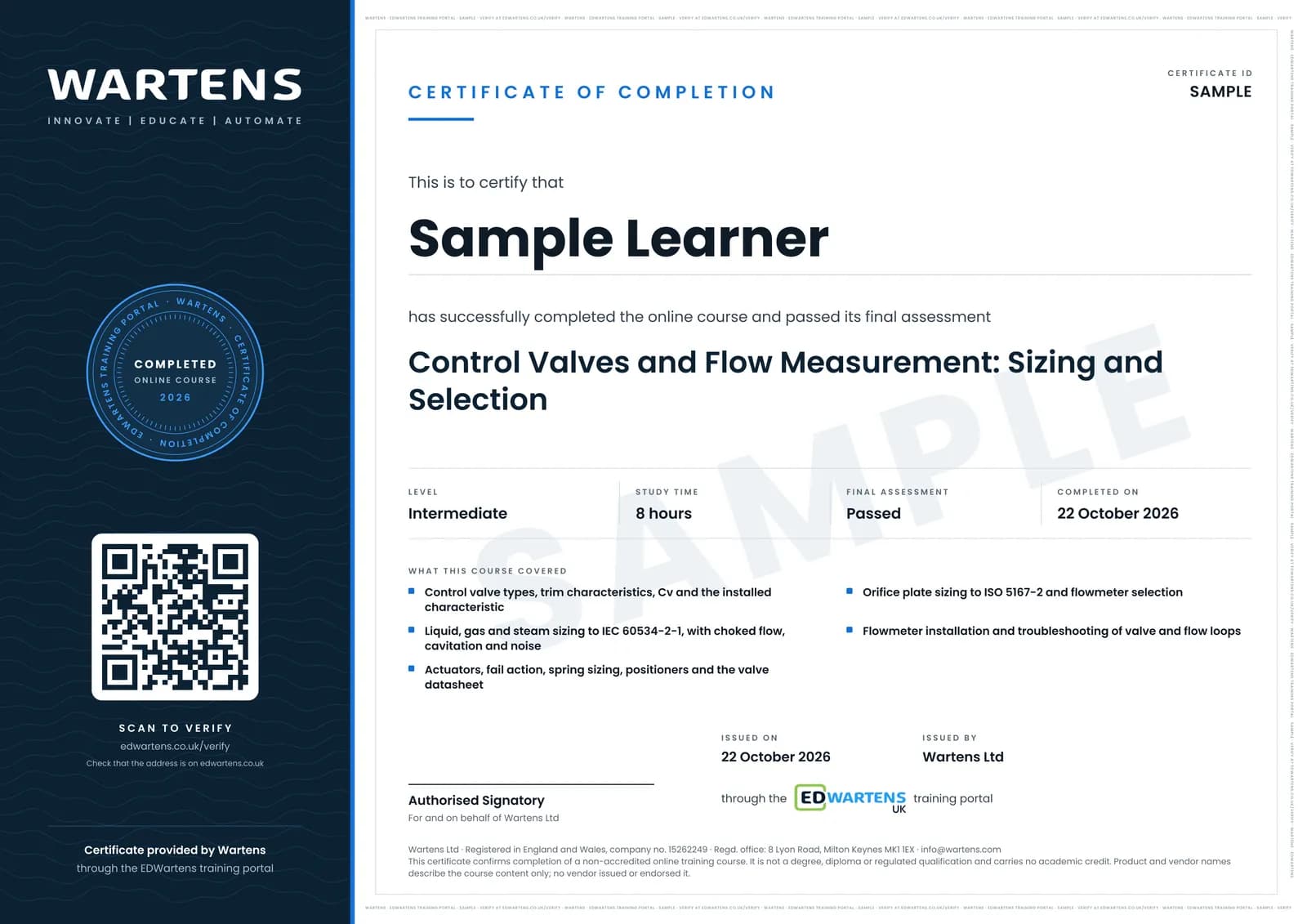
Sample certificate. Optional, issued when you pass the final exam.
- Level
- Intermediate
- Modules
- 13
- Video
- 14 hours
- Price
- Free
Outcome
What you will be able to do
Choose a control valve body and trim for a duty; calculate Cv and Kv and the installed characteristic from valve authority; size liquid valves to IEC 60534-2-1 and check for choked flow, flashing and cavitation; size gas and steam valves with the expansion factor and check outlet velocity and noise; choose fail action and size an actuator spring; specify positioners, boosters, solenoids and limit switches; fill in a control valve datasheet; size an orifice plate to ISO 5167 and check its limits; choose between DP, magnetic, vortex, ultrasonic, Coriolis and thermal meters; install meters with the right straight runs, impulse lines and grounding; and diagnose stiction, hunting and drift.
- Choose globe, ball, butterfly or eccentric plug valves and the right trim characteristic
- Calculate Cv and Kv, valve authority and the installed characteristic
- Size liquid valves to IEC 60534-2-1 and check choked flow, flashing and cavitation
- Size gas and steam valves with the expansion factor, and check noise and outlet velocity
- Choose fail action, size the actuator spring and specify positioners and accessories
- Fill a control valve datasheet and check travel at maximum, normal and minimum flow
- Size an orifice plate to ISO 5167-2 and choose between DP, magnetic, vortex, ultrasonic, Coriolis and thermal meters
- Install meters correctly and diagnose stiction, hunting and drift in flow loops
Software
A spreadsheet for the sizing calculations (LibreOffice Calc is free). Vendor sizing tools such as Fisher Specification Manager and the free online sizing tools from valve and flowmeter makers are used to check hand calculations; none is required.
Hardware
None.
Syllabus
13 modules
Each module has video lessons, notes and a short quiz. The final exam closes the course.
- Control valve types and what the trim does3 lessonsLab
- Cv, pressure drop and the installed characteristic5 lessons
- Liquid sizing to IEC 60534 and ISA-75: flashing and cavitation4 lessons
- Gas and steam sizing, and valve noise5 lessons
- Actuators, fail action and spring sizing3 lessonsLab
- Positioners, boosters, solenoids and limit switches4 lessonsLab
- The control valve datasheet and specification2 lessons
- Flow measurement principles: accuracy, turndown and selection3 lessons
- Differential pressure flow: orifice plates to ISO 5167, and venturis4 lessons
- Magnetic, vortex, ultrasonic, Coriolis and thermal: a selection table5 lessons
- Installation: straight runs, impulse lines and magmeter grounding5 lessons
- Troubleshooting valve and flow loops: stiction, hunting and drift1 lessonLab
- Final Assessment1 lesson
How it works
How this course works
- Watch the video lessonsOne module at a time, at your own pace.
- Take the module quizA short quiz at the end of each module shows what stuck.
- Keep your notesWrite in My notes beside each module and ask the trainer if you are stuck.
- Practise in the labOptionalTry a task from the module in the EDWartens Lab, in your browser.
- Sit the final examPass it once you have been through the modules.
- Certificate, if you want oneOptionalPaid, and only after you pass. Anyone can check it online.
EDWartens Lab
Practise this in the EDWartens Lab
Calibrate a 4 to 20 mA transmitter, tune a level or flow loop and read the trend in the Lab's process simulator.
Works alongside Control Valves and Flow Measurement: Sizing and Selection. The Lab is process control practice in your browser: no install, no hardware, free to use. Sign in as a learner and it opens with your account.
Levels to try with this course
PRC-01 · Process lab
Read the P&ID
Open in the lab (opens in a new tab)PRC-05 · Process lab
Flow loop and control valve
Open in the lab (opens in a new tab)
Optional. Skip it whenever you like: it never blocks your progress or your certificate.
Why practise in a lab
Technical work is judged on what you can do: wiring, commissioning, finding a fault. Doing a task yourself teaches more than watching it a second time, and a lab lets you try it safely before you meet real equipment. It does not replace working on real hardware.
- Practise safely, so a mistake costs nothing.
- The lab checks your work like a site test, so you know when it is right.
- Free, in your browser, with nothing to install.
Certificate
An optional certificate when you pass
Learning is free. Pass the final exam and you can have a certificate for £19, including VAT, with a number employers can check online. It records that you completed a free online course; it is not a regulated qualification or a CPD certificate.
- Your name, the course, its study time and your final exam score
- A unique certificate number and a QR code to its verification page
- Issued by Wartens Ltd; add it to your LinkedIn profile in one click
- Pay now or after you pass: it is issued the moment you pass the final
Credits
Who made the lessons
The video lessons belong to their creators. EDWartens wrote the study plan, notes, quizzes and the final exam.
- Fisher Valves & Instruments (Emerson)
the lessons on the types of control valves, the Control-Disk rotary valve, sizing a control valve for liquid flow and for compressible fluid, the cavitation demonstration, the noise demonstration and treating valve noise with Whisper trim
- Endress+Hauser
the electromagnetic, vortex, ultrasonic and Coriolis flow measuring principle animations
- Rosemount (Emerson)
how differential pressure flow works, how conditioning orifice plates work, installing the 405 conditioning orifice with a centering ring, grounding procedures for magnetic flowmeters and the plugged impulse line diagnostic
- Kimray
the lessons on the three types of control valve trim and on selecting and sizing a control valve
- Control Station
the webinar on how stiction disrupts PID control and what to do about it
- HardHat Engineer
the lessons on fail open, fail closed and fail lock, and on the types of flowmeters in piping
- Asad (I&C Engineer)
the lesson on how a valve positioner works, and the two long webinars on control valve datasheet preparation and control valve knowledge
- IMI Climate Control
the webinar on sizing and selection of control valves, including authority
- Douglas Price
the lecture on control valve basics
- Boostrand ChemE
the lesson on sizing parameters and inherent and installed characteristics
- Engineering Design & Management
the lesson on control valve flow characteristics and sizing
- Simple Science
the Cv calculation for liquids
- Instrumentation Tools
the lesson on cavitation, flashing and choked flow
- BAS Simplified
the steam control valve sizing lesson with a worked example
- Process Simulation
the walk-through of gas valve sizing in Fisher sizing software
- Technical Engineering School
the lesson on how pneumatic actuators work and their types
- REXA
the clip on spring fail-safe actuation
- Smart Automation Solutions
the DVC6200 positioner installation and stroking clip
- Instrument Specialties
the lesson on pneumatic volume boosters on valve systems
- Process Systems
the lesson on limit switch boxes for pneumatic actuators
- JUMO
the basics of flow measurement
- 3D DECODE
the comparison of DP, vortex, magnetic and Coriolis technologies for selection
- Hibiscus Pink
the lesson relating Bernoulli's theorem to the ISO 5167 mass flow equation
- Set-Point
the orifice plate flow and pressure drop calculation
- Flow Control Magazine (Sierra Instruments video)
the Sierra video on how thermal mass flow meter technology works
- ifm efector USA
the lesson on installing a magnetic flowmeter
- Calibration Academy
the lesson on DP transmitter installation for flow and level
Questions
About this course
Who is this control valve sizing course for?
Is the course free to learn?
Which standards does it follow?
Do I need Fisher Specification Manager or other sizing software?
How long does it take?
What certificate do I get?
How is it different from the Industrial Instrumentation course?
What job does it help with?
Want a live class and career support?
The Professional Module is five live days of Siemens PLC, HMI and SCADA with an instructor, then a resume session and a CPD certificate.