

Free course · Safety
Safety Instrumented Systems and SIL to IEC 61511
The protection layer that acts once control has already failed: why the SIS is kept apart from the BPCS, safety instrumented functions written with a trip point and a safe state, LOPA and the SIL target, PFDavg arithmetic, sensors, logic solvers and shutdown valves, de-energise against energise to trip, bypass and MOS discipline, 1oo2 and 2oo3 voting, common cause failure, the safety requirements specification, application programs, validation, proof testing and repair deferral.
Free to learn. Verifiable certificate £19 when you pass the final exam (optional, VAT included).
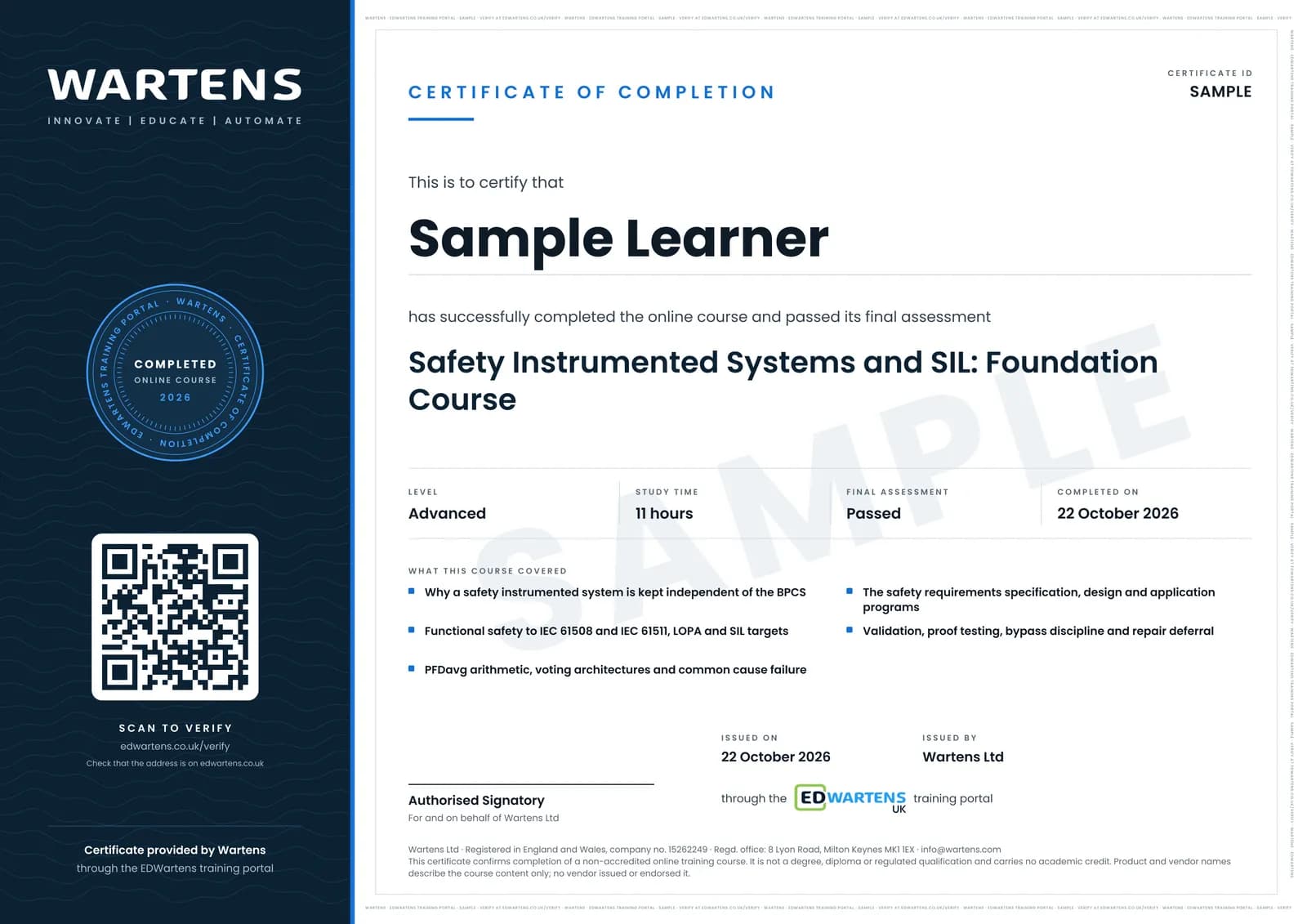
Sample certificate. Optional, issued when you pass the final exam.
- Level
- Advanced
- Modules
- 15
- Video
- 16 hours
- Price
- Free
Outcome
What you will be able to do
Explain why a safety instrumented system is kept independent of the control system; write a safety instrumented function with a trip point, a safe state and a response time; follow a LOPA to a SIL target and check it against a PFDavg calculation; choose a voting architecture from the SIL target and the cost of a spurious trip; find the common causes that quietly defeat redundancy; read a safety requirements specification and name what is missing; plan a validation test and a proof test that actually finds dangerous undetected failures; and run bypasses, overrides and repair deferrals with a record that stands up to an audit.
- Say in one paragraph why a safety instrumented system is kept independent of the basic process control system
- Write a safety instrumented function with a trip point, a safe state and a response time a designer can build from
- Follow a LOPA to a SIL target and check it with a PFDavg calculation and a proof test interval
- Choose between 1oo1, 1oo2, 2oo2 and 2oo3 using the SIL target and the cost of one spurious shutdown
- Find the shared impulse lines, supplies and procedures that defeat redundancy, and read a safety requirements specification for what is missing
- Plan a validation test and a proof test, and run bypasses, overrides and repair deferrals with an auditable record
Software
None required.
Hardware
None required. Access to a plant P&ID and a cause and effect chart makes the practice tasks real.
Syllabus
15 modules
Each module has video lessons, notes and a short quiz. The final exam closes the course.
- Why a plant needs a safety layer4 lessons
- BPCS, SIS and the safety instrumented function3 lessons
- Functional safety, IEC 61508, IEC 61511 and LOPA3 lessons
- PFD and the reliability arithmetic behind SIL3 lessons
- The SIS loop end to end4 lessons
- Trip philosophy, fail-safe design and overrides4 lessonsLab
- Redundancy, voting and safety architecture3 lessons
- Common cause failure and how SIS equipment fails4 lessons
- The safety requirements specification4 lessons
- SIS design and the documents it produces2 lessons
- The application program in the safety logic solver3 lessons
- Validation, verification and the SIS work process4 lessonsLab
- Proof testing instruments and valves4 lessonsLab
- Maintenance, repair deferral and engineering practice4 lessons
- Final assessment0 lessons
How it works
How this course works
- Watch the video lessonsOne module at a time, at your own pace.
- Take the module quizA short quiz at the end of each module shows what stuck.
- Keep your notesWrite in My notes beside each module and ask the trainer if you are stuck.
- Practise in the labOptionalTry a task from the module in the EDWartens Lab, in your browser.
- Sit the final examPass it once you have been through the modules.
- Certificate, if you want oneOptionalPaid, and only after you pass. Anyone can check it online.
EDWartens Lab
Practise this in the EDWartens Lab
Calibrate a 4 to 20 mA transmitter, tune a level or flow loop and read the trend in the Lab's process simulator.
Works alongside Safety Instrumented Systems and SIL to IEC 61511. The Lab is process control practice in your browser: no install, no hardware, free to use. Sign in as a learner and it opens with your account.
Levels to try with this course
PRC-05 · Process lab
Flow loop and control valve
Open in the lab (opens in a new tab)PRC-08 · Process lab
Site acceptance and fault finding
Open in the lab (opens in a new tab)
Optional. Skip it whenever you like: it never blocks your progress or your certificate.
Why practise in a lab
Technical work is judged on what you can do: wiring, commissioning, finding a fault. Doing a task yourself teaches more than watching it a second time, and a lab lets you try it safely before you meet real equipment. It does not replace working on real hardware.
- Practise safely, so a mistake costs nothing.
- The lab checks your work like a site test, so you know when it is right.
- Free, in your browser, with nothing to install.
Certificate
An optional certificate when you pass
Learning is free. Pass the final exam and you can have a certificate for £19, including VAT, with a number employers can check online. It records that you completed a free online course; it is not a regulated qualification or a CPD certificate.
- Your name, the course, its study time and your final exam score
- A unique certificate number and a QR code to its verification page
- Issued by Wartens Ltd; add it to your LinkedIn profile in one click
- Pay now or after you pass: it is issued the moment you pass the final
Credits
Who made the lessons
The video lessons belong to their creators. EDWartens wrote the study plan, notes, quizzes and the final exam.
- Instrumentation Tools
the Safety Instrumented System training playlist, which supplies every video lesson in this course, from BPCS against SIS through LOPA, SIL and PFD to voting, the SRS, application programs, validation, proof testing and maintenance
Questions
About this course
Is the course really free?
What certificate do I get?
Is this the same as a TUV or exida functional safety engineer certification?
Who made the video lessons?
What should I know before starting?
Do I need any software, hardware or a licence?
Does the course cover HAZOP?
Who is it for?
Want a live class and career support?
The Professional Module is five live days of Siemens PLC, HMI and SCADA with an instructor, then a resume session and a CPD certificate.