
Free course · Quality management
Electrical and Instrumentation QA/QC Inspection
Inspect electrical and instrumentation construction the way an EPC site expects: the QA/QC role and the ITP, method statements and inspection requests, material receiving, cable containment and laying, glanding and terminations, insulation resistance and continuity records, earthing and bonding, equipment and instrument installation, loop checks from the QC side, NCRs, punch lists and the handover dossier.
Free to learn. Verifiable certificate £19 when you pass the final exam (optional, VAT included).
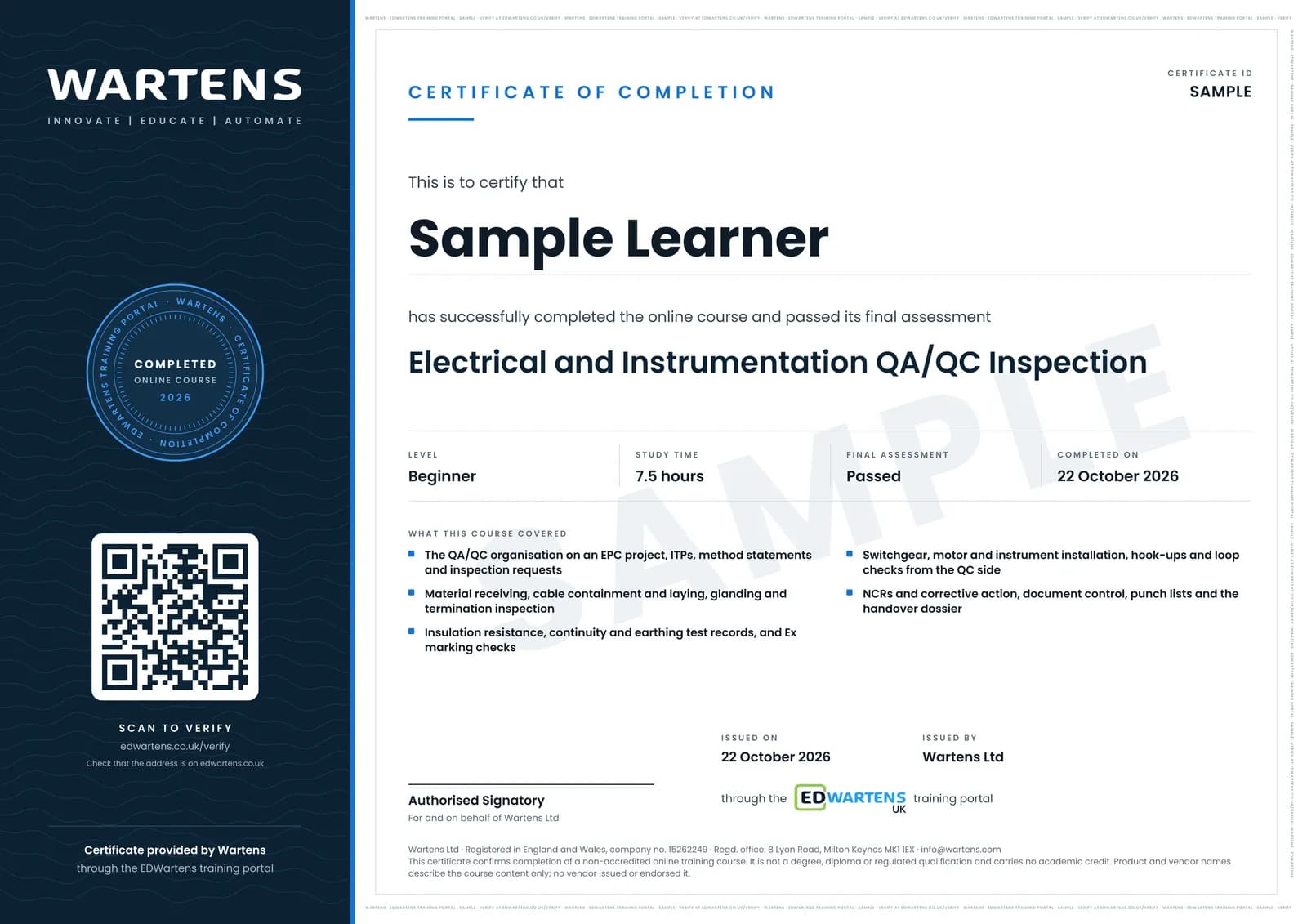
Sample certificate. Optional, issued when you pass the final exam.
- Level
- Beginner
- Modules
- 13
- Video
- 13 hours
- Price
- Free
Outcome
What you will be able to do
Explain the QA/QC organisation on an EPC project and the inspector's authority; write ITP lines with hold, witness, review and surveillance points; review method statements and raise inspection requests; inspect E&I material on receipt; inspect cable trays, cable laying, glands and terminations; witness and review insulation resistance, continuity and earthing tests; inspect switchgear, motor and instrument installation and hook-ups; check a loop folder and witness loop checks from the QC side; write NCRs that get closed; and compile punch lists and a handover dossier. It prepares you for E&I QC inspector roles; it is not an owner's inspector approval or a third-party certification.
- Explain who inspects whose work on an EPC project and what the E&I inspector may and may not decide
- Write ITP lines with clauses, measurable criteria and hold, witness, review and surveillance points
- Inspect E&I material on receipt and decide accept, hold or reject on a material inspection report
- Inspect trays, cable laying, glands and terminations against the schedules and drawings
- Judge insulation resistance readings per kilometre and reject a test record that cannot be checked
- Witness earth electrode and continuity tests and match Ex markings to the hazardous area
- Inspect instrument hook-ups and tubing, and check a loop folder and its expected mA values
- Write NCRs that get closed, run punch lists by category and score a handover dossier
Software
A spreadsheet (LibreOffice Calc is free) for the ITP, the test records, the NCR log and the punch list. Nothing else is needed.
Hardware
None. If you can borrow an insulation tester and a multimeter at work, the practice tasks are better for it, but every task can be done on paper.
Syllabus
13 modules
Each module has video lessons, notes and a short quiz. The final exam closes the course.
- The E&I QA/QC inspector on an EPC site2 lessons
- ITPs, inspection points, method statements and inspection requests3 lessons
- Material receiving inspection2 lessons
- Cable containment and cable laying4 lessons
- Cable glanding and termination inspection4 lessons
- Insulation resistance and continuity test records3 lessons
- Earthing and bonding inspection4 lessons
- Electrical equipment installation: switchgear, transformers and motors3 lessons
- Instrument installation and hook-up inspection4 lessons
- Loop checks and ITRs from the QC side1 lessonLab
- Nonconformance reports and corrective action1 lesson
- Document control, punch lists and the handover dossier3 lessons
- Final Assessment1 lesson
How it works
How this course works
- Watch the video lessonsOne module at a time, at your own pace.
- Take the module quizA short quiz at the end of each module shows what stuck.
- Keep your notesWrite in My notes beside each module and ask the trainer if you are stuck.
- Practise in the labOptionalTry a task from the module in the EDWartens Lab, in your browser.
- Sit the final examPass it once you have been through the modules.
- Certificate, if you want oneOptionalPaid, and only after you pass. Anyone can check it online.
EDWartens Lab
Practise this in the EDWartens Lab
Do a loop check yourself in the Process lab, so you know what a good loop check record looks like before you sign one as an inspector.
Works alongside Electrical and Instrumentation QA/QC Inspection. The Lab is process control practice in your browser: no install, no hardware, free to use. Sign in as a learner and it opens with your account.
Levels to try with this course
PRC-02 · Process lab
Loop check
Open in the lab (opens in a new tab)
Optional. Skip it whenever you like: it never blocks your progress or your certificate.
Why practise in a lab
Technical work is judged on what you can do: wiring, commissioning, finding a fault. Doing a task yourself teaches more than watching it a second time, and a lab lets you try it safely before you meet real equipment. It does not replace working on real hardware.
- Practise safely, so a mistake costs nothing.
- The lab checks your work like a site test, so you know when it is right.
- Free, in your browser, with nothing to install.
Certificate
An optional certificate when you pass
Learning is free. Pass the final exam and you can have a certificate for £19, including VAT, with a number employers can check online. It records that you completed a free online course; it is not a regulated qualification or a CPD certificate.
- Your name, the course, its study time and your final exam score
- A unique certificate number and a QR code to its verification page
- Issued by Wartens Ltd; add it to your LinkedIn profile in one click
- Pay now or after you pass: it is issued the moment you pass the final
Credits
Who made the lessons
The video lessons belong to their creators. EDWartens wrote the study plan, notes, quizzes and the final exam.
- QualityEngineers Guide
the lessons on quality assurance against quality control, the inspection and test plan, submitting a method statement and the NCR and its purpose, and the recap in the final module
- Engineering Management Institute
quality assurance against quality control on a construction project
- Quality Control with Frans
the ITP explained, and material inspection reports for material that arrives before it is approved
- Sofeast
setting up a receiving quality inspection
- IIQA
the cable tray installation and inspection checklist, and thirty instrumentation commissioning and loop check problems
- eFIXX
cable bending radius on site
- ELEK Software
cable pulling tension calculations
- Rashid iqubal
the underground MV cable laying procedure
- GSH Electrical
the parts of BW and CW armoured cable glands
- CMP Products
making off a sealed armoured gland, a direct make-off gland and a compound-filled barrier gland
- LEARN ELECTRICS
testing cable continuity and insulation resistance
- Polycab India Limited
an insulation resistance test on LV cables at site
- Tom Sandri
acceptance and maintenance testing of medium-voltage power cables
- John Ward (jwflame)
earth electrode testing
- Master Electricians New Zealand
the earth continuity test
- OMICRONenergy
testing the grounding systems of medium-voltage substations
- SparkyNinja
the earthing and bonding webinar
- Eaton
medium-voltage switchgear fundamentals
- Gaurav J - TheElectricalGuy
a factory walkthrough of every medium-voltage switchgear component
- The Electrical Guy
checking a motor with an insulation tester
- eFunda Engineers
reading instrument hook-up drawings
- Instrumentation ABC
inspecting tubing installation and pressure transmitter installation
- Swagelok
assembling tube fittings of 1 inch and under
- Engineering Design & Management
document control and traceability on EPC projects
- Oil & Gas - Completions Coordinator
punchlisting, step by step
- CommissioningCoach.com
commissioning dossiers, with David Nisbett
Questions
About this course
Who is this E&I QA/QC inspection course for?
Is the course free to learn?
Which standards does it use?
Does it help me get approved as an inspector on Saudi Aramco, ADNOC or QatarEnergy projects?
What certificate do I get?
Does it teach me to do the tests myself?
How long does the course take?
What is the project?
Want a live class and career support?
The Professional Module is five live days of Siemens PLC, HMI and SCADA with an instructor, then a resume session and a CPD certificate.