
Free course · Electric vehicles
EV Charging Infrastructure: AC, DC, CCS2 and Charging Stations
How EV charging works in Britain: Type 2 and CCS2, BS 7671 Section 722, PME earthing, smart and public charge point regulations, OCPP, DNO connections and charging economics.
Free to learn. Verifiable certificate £19 when you pass the final exam (optional, VAT included).
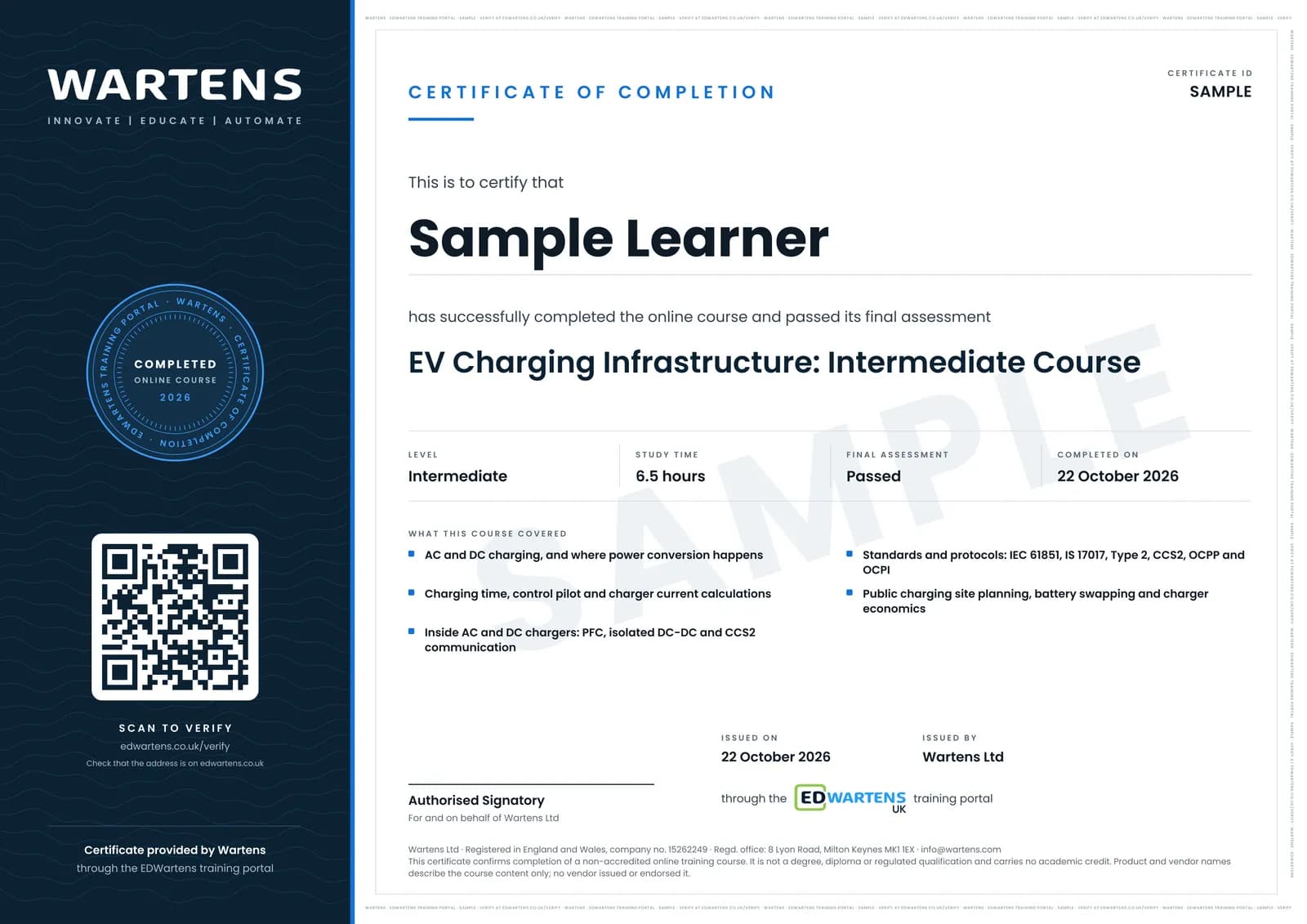
Sample certificate. Optional, issued when you pass the final exam.
- Level
- Intermediate
- Modules
- 9
- Video
- 9 hours
- Price
- Free
Outcome
What you will be able to do
Explain the difference between AC and DC charging and where conversion happens; calculate charging times and currents; describe the control pilot and proximity pilot and the Type 2 and CCS2 connectors; explain what BS 7671 Section 722 and the IET Code of Practice ask of an EV installation, including earthing on PME supplies; describe the Electric Vehicles (Smart Charge Points) Regulations 2021 and the Public Charge Point Regulations 2023; describe OCPP and OCPI; plan a charging site from DNO connection to commissioning tests; and work out the payback of a charger from utilisation and margin.
- Explain AC and DC charging and where conversion happens
- Calculate charging times and control pilot currents
- Describe the Type 2 and CCS2 connectors and what is inside AC and DC chargers
- Apply BS 7671 Section 722 and the IET Code of Practice, including earthing on PME supplies
- Describe the Smart Charge Points Regulations 2021 and the Public Charge Point Regulations 2023
- Explain OCPP and OCPI and avoid vendor lock-in
- Plan a charging site from DNO connection to commissioning tests
- Calculate a charger's payback from utilisation, margin and tariff
Software
None required. A spreadsheet for the calculations.
Hardware
None.
Syllabus
9 modules
Each module has video lessons, notes and a short quiz. The final exam closes the course.
- Charging in Britain: the picture4 lessonsLab
- Slow or fast: charger types and modes5 lessons
- Inside an AC charger: Type 2, pilots and BS 7671 Section 7226 lessonsLab
- Inside a DC charger and CCS24 lessons
- Smart charging, OCPP and the Smart Charge Points Regulations6 lessons
- Public charging sites, the Public Charge Point Regulations and DNO connections5 lessons
- Workplace and depot charging, load management and commissioning7 lessonsLab
- Economics of charging in the UK5 lessons
- Final Assessment2 lessons
How it works
How this course works
- Watch the video lessonsOne module at a time, at your own pace.
- Take the module quizA short quiz at the end of each module shows what stuck.
- Keep your notesWrite in My notes beside each module and ask the trainer if you are stuck.
- Practise in the labOptionalTry a task from the module in the EDWartens Lab, in your browser.
- Sit the final examPass it once you have been through the modules.
- Certificate, if you want oneOptionalPaid, and only after you pass. Anyone can check it online.
EDWartens Lab
Practise this in the EDWartens Lab
Test a solar string, isolate the DC side safely and find an EV charger fault in the Lab's Solar and EV simulator.
Works alongside EV Charging Infrastructure: AC, DC, CCS2 and Charging Stations. The Lab is solar and ev charging practice in your browser: no install, no hardware, free to use. Sign in as a learner and it opens with your account.
Levels to try with this course
SEV-01 · Solar and EV lab
Site survey: name every part and every isolation point
Open in the lab (opens in a new tab)SEV-07 · Solar and EV lab
EV charger fault: a car will not charge
Open in the lab (opens in a new tab)SEV-08 · Solar and EV lab
Load management: three chargers on a limited supply
Open in the lab (opens in a new tab)
Optional. Skip it whenever you like: it never blocks your progress or your certificate.
Why practise in a lab
Technical work is judged on what you can do: wiring, commissioning, finding a fault. Doing a task yourself teaches more than watching it a second time, and a lab lets you try it safely before you meet real equipment. It does not replace working on real hardware.
- Practise safely, so a mistake costs nothing.
- The lab checks your work like a site test, so you know when it is right.
- Free, in your browser, with nothing to install.
Certificate
An optional certificate when you pass
Learning is free. Pass the final exam and you can have a certificate for £19, including VAT, with a number employers can check online. It records that you completed a free online course; it is not a regulated qualification or a CPD certificate.
- Your name, the course, its study time and your final exam score
- A unique certificate number and a QR code to its verification page
- Issued by Wartens Ltd; add it to your LinkedIn profile in one click
- Pay now or after you pass: it is issued the moment you pass the final
Credits
Who made the lessons
The video lessons belong to their creators. EDWartens wrote the study plan, notes, quizzes and the final exam.
- Engineering Simplified
the lesson "How EV Chargers Actually Work - UK & Ireland Explained"
- Zapmap
the lessons "UK EV Charging Network 2026: Full 2025 Analysis & Data", "UK EV Market Q1 2026: price parity, charger metrics & new utilisation white paper"
- The Regs Guy
the lesson "Electric Vehicle Charging Modes UK"
- Explainer Ted
the lesson "Every EV Charging Connector Explained in 13 Minutes"
- We Power Your Car
the lessons "7kW VS 22kW Home EV Charger - Which Is Right For You?", "DNOs And EV Charging Explained: Why You Need To Notify The DNO Of An EV Charger Installati"
- OpenEVSE
the lesson "EV Charging Station EVSE - What is pilot and proximity? by OpenEVSE"
- eFIXX
the lessons "Don't Make This Mistake When Installing an EV Charger", "KNOW HOW: PEN FAULT protection methods for EV chargers - BS7671 Amendments", "How does BS7671 amendment 1 change the way we install EV chargers?" and 4 more
- Charge Rigs
the lesson "What’s Inside a DC Fast Charger?"
- Primetime EV
the lesson "EV Charging Connectors Explained: Type 2 vs CCS vs CHAdeMO"
- myenergi
the lesson "The Electric Vehicles (Smart Charge Points) Regulations 2021 Explained by myenergi"
- Morzak EV
the lesson "Dumb EV Charge Points Banned - What Are The New Charge Point Regulations?"
- Nice & EV
the lesson "Explore the LARGEST Ultra Rapid EV Charging Hub in the UK!"
- EVC Solutions
the lesson "Fleet EV Charging With Limited Power Supply"
- CGTN Europe
the lesson "EV battery-swap tech pioneer Nio targets expansion in European market"
- Dave Takes It On
the lesson "This May Be Controversial!"
- Easee
the lesson "Workplace Charging Scheme. UK Government Grants Explained"
- Pod
the lesson "What are the electric vehicle Smart Chargepoint Regulations for?"
Questions
About this course
Who is this course for?
Where do the lessons come from?
Do I need power electronics?
Which regulations and standards does it cover?
How long does the course take?
Is the course really free?
What certificate do I get?
Does it lead to a job?
Want a live class and career support?
The Professional Module is five live days of Siemens PLC, HMI and SCADA with an instructor, then a resume session and a CPD certificate.