
Free course · Renewable energy
Battery Energy Storage Systems (BESS): Design, Controls and Safety
A BESS course for electrical engineers: size storage, compare LFP and NMC, apply UL 9540A and NFPA 855. Free to learn; the certificate is optional and paid.
Free to learn. Verifiable certificate £19 when you pass the final exam (optional, VAT included).
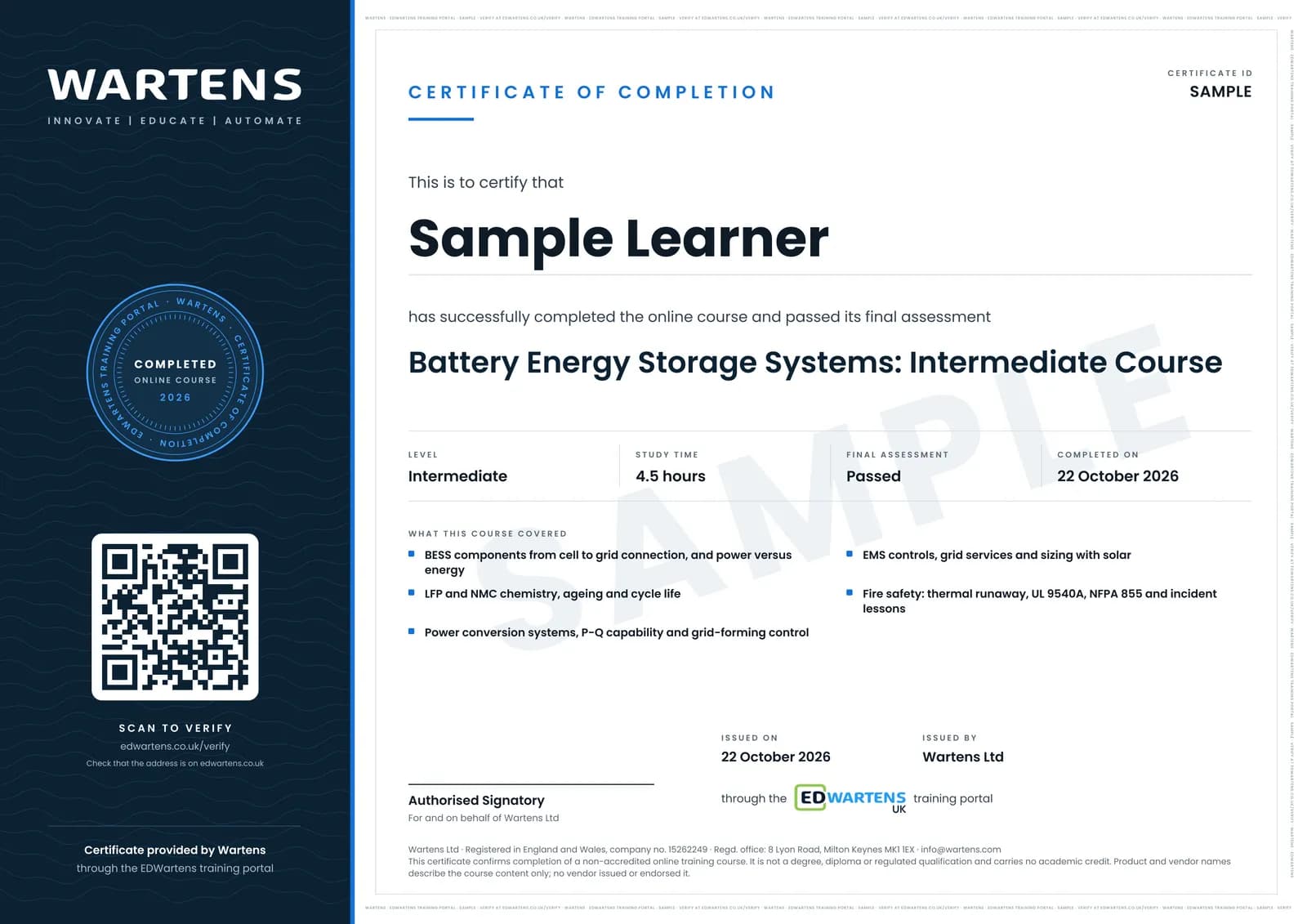
Sample certificate. Optional, issued when you pass the final exam.
- Level
- Intermediate
- Modules
- 9
- Video
- 8 hours
- Price
- Free
Outcome
What you will be able to do
Explain the parts of a BESS from cell to grid connection; tell MW from MWh and calculate duration, C-rate and round-trip losses; compare LFP and NMC for stationary use; explain what a PCS does and calculate its P and Q limits; describe the EMS, BMS and PCS control stack and the grid services a battery can provide; size a battery for a solar time-shift duty with degradation allowed for; explain thermal runaway, UL 9540, UL 9540A and NFPA 855; and draw design lessons from real BESS fires.
- Tell MW from MWh and calculate duration, C-rate and round-trip losses
- Name every part of a BESS from cell to MV switchgear
- Compare LFP and NMC chemistry for stationary storage
- Explain what a PCS does and calculate its reactive power headroom
- Describe the EMS, PCS and BMS stack and the grid services a battery provides
- Size a battery for a solar time-shift duty, allowing for fade
- Explain thermal runaway, UL 9540A and NFPA 855
- Apply the lessons of real BESS fires to a design
Software
None required. A spreadsheet for the sizing calculations.
Hardware
None.
Syllabus
9 modules
Each module has video lessons, notes and a short quiz. The final exam closes the course.
- What a battery energy storage system is3 lessons
- Every component, explained2 lessonsLab
- Battery chemistry: LFP versus NMC3 lessons
- Power conversion systems2 lessons
- EMS, controls and grid services5 lessonsLab
- Sizing, and solar plus storage3 lessonsLab
- Fire safety: UL 9540A and NFPA 8554 lessons
- Learning from BESS fires3 lessons
- Final Assessment1 lesson
How it works
How this course works
- Watch the video lessonsOne module at a time, at your own pace.
- Take the module quizA short quiz at the end of each module shows what stuck.
- Keep your notesWrite in My notes beside each module and ask the trainer if you are stuck.
- Practise in the labOptionalTry a task from the module in the EDWartens Lab, in your browser.
- Sit the final examPass it once you have been through the modules.
- Certificate, if you want oneOptionalPaid, and only after you pass. Anyone can check it online.
EDWartens Lab
Practise this in the EDWartens Lab
Test a solar string, isolate the DC side safely and find an EV charger fault in the Lab's Solar and EV simulator.
Works alongside Battery Energy Storage Systems (BESS): Design, Controls and Safety. The Lab is solar and ev charging practice in your browser: no install, no hardware, free to use. Sign in as a learner and it opens with your account.
Levels to try with this course
SEV-01 · Solar and EV lab
Site survey: name every part and every isolation point
Open in the lab (opens in a new tab)SEV-05 · Solar and EV lab
Battery dispatch: cut the bill under a time-of-use tariff
Open in the lab (opens in a new tab)SEV-04 · Solar and EV lab
Generation against load: size the array for self-consumption
Open in the lab (opens in a new tab)
Optional. Skip it whenever you like: it never blocks your progress or your certificate.
Why practise in a lab
Technical work is judged on what you can do: wiring, commissioning, finding a fault. Doing a task yourself teaches more than watching it a second time, and a lab lets you try it safely before you meet real equipment. It does not replace working on real hardware.
- Practise safely, so a mistake costs nothing.
- The lab checks your work like a site test, so you know when it is right.
- Free, in your browser, with nothing to install.
Certificate
An optional certificate when you pass
Learning is free. Pass the final exam and you can have a certificate for £19, including VAT, with a number employers can check online. It records that you completed a free online course; it is not a regulated qualification or a CPD certificate.
- Your name, the course, its study time and your final exam score
- A unique certificate number and a QR code to its verification page
- Issued by Wartens Ltd; add it to your LinkedIn profile in one click
- Pay now or after you pass: it is issued the moment you pass the final
Credits
Who made the lessons
The video lessons belong to their creators. EDWartens wrote the study plan, notes, quizzes and the final exam.
- TheElectricalGuy (Gaurav J)
the lessons on BESS components and how a battery energy storage system is put together and works
- StacheD Training
the incident reviews of the Moss Landing fire, two BESS fires with different outcomes, and bunker-style BESS construction
- Infineon Technologies
the introduction to and deep dive into power conversion systems (PCS) for battery storage
- UL Solutions
the lessons on large-scale fire testing and the UL 9540A test method
- All About Solar
the comparison of LFP and NMC batteries
- Sergey Syrvachev (BESS Engineer)
the lesson on why a battery fire cannot simply be extinguished
- Circuit Masterclass
the overview of BESS layout, PCS, EMS, BMS and working principle
- Enjoypowers
the worked example of communication between the PCS and the EMS
- Ford Motor Company
the explainer on LFP and NCM battery chemistries
- Fortress Power
the explainer on what an energy management system does
- Greenectra
the comparison of LFP and NMC lithium-ion chemistries
- Initial Learn With Me
the overview of an energy management system
- Moxa
the introduction to what a battery energy storage system is and how its parts communicate
- Owl WiS
the review lesson on how a BESS works
- SolarReviews
the explainer on how hybrid solar plus battery systems work
- Storlytics Energy Storage
the lesson on sizing a grid battery tied to a PV plant
- TaiyangNews - All About Solar
the talk on a solar-plus-storage plant design
- Vortex Fire
the introductory webinar on NFPA 855
- Your Utilities Hub
the lesson on how energy storage supports grid stability
- arshyan azam
the lesson on controlling reactive power with battery storage
- Gaurav J - TheElectricalGuy
3 lessons in "What a battery energy storage system is" and "Every component, explained"
- BESS Engineer | Sergey Syrvachev
a lesson in "Fire safety: UL 9540A and NFPA 855"
Questions
About this course
What is a battery energy storage system (BESS)?
Why do most battery storage projects use LFP cells?
What is the difference between MW and MWh in battery storage?
Who is this course for?
Do I need to know battery chemistry?
Does it cover fire safety standards?
Is it about grid-scale or commercial batteries?
Is the course really free?
What certificate do I get?
How long does the course take?
Is this a UL or NFPA certification?
Want a live class and career support?
The Professional Module is five live days of Siemens PLC, HMI and SCADA with an instructor, then a resume session and a CPD certificate.