
Free course · Electric vehicles
Electric Vehicle Technology Fundamentals
How an electric vehicle works, from the road back to the cell: the drivetrain, EV markets with India's two- and three-wheeler market as a case study, the forces on a vehicle, drive cycles and energy per km, lithium-ion battery parameters, SoC and SoH, pack development, the BMS and thermal design, and motors and controllers. Built on NPTEL lectures from IIT Madras.
Free to learn. Verifiable certificate £19 when you pass the final exam (optional, VAT included).
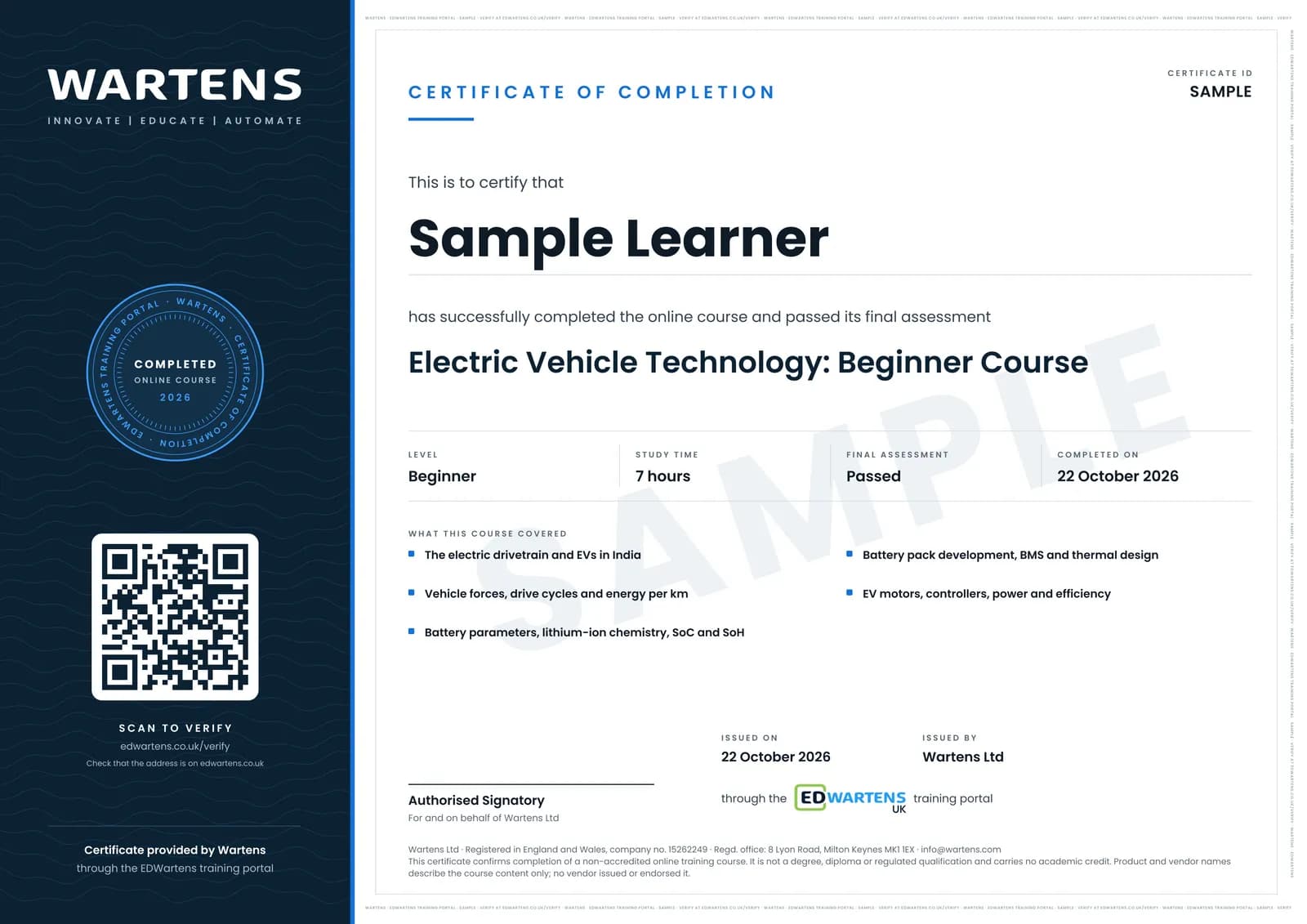
Sample certificate. Optional, issued when you pass the final exam.
- Level
- Beginner
- Modules
- 9
- Video
- 10 hours
- Price
- Free
Outcome
What you will be able to do
Describe the parts of an electric drivetrain and how energy flows through it; explain why some EV markets, such as India's, are led by two- and three-wheelers; calculate the forces on a vehicle and the power it needs; estimate energy per km from a drive cycle; read battery parameters and choose a chemistry; estimate SoC and SoH; design a battery pack from cells; explain what a BMS does and why thermal design matters; and calculate motor torque, power and efficiency.
- Describe the parts of an electric drivetrain and how energy flows
- Explain why two- and three-wheelers lead some EV markets, such as India's
- Calculate drag, rolling resistance, gradient force and power
- Estimate energy per km from a drive cycle, with regeneration
- Read battery parameters and calculate pack voltage, energy and C-rate
- Estimate SoC and SoH and design a pack's series and parallel arrangement
- Explain what a BMS does and calculate pack heat
- Calculate motor torque, power and speed through the drivetrain
Software
None required. A spreadsheet helps with the calculations.
Hardware
None.
Syllabus
9 modules
Each module has video lessons, notes and a short quiz. The final exam closes the course.
- How an electric vehicle works3 lessons
- Electric vehicles in India2 lessons
- EV subsystems and the forces on a vehicle2 lessons
- Drive cycles and energy per kilometre2 lessons
- Battery parameters, and why lithium-ion2 lessons
- State of charge, state of health, the battery pack and charging2 lessons
- The BMS and thermal design2 lessons
- Motors and controllers3 lessons
- Final Assessment1 lesson
How it works
How this course works
- Watch the video lessonsOne module at a time, at your own pace.
- Take the module quizA short quiz at the end of each module shows what stuck.
- Keep your notesWrite in My notes beside each module and ask the trainer if you are stuck.
- Sit the final examPass it once you have been through the modules.
- Certificate, if you want oneOptionalPaid, and only after you pass. Anyone can check it online.
EDWartens Lab
Practise this in the EDWartens Lab
Test a solar string, isolate the DC side safely and find an EV charger fault in the Lab's Solar and EV simulator.
Works alongside Electric Vehicle Technology Fundamentals. The Lab is solar and ev charging practice in your browser: no install, no hardware, free to use. Sign in as a learner and it opens with your account.
Certificate
An optional certificate when you pass
Learning is free. Pass the final exam and you can have a certificate for £19, including VAT, with a number employers can check online. It records that you completed a free online course; it is not a regulated qualification or a CPD certificate.
- Your name, the course, its study time and your final exam score
- A unique certificate number and a QR code to its verification page
- Issued by Wartens Ltd; add it to your LinkedIn profile in one click
- Pay now or after you pass: it is issued the moment you pass the final
Credits
Who made the lessons
The video lessons belong to their creators. EDWartens wrote the study plan, notes, quizzes and the final exam.
- NPTEL IIT Madras
the Fundamentals of Electric Vehicles lectures on EVs in India, EV subsystems, vehicle forces, drive cycles and energy per km, battery parameters, lithium-ion, SoC and SoH, pack development, BMS and thermal design, and motors and controllers
- CNET
the explainer on how an electric vehicle's battery, motor and charger work together
- E-Mobility Trends
the introduction to how electric cars work
- NPTEL-NOC IITM
17 lessons in "How an electric vehicle works", "Electric vehicles in India", "EV subsystems and the forces on a vehicle", "Drive cycles and energy per kilometre", "Battery parameters, and why lithium-ion", "State of charge, state of health, the battery pack and charging", "The BMS and thermal design", "Motors and controllers" and "Final Assessment"
Questions
About this course
Who is this course for?
Is this an NPTEL course?
Does it cover charging stations?
Is there a lot of maths?
Is the course really free?
What certificate do I get?
How long does the course take?
What is the project?
Want a live class and career support?
The Professional Module is five live days of Siemens PLC, HMI and SCADA with an instructor, then a resume session and a CPD certificate.