
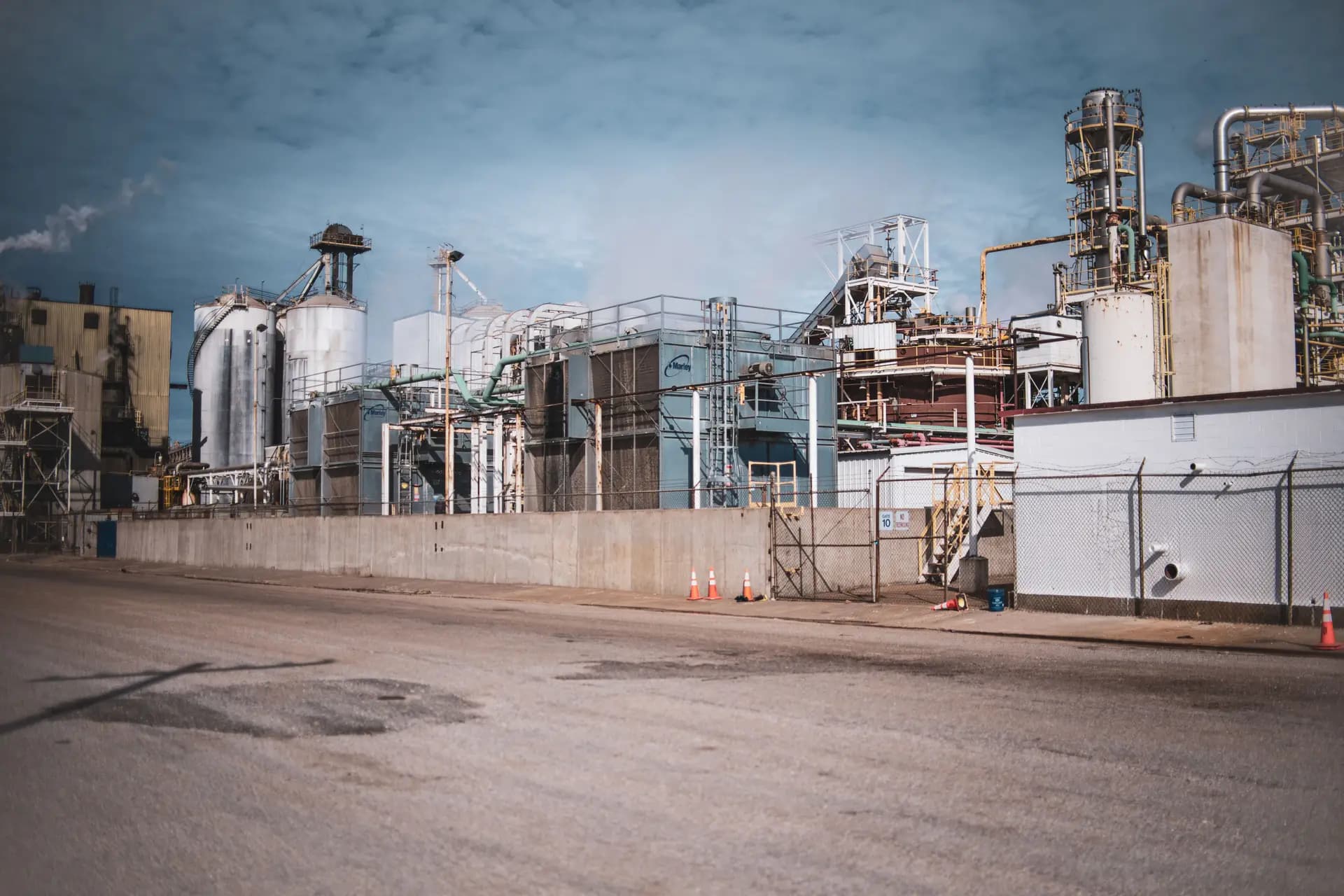
Free job simulation · Automation and controls
Instrumentation engineer job simulation
An instrumentation engineer job simulation is practice at the measurement side of a process plant. You check datasheets and loop diagrams against the instrument index, calibrate and judge a transmitter from as-found data, size a control valve, check Ex nameplates for a hazardous area and review a safety function on a simulated solvent blending plant. It is practice, not employment or a certification.
You join Marlstone Process Engineering Ltd (simulated company), a process engineering contractor in Warrington. Days 1 to 5 are free, with about 10 h 20 min of tickets. Premium continues to day 20. It is practice, not employment.
Days 1 to 5 are free. You need a free account and no card. Create an account.
- Free days
- 1 to 5
- Free tickets
- about 10 h 20 min
- Project documents
- 9
- Certificate, optional
- £14.99
The project
You join Marlstone Process Engineering Ltd (simulated company)
Marlstone Process Engineering Ltd (simulated company) is a process engineering contractor in Warrington. You help its team deliver a project for Quenby Solvents Ltd, at Solvent blend tank T-2100 and drum filling line (project QSB-520).
You are the junior instrumentation engineer on the instrumentation package of a solvent blending tank. The plant handles flammable liquids, so the hazardous area classification, the instrument index and the safety function matter. You check a vendor datasheet, work out a level transmitter range, judge a calibration, and decide what to do when a calibrator is out of date. Later the client raises the throughput, a flameproof device turns out to be in the wrong gas group, a safety transmitter is found out of tolerance and the client asks you to re-issue a SIL the calculation does not support. The skill is to be exact, to write down what you found, and to be impossible to hurry past a safety rule.
What you will do
- Check vendor datasheets and loop diagrams against the index and the area classification
- Calibrate and judge a transmitter from as-found and as-left data
- Size a control valve and update the index when the process changes
- Judge an Ex nameplate for a Zone 1 area and say no to an unsuitable device
- Verify a safety function and refuse to re-issue a SIL the numbers do not support
The people you deal with
- Lead Instrumentation Engineercompany
- Project Managercompany
- Instrument Techniciancompany
- Process Engineercompany
- Client Site Managerclient
- Client Safety Officerclient
- Client Ex Competent Personclient
- Client Operations Managerclient
- Instrument Vendor Supportvendor
The company, client and site are fictional. The people are fictional too.
Look inside
What the simulator looks like
The workplace, your tickets, the documents and the team chat, as a learner sees them.
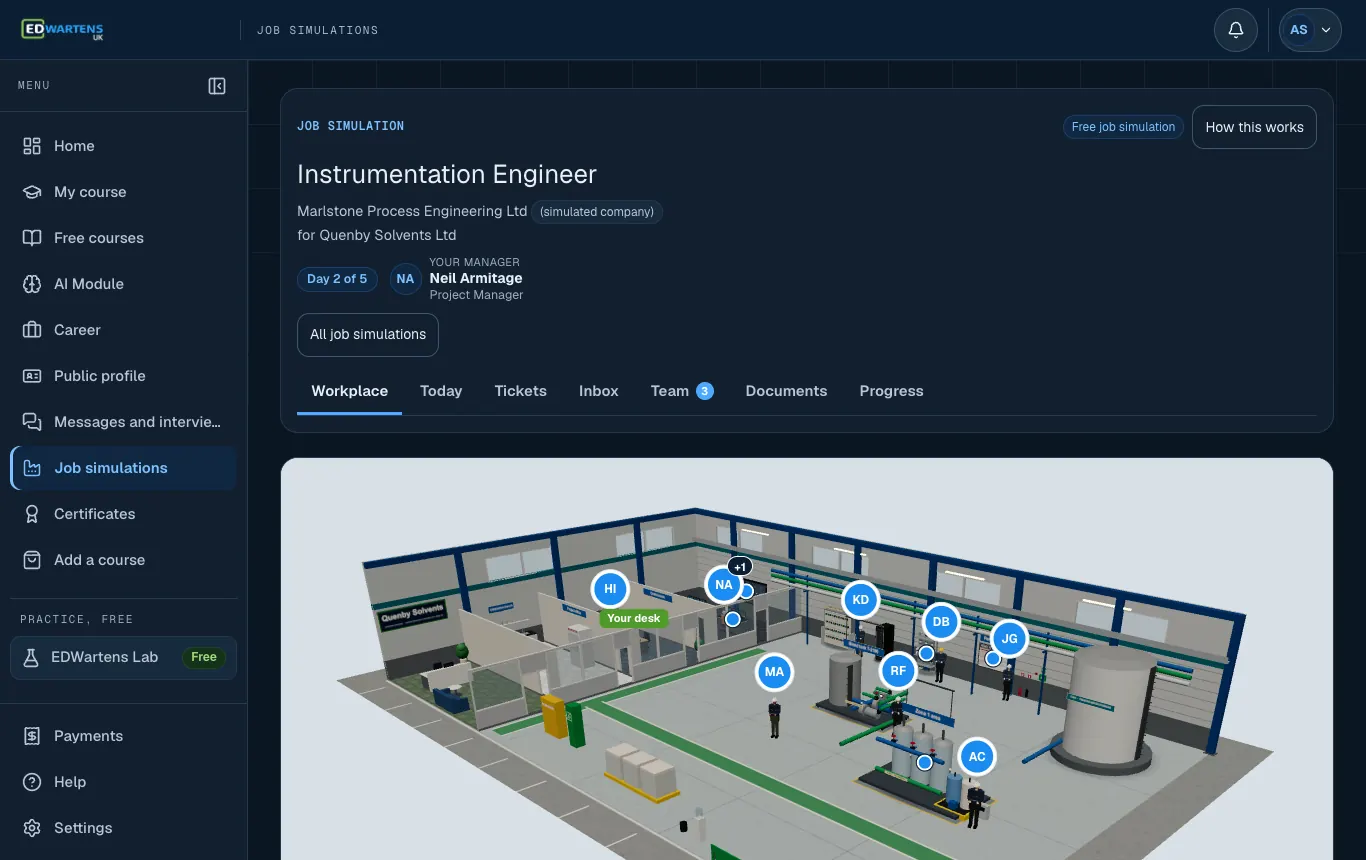
Start in the workplace, with the team around you. 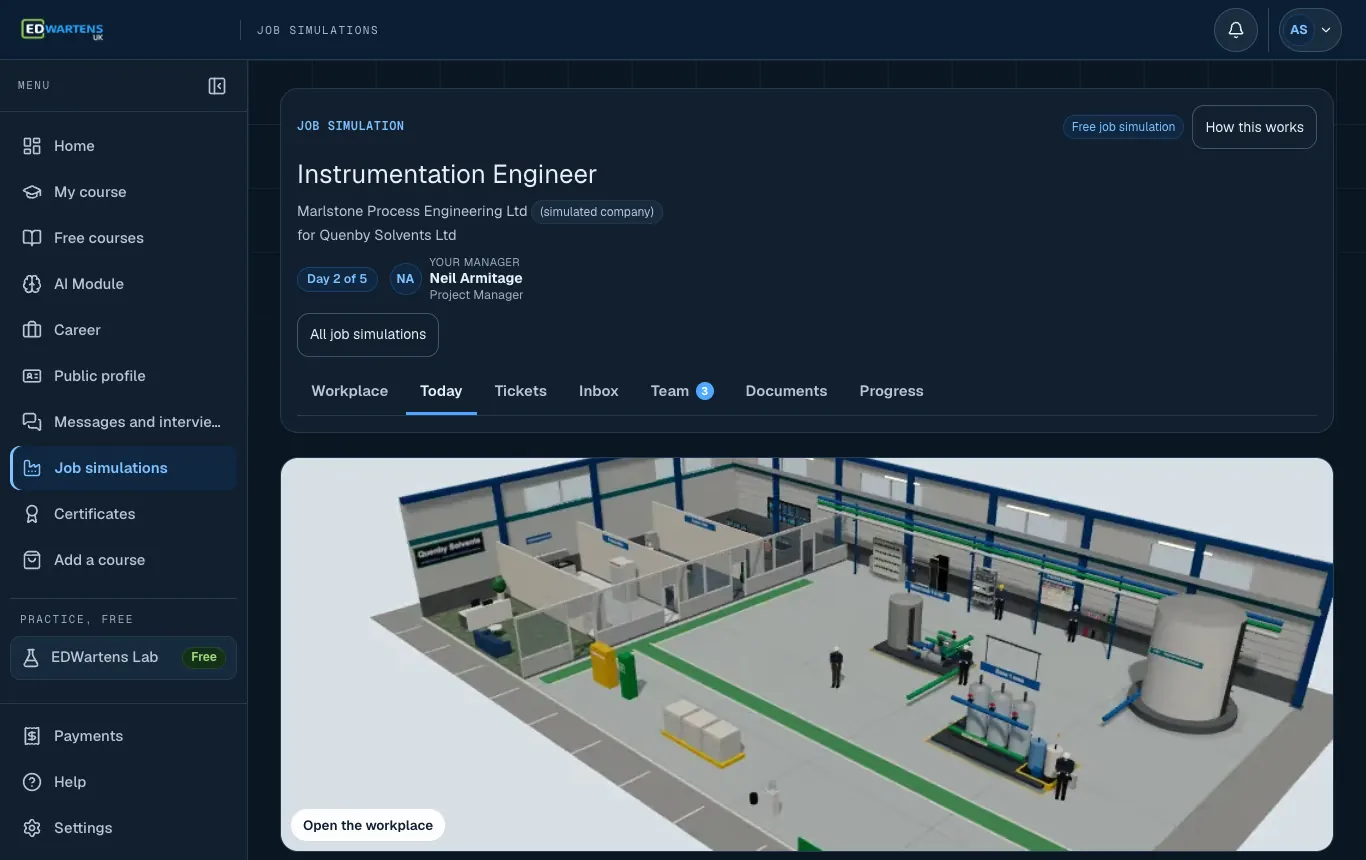
Today: the morning email and your tickets for the day. 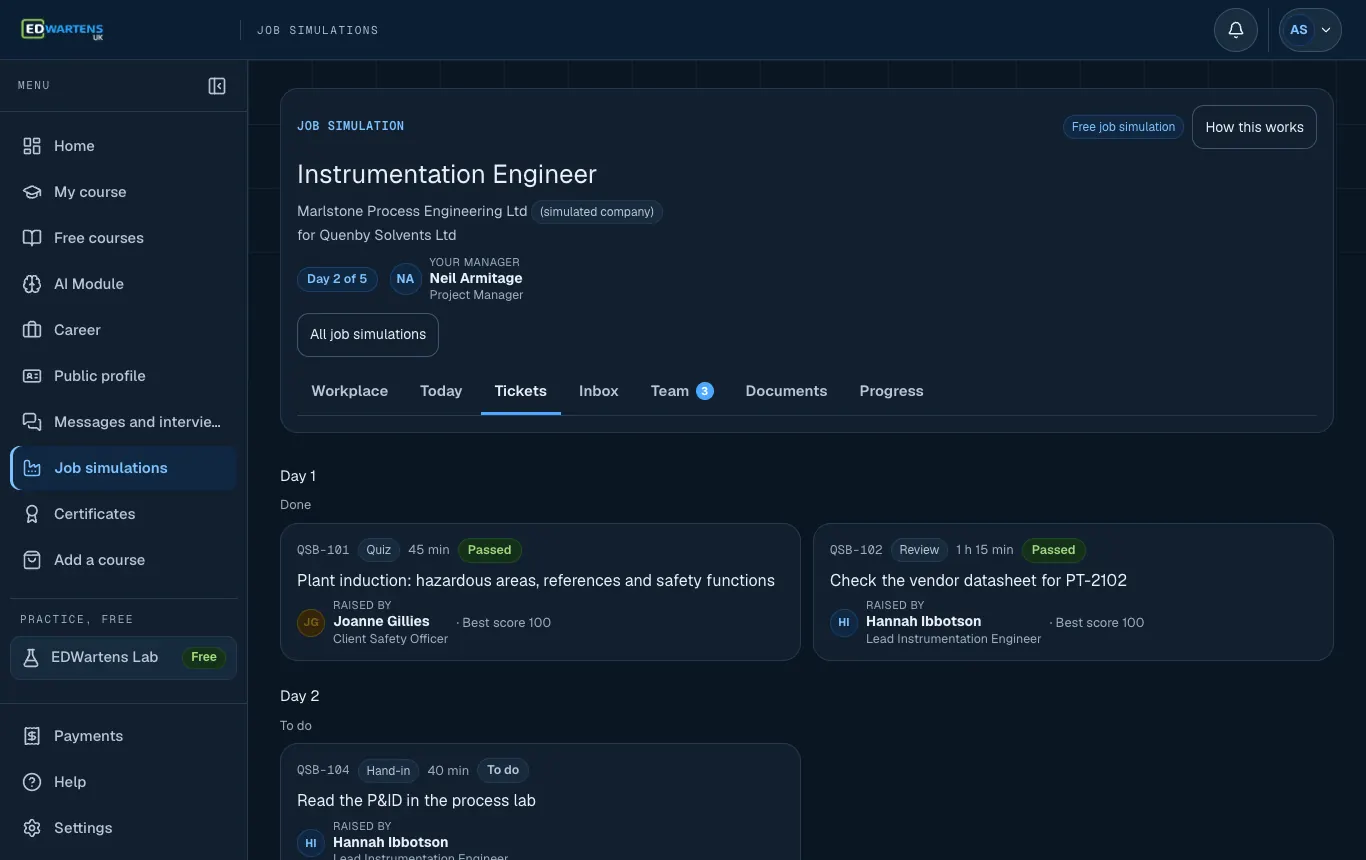
Work: every ticket, by day, with its status. 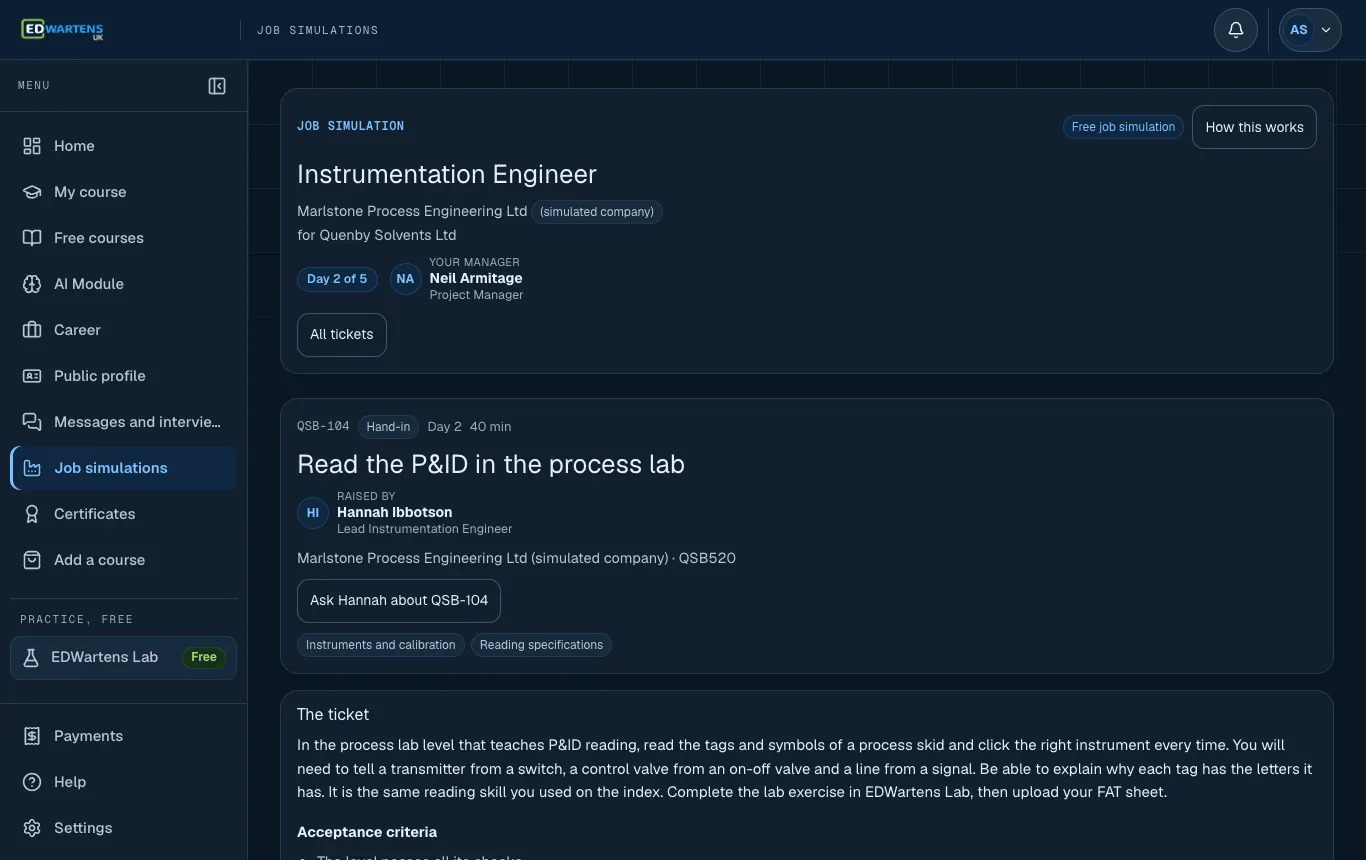
A ticket, written the way a colleague would write it. 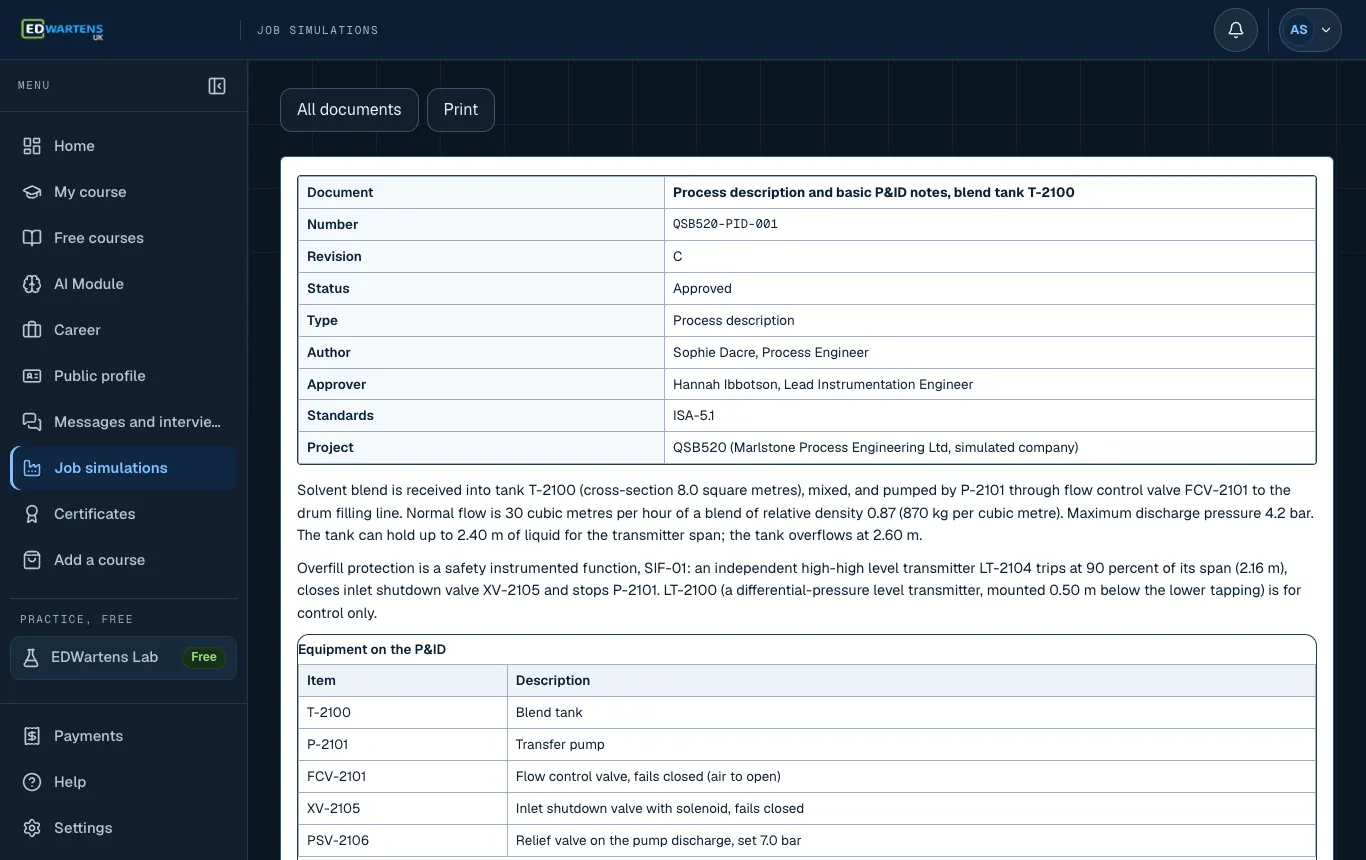
A project document with its number, revision and status. 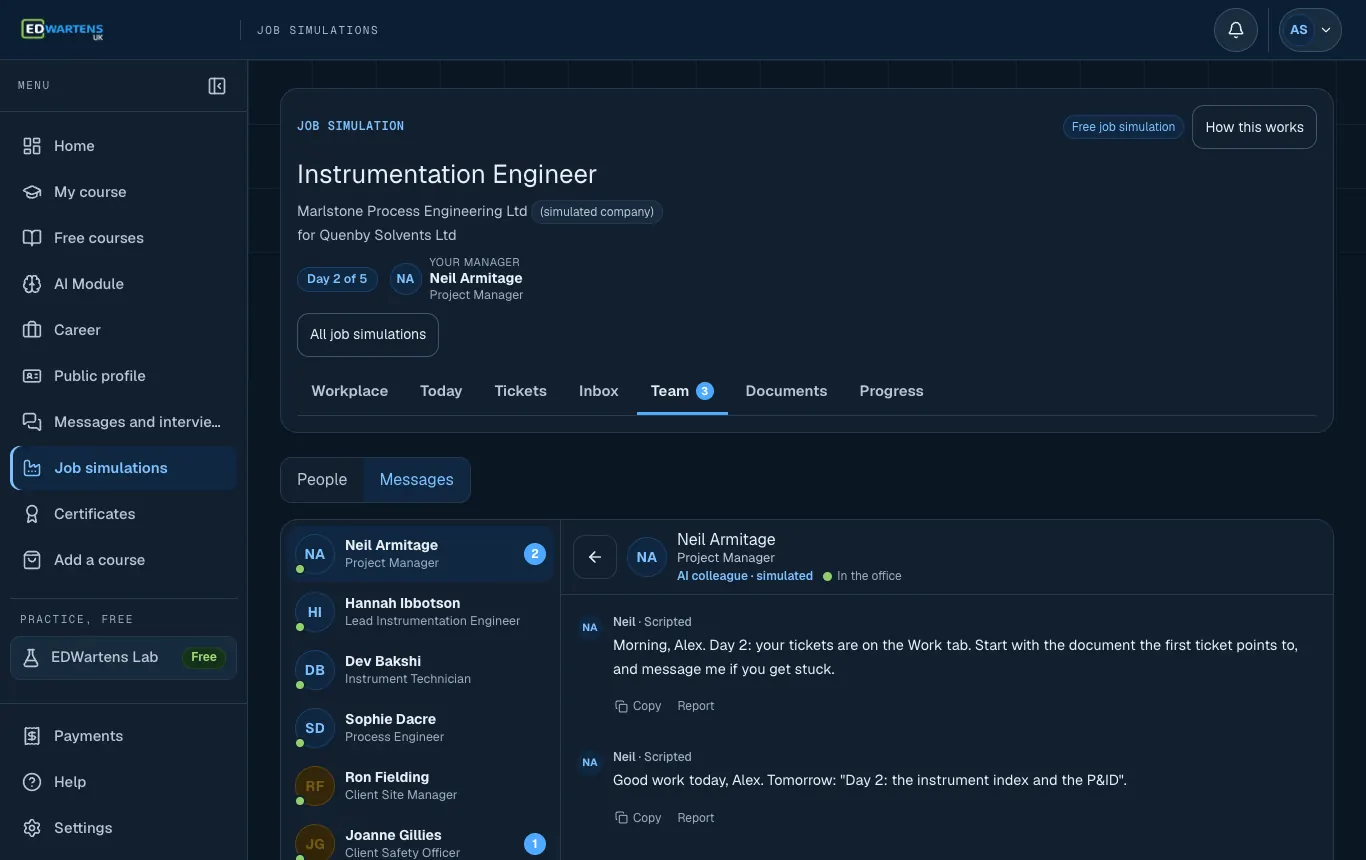
Ask a colleague. They are AI colleagues: they help you think, they do not hand out answers.


Screenshots from the simulator. Company, people and data are fictional. Portraits are AI-generated.
Meet the team
The colleagues you work with
You can read their messages and ask them questions. They are AI colleagues, clearly labelled. They help you think a ticket through; they do not hand out its answer.
- NANeil ArmitageProject ManagerSimulated colleague, company side
- HIHannah IbbotsonLead Instrumentation EngineerSimulated colleague, company side
- DBDev BakshiInstrument TechnicianSimulated colleague, company side
- SDSophie DacreProcess EngineerSimulated colleague, company side
- JGJoanne GilliesClient Safety OfficerSimulated colleague, client side
- RFRon FieldingClient Site ManagerSimulated colleague, client side
- ACAlan CheethamClient Ex Competent PersonSimulated colleague, client side
- MAMehmet AksoyClient Operations ManagerSimulated colleague, client side
Fictional people. Portraits are AI-generated.
What you get
What you walk away with
Design, calibrate and prove the instrumentation for a solvent blend tank, including a hazardous area and a safety function.
What you produce
Instrument index entries
Instrument index
As-found calibration error review
Calibration record
Calibration summary note for PT-2102
Calibration note
Loop diagram review for FIC-2101
Loop diagram checkPremium
Change impact note for CR-01
Change controlPremium
Instrument index changes for Rev C
Instrument indexPremium
SIF-01 PFDavg and SIL verification
SIF verificationPremium
Instrumentation design and test pack
CapstonePremium
Skills you practise
- Instruments and calibration
- Safety and safe systems of work
- Applying standards
- Document and revision control
- Written communication
- Testing and acceptance
- Reading specifications
- Process control and tuning
Roles to look for
- Instrumentation Engineer
- C&I Engineer
- Instrument Technician
- Process Control Engineer
755 live openings on the UK jobs board, checked 24 Oct 2026. See the jobs
Your proof
- A certificate anyone can verify. Optional, and included in Premium.
- An entry on your EDWartens profile under Work experience, marked as a job simulation.
- A work record with your skill scores, with Premium.
Free courses that go with it
- Free course Instrument Calibration, Loop Checks and Commissioning
- Free course Industrial Instrumentation and Process Control
- Free course Hazardous Areas: Ex Equipment, Zones and Inspection
- Free course P&ID Reading and Instrumentation Design Documents
- Free course Safety Instrumented Systems and SIL to IEC 61511
What you can talk about at interview
- You can explain how you range a differential-pressure level transmitter and check an as-found calibration.
- You can describe how you loop check an instrument and write a calibration summary with units.
- In Premium, you can talk through a change impact note, a hazardous area nameplate check and a safety function verification.
Day by day
Days 1 to 5, ticket by ticket
Self-paced. A day opens when you hand in the previous day's tickets. Every ticket is checked, and you see the model answer after it.
Day 1
about 2 h- Plant induction: hazardous areas, references and safety functionsQuiz · 45 min
- Check the vendor datasheet for PT-2102Document review · 1 h 15 min
Day 2
about 1 h 50 min- Complete the instrument index entriesTable · 1 h 10 min
- Read the P&ID in the process labHand-in · 40 min
Day 3
about 2 h 15 min- Range of the differential-pressure level transmitterCalculation · 1 h
- Errors in the as-found calibration of PT-2102Table · 1 h 15 min
Day 4
about 1 h 55 min- Calibrate a pressure transmitter in the process labHand-in · 1 h 20 min
- The calibrator whose certificate has expiredDecision · 35 min
Day 5
about 2 h 20 min- Loop check in the process labHand-in · 1 h 20 min
- Summary note for the PT-2102 calibration recordWriting · 1 h
Premium: days 6 to 20about 22 h 40 min more
After day 5 the project goes on with a change request, site work, faults, a handover and a capstone reviewed by an engineer.
Day 6
about 1 h 10 min- Review the loop diagram for FIC-2101Document review · 1 h 10 min
Day 7
about 1 h 10 min- Intrinsic safety entity check for TT-2103Calculation · 1 h 10 min
Day 8
about 1 h 30 min- Change impact note for CR-01Writing · 1 h 30 min
Day 9
about 1 h 5 min- Is the control valve still big enough?Calculation · 1 h 5 min
Day 10
about 1 h 15 min- What changes in the instrument index for CR-01Table · 1 h 15 min
Day 11
about 1 h 40 min- Check each nameplate against the Zone 1 areaTable · 1 h 40 min
Day 12
about 2 h 30 min- A flameproof switch in the wrong gas groupDecision · 40 min
- Site acceptance and fault finding in the process labHand-in · 1 h 50 min
Day 13
about 1 h 40 min- Flow loop and control valve in the process labHand-in · 1 h 40 min
Day 14
about 1 h 40 min- Impact assessment: LT-2104 failed as-foundWriting · 1 h 40 min
Day 15
about 1 h 15 min- Verify SIF-01: PFDavg and SILCalculation · 1 h 15 min
Day 16
about 45 min- Can the proof test move to every two years?Decision · 45 min
Day 17
about 1 h 15 min- Check the handover dossier indexDocument review · 1 h 15 min
Day 18
about 4 h- Capstone: the instrumentation design and test packHand-in · 4 h
Day 19
about 1 h- Note for the maintenance team taking overWriting · 1 h
Day 20
about 45 min- A conversation about your own workViva · 45 min
Real documents
The documents you will work with
Each one has a number, a revision and an approver, the way a project document does. You read them, check them and write your own.
QSB520-HSE-001
Site rules: hazardous areas, calibration and safety systems
Rev 1Site rules
QSB520-HAC-001
Hazardous area classification and Ex marking guide
Rev 2Area classification
QSB520-PID-001
Process description and basic P&ID notes, blend tank T-2100
Rev CProcess description
QSB520-INS-IDX-001
Instrument index, blend tank T-2100
Rev BInstrument index
QSB520-DS-PT-2102
Instrument datasheet, PT-2102 pump discharge pressure transmitter
Rev ADatasheet
QSB520-CAL-001
Level transmitter data and calculation rules, LT-2100
Rev 1Calculation data
QSB520-CAL-014
As-found calibration record, PT-2102
Rev 1Calibration record
QSB520-CAL-REF-001
Reference equipment register
Rev 3Register
QSB520-LCS-001
Loop check procedure and acceptance
Rev 1Loop check procedure
Documents that arrive in Premiumchange requests, records, handover
QSB520-LD-FT-2101
Loop diagram, flow loop FIC-2101
Rev 1Loop diagramPremium
QSB520-IS-001
Intrinsic safety loop data, TT-2103
Rev 1IS entity dataPremium
QSB520-CV-001
Control valve sizing data, FCV-2101
Rev 1Valve sizingPremium
QSB520-INS-IDX-001
Instrument index, change to Rev C (CR-01 data)
Rev CInstrument indexPremium
QSB520-EX-REG-001
Ex register, site inspection of the blend tank area
Rev AEx registerPremium
QSB520-SIF-001
Safety instrumented function SIF-01 specification and verification
Rev 1SIF specificationPremium
QSB520-CAL-031
Proof test and as-found calibration record, LT-2104
Rev 1Calibration recordPremium
QSB520-HOV-001
Handover dossier index, instrumentation
Rev ADossier indexPremium
Tools
In the industry, and here
| In the industry | Here |
|---|---|
| Instrument database and datasheet software | The index, datasheets and loop diagrams as documents you review and complete |
| Loop calibrator and pressure calibrator | EDWartens Lab's calibration and loop check exercises |
| Valve sizing and SIL calculation tools | Calculations from the data sheets, with the working shown |
| Ex register and inspection records | A table where you judge each nameplate against the area |
Standards
The standards the work follows
- ISA-5.1
- ISA-5.4
- IEC 60079-14
- IEC 61511-1
- IEC 60534-2-1
In the UK
The Instrumentation Engineer role in a UK setting
Who employs this kind of engineer: Process engineering contractors, water, chemical, pharmaceutical and energy operators, and the vendors and calibration teams that support them.
Where: Chemical and process sites cluster in places such as Teesside, Cheshire, the Humber and the Scottish central belt, but instrumentation work exists in every region. This is context, not a statement about vacancies.
UK standards and regulations to know about
BS EN 61511 and BS EN 61508
Functional safety: safety instrumented systems for the process industry, and the general standard behind them.
DSEAR 2002 and the ATEX regulations
The law on dangerous substances and explosive atmospheres, and on equipment for use in them. HSE publishes the DSEAR approved code of practice.
COMAH 2015
Control of Major Accident Hazards: extra duties for sites holding large quantities of dangerous substances.
IEC 60079-14
Selection and installation of equipment for explosive atmospheres.
Schemes to be aware of
CompEx
A competence scheme for people who work on electrical and instrument equipment in potentially explosive atmospheres. Awareness only: this simulation does not lead to it.
These are named so that you recognise them. A job simulation does not teach them as a qualification, the tasks use simplified data, and you should always read the current edition of anything you rely on.
Your proof, optional
A certificate you can verify
The free days are free. The graded, verifiable certificate is an optional extra, and it is included in Premium.
- A graded, verifiable certificate with your score and band
- A public verification page and QR code
- One-click add to LinkedIn as a licence or certification
- Issued by WARTENS LTD. It is a training certificate, not an accredited qualification, and the company is simulated
Optional: £14.99 including VAT, once you pass.
Job Simulation Certificate
Your name
completed the Instrumentation Engineer job simulation at Marlstone Process Engineering Ltd (simulated company). Your score and band are shown on the real certificate.
- Number
- EDW-JS-0000
- Issued by
- WARTENS LTD
Not an accredited qualification. A verification page and QR code are printed on the real certificate.
Prepare
Free courses and labs that get you ready
Linked from the tickets that need them. You can read them before you start.
Free courses
- Instrument Calibration, Loop Checks and Commissioning
- Control Valves and Flow Measurement: Sizing and Selection
- P&ID Reading and Instrumentation Design Documents
- Hazardous Areas: Ex Equipment, Zones and Inspection
- Health and Safety Foundations: HSWA 1974, RIDDOR and ISO 45001
- Industrial Instrumentation and Process Control
- Instrumentation for PLC Engineers
- HAZOP and Process Safety Management
EDWartens Lab guides
The hands-on tickets are finished in EDWartens Lab, then you record the figures and upload a FAT sheet or notes for checking. Nothing is marked as passed on the lab's say-so.
A course that goes with this role
Professional Module
A paid course in PLC, HMI and WinCC SCADA programming with Siemens TIA Portal, taught live online by an instructor. It is a separate product: you do not need it to finish the job simulation, and it does not lead to a job. Its certificate is a certificate of completion, not a regulated qualification.
- Price
- £2,568 including VAT (£2,140 + VAT)
- Format
- Live online, five days, with self-paced modules after
About the Instrumentation Engineer role
Instrument index to loop diagram: how the documents chain together
The instrument index lists every instrument by tag. From it come datasheets, which define what is bought, and loop diagrams, which show how each loop is wired from field device to controller. Errors in one document flow into the next.
In the simulation you check a vendor datasheet for a pressure transmitter, complete index entries, review the loop diagram for a flow loop, and later update the index when a change request alters the process. ISA-5.1 gives the tag naming conventions you will see throughout.
Calibration: what as-found and as-left data tell you
Calibration compares an instrument against a more accurate reference at several points up and down its range. The as-found record shows how far it had drifted, and the as-left record shows what you leave behind.
You judge an as-found record with deliberate errors in it, calibrate a transmitter in an EDWartens Lab exercise and decide what to do when the calibrator's own certificate has expired. The last case is one where the right answer is not to carry on.
Treat the certificate and the reference equipment register as part of the evidence, not paperwork.
4 to 20 mA fault finding
A 4 to 20 mA signal puts the bottom of the range at 4 mA, not zero, so a reading near zero tells you the loop is broken. That live zero is why the standard works so well for diagnosis.
In the simulation you loop check in an EDWartens Lab exercise, test the intrinsic safety entity parameters for a temperature transmitter, and size a control valve with the data on its sheet. When a failed as-found result on a level transmitter arrives, you write an impact assessment instead of quietly adjusting it.
Hazardous areas and safety functions
IEC 60079-14 covers the selection and installation of equipment for explosive atmospheres. The project gives you a Zone 1 area and a table of nameplates to judge, including a flameproof switch in the wrong gas group, where the right decision is to refuse it.
IEC 61511-1 frames safety instrumented systems. You verify a safety function and decide whether a proof test interval can move, refusing to re-issue a safety integrity level that the numbers do not support.
Both cases reward the same habit: when the evidence does not support a claim, say so and write down why.
Where instrumentation leads
Instrumentation engineers move towards commissioning, process control and safety systems. Nearly every route needs comfortable P&ID reading and loop thinking, which is the core of this role.
The related roles, commissioning and SCADA, are the engineers who test and use the loops you document. The linked free courses cover calibration, control valves and P&ID reading.
Keep the loop diagram and the calibration record you produce. They are concrete examples to show in an interview, and they point clearly at the gaps you may want to study next.
Keep going
Related job simulations and courses
Commissioning Engineer
Loop checks, I/O checkout, SAT and a punch list on a plant that is nearly ready.
SCADA and HMI Engineer
Build the tag list, alarm list and screens for a live process.
PLC Programmer
Write the I/O list, program the line, run the FAT and handle a change request.
- Engineering job simulations
- Free courses
- Browse jobs
- Virtual work experience in the UK
- Job simulation questions
Content reviewed 19 Oct 2026; UK context added 21 Oct 2026. Practice, not employment.
Questions
Quick answers
What does an instrumentation engineer do?
They design, install and maintain instruments that measure and control industrial processes, producing instrument indexes, datasheets, loop diagrams and calibration records. Entry roles work under supervision and mostly on lists and records.
What is a loop diagram?
It is a drawing of one control loop showing the field device, wiring, junction boxes, I/O channel and controller or tag. It is used for installation, loop checks and fault finding.
How do you calibrate a pressure transmitter?
Compare its output with a known standard at several points across the range, upwards and downwards, to check accuracy and hysteresis, then adjust zero and span if needed. The standard should be clearly more accurate than the instrument, and your site procedure sets how much.
What is a control loop?
A sensor, a transmitter, a controller and a final control element, often a valve, working together to hold a process variable at its setpoint. A thermostat controlling a room is the everyday version.
What does 4 to 20 mA mean?
It is a standard analogue signal in which 4 mA is the bottom of the range and 20 mA is the top. A reading near zero signals a broken wire, which is why 4 mA is called the live zero.
Instrumentation or electrical engineering: which should I study?
Both feed the field. Instrumentation focuses on measurement and control loops, and electrical on power and distribution. Many graduate and entry-level roles accept either degree.
What do new starters do on day one in instrumentation?
Typically they update instrument lists and datasheets and support loop checks and calibration under supervision. The simulation starts with the same kind of tasks.
Which standard names instruments on a P&ID?
ISA-5.1 is the common standard for instrument symbols and identification. Check the edition your employer uses.
Do I need instrumentation experience first?
No. The simulation teaches the documents and the reasoning as you go. Some knowledge of 4 to 20 mA signals and basic maths helps.
Is the solvent plant real?
No. Marlstone Process Engineering and Quenby Solvents are made-up companies and the project is simulated. The documents, standards and situations follow what a junior instrumentation engineer meets.
How long does it take?
The free week is about ten hours over five days. The full Premium edition runs over twenty working days and about thirty-three hours, at your own pace.
Which instrument brands does it use?
None. The content is vendor-neutral, so it applies to any plant that follows the same standards.
What do I get at the end?
A work record with scores by task and skill, which shows on your EDWartens profile under Work experience, marked as a job simulation.
Is the Instrumentation Engineer job simulation free?
Yes, to start. Days 1 to 5 are free. The certificate (£14.99) and the Premium edition (£53.99) are optional, and both prices include VAT.
Does it count as work experience?
No. It is a training project at a simulated company, not employment, an internship or a placement. A job simulation is a realistic training project at a simulated company. It is not employment, an internship or a work placement, and it is not a job offer. Hours are active hours the learner logged on EDWartens UK.
A job simulation is a realistic training project at a simulated company. It is not employment, an internship or a work placement, and it is not a job offer. Hours are active hours the learner logged on EDWartens UK.
Start the Instrumentation Engineer job simulation today
Days 1 to 5 are free. No card to start. Practice, not employment.