

Free job simulation · Electrical and energy
Electrical design engineer job simulation
An electrical design engineer job simulation is practice at the core design chain. You build a load list, work out maximum demand, size cables for current rating and voltage drop, check fault levels and discrimination, and rework every affected document when a late 75 kW pump arrives. You keep the calculations as proof of method. It is practice, not paid employment.
You join Halvern Power Design Ltd (simulated company), a electrical design consultancy in Leeds. Days 1 to 5 are free, with about 8 h 40 min of tickets. Premium continues to day 20. It is practice, not employment.
Days 1 to 5 are free. You need a free account and no card. Create an account.
- Free days
- 1 to 5
- Free tickets
- about 8 h 40 min
- Project documents
- 7
- Certificate, optional
- £14.99
The project
You join Halvern Power Design Ltd (simulated company)
Halvern Power Design Ltd (simulated company) is a electrical design consultancy in Leeds. You help its team deliver a project for Wendmoor Creamery Ltd, at Utilities Block U-3, Wendmoor Creamery.
Wendmoor Creamery is building a new utilities block and has asked Halvern Power Design to design the electrical supply, protection and cabling. You join the design team in week one with a half-finished load list. By the end of week one you have checked the loads, sized the cables and reviewed a drawing. Later, a 75 kW pump arrives late and moves the transformer, the boards, the fault levels and the cables. You carry the change through every document, face a contractor pressing you to energise early, and hand over the pack.
What you will do
- Build a load list and work out maximum demand and transformer loading
- Size cables for current rating and voltage drop, and review a cable schedule
- Check fault levels, discrimination and earth fault loop impedance
- Handle a late client change through every affected document
- Hand over a design pack that someone else can build from
The people you deal with
- Lead Electrical Engineercompany
- Design Checkercompany
- Document Controllercompany
- Mechanical Design Leadcompany
- Client Project Managerclient
- Client Operations Engineerclient
- Contractor Site Engineervendor
- Pump Vendor Supportvendor
The company, client and site are fictional. The people are fictional too.
Look inside
What the simulator looks like
The workplace, your tickets, the documents and the team chat, as a learner sees them.
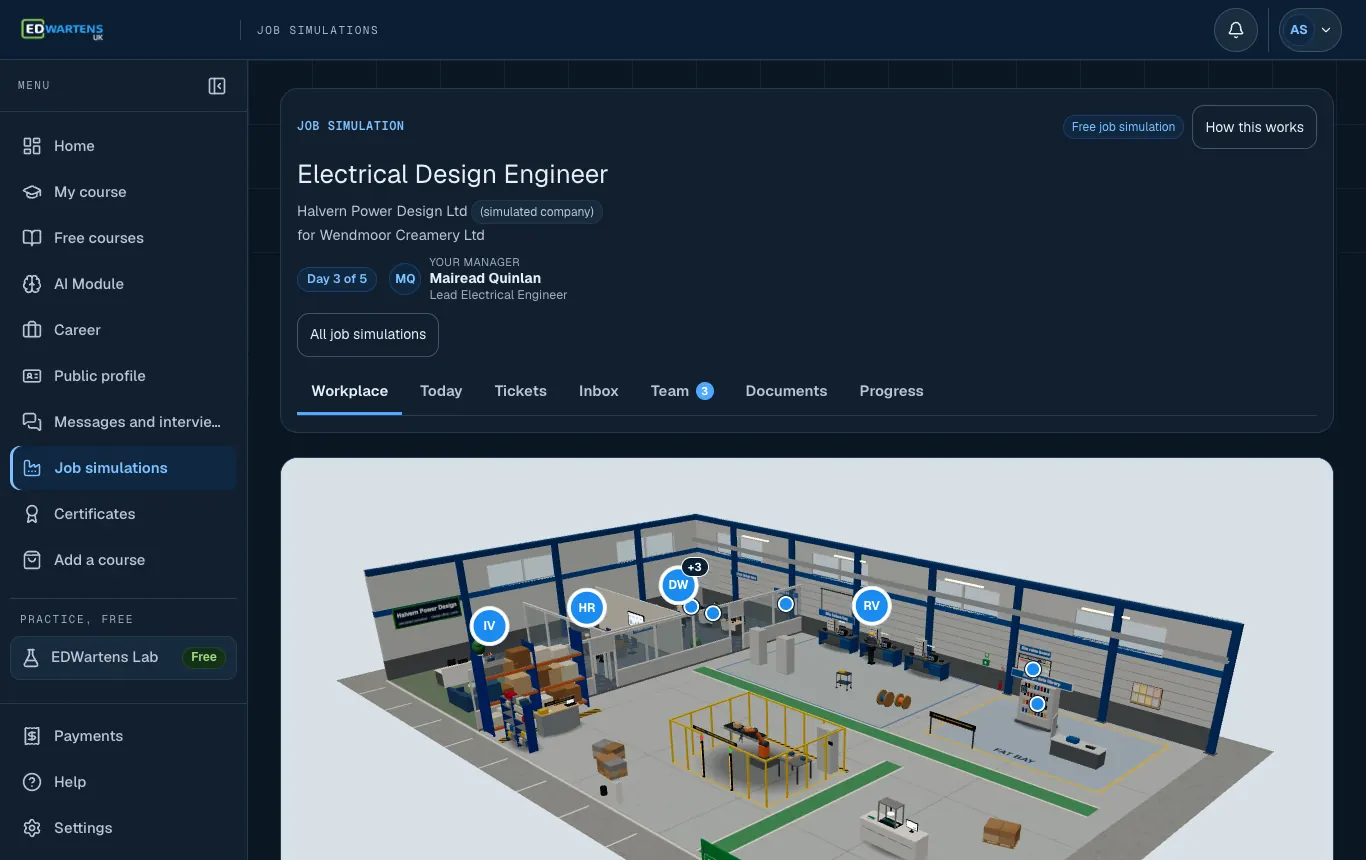
Start in the workplace, with the team around you. 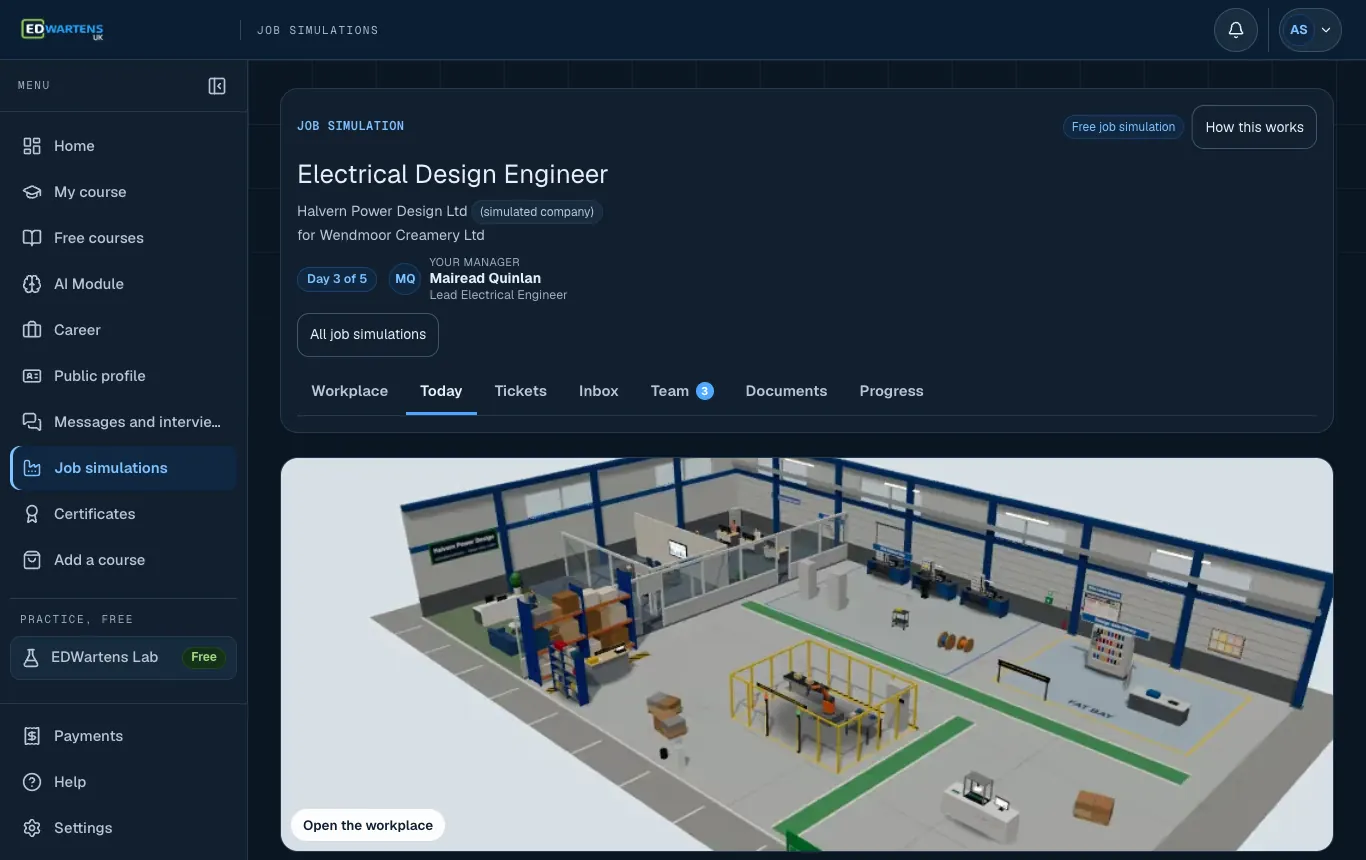
Today: the morning email and your tickets for the day. 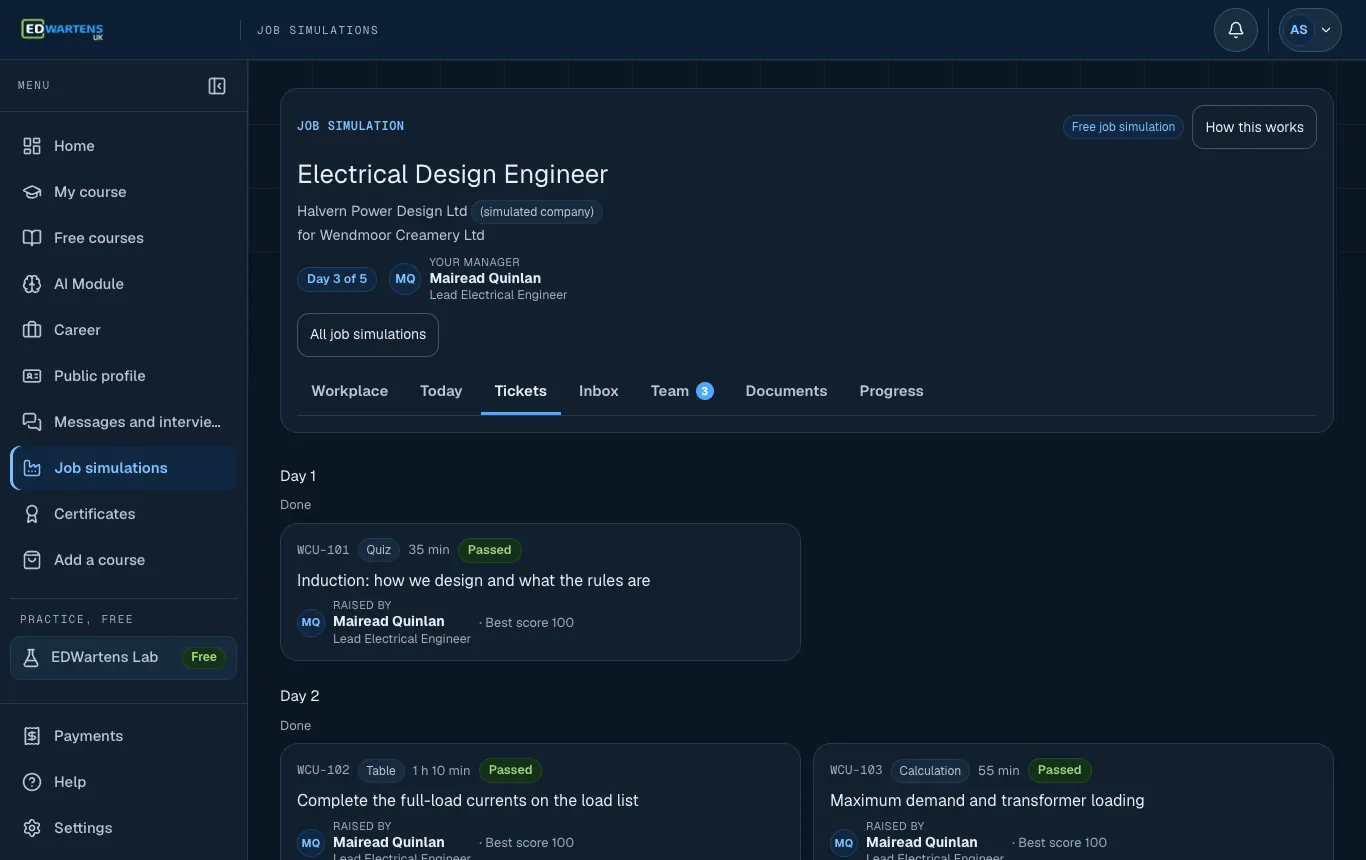
Work: every ticket, by day, with its status. 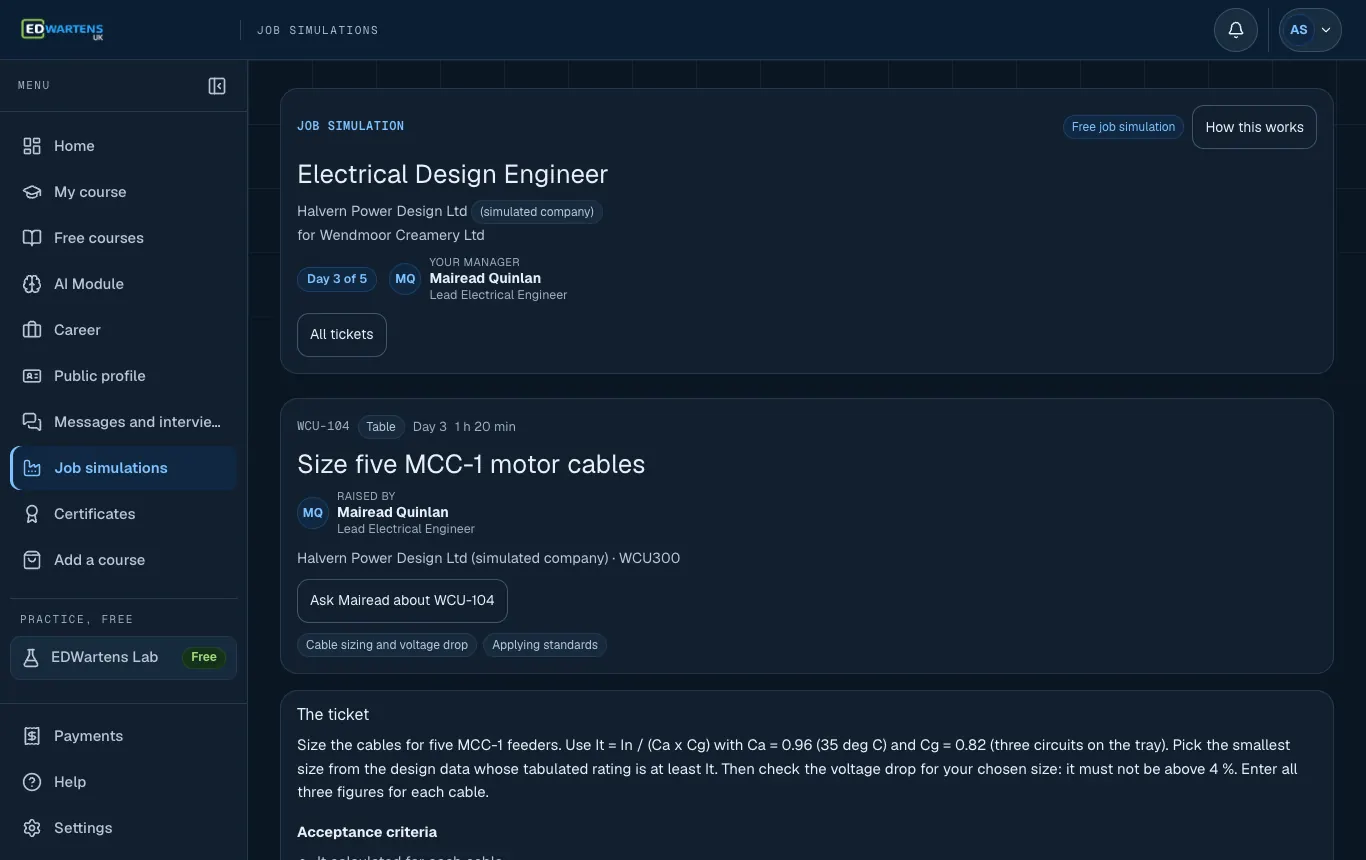
A ticket, written the way a colleague would write it. 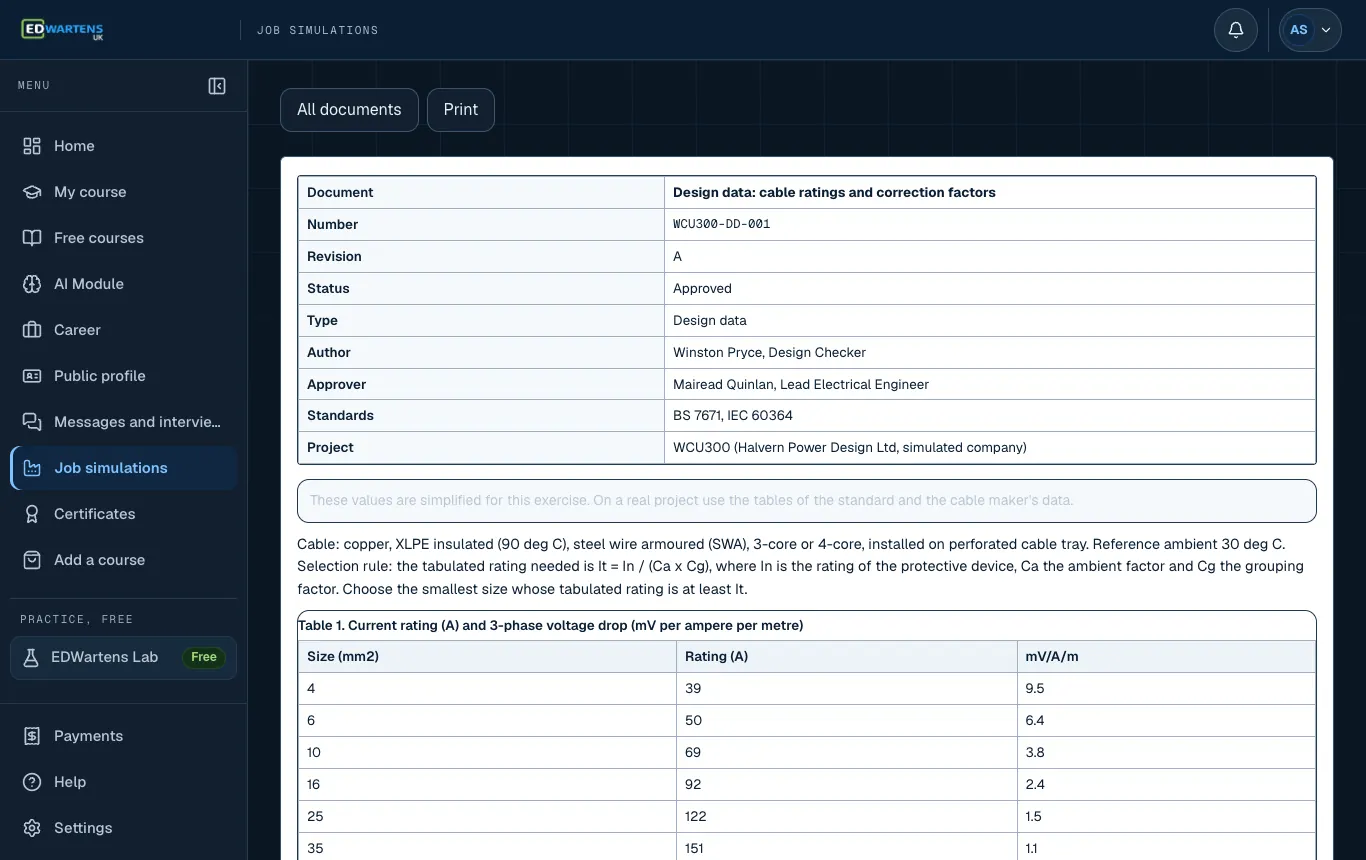
A project document with its number, revision and status. 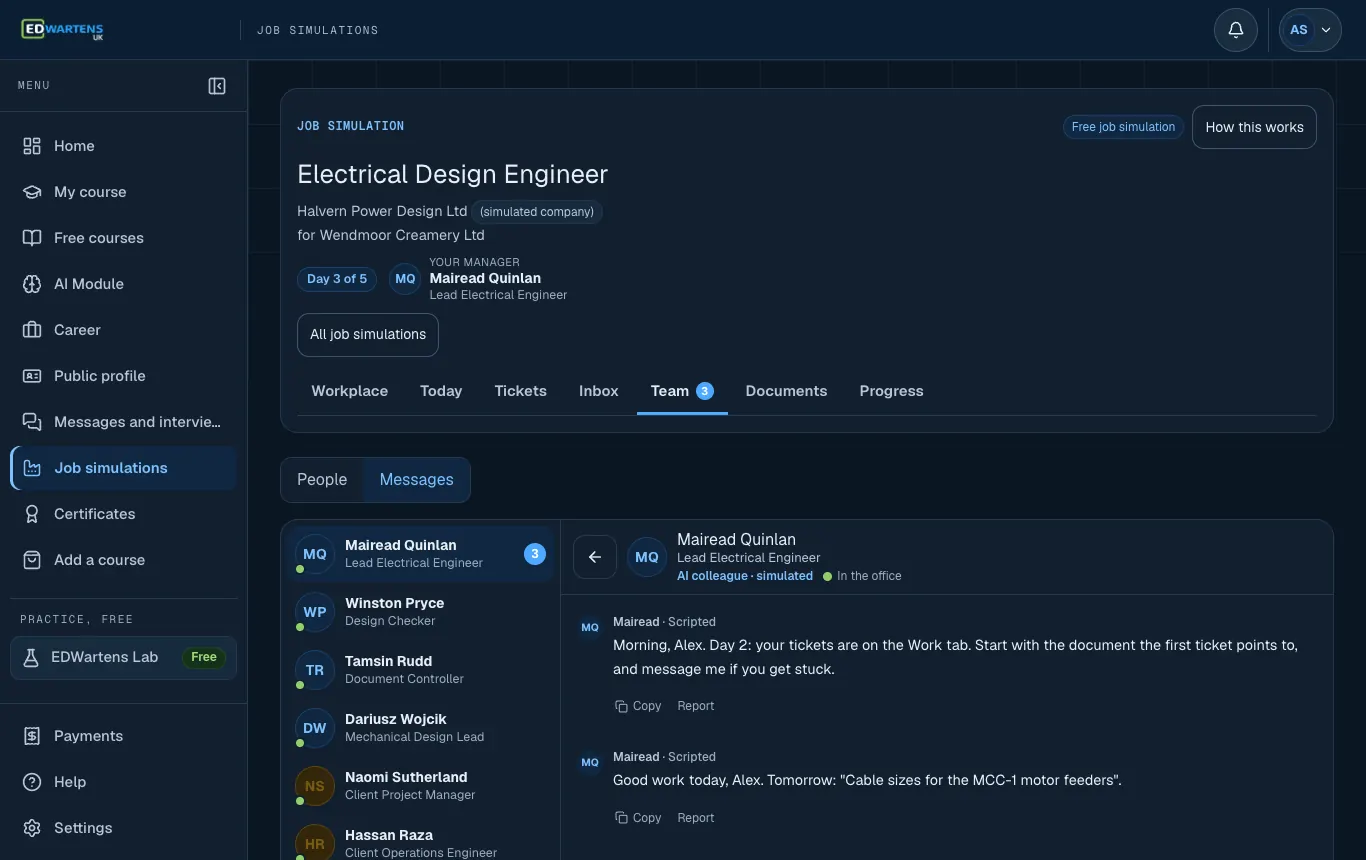
Ask a colleague. They are AI colleagues: they help you think, they do not hand out answers.


Screenshots from the simulator. Company, people and data are fictional. Portraits are AI-generated.
Meet the team
The colleagues you work with
You can read their messages and ask them questions. They are AI colleagues, clearly labelled. They help you think a ticket through; they do not hand out its answer.
- MQMairead QuinlanLead Electrical EngineerSimulated colleague, company side
- WPWinston PryceDesign CheckerSimulated colleague, company side
- DWDariusz WojcikMechanical Design LeadSimulated colleague, company side
- TRTamsin RuddDocument ControllerSimulated colleague, company side
- NSNaomi SutherlandClient Project ManagerSimulated colleague, client side
- HRHassan RazaClient Operations EngineerSimulated colleague, client side
- RVRhys VaughanContractor Site EngineerSimulated colleague, vendor
- IVInes VogelPump Vendor SupportSimulated colleague, vendor
Fictional people. Portraits are AI-generated.
What you get
What you walk away with
Design the electrical supply for a utilities block: loads, cables, fault levels, a late change and an issued pack.
What you produce
Load list with full-load currents
Design calculation
MCC-1 motor cable sizing table
Cable calculation
Cable schedule review comments
Check record
RFI: cable tray against ventilation duct
RFI log entry
Fault level calculation for MSB-1 and MCC-1
Short-circuit calculationPremium
Impact note for an engineering change request
Change controlPremium
Electrical design pack for Utilities Block U-3
CapstonePremium
Handover note for the operations team
Handover notePremium
Skills you practise
- Applying standards
- Document and revision control
- Cable sizing and voltage drop
- Working with clients and stakeholders
- Written communication
- Protection and discrimination
- Change control
- Load lists and demand
Roles to look for
- Electrical Design Engineer
- Power Systems Design Engineer
- Electrical Engineer (Consultancy)
- Graduate Electrical Design Engineer
274 live openings on the UK jobs board, checked 24 Oct 2026. See the jobs
Your proof
- A certificate anyone can verify. Optional, and included in Premium.
- An entry on your EDWartens profile under Work experience, marked as a job simulation.
- A work record with your skill scores, with Premium.
Free courses that go with it
- Free course Electrical Design Engineering: Loads, Cables, Breakers and Distribution
- Free course ETAP Power System Analysis: Load Flow, Short Circuit, Protection, Arc Flash and Stability
- Free course Earthing and Lightning Protection Design
- Free course Excel for Engineers: Formulas, Data and Dashboards
- Free course Electrical and Instrumentation QA/QC Inspection
What you can talk about at interview
- You can explain how you built a load list, sized motor cables and checked voltage drop on a long run.
- You can walk through a cable schedule review and say what you looked for.
- In Premium, you can describe how a late pump changed the transformer, fault levels and documents, and why you would not energise before the tests were complete.
Day by day
Days 1 to 5, ticket by ticket
Self-paced. A day opens when you hand in the previous day's tickets. Every ticket is checked, and you see the model answer after it.
Day 1
about 35 min- Induction: how we design and what the rules areQuiz · 35 min
Day 2
about 2 h 5 min- Complete the full-load currents on the load listTable · 1 h 10 min
- Maximum demand and transformer loadingCalculation · 55 min
Day 3
about 1 h 20 min- Size five MCC-1 motor cablesTable · 1 h 20 min
Day 4
about 1 h 30 min- Voltage drop on the 380 m run to EPS-1Calculation · 1 h
- A drum of the wrong cable and a crane booked at 07:00Decision · 30 min
Day 5
about 3 h 10 min- Review the cable schedule Rev ADocument review · 1 h 10 min
- Raise the RFI: cable tray against ventilation ductWriting · 45 min
- Commission a motor starter in the panel labHand-in · 1 h 15 min
Premium: days 6 to 20about 22 h 5 min more
After day 5 the project goes on with a change request, site work, faults, a handover and a capstone reviewed by an engineer.
Day 6
about 2 h- Fault level at MSB-1 and MCC-1Calculation · 2 h
Day 7
about 1 h 30 min- Discrimination between devicesTable · 1 h 30 min
Day 8
about 1 h 15 min- Impact note for ECR-001: the 75 kW pumpWriting · 1 h 15 min
Day 9
about 2 h- Recalculate demand, incomers and fault level with P-310Calculation · 2 h
Day 10
about 1 h 15 min- Which documents change, and to which revision?Table · 1 h 15 min
Day 11
about 1 h 40 min- Hot roof space, four cables: re-size the tray T-12 circuitsCalculation · 1 h 40 min
Day 12
about 1 h 20 min- Review the earthing and protection noteDocument review · 1 h 20 min
Day 13
about 1 h 15 min- Commission the star-delta starter for EF-01Hand-in · 1 h 15 min
Day 14
about 40 min- Energise MSB-1 before the tests are finished?Decision · 40 min
Day 15
about 1 h 20 min- Earth fault loop impedance on the P-310 circuitCalculation · 1 h 20 min
Day 16
about 1 h- Vendor Rev 1: what changes and what does notTable · 1 h
Day 17
about 1 h 10 min- Check the issue-for-construction transmittalDocument review · 1 h 10 min
Day 18
about 4 h- Capstone: electrical design pack for Utilities Block U-3Hand-in · 4 h
Day 19
about 1 h- Handover note for the client's operations teamWriting · 1 h
Day 20
about 40 min- Viva: your design decisionsViva · 40 min
Real documents
The documents you will work with
Each one has a number, a revision and an approver, the way a project document does. You read them, check them and write your own.
WCU300-URS-001
Basis of design and client requirements, Utilities Block U-3
Rev 2URS
WCU300-LL-001
Load list, Utilities Block U-3
Rev BLoad list
WCU300-SLD-001
Single-line diagram, MSB-1 and MCC-1 (sheet 1 of 2)
Rev BSLD
WCU300-DD-001
Design data: cable ratings and correction factors
Rev ADesign data
WCU300-CS-001
Cable schedule (draft for review)
Rev ACable schedule
WCU300-CL-001
Containment layout notes, plant room and pump house
Rev BContainment layout
WCU300-RFI-LOG-001
RFI log
Rev ARFI log
Documents that arrive in Premiumchange requests, records, handover
WCU300-CALC-004
Short-circuit and discrimination basis
Rev ACalculationPremium
WCU300-ECR-001
Engineering change request: add chilled water booster pump P-310
Rev 0Change requestPremium
WCU300-VD-310
Vendor data sheet, booster pump P-310 motor
Rev 0Vendor dataPremium
WCU300-VD-310
Vendor data sheet, booster pump P-310 motor (test certificate figures)
Rev 1Vendor dataPremium
WCU300-LL-001
Load list, Utilities Block U-3 (with P-310)
Rev CLoad listPremium
WCU300-CS-001
Cable schedule (issued for approval)
Rev BCable schedulePremium
WCU300-ERT-001
Earthing and protection note
Rev ADesign notePremium
WCU300-CALC-003
Cable sizing and voltage drop (draft Rev B, site conditions)
Rev BCalculationPremium
WCU300-IT-001
Initial verification results, MSB-1 outgoing ways
Rev ATest sheetPremium
WCU300-TRN-001
Transmittal: issue for construction
Rev ATransmittalPremium
Tools
In the industry, and here
| In the industry | Here |
|---|---|
| EPLAN or AutoCAD Electrical for schematics | Schedules and tables in the browser |
| ETAP or SKM for fault and protection studies | Worked calculations with the same method |
| Excel cable sizing templates | The calculation fields and your own working |
| A panel build and test bench | EDWartens Lab's panel exercises |
Standards
The standards the work follows
- BS 7671 / IEC 60364
- IEC 61439
- IEC 60909
- IEC 60947-2
In the UK
The Electrical Design Engineer role in a UK setting
Who employs this kind of engineer: Consulting engineers, building services and industrial design consultancies, and electrical contractors with a design office.
Where: Design offices are found in most UK cities, with larger groups in London, Birmingham, Manchester, Leeds, Bristol and Glasgow. This is context, not a statement about vacancies.
UK standards and regulations to know about
BS 7671:2018+A2:2022 (the IET Wiring Regulations)
The UK standard for electrical installations. The IET Guidance Notes, such as GN6 on protection against overcurrent, and the On-Site Guide explain it.
BS EN 61439
Low-voltage switchgear and controlgear assemblies.
Electricity at Work Regulations 1989
The law on safe work with electrical systems. HSE guidance HSG85 explains safe working practices.
CDM 2015
The Construction (Design and Management) Regulations: duties for clients, designers and contractors on construction work, including handover information.
Schemes to be aware of
ECS card (Electrotechnical Certification Scheme)
The industry card that many UK electrotechnical employers and sites ask to see. It is linked to qualifications and a health and safety assessment. EDWartens does not issue it, and this simulation does not lead to it.
These are named so that you recognise them. A job simulation does not teach them as a qualification, the tasks use simplified data, and you should always read the current edition of anything you rely on.
Your proof, optional
A certificate you can verify
The free days are free. The graded, verifiable certificate is an optional extra, and it is included in Premium.
- A graded, verifiable certificate with your score and band
- A public verification page and QR code
- One-click add to LinkedIn as a licence or certification
- Issued by WARTENS LTD. It is a training certificate, not an accredited qualification, and the company is simulated
Optional: £14.99 including VAT, once you pass.
Job Simulation Certificate
Your name
completed the Electrical Design Engineer job simulation at Halvern Power Design Ltd (simulated company). Your score and band are shown on the real certificate.
- Number
- EDW-JS-0000
- Issued by
- WARTENS LTD
Not an accredited qualification. A verification page and QR code are printed on the real certificate.
Prepare
Free courses and labs that get you ready
Linked from the tickets that need them. You can read them before you start.
Free courses
- Electrical Design Engineering: Loads, Cables, Breakers and Distribution
- Excel for Engineers: Formulas, Data and Dashboards
- Earthing and Lightning Protection Design
- Electrical Fundamentals for Technicians: Volts to Multimeter to Drawings
- Electrical Safety at Work (UK): Safe Isolation, Lock-off and Arc Flash
- Electrical and Instrumentation QA/QC Inspection
- Industrial Motor Control
- Electrical Control Panel Design, Building and Testing
About the Electrical Design Engineer role
Load list to cable schedule: one worked chain
Electrical design is a chain in which each document feeds the next. The load list gives full-load currents and maximum demand. That sets transformer loading and incomer ratings, which in turn set cable sizes and the cable schedule.
In the simulation you complete the full-load currents, work out maximum demand and transformer loading, size five motor cables, and review a draft cable schedule for planted mistakes. Because the same chain runs for a real utilities block, you finish with something you can explain step by step.
Three checks every cable needs
Choosing a cable by current alone is a common junior mistake. Each cable needs a current-carrying capacity check for its installation conditions, a voltage drop check over its length, and a check that it withstands the fault current until the protection operates.
The project includes a long run to an outbuilding where voltage drop decides the size, and a hot roof space with grouped cables where derating does. Standards such as IEC 60364 and BS 7671 supply the tables, so use the code of your own region.
Revision control: handling the late change
The pump arrives after the design has been issued for approval. A change request lands, and the work is to find what moves: the load list, demand, incomer, fault level, cable schedule, single-line diagram and earthing note.
You write the impact note, recalculate with the new load and decide which documents go to which revision. A vendor data sheet then changes a figure, so you also work out what changes and what does not. This is revision discipline, which many reviewers check first.
Standards map: which code for which country
Wiring rules differ by country. BS 7671 is the UK wiring regulation and follows IEC 60364, while other regions use their own national codes. IEC 61439 covers assemblies, IEC 60909 covers short-circuit currents and IEC 60947-2 covers circuit breakers.
The simulation uses a UK-style project, but the method of load, current, voltage drop and fault level carries to any region. Always check the edition your employer or client names.
Name the code on every calculation sheet. A reviewer then knows which tables you used, and a change of region becomes a change of tables, not a rewrite.
What to learn next
From design, people move towards project engineering, design leadership or specialisms such as solar and data centres. Software skills matter, but job advertisements show the thinking behind the drawing is what they test.
The related roles, control panel design and the substation and MCC engineer, work next to this one. The free courses linked here cover electrical design, spreadsheet working and earthing.
Keep the calculation sheets you produce, tidy and labelled. In an interview, walking through one load to cable chain, including the late change, shows more than a list of software names does.
Keep going
Related job simulations and courses
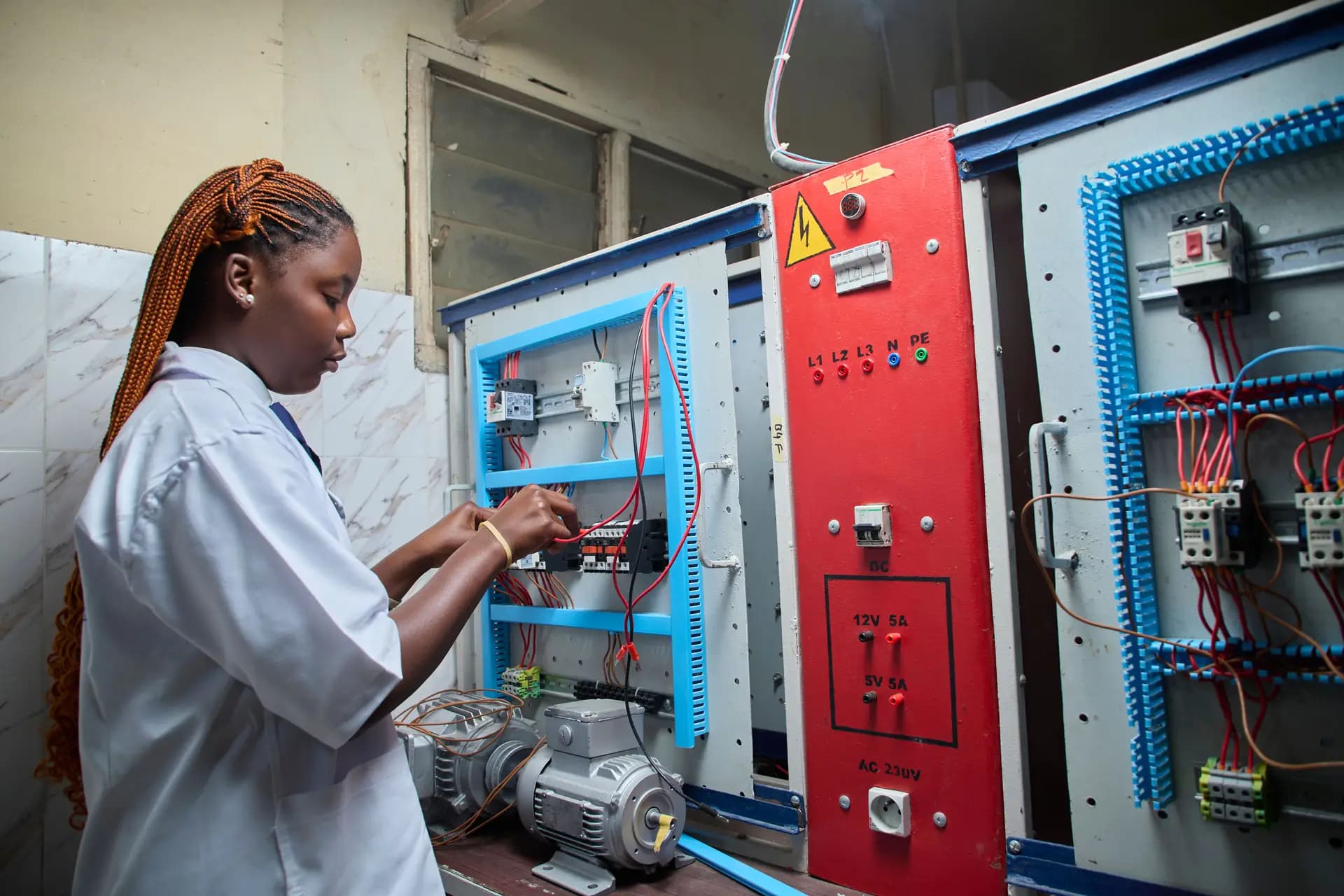
Control Panel Design Engineer
GA drawing, schematics, BOM, heat calculation and the routine test.
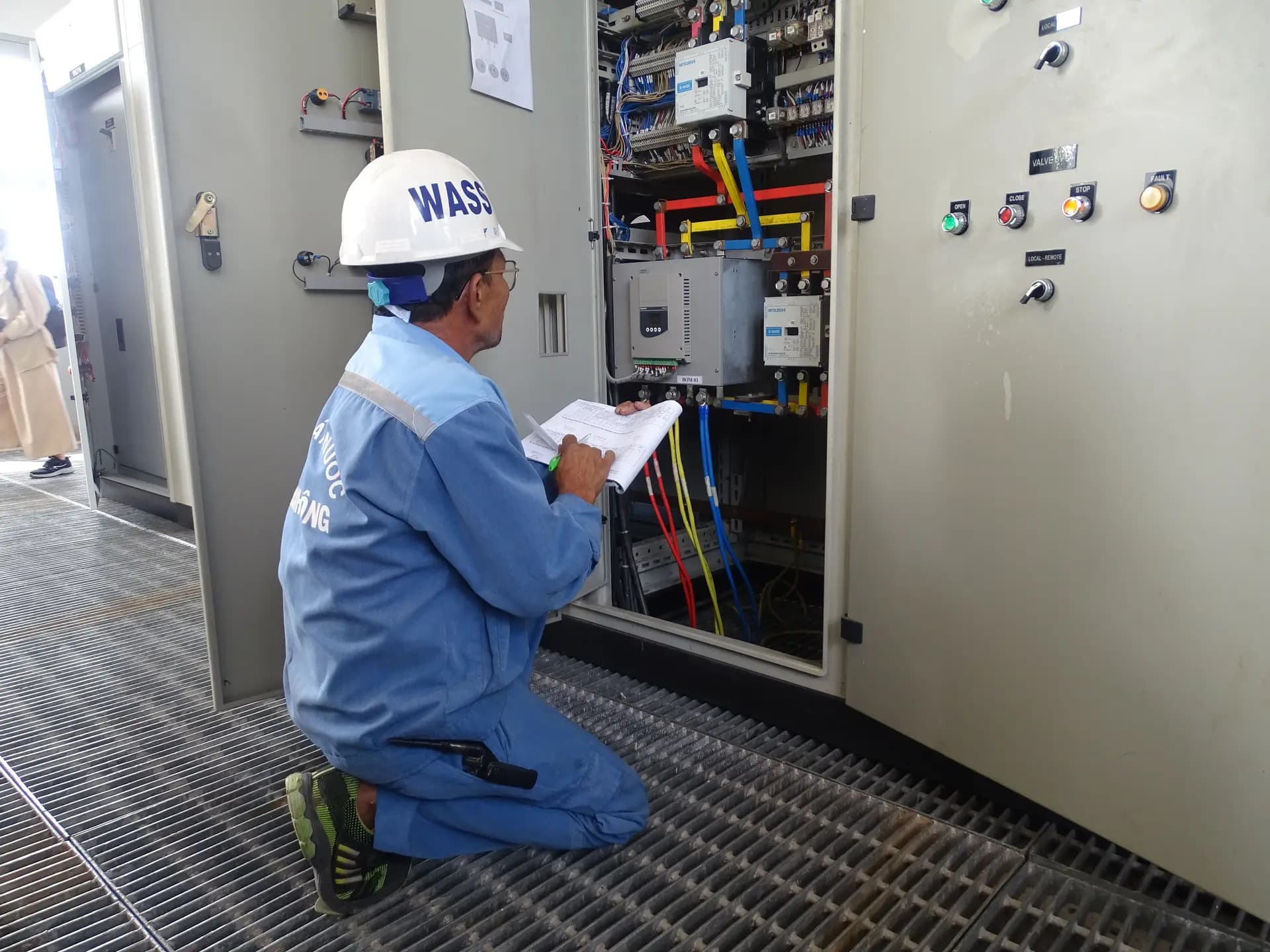
Substation and MCC Engineer
Protection settings, relay tests and an inrush trip on a new feeder.

Solar PV and EV Charging Engineer
Size a PV array, test it to IEC 62446 and fit EV chargers on a limited supply.
- Engineering job simulations
- Free courses
- Browse jobs
- Virtual work experience in the UK
- Job simulation questions
Content reviewed 19 Oct 2026; UK context added 21 Oct 2026. Practice, not employment.
Questions
Quick answers
What does an electrical design engineer do?
They produce load calculations, single line diagrams, cable and protection sizing, schedules and layouts, then update them when the design changes. Job advertisements list these tasks, and the simulation follows the same chain.
How do you size a cable?
Check current-carrying capacity for the installation conditions, then voltage drop and short-circuit withstand, and choose protection that matches. Standards such as IEC 60364 or BS 7671 give the tables, and you use your region's code.
What is the difference between demand factor and diversity factor?
Demand factor is the maximum demand divided by the connected load. Diversity reflects that not all loads peak together. Both reduce the design load from the connected total.
What is a single line diagram?
A one-line drawing of the supply, transformers, switchgear and distribution boards, showing ratings and protection. It is usually the first drawing a reviewer asks for.
Which software do beginners need?
Job advertisements often name electrical drafting software for single line diagrams. The thinking, meaning the load list and the sizing logic, matters more than the tool, and the simulation works with tables and calculations.
How is a late design change handled?
Update the load list, check transformer and cable margins, revise drawings and schedules together and log the revision. The simulation makes you decide which documents change and to which revision.
Can I do electrical design experience online?
Virtual projects and simulations can show the calculation chain, but they do not replace supervised design experience. Describe yours as a project or job simulation.
Do I need an ECS card for electrical design work?
A design office role may not need one, but visits to site often do. The ECS card is the industry card that many UK electrotechnical employers and sites ask for, and it depends on qualifications and a health and safety assessment. This simulation does not give you a card or a qualification, so check what each employer asks for.
Do I need design software?
No. Everything is done in the browser with schedules, tables and calculation fields.
Which standards does the simulation follow?
It follows the ideas of BS 7671 and IEC 60364, IEC 61439 and the IEC 60909 method. Cable data in the exercise is simplified, so use the real tables on a real project.
How long does the free week take?
About nine hours of active work over five working days.
What do I get in the Premium edition?
The full four-week project with the late pump change, site faults, a capstone design pack reviewed by an engineer, and an AI viva.
Is this a real job?
No. It is a job simulation at a simulated company. It is not employment.
Is the Electrical Design Engineer job simulation free?
Yes, to start. Days 1 to 5 are free. The certificate (£14.99) and the Premium edition (£53.99) are optional, and both prices include VAT.
Does it count as work experience?
No. It is a training project at a simulated company, not employment, an internship or a placement. A job simulation is a realistic training project at a simulated company. It is not employment, an internship or a work placement, and it is not a job offer. Hours are active hours the learner logged on EDWartens UK.
A job simulation is a realistic training project at a simulated company. It is not employment, an internship or a work placement, and it is not a job offer. Hours are active hours the learner logged on EDWartens UK.
Start the Electrical Design Engineer job simulation today
Days 1 to 5 are free. No card to start. Practice, not employment.