
Free course · Electrical
Earthing and Lightning Protection Design
Design an earthing system and lightning protection that pass inspection in Great Britain: BS 7671 earthing arrangements, BS 7430 electrodes, ENA TS 41-24 substation earthing, BS EN 62305 and BS 7671 Sections 443 and 534 SPDs, with IEEE 80 only as an international comparison.
Free to learn. Verifiable certificate £19 when you pass the final exam (optional, VAT included).
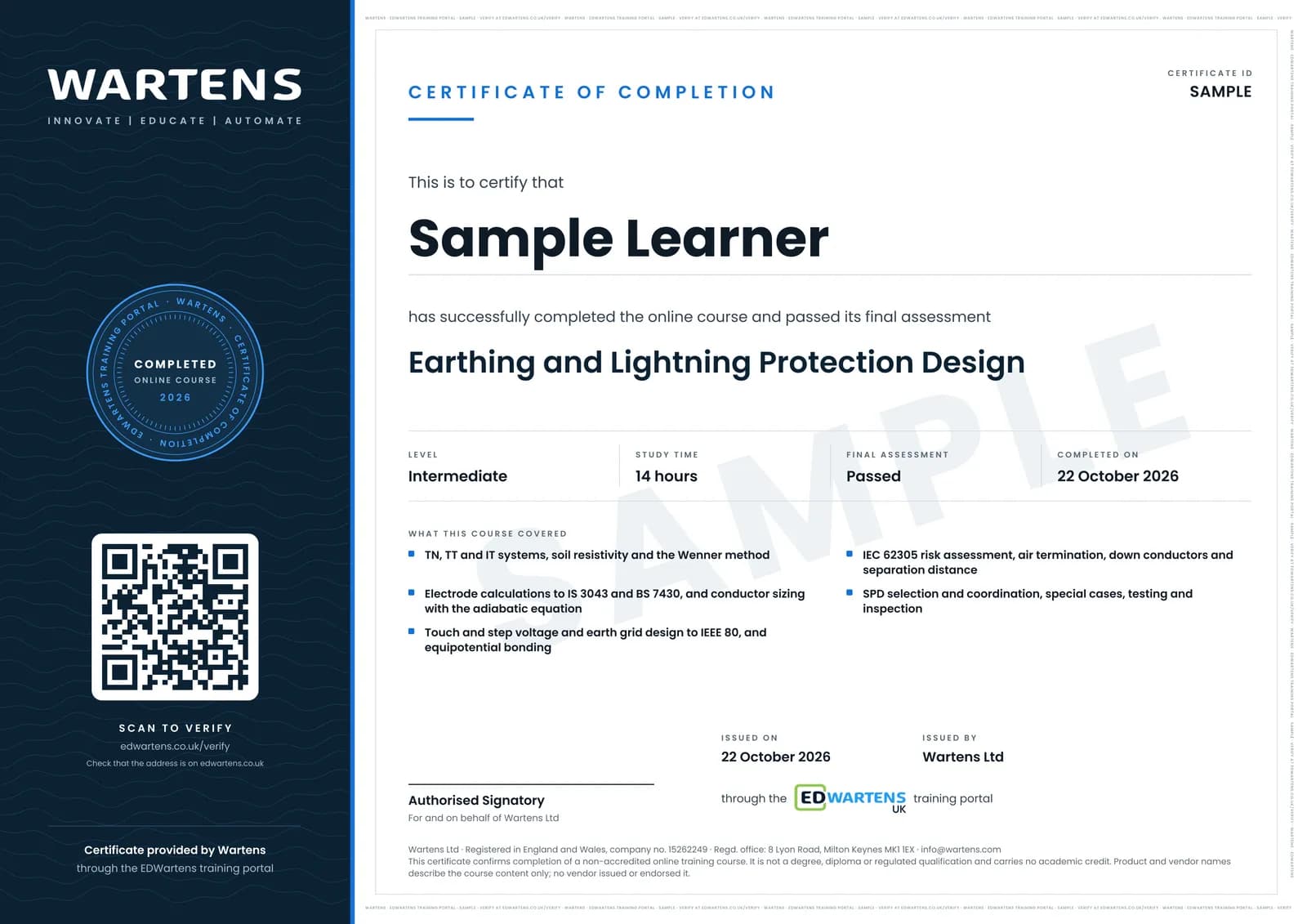
Sample certificate. Optional, issued when you pass the final exam.
- Level
- Intermediate
- Modules
- 13
- Video
- 21 hours
- Price
- Free
Outcome
What you will be able to do
Explain why systems and equipment are earthed and identify TN-S, TN-C-S (PME), TT and IT arrangements under BS 7671 and ESQCR 2002; check automatic disconnection (Chapter 41) with earth fault loop impedance; measure and interpret soil resistivity with the Wenner method; calculate rod, plate and strip electrode resistance and combine electrodes using BS 7430; size earthing and protective conductors with the adiabatic equation and Chapter 54 tables; calculate tolerable touch and step voltages and understand earth potential rise in substations (ENA TS 41-24, with the IEEE 80 method as an international comparison); design main and supplementary bonding; run a BS EN 62305-2 risk assessment and choose the LPS class; place air terminals with the rolling sphere, angle and mesh methods and size down conductors; select and coordinate Type 1, 2 and 3 SPDs to BS 7671 Sections 443 and 534; handle PV, towers, tanks and hazardous areas; and test, inspect and report an earthing and lightning protection system.
- Identify TN-S, TN-C-S (PME), TT and IT arrangements under BS 7671 and explain how each clears an earth fault
- Turn a Wenner survey into a design soil resistivity
- Calculate rod, plate and strip electrodes to BS 7430 and combine electrodes
- Size protective conductors with the adiabatic equation and BS 7671 Chapter 54
- Check automatic disconnection with Zs and apply tolerable touch and step voltages
- Explain earth potential rise in substations to ENA TS 41-24, with IEEE 80 as an international comparison
- Run a BS EN 62305-2 risk assessment and lay out air terminals, down conductors and separation distances
- Select and coordinate Type 1, 2 and 3 SPDs to BS 7671 Sections 443 and 534, then test and report
Software
A spreadsheet for every calculation (LibreOffice Calc is free); you build the BS 7430 electrode sheet and the Zs and conductor-sizing sheets yourself in the modules. A free online BS EN 62305-2 risk calculator is used to check the hand risk assessment, and LibreCAD (free) or any CAD tool can draw the layouts. ETAP, CDEGS and similar packages are mentioned but not required.
Hardware
None. Earth testers (loop impedance, fall-of-potential and soil resistivity) are shown in the videos; you do not need one.
Syllabus
13 modules
Each module has video lessons, notes and a short quiz. The final exam closes the course.
- Why we earth: BS 7671 earthing arrangements TN-S, TN-C-S (PME), TT and IT5 lessons
- Soil resistivity: the Wenner test and reading the results2 lessons
- Earth electrodes: rod, plate and strip calculations (BS 7430 and BS 7671 Section 542)4 lessons
- Sizing protective conductors: the adiabatic equation and BS 7671 Chapter 544 lessons
- Automatic disconnection, earth fault loop impedance, touch and step voltage4 lessons
- Substation earthing: EPR, ENA TS 41-24 and the IEEE 80 grid method4 lessons
- Equipotential bonding: main and supplementary bonding under BS 76716 lessons
- Lightning physics and the BS EN 62305 risk assessment4 lessons
- External LPS to BS EN 62305-3: air terminals, rolling sphere, down conductors, earth termination6 lessons
- Surge protective devices: Type 1, 2 and 3, BS 7671 Sections 443 and 534, and BS EN 62305-47 lessonsLab
- Special cases: solar PV, EV charging, telecom towers, tanks and hazardous areas4 lessons
- Testing, inspection and the design report (BS 7671 Part 6 and BS 7430)7 lessons
- Final Assessment1 lesson
How it works
How this course works
- Watch the video lessonsOne module at a time, at your own pace.
- Take the module quizA short quiz at the end of each module shows what stuck.
- Keep your notesWrite in My notes beside each module and ask the trainer if you are stuck.
- Practise in the labOptionalTry a task from the module in the EDWartens Lab, in your browser.
- Sit the final examPass it once you have been through the modules.
- Certificate, if you want oneOptionalPaid, and only after you pass. Anyone can check it online.
EDWartens Lab
Practise this in the EDWartens Lab
Choose surge protectors for a solar array from its voltages and cable runs, the same choices a protection design makes.
Works alongside Earthing and Lightning Protection Design. The Lab is solar and ev charging practice in your browser: no install, no hardware, free to use. Sign in as a learner and it opens with your account.
Levels to try with this course
SEV-03 · Solar and EV lab
Select cables, fuses, isolators and surge protectors
Open in the lab (opens in a new tab)
Optional. Skip it whenever you like: it never blocks your progress or your certificate.
Why practise in a lab
Technical work is judged on what you can do: wiring, commissioning, finding a fault. Doing a task yourself teaches more than watching it a second time, and a lab lets you try it safely before you meet real equipment. It does not replace working on real hardware.
- Practise safely, so a mistake costs nothing.
- The lab checks your work like a site test, so you know when it is right.
- Free, in your browser, with nothing to install.
Certificate
An optional certificate when you pass
Learning is free. Pass the final exam and you can have a certificate for £19, including VAT, with a number employers can check online. It records that you completed a free online course; it is not a regulated qualification or a CPD certificate.
- Your name, the course, its study time and your final exam score
- A unique certificate number and a QR code to its verification page
- Issued by Wartens Ltd; add it to your LinkedIn profile in one click
- Pay now or after you pass: it is issued the moment you pass the final
Credits
Who made the lessons
The video lessons belong to their creators. EDWartens wrote the study plan, notes, quizzes and the final exam.
- GSH Electrical
the lessons "Earthing Arrangements TN-C-S, TN-S and TT Identified and Explained", "Earth Fault Loop Impedance Test - 3 Lead Low or 2 Lead High"
- eFIXX
the lessons "Understanding Earthing Arrangements - TNCS, TT, TNS", "Earthing vs. Bonding: What's the Difference?", "Why are earth bonding conductor sizes different for TT and TN-C-S (PME) earthing arrangeme" and 2 more
- SCIENTIA
the lesson "How electrical distribution systems TN TT IT protect against indirect contacts. Grounding"
- Railway Engineering Insights
the lessons "Earthing & Bonding Lecture 1: Basic Definitions and Interesting Facts", "Earthing & Bonding Lecture 7 : Earth Resistance of Vertical Rod", "Earthing & Bonding Lecture 5: Earth Conductor Sizing (Part 1)" and 7 more
- Circuit Masterclass
the lesson "Soil Resistivity Testing Explained: Wenner Method & Polar Curve Analysis for Grounding Sys"
- Engr. Ahmed / Khadija Academy
the lessons "Factors Affecting Soil Resistivity - Lesson 8 - Earthing Design Course", "Vertical Earthing Electrodes - Lesson 7 - Earthing Design Course", "Multiple Earthing Electrodes Resistance - BS 7430 - Lesson 14"
- JPElectric
the lessons "The Adiabatic Equation", "Supplementary Protective Bonding and Touch Voltage"
- Graham Mackie
the lesson "Protective conductor size selection/confirmation via the adiabatic equation"
- John Ward (jwflame)
the lessons "Calculating maximum values of earth loop impedance, Zs", "Earthing & Bonding - Part 2 : Main Protective Equipotential Bonding", "Earth Electrode Testing"
- Axis Electricals
the lessons "8 Steps of Substation Earthing Design - Explained with Substation Earthing Calculations", "How to select Down Conductors for Lightning Protection System?", "Lightning Protection for Rooftop Solar PV Plants Explained!" and 1 more
- Smart Educare
the lessons "Earthing Grid Design in Excel as per IEEE80 (Part-1)", "Earthing Grid Design in Excel as per IEEE80 (Part-2)"
- Mohamad Nassereddine
the lesson "Substation Earth Grid Resistance Calculation as per IEEE-80 Standards"
- Pecos Hank
the lesson "HOW LIGHTNING WORKS - Weird World of Lightning"
- DEHN Inc.
the lesson "Dehn Miami Tech Seminar Session 1 - Day 1 - Introduction to the IEC 62305 Suite of Standar"
- ABB Learning
the lesson "How to Navigate the Major Changes in IEC 62305:2024 Protection Against Lightning?"
- CITEL
the lessons "TechBreak#4 : LPZ : Lightning Protection Zones CITEL EN", "Type 1 and type 2 SPD : installation and rules"
- SDG Electronics
the lesson "SDG #045 Surge Protection Devices - BS7671 18th Edition"
- ELEK Software
the lesson "Earthing Design and Modelling Guide for Renewable Energy Projects"
- Bentley EasyPower Software
the lesson "Bonded vs Isolated Lightning Protection Concepts & their Application to Explosive Areas"
- Megger US
the lesson "How-to Perform a Fall of Potential Test with the Megger DET2/3 Ground Tester"
Questions
About this course
Who is this earthing and lightning protection course for?
Is the course free to learn?
Which standards does it cover?
Do I need ETAP or other earthing software?
How long does the course take?
What certificate do I get?
What should I take before this course?
What work does earthing and lightning protection design involve?
Want a live class and career support?
The Professional Module is five live days of Siemens PLC, HMI and SCADA with an instructor, then a resume session and a CPD certificate.