
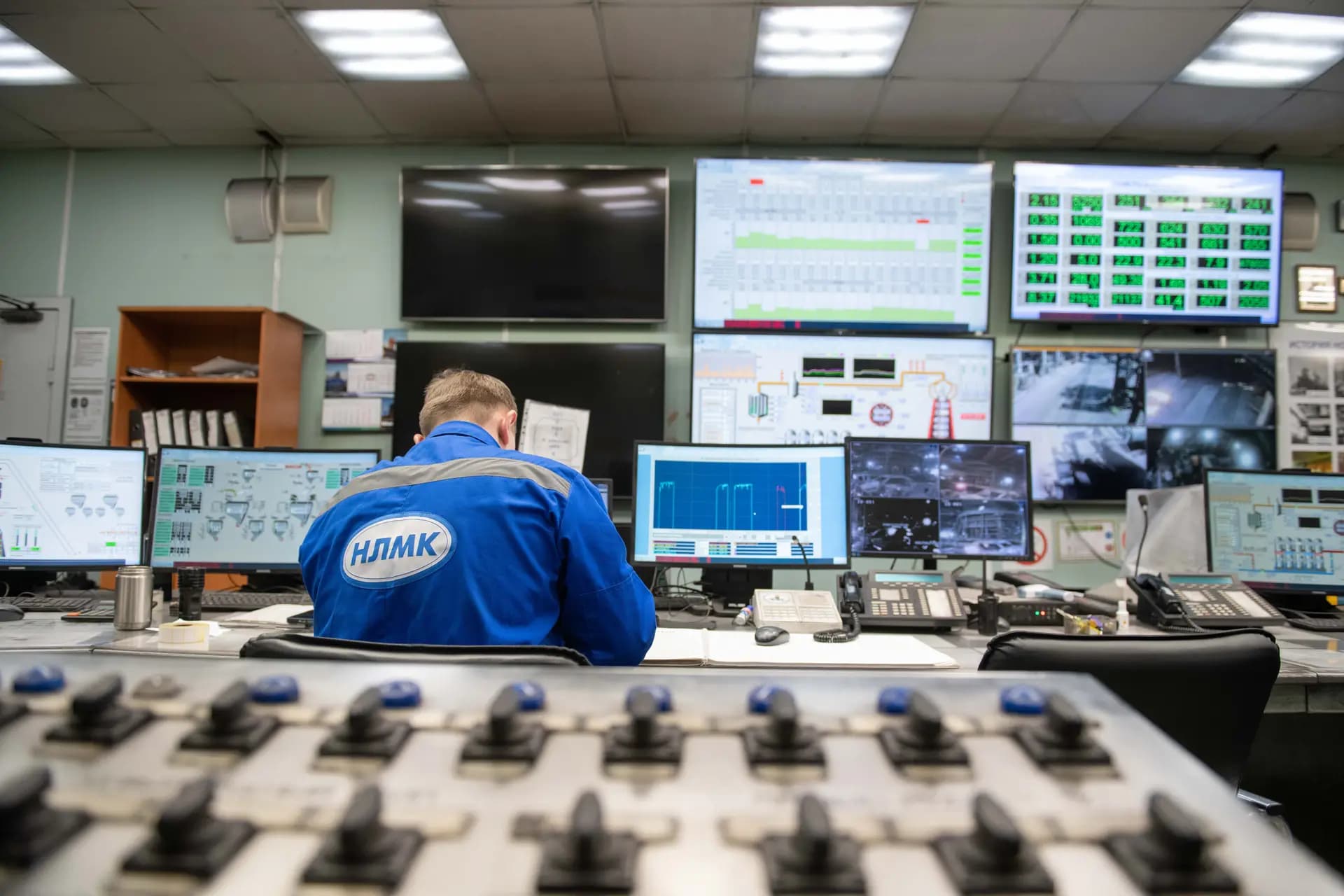
Free job simulation · Automation and controls
SCADA and HMI engineer job simulation
A SCADA and HMI engineer job simulation is hands-on practice at the operator side of automation. You turn raw counts into engineering values, set alarm priorities, build calm operator screens for a simulated water works and sort an alarm flood into cause and noise. It teaches the deliverables an entry-level SCADA engineer produces. It is practice, not paid employment.
You join Halcombe Control Systems Ltd (simulated company), a control systems integrator in Reading. Days 1 to 5 are free, with about 10 h 15 min of tickets. Premium continues to day 20. It is practice, not employment.
Days 1 to 5 are free. You need a free account and no card. Create an account.
- Free days
- 1 to 5
- Free tickets
- about 10 h 15 min
- Project documents
- 9
- Certificate, optional
- £14.99
The project
You join Halcombe Control Systems Ltd (simulated company)
Halcombe Control Systems Ltd (simulated company) is a control systems integrator in Reading. You help its team deliver a project for Eskmoor Water Services Ltd, at Eskmoor Treatment Works, treatment stream (project ESK-410).
You are the junior SCADA and HMI engineer on the control room upgrade of a water treatment works. The operators work twelve-hour shifts on what you build, so the screens must be calm and the alarms must mean something. You check a functional specification, scale and size tags, set alarm priorities with a matrix, and answer a client who wants everything flashing red. Later the client changes the scope, a scaling error causes a false alarm, a power dip floods the screen, a manager wants alarms on his phone with a shared password, and the historian loses 25 minutes. The skill is to be clear, polite and exact, and to keep the live plant safe.
What you will do
- Scale raw counts into engineering values and size a historian from planning figures
- Set alarm priorities from a consequence and response-time matrix and measure alarm KPIs
- Design calm operator screens and say no, politely, to flashing red everywhere
- Sort an alarm flood into the cause, the consequences and the noise
- Handle a change request, a licence limit and a request for remote access safely
The people you deal with
- Lead SCADA Engineercompany
- Project Managercompany
- PLC Engineercompany
- Client Process Managerclient
- Client Operations Supervisorclient
- Control Room Operatorclient
- Client IT Security Leadclient
- Client Safety Officerclient
- SCADA Software Supportvendor
The company, client and site are fictional. The people are fictional too.
Look inside
What the simulator looks like
The workplace, your tickets, the documents and the team chat, as a learner sees them.
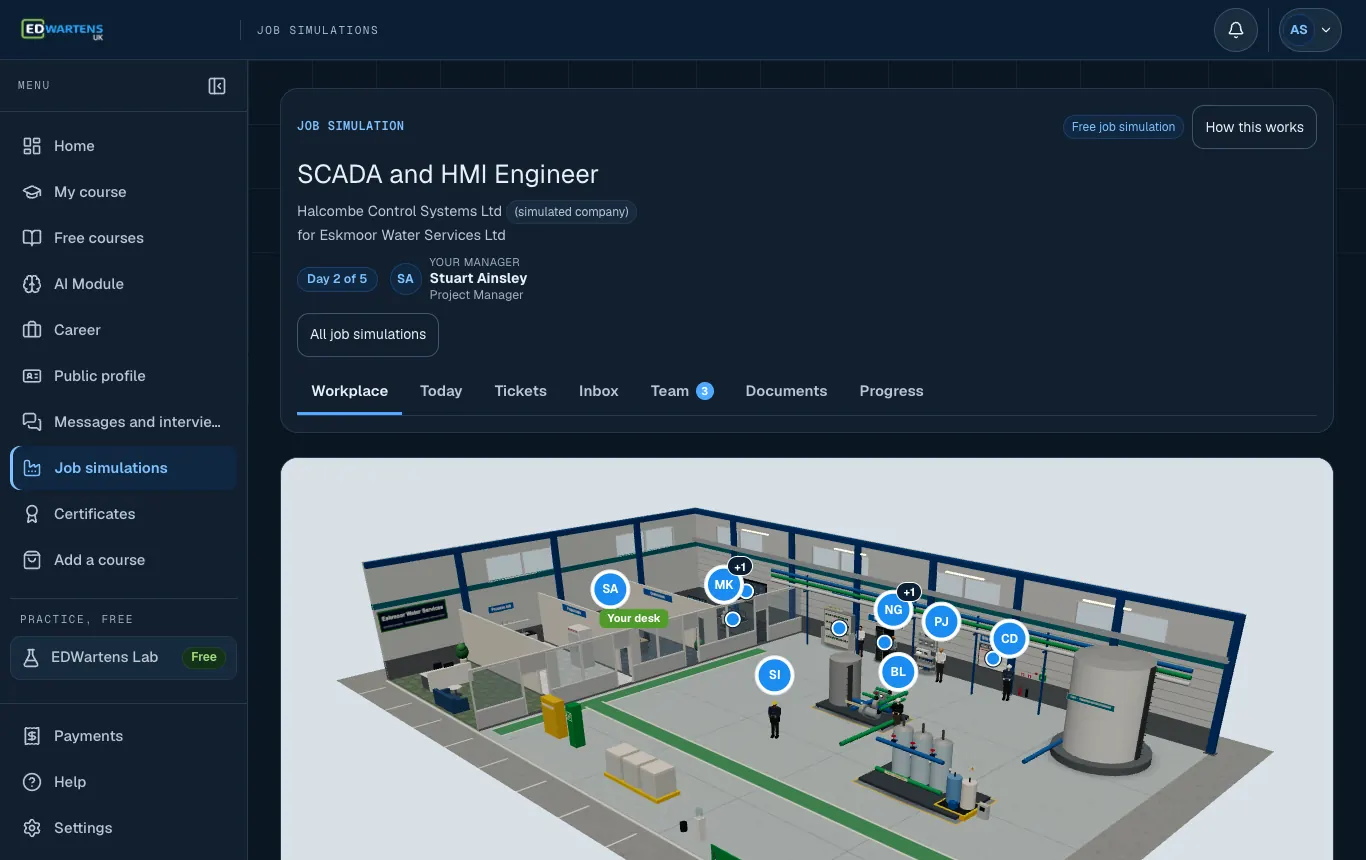
Start in the workplace, with the team around you. 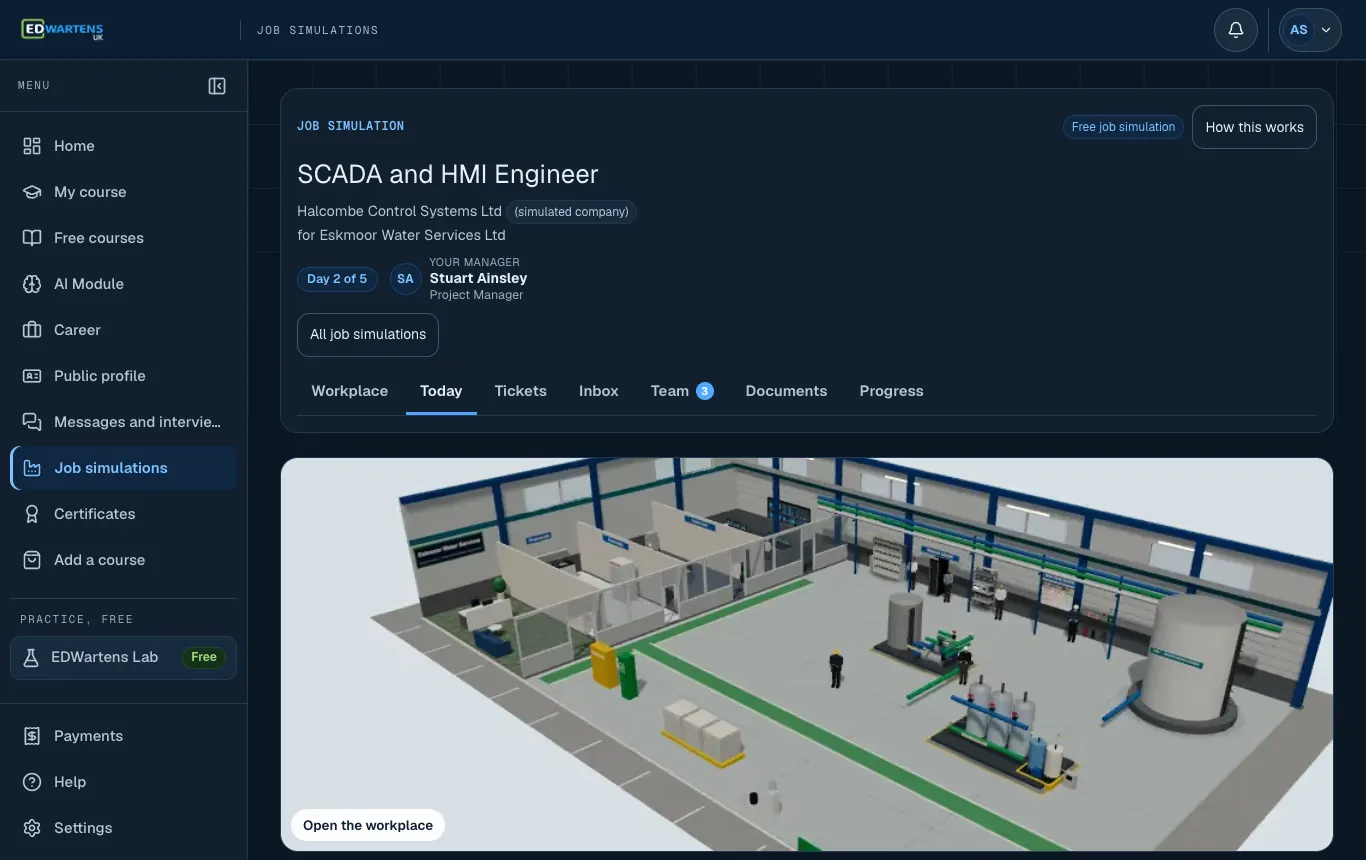
Today: the morning email and your tickets for the day. 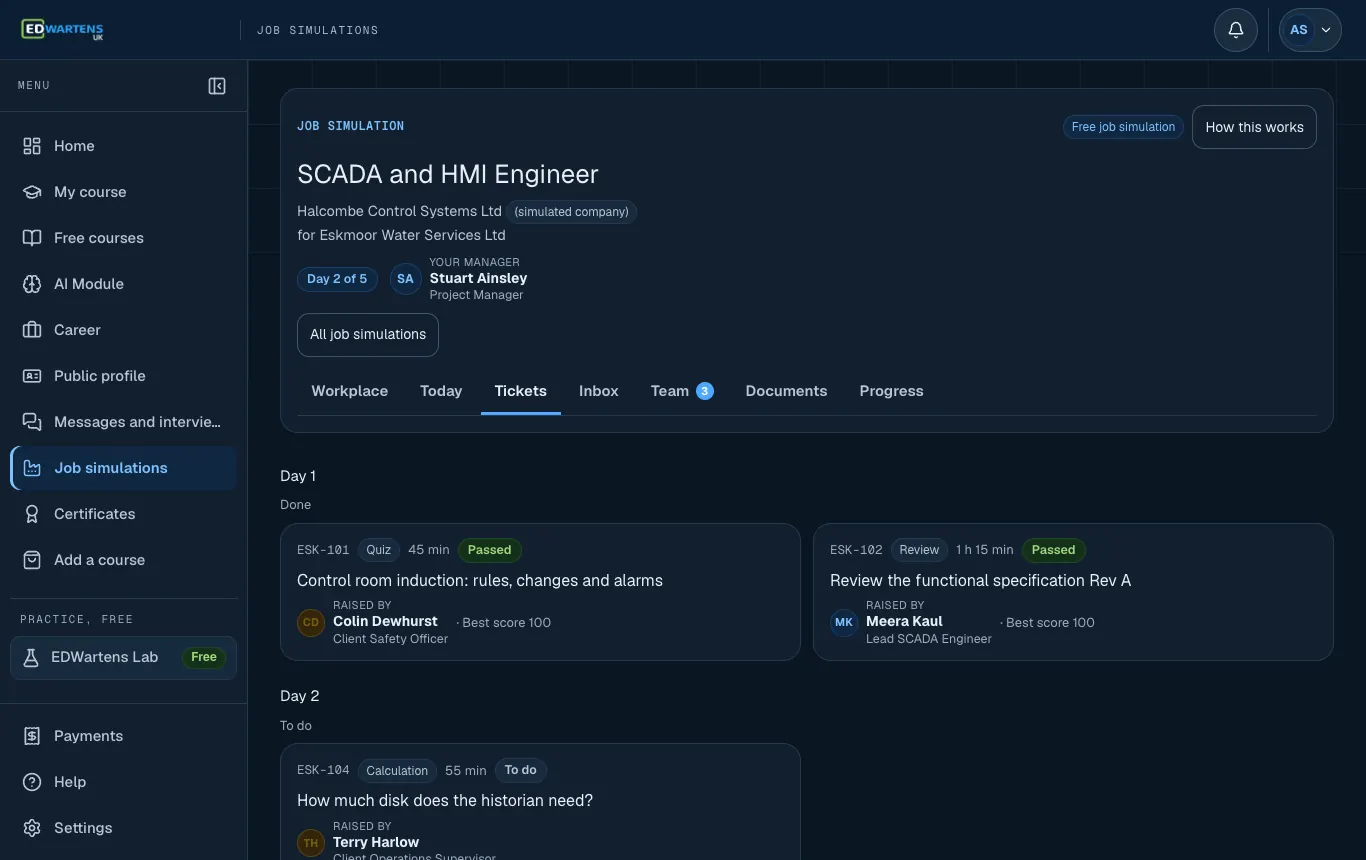
Work: every ticket, by day, with its status. 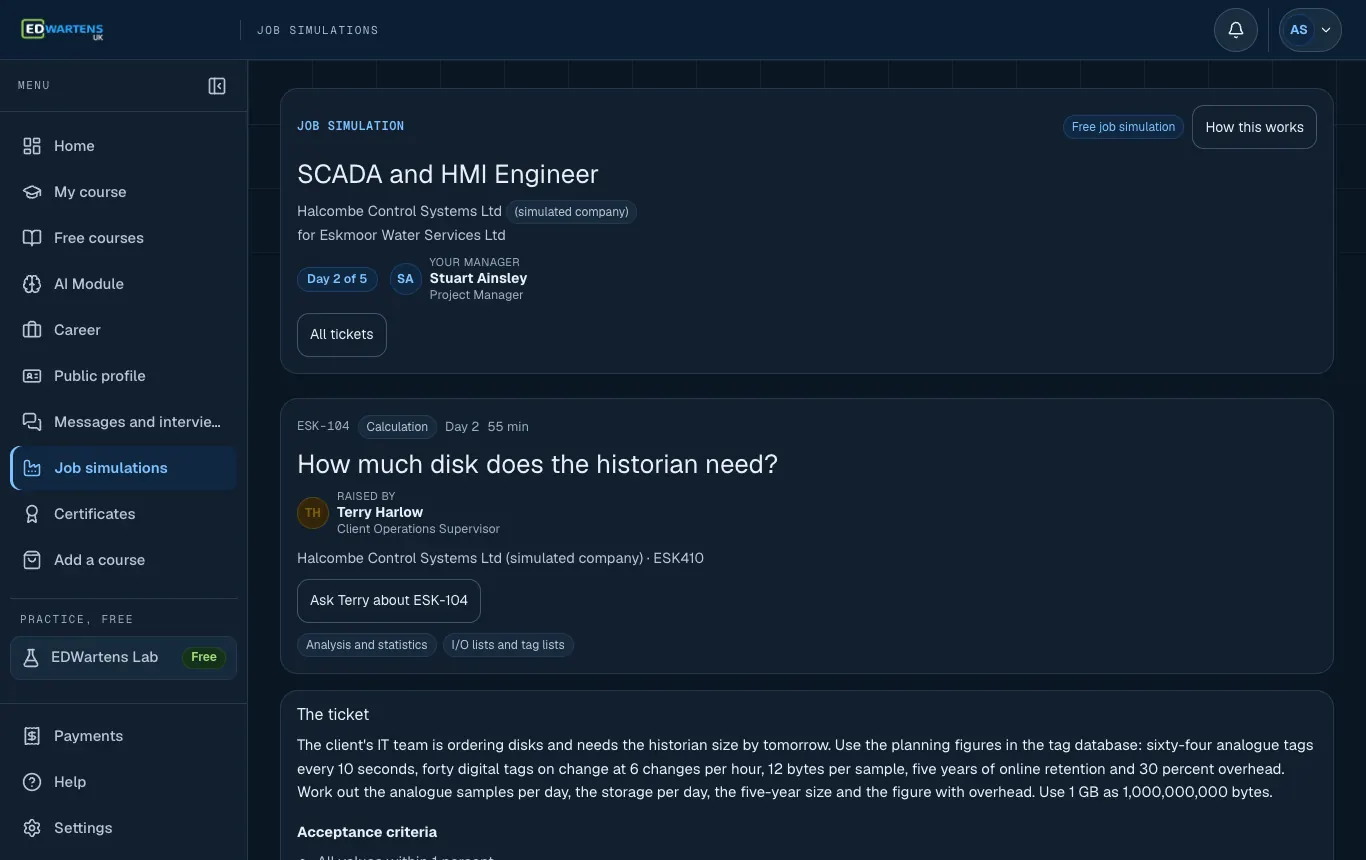
A ticket, written the way a colleague would write it. 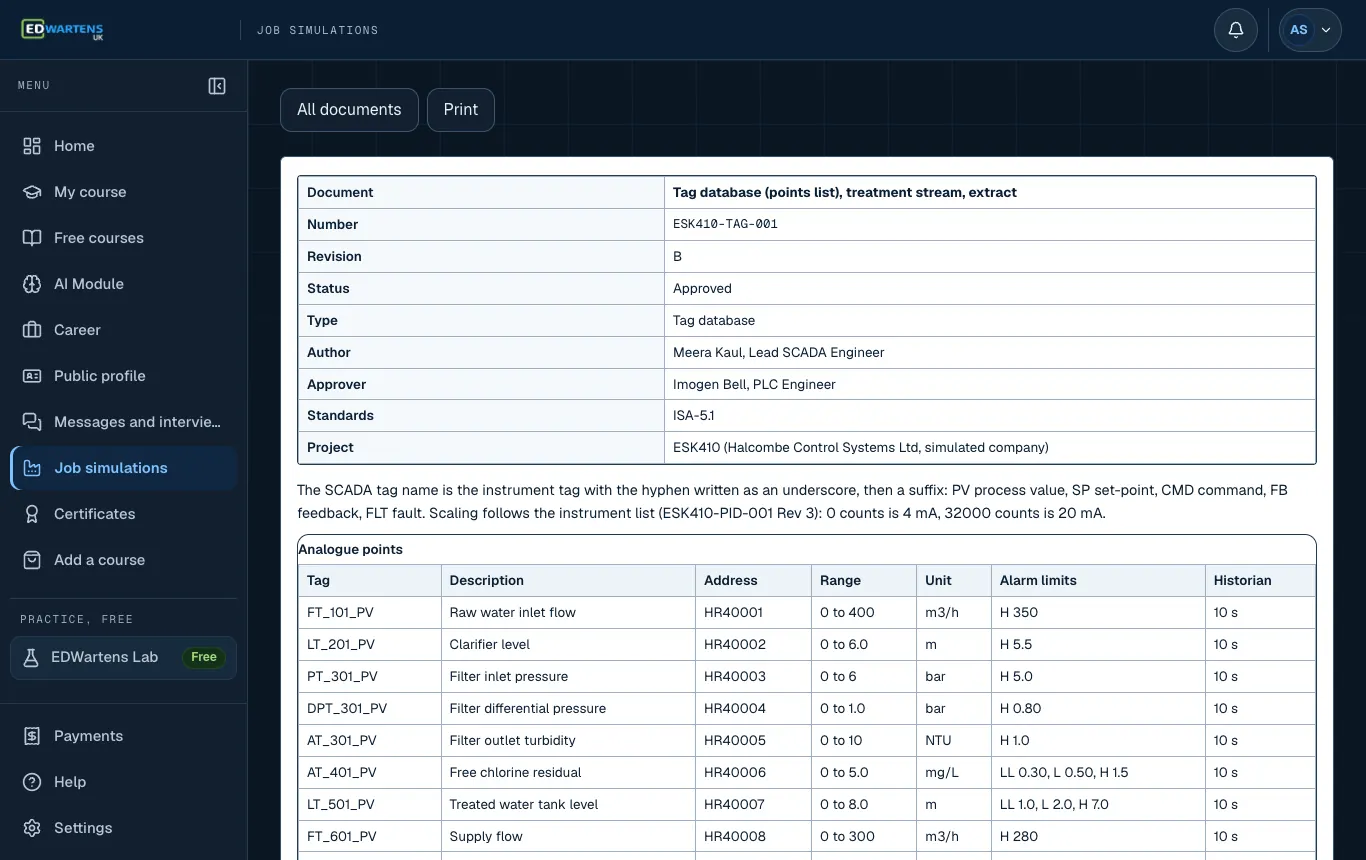
A project document with its number, revision and status. 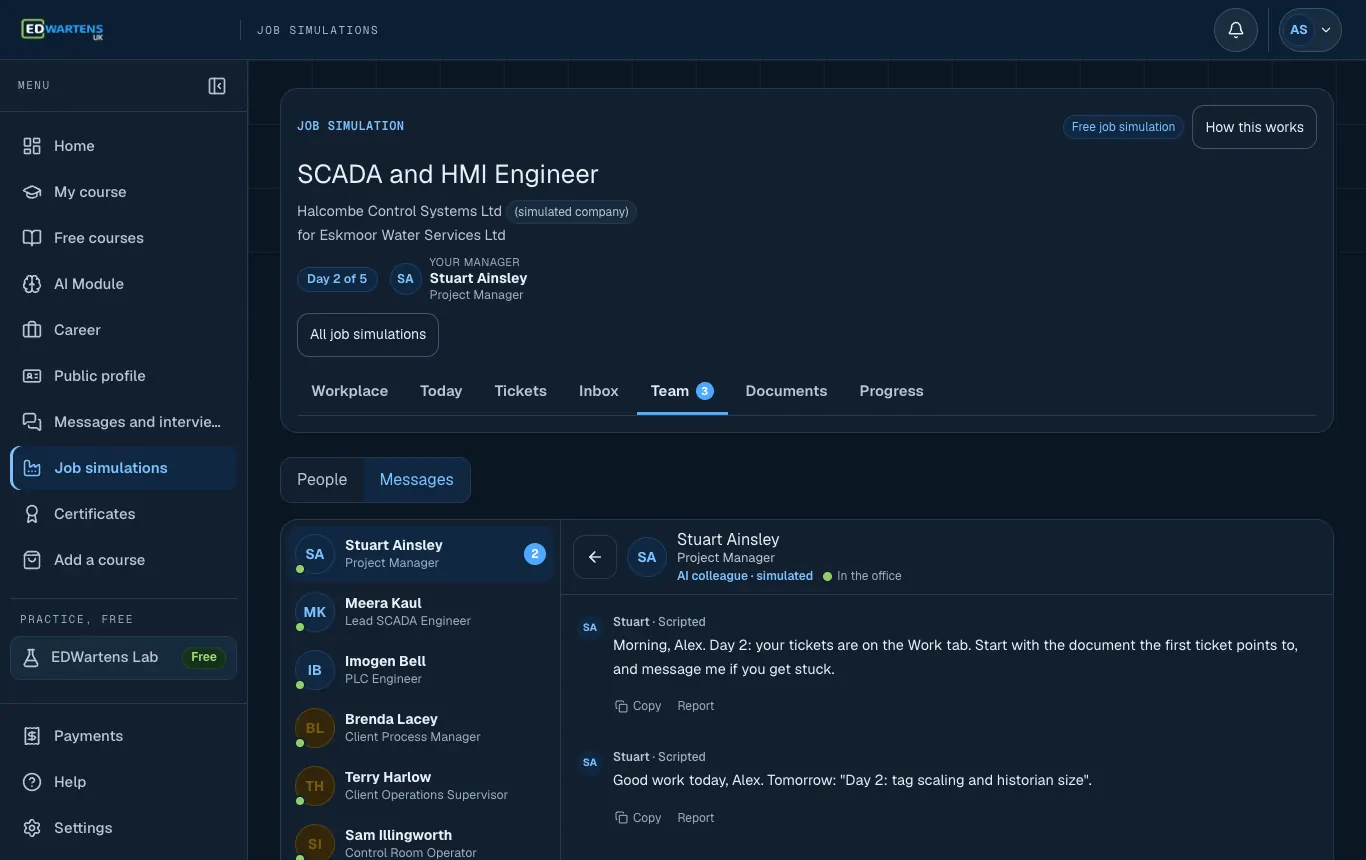
Ask a colleague. They are AI colleagues: they help you think, they do not hand out answers.


Screenshots from the simulator. Company, people and data are fictional. Portraits are AI-generated.
Meet the team
The colleagues you work with
You can read their messages and ask them questions. They are AI colleagues, clearly labelled. They help you think a ticket through; they do not hand out its answer.
- SAStuart AinsleyProject ManagerSimulated colleague, company side
- MKMeera KaulLead SCADA EngineerSimulated colleague, company side
- IBImogen BellPLC EngineerSimulated colleague, company side
- CDColin DewhurstClient Safety OfficerSimulated colleague, client side
- BLBrenda LaceyClient Process ManagerSimulated colleague, client side
- THTerry HarlowClient Operations SupervisorSimulated colleague, client side
- SISam IllingworthControl Room OperatorSimulated colleague, client side
- NGNadia GhoshClient IT Security LeadSimulated colleague, client side
Fictional people. Portraits are AI-generated.
What you get
What you walk away with
Design and test SCADA and HMI for a water treatment stream: tags, alarms, screens, security and handover.
What you produce
Tag scaling sheet from raw counts to engineering values
Tag database
Alarm priority list
Alarm rationalisation
Alarm performance measured against targets
Alarm report
Operator walkthrough action note
Meeting notes
SCADA and PLC tag reconciliation
Tag check listPremium
Change impact note for a change request
Change controlPremium
Completed FAT record
Test recordPremium
SCADA and HMI design pack
CapstonePremium
Skills you practise
- Alarm management
- HMI and SCADA screens
- Applying standards
- Document and revision control
- Written communication
- I/O lists and tag lists
- Analysis and statistics
- Working with clients and stakeholders
Roles to look for
- SCADA Engineer
- HMI Developer
- Controls and SCADA Engineer
- Process Control Engineer
570 live openings on the UK jobs board, checked 24 Oct 2026. See the jobs
Your proof
- A certificate anyone can verify. Optional, and included in Premium.
- An entry on your EDWartens profile under Work experience, marked as a job simulation.
- A work record with your skill scores, with Premium.
Free courses that go with it
What you can talk about at interview
- You can explain how you turn raw counts into engineering values and size a historian.
- You can describe how you rationalise an alarm list and measure it against the targets.
- In Premium, you can walk through a change request, a factory test and a site fault, and say how you kept security rules in the design.
Day by day
Days 1 to 5, ticket by ticket
Self-paced. A day opens when you hand in the previous day's tickets. Every ticket is checked, and you see the model answer after it.
Day 1
about 2 h- Control room induction: rules, changes and alarmsQuiz · 45 min
- Review the functional specification Rev ADocument review · 1 h 15 min
Day 2
about 2 h 10 min- From raw counts to engineering valuesTable · 1 h 15 min
- How much disk does the historian need?Calculation · 55 min
Day 3
about 1 h 45 min- The client wants flashing red everywhereDecision · 35 min
- Build an operator screen in the process labHand-in · 1 h 10 min
Day 4
about 2 h 20 min- Set the priority of each alarmTable · 1 h 5 min
- Rationalise twelve alarms in the process labHand-in · 1 h 15 min
Day 5
about 2 h- Measure the old system against the alarm targetsCalculation · 1 h
- Operator walkthrough: the action noteWriting · 1 h
Premium: days 6 to 20about 22 h 15 min more
After day 5 the project goes on with a change request, site work, faults, a handover and a capstone reviewed by an engineer.
Day 6
about 45 min- Zones, accounts and remote accessQuiz · 45 min
Day 7
about 1 h 10 min- Sync SCADA tags with the PLC symbol tableTable · 1 h 10 min
Day 8
about 1 h 40 min- Change impact note for CR-01Writing · 1 h 40 min
Day 9
about 1 h- Licence count: are we over the 500-tag band?Calculation · 1 h
Day 10
about 1 h 5 min- Review the user access matrixDocument review · 1 h 5 min
Day 11
about 2 h 25 min- Complete the FAT recordTable · 1 h 50 min
- An operator cannot tell red from yellowDecision · 35 min
Day 12
about 1 h 50 min- Site acceptance and fault finding in the process labHand-in · 1 h 50 min
Day 13
about 1 h 15 min- Why the clarifier level alarm is falseCalculation · 1 h 15 min
Day 14
about 1 h 50 min- Sort the alarm flood from the tripTable · 1 h 50 min
Day 15
about 45 min- Alarms on the Process Manager's phoneDecision · 45 min
Day 16
about 1 h 20 min- Incident report: the gap in the chlorine trendWriting · 1 h 20 min
Day 17
about 1 h 15 min- Check the handover index against the project recordsDocument review · 1 h 15 min
Day 18
about 4 h- Capstone: the SCADA and HMI design packHand-in · 4 h
Day 19
about 1 h 10 min- Day-one note for the operatorsWriting · 1 h 10 min
Day 20
about 45 min- A conversation about your own workViva · 45 min
Real documents
The documents you will work with
Each one has a number, a revision and an approver, the way a project document does. You read them, check them and write your own.
ESK410-HSE-001
Site rules and control room induction
Rev 1Site rules
ESK410-PID-001
Process description and instrument list, treatment stream
Rev 3Instrument list
ESK410-STD-001
Screen design standard (style guide)
Rev 2Screen standard
ESK410-ALM-001
Alarm philosophy
Rev 1Alarm philosophy
ESK410-TAG-001
Tag database (points list), treatment stream, extract
Rev BTag database
ESK410-ALM-002
Alarm list for rationalisation, draft
Rev AAlarm list
ESK410-LOG-001
Alarm log summary of the old system, last 12-hour shift
Rev 1Alarm log summary
ESK410-FS-001
HMI and SCADA functional specification
Rev AFunctional specification
ESK410-LOG-002
Operator walkthrough notes, day 5
Rev 1Meeting notes
Documents that arrive in Premiumchange requests, records, handover
ESK410-PLC-001
PLC symbol export and tag check list
Rev ASymbol tablePremium
ESK410-FS-001
HMI and SCADA functional specification
Rev CFunctional specificationPremium
ESK410-TAG-001
Tag database (points list), change to Rev C
Rev CTag databasePremium
ESK410-SEC-001
User access matrix and account rules
Rev AAccess matrixPremium
ESK410-NET-001
Network zones and remote access policy
Rev 1Network policyPremium
ESK410-FAT-001
Factory acceptance test procedure and record
Rev AFAT recordPremium
ESK410-CAL-021
Calibration certificate, LT-201 clarifier level transmitter
Rev 1Calibration certificatePremium
ESK410-CE-001
Cause and effect, MCC-1 incomer undervoltage, and trip classification rules
Rev 1Cause and effectPremium
ESK410-INC-001
Historian gap record, night of day 15
Rev 1Incident recordPremium
ESK410-HOV-001
Handover index, draft
Rev AHandover indexPremium
Tools
In the industry, and here
| In the industry | Here |
|---|---|
| SCADA and HMI development software | EDWartens Lab's operator-screen and alarm exercises, with documents you review and fill in |
| Tag databases and alarm lists in spreadsheets | Tables where you complete values, priorities and classes |
| Historian and trend tools | Calculations from the planning figures and an incident record |
| Change forms and design review packs | Impact notes and a design pack you upload for review |
Standards
The standards the work follows
- ISA-101
- ISA-18.2
- IEC 62443
- ISA-5.1
- EEMUA 191 (guidance)
In the UK
The SCADA and HMI Engineer role in a UK setting
Who employs this kind of engineer: Control systems integrators, water companies and their contractors, energy and food and drink manufacturers.
Where: Water and energy operators are spread across the whole UK, and integrators are found in most regions. This is context, not a statement about vacancies.
UK standards and regulations to know about
ISA-101 and ISA-18.2
Guidance on operator interface design and on alarm management.
EEMUA 191
UK-originated guidance on alarm systems: design, management and procurement.
IEC 62443
Security for industrial automation and control systems.
NIS Regulations 2018 and the NCSC Cyber Assessment Framework
Operators of essential services such as water and energy are regulated for the security of their networks and information systems. The NCSC framework is used to assess them.
These are named so that you recognise them. A job simulation does not teach them as a qualification, the tasks use simplified data, and you should always read the current edition of anything you rely on.
Your proof, optional
A certificate you can verify
The free days are free. The graded, verifiable certificate is an optional extra, and it is included in Premium.
- A graded, verifiable certificate with your score and band
- A public verification page and QR code
- One-click add to LinkedIn as a licence or certification
- Issued by WARTENS LTD. It is a training certificate, not an accredited qualification, and the company is simulated
Optional: £14.99 including VAT, once you pass.
Job Simulation Certificate
Your name
completed the SCADA and HMI Engineer job simulation at Halcombe Control Systems Ltd (simulated company). Your score and band are shown on the real certificate.
- Number
- EDW-JS-0000
- Issued by
- WARTENS LTD
Not an accredited qualification. A verification page and QR code are printed on the real certificate.
Prepare
Free courses and labs that get you ready
Linked from the tickets that need them. You can read them before you start.
Free courses
- Ignition SCADA by Inductive Automation
- HMI Design and Programming: Siemens WinCC and FactoryTalk View ME
- SQL for PLC and SCADA Engineers
- Health and Safety Foundations: HSWA 1974, RIDDOR and ISO 45001
- P&ID Reading and Instrumentation Design Documents
- Industrial Instrumentation and Process Control
- Industrial DataOps: OPC UA, MQTT and Unified Namespace
- HAZOP and Process Safety Management
EDWartens Lab guides
The hands-on tickets are finished in EDWartens Lab, then you record the figures and upload a FAT sheet or notes for checking. Nothing is marked as passed on the lab's say-so.
A course that goes with this role
Professional Module
A paid course in PLC, HMI and WinCC SCADA programming with Siemens TIA Portal, taught live online by an instructor. It is a separate product: you do not need it to finish the job simulation, and it does not lead to a job. Its certificate is a certificate of completion, not a regulated qualification.
- Price
- £2,568 including VAT (£2,140 + VAT)
- Format
- Live online, five days, with self-paced modules after
About the SCADA and HMI Engineer role
The tag list and the alarm list: two documents that decide a project
Screens are drawn from a tag list, and operators live with the alarm list. A tag list records each data point with its name, address, type, scaling and limits. An alarm list says which conditions interrupt an operator and what they should do.
In the simulation you complete scaled values from raw counts, check the SCADA tags against the PLC symbol table and later update the tag database for a change request. You also set the priority of each alarm using a consequence and response-time matrix, so priority follows a rule rather than opinion.
HMI design rules: calm screens in practice
ISA-101 is the guidance behind calm operator screens: a restrained palette, colour kept for abnormal conditions, and consistent layout. The project puts a client in front of you who wants flashing red everywhere, and the task is to say no politely and explain why.
You build an operator screen in the process exercise, then face a later case in which an operator cannot tell red from yellow. Good design is tested against people, not taste.
The outcome you are practising is judgement: clear screens that help an operator act, and a courteous way to push back on a design that would not.
Alarm rationalisation and the trip-time flood
ISA-18.2 describes the life cycle of alarm management, and EEMUA 191 is the widely used guidance on alarm system performance. You use these ideas to measure the old system against alarm targets from a real-looking shift log.
The Premium days add a trip that sets off a flood of alarms. You sort it into the cause, the consequences and the noise, which is a skill employers recognise because every plant has had a flood. You also write an incident report on a gap in a chlorine trend, using historian evidence.
OPC, PLC tag mapping and remote access in plain words
A SCADA system reads values from controllers through a driver or a protocol such as OPC. The practical job is keeping names, addresses and scaling consistent between the PLC and SCADA, which is the task that syncs tags with the symbol table.
IEC 62443 enters when a vendor, or the process manager, asks for remote access. The project covers zones, accounts and a user access matrix, and asks you to handle the request safely rather than just say yes.
These are small tasks, but they are the ones that cause real outages when they are skipped.
Where SCADA leads
SCADA engineers move towards distributed control systems, manufacturing execution, or OT security. A solid PLC background and basic networking help in all three.
The related roles on this page, PLC programmer and OT security analyst, are the natural neighbours. The free courses linked here cover HMI design, SQL for historians and industrial communication.
Whatever you choose, keep the alarm list and tag list habits. They carry into every control system and every vendor tool, and they are what interviewers can test in a few minutes of conversation.
Keep going
Related job simulations and courses
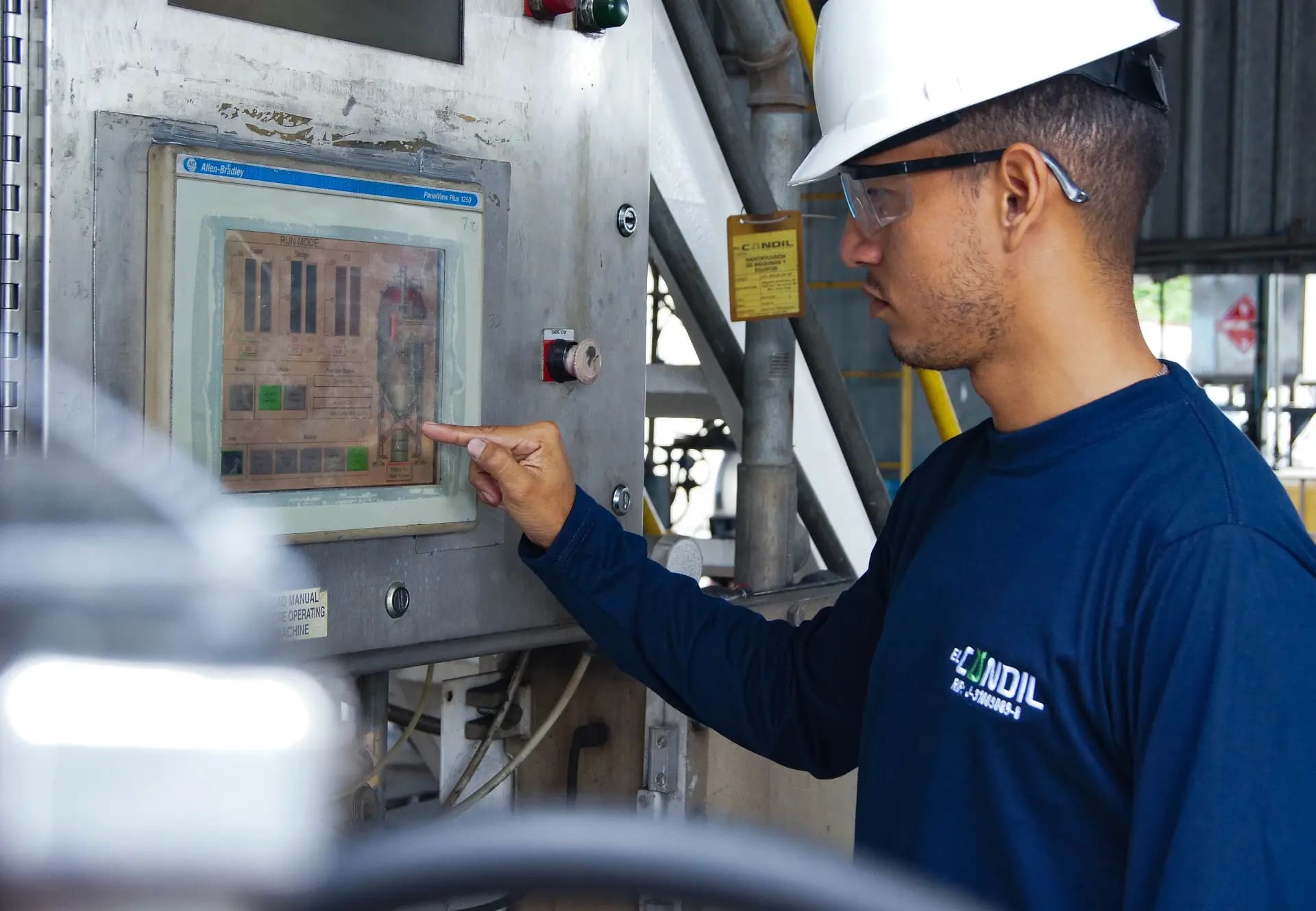
PLC Programmer
Write the I/O list, program the line, run the FAT and handle a change request.

OT Security Analyst
Asset inventory, zones and conduits, and a remote-access incident at a plant.

Instrumentation Engineer
Instrument index, datasheets, loop diagrams and calibration on a process plant.
- Engineering job simulations
- Free courses
- Browse jobs
- Virtual work experience in the UK
- Job simulation questions
Content reviewed 19 Oct 2026; UK context added 21 Oct 2026. Practice, not employment.
Questions
Quick answers
What does a SCADA and HMI engineer do?
They configure tags, screens, alarms, trends and reports, link them to PLCs through protocols such as OPC, and test with operators. Entry roles usually work under supervision.
Do I need PLC knowledge for SCADA work?
Postings commonly expect at least working familiarity with ladder logic and addressing, plus industrial protocols and networking basics. The simulation includes a PLC symbol table check for that reason.
What is the difference between SCADA and an HMI?
An HMI is the operator screen for a machine or a process. SCADA supervises many areas or sites, collecting data, alarms and history, often with a server and a database.
What is a tag list?
It is the register of every data point used by the screens and alarms, with its name, address, type, scaling and alarm limits. Errors in it show up later as wrong values on screen.
What makes a good alarm list?
Each alarm should need an operator action, carry a priority and have a sensible limit. ISA-18.2 covers alarm management practice, and you apply a consequence and response-time rule in the simulation.
Which SCADA software should a beginner learn?
Employer-specific tools vary, so learn the concepts first: tags, alarms, screens, trends and historians. Some vendors offer free development downloads and training, so check their sites for current terms.
Can I build a SCADA project without hardware?
Yes, against a simulated process or a soft PLC, which is how this simulation works. The process exercise in EDWartens Lab gives you a running plant to build screens and alarms for.
Are there certifications for control systems?
ISA offers control systems and cybersecurity certifications, among others. Check isa.org for current details, and note that a job simulation is not a certification.
What do SCADA engineers earn in the UK?
ITJobsWatch, which tracks UK IT-focused vacancies, showed a median salary of £55,000 for adverts mentioning SCADA as of 21 October 2026 (632 adverts in its sample). It covers IT-focused adverts only and includes senior roles, so entry-level pay is lower and varies by sector and region. A simulation does not set what you are paid.
Source: ITJobsWatch, SCADA (UK IT vacancies) (opens in a new tab), checked 21 Oct 2026.
Do I need SCADA software experience first?
No. The simulation teaches the order of work, the documents and the reasoning as you go. Some knowledge of 4 to 20 mA instruments helps.
Is the water company real?
No. Halcombe Control Systems and Eskmoor Water Services are made-up companies and the project is simulated. The documents, standards and situations follow what a junior SCADA engineer meets.
How long does it take?
The free week is about ten hours over five days. The full Premium edition runs over twenty working days and about thirty-five hours, at your own pace.
Which software brands does it use?
None. The content is vendor-neutral, so it applies to any SCADA or HMI platform that follows the same standards.
What do I get at the end?
A work record with scores by task and skill, which shows on your EDWartens profile under Work experience, marked as a job simulation.
Is the SCADA and HMI Engineer job simulation free?
Yes, to start. Days 1 to 5 are free. The certificate (£14.99) and the Premium edition (£53.99) are optional, and both prices include VAT.
Does it count as work experience?
No. It is a training project at a simulated company, not employment, an internship or a placement. A job simulation is a realistic training project at a simulated company. It is not employment, an internship or a work placement, and it is not a job offer. Hours are active hours the learner logged on EDWartens UK.
A job simulation is a realistic training project at a simulated company. It is not employment, an internship or a work placement, and it is not a job offer. Hours are active hours the learner logged on EDWartens UK.
Start the SCADA and HMI Engineer job simulation today
Days 1 to 5 are free. No card to start. Practice, not employment.