
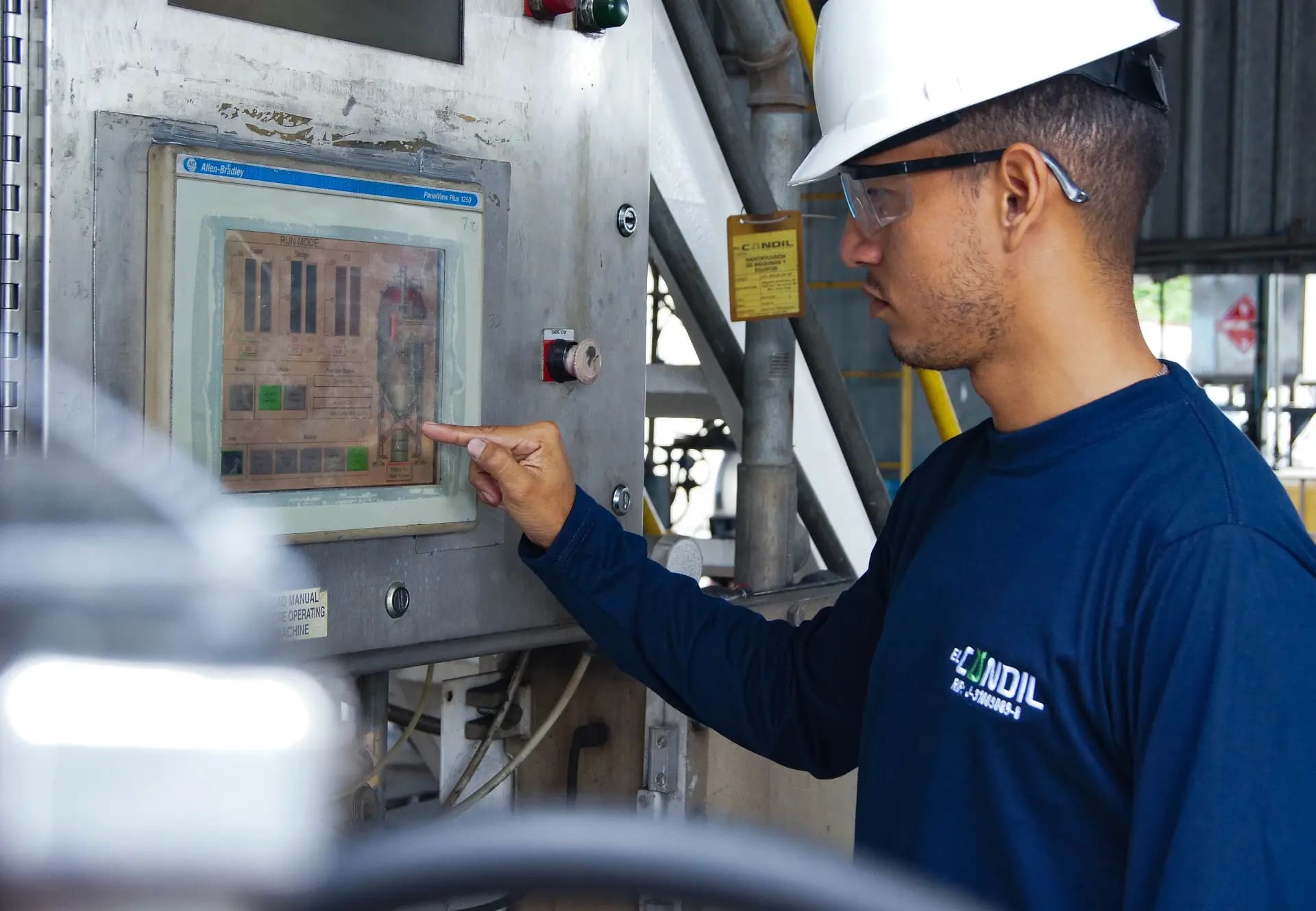
Free job simulation · Automation and controls
PLC programmer job simulation
A PLC programmer job simulation is hands-on practice that puts you in a junior PLC programmer's first weeks. You review a design specification, write the I/O list and a cause and effect matrix, program a simulated bottling line (the hands-on part is done in EDWartens Lab), run a factory acceptance test and handle a late change request. It is practice with real documents, not paid employment.
You join Tarnbrook Controls Ltd (simulated company), a systems integrator in Leeds. Days 1 to 5 are free, with about 9 h 50 min of tickets. Premium continues to day 20. It is practice, not employment.
Days 1 to 5 are free. You need a free account and no card. Create an account.
- Free days
- 1 to 5
- Free tickets
- about 9 h 50 min
- Project documents
- 9
- Certificate, optional
- £14.99
The project
You join Tarnbrook Controls Ltd (simulated company)
Tarnbrook Controls Ltd (simulated company) is a systems integrator in Leeds. You help its team deliver a project for Larkfield Drinks Ltd, at Bottling hall, line 2 (project BFL-200).
You are the junior PLC programmer on the control upgrade of bottling line 2 for Larkfield Drinks. The Lead Engineer gives you the client's requirements, a draft design with mistakes in it, a wiring schedule and tickets with acceptance criteria. Over four weeks you write the I/O list, check the design, program counting and level logic, run the factory acceptance test, handle a client change request, meet the faults that only show up on site, and hand over. Some people will ask you to cut corners. The skill is knowing which ones you cannot cut.
What you will do
- Review a functional design specification against the client's requirements and find the mistakes
- Write an I/O list and a cause and effect matrix from real wiring documents
- Program and test counting and level logic, then run and judge a factory acceptance test
- Handle a client change request with an impact note and revised documents
- Refuse to bypass a safety function and hand the project over with an honest pack
The people you deal with
- Lead Engineercompany
- Project Managercompany
- Electrical Designercompany
- Client Project Managerclient
- Client Production Supervisorclient
- Client Safety Officerclient
- Site Supervisorclient
- Site Electricianclient
The company, client and site are fictional. The people are fictional too.
Look inside
What the simulator looks like
The workplace, your tickets, the documents and the team chat, as a learner sees them.
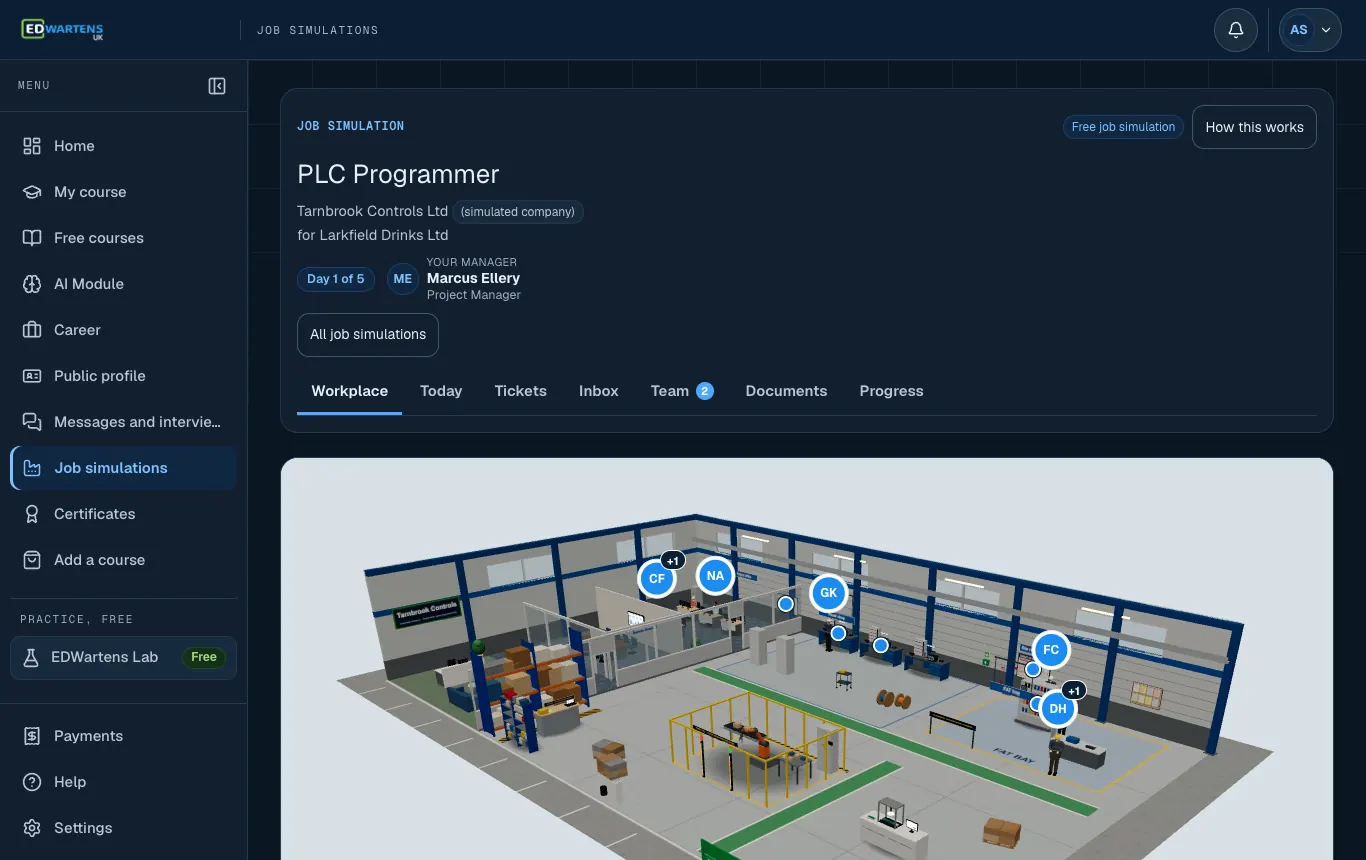
Start in the workplace, with the team around you. 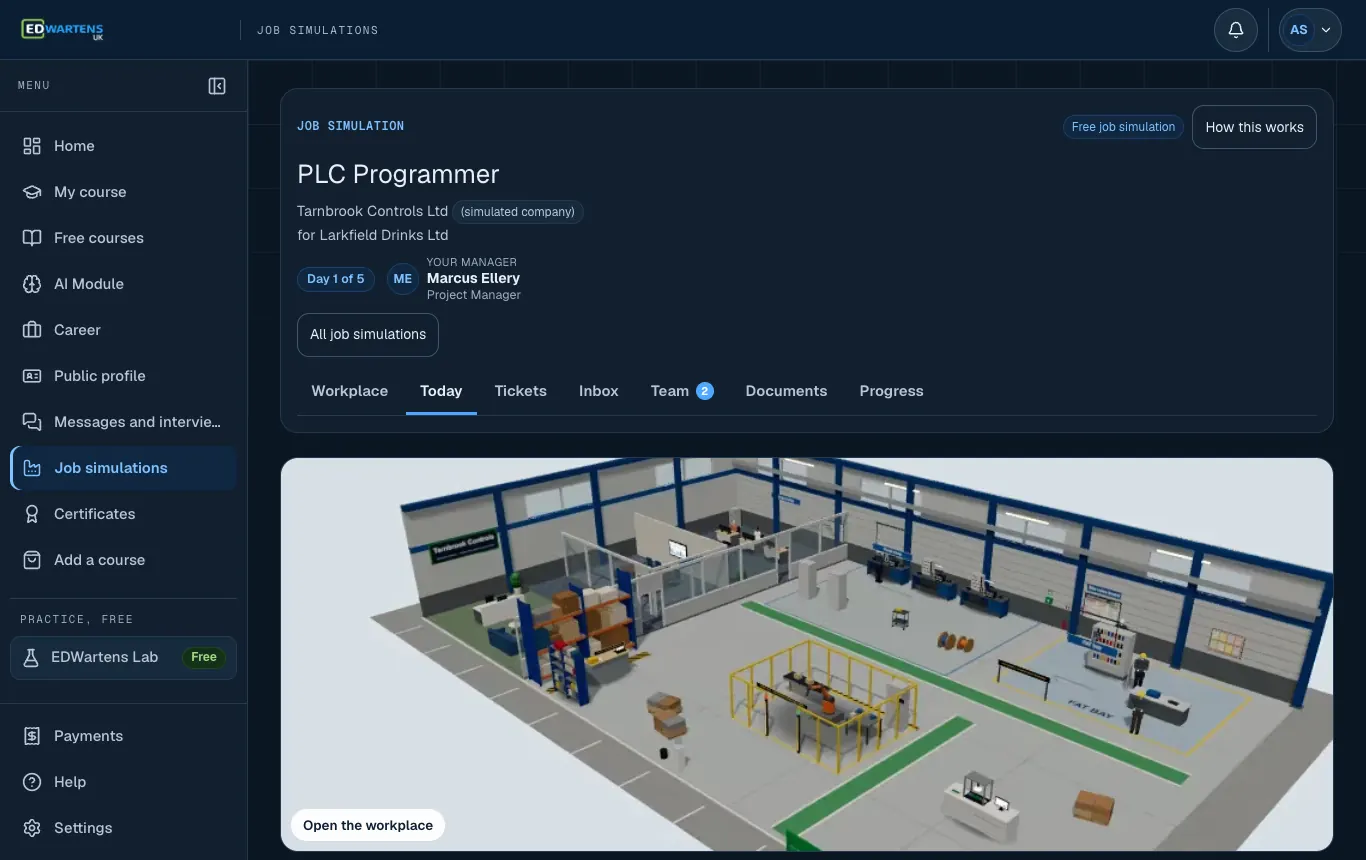
Today: the morning email and your tickets for the day. 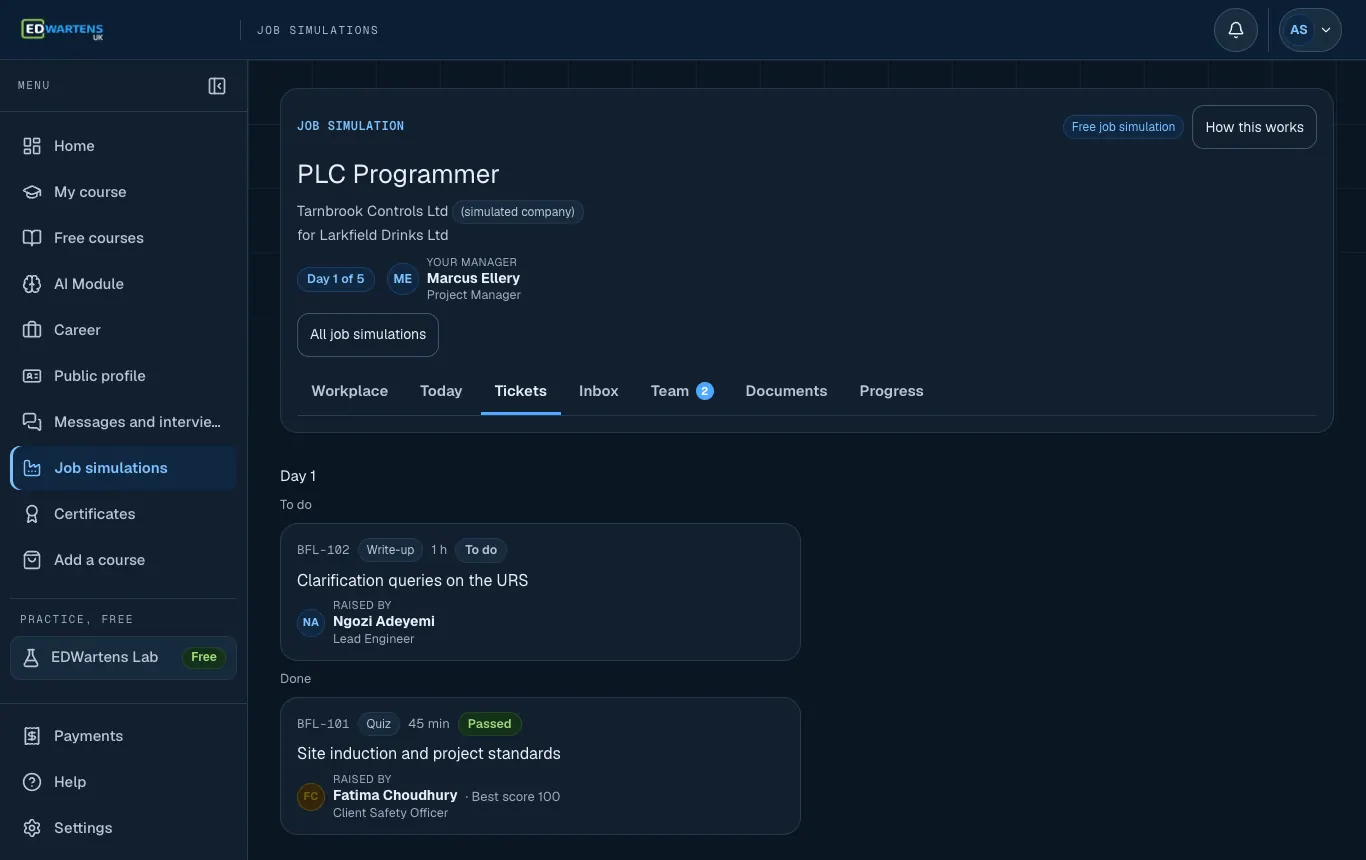
Work: every ticket, by day, with its status. 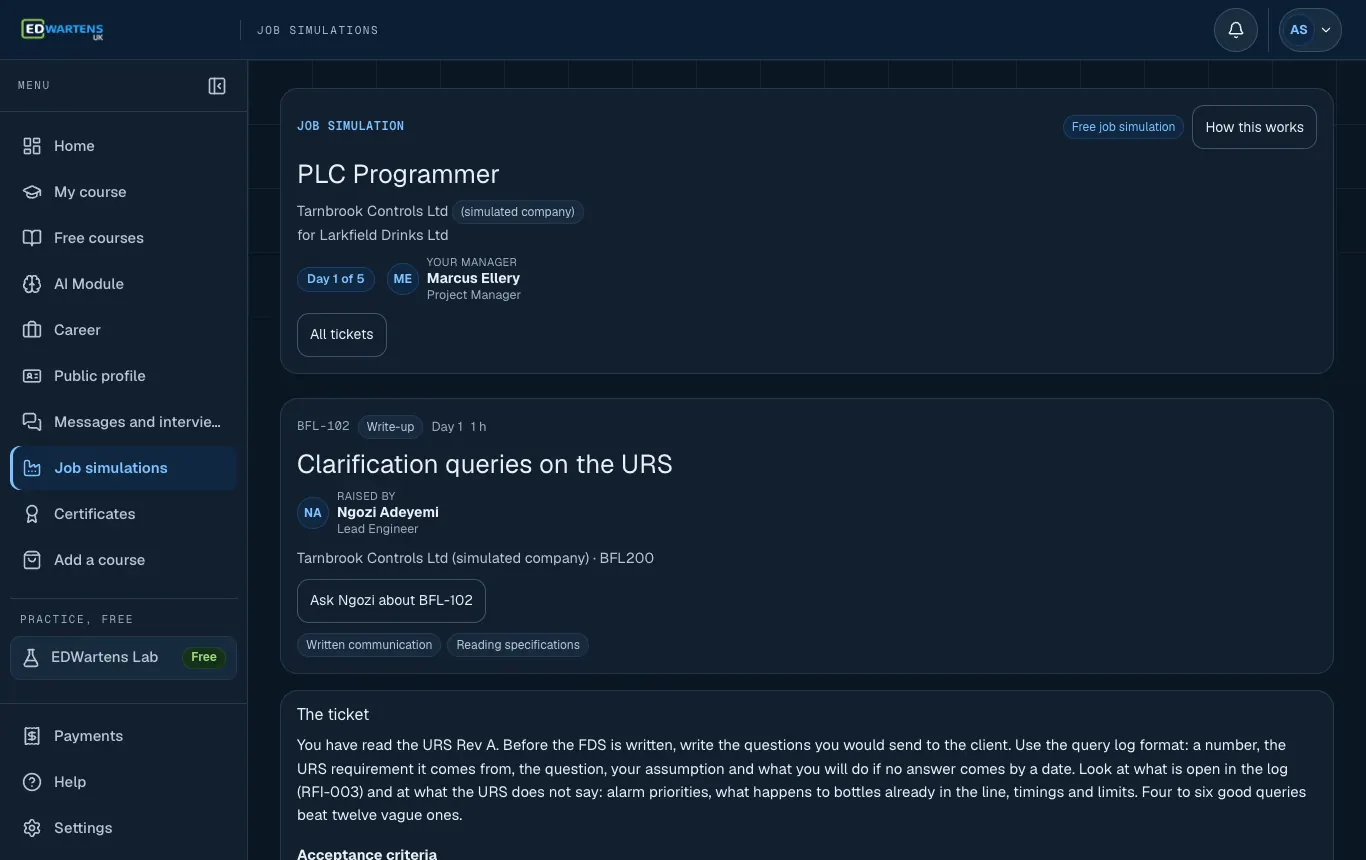
A ticket, written the way a colleague would write it. 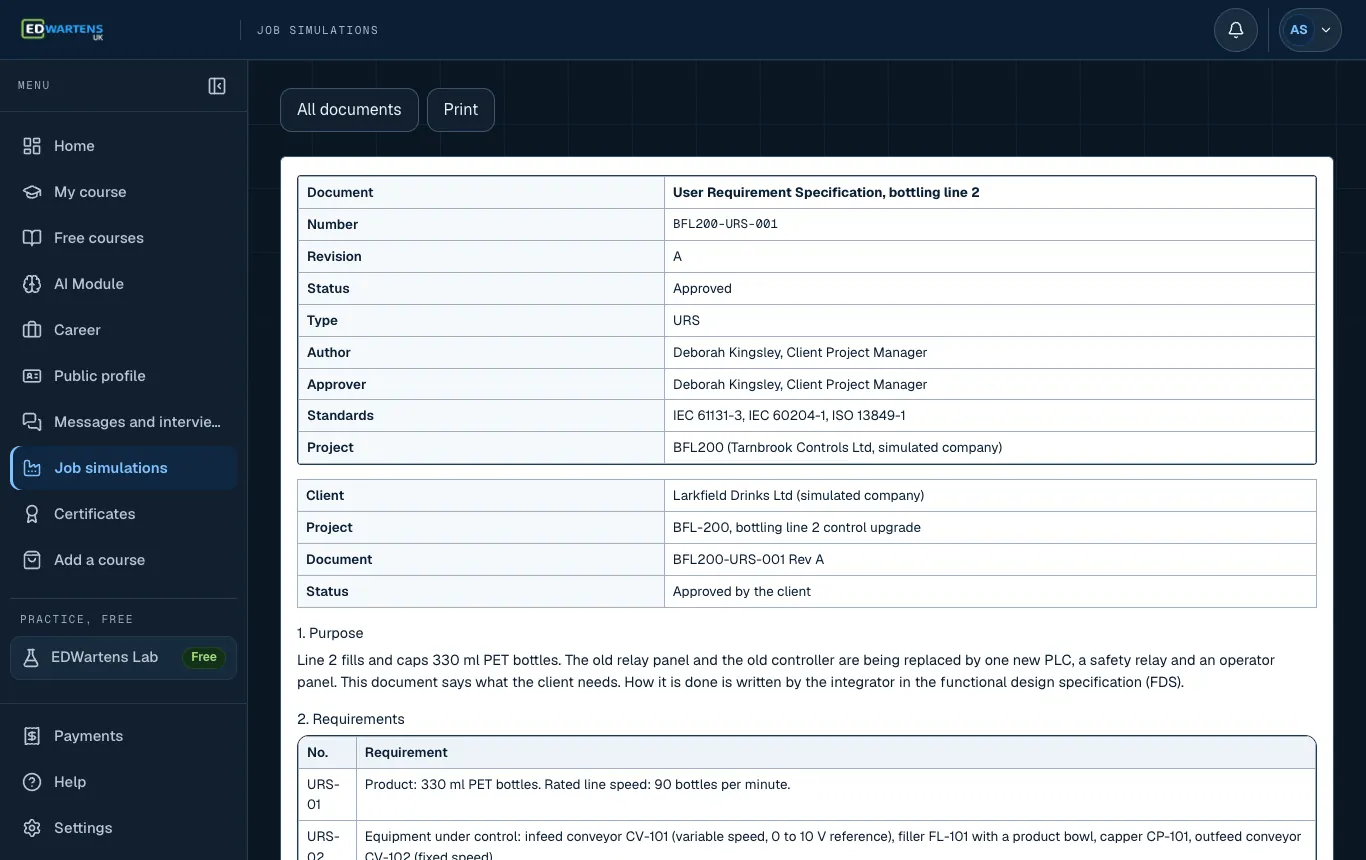
A project document with its number, revision and status. 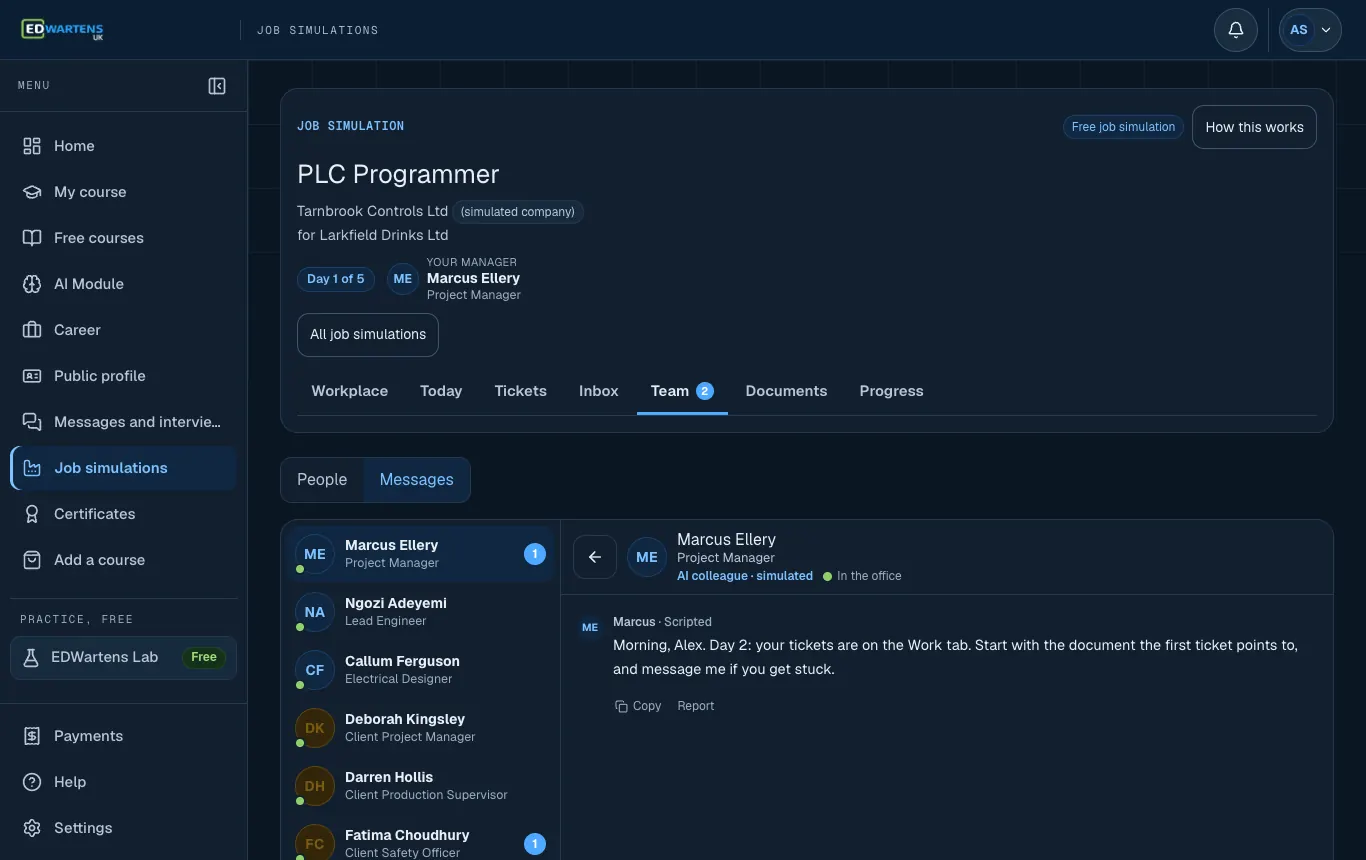
Ask a colleague. They are AI colleagues: they help you think, they do not hand out answers.


Screenshots from the simulator. Company, people and data are fictional. Portraits are AI-generated.
Meet the team
The colleagues you work with
You can read their messages and ask them questions. They are AI colleagues, clearly labelled. They help you think a ticket through; they do not hand out its answer.
- MEMarcus ElleryProject ManagerSimulated colleague, company side
- NANgozi AdeyemiLead EngineerSimulated colleague, company side
- CFCallum FergusonElectrical DesignerSimulated colleague, company side
- FCFatima ChoudhuryClient Safety OfficerSimulated colleague, client side
- DKDeborah KingsleyClient Project ManagerSimulated colleague, client side
- DHDarren HollisClient Production SupervisorSimulated colleague, client side
- LILewis IngramSite SupervisorSimulated colleague, client side
- GKGary KelsallSite ElectricianSimulated colleague, client side
Fictional people. Portraits are AI-generated.
What you get
What you walk away with
Write the PLC software for a bottling line, from the first query to the handover pack.
What you produce
URS clarification queries
RFI log entries
I/O list, section B
I/O list
Cause and effect matrix
Safety logic document
FAT results with punch categories
Test recordPremium
Impact note for a change request
Change controlPremium
I/O list Rev D from the wiring schedule
I/O listPremium
Software release record check
Release recordPremium
Line 2 handover pack
CapstonePremium
Skills you practise
- Written communication
- Document and revision control
- Testing and acceptance
- Handover and documentation
- PLC programming (ladder)
- Safety and safe systems of work
- Reading specifications
- I/O lists and tag lists
Roles to look for
- PLC Programmer
- Controls Engineer
- Automation Engineer
- Software Engineer (Industrial Controls)
934 live openings on the UK jobs board, checked 24 Oct 2026. See the jobs
Your proof
- A certificate anyone can verify. Optional, and included in Premium.
- An entry on your EDWartens profile under Work experience, marked as a job simulation.
- A work record with your skill scores, with Premium.
Free courses that go with it
- Free course CODESYS and IEC 61131-3 Programming
- Free course PLC and Electrical Troubleshooting for Maintenance Teams
- Free course Instrumentation for PLC Engineers
- Free course Machine Safety: ISO 12100, ISO 13849 and SISTEMA
- Free course Electrical Safety at Work (UK): Safe Isolation, Lock-off and Arc Flash
What you can talk about at interview
- You can explain how you turn a URS into queries, an I/O list and a cause and effect matrix.
- You can describe how you scaled an analogue level and set the wire-break limit.
- In Premium, you can walk through a factory test, a change request and a site fault, and say why you would not link out a guard switch.
Day by day
Days 1 to 5, ticket by ticket
Self-paced. A day opens when you hand in the previous day's tickets. Every ticket is checked, and you see the model answer after it.
Day 1
about 1 h 45 min- Site induction and project standardsQuiz · 45 min
- Clarification queries on the URSWriting · 1 h
Day 2
about 1 h 20 min- Review FDS Rev B against the URSDocument review · 1 h 20 min
Day 3
about 2 h 10 min- I/O list, section BTable · 1 h 20 min
- Scale the bowl level and set the wire-break limitCalculation · 50 min
Day 4
about 1 h 45 min- Cause and effect matrixTable · 1 h 10 min
- A small favour from the client's supervisorDecision · 35 min
Day 5
about 2 h 50 min- Count bottles once each and finish the batchHand-in · 1 h 30 min
- Fill the bowl between two levels without running dryHand-in · 1 h 20 min
Premium: days 6 to 20about 20 h 55 min more
After day 5 the project goes on with a change request, site work, faults, a handover and a capstone reviewed by an engineer.
Day 6
about 2 h 5 min- Commission a variable-speed infeed driveHand-in · 1 h 30 min
- Two engineers, one project fileDecision · 35 min
Day 7
about 1 h 30 min- FAT results: pass, fail and punch categoriesTable · 1 h 30 min
Day 8
about 1 h 30 min- Impact note for change request CR-01Writing · 1 h 30 min
Day 9
about 1 h 10 min- I/O list Rev D from wiring schedule Rev 3Table · 1 h 10 min
Day 10
about 1 h 30 min- Fire the reject pusher at the right momentHand-in · 1 h 30 min
Day 11
about 1 h 30 min- A sensor of the wrong type on siteHand-in · 1 h 30 min
Day 12
about 1 h 20 min- Loop check the level signal on siteHand-in · 1 h 20 min
Day 13
about 35 min- A link across the guard switch, for today onlyDecision · 35 min
Day 14
about 1 h 30 min- Sort the site acceptance findingsTable · 1 h 30 min
Day 15
about 50 min- Where did the scan time go?Calculation · 50 min
Day 16
about 1 h- Check the software release recordDocument review · 1 h
Day 17
about 1 h 10 min- Operator note: power loss and restartWriting · 1 h 10 min
Day 18
about 3 h 30 min- Capstone: the handover pack for line 2Hand-in · 3 h 30 min
Day 19
about 1 h- Handover email to the clientWriting · 1 h
Day 20
about 45 min- A conversation about your own workViva · 45 min
Real documents
The documents you will work with
Each one has a number, a revision and an approver, the way a project document does. You read them, check them and write your own.
BFL200-URS-001
User Requirement Specification, bottling line 2
Rev AURS
BFL200-HSE-001
Site rules and project standards, one page
Rev 1Site rules
BFL200-LAY-001
Line layout and equipment list
Rev 2Equipment list
BFL200-WIR-001
Field wiring schedule (PLC cabinet)
Rev 2Wiring schedule
BFL200-IOL-001
I/O list, section A (safety, operator and infeed)
Rev CI/O list
BFL200-SWD-001
Software design and coding standard
Rev ASoftware design
BFL200-CEM-001
Cause and effect matrix
Rev ACause and effect
BFL200-FDS-001
Functional design specification, bottling line 2
Rev BFDS
BFL200-RFI-001
Query log (RFI log)
Rev 3RFI log
Documents that arrive in Premiumchange requests, records, handover
BFL200-FAT-001
Factory acceptance test procedure and record
Rev AFATPremium
BFL200-CR-001
Change request CR-01
Rev AChange requestPremium
BFL200-WIR-001
Field wiring schedule, additions for CR-01
Rev 3Wiring schedulePremium
BFL200-FDS-001
Functional design specification, bottling line 2
Rev CFDSPremium
BFL200-CEM-001
Cause and effect matrix, with CR-01
Rev BCause and effectPremium
BFL200-SAT-001
Site acceptance test record, findings list
Rev ASATPremium
BFL200-REL-001
Software release record, v1.12
Rev ARelease recordPremium
BFL200-HOV-001
Handover pack requirements
Rev AHandover indexPremium
Tools
In the industry, and here
| In the industry | Here |
|---|---|
| PLC programming software (ladder, structured text) | EDWartens Lab's PLC exercises, which stand in for parts of the line |
| Wiring and panel testing with a meter | EDWartens Lab's panel exercises, with sensors, a drive and a 4 to 20 mA loop |
| Document control, query log and version control | Numbered, revised documents and an inbox of tickets and emails |
| Spreadsheets for I/O lists, FAT and SAT sheets | Tables you fill in and have checked |
Standards
The standards the work follows
- IEC 61131-3
- IEC 60204-1
- ISO 13849-1
In the UK
The PLC Programmer role in a UK setting
Who employs this kind of engineer: Systems integrators, machine builders and the food and drink, packaging and automotive manufacturers they work for.
Where: Industrial regions such as the North West, Yorkshire, the Midlands, Scotland and the South West have many employers of this kind. This is context, not a statement about vacancies.
UK standards and regulations to know about
IEC 61131-3
The standard for PLC programming languages: ladder, function block diagram and structured text.
BS EN 60204-1
Electrical equipment of machines, including emergency stop and control circuit rules.
BS EN ISO 13849-1
Safety-related parts of control systems and performance levels.
PUWER 1998
The Provision and Use of Work Equipment Regulations: equipment must be suitable, maintained and safe to use. HSE guidance L22 explains them.
Supply of Machinery (Safety) Regulations 2008
The rules for machinery supplied in Great Britain. Check the current marking requirements on gov.uk.
These are named so that you recognise them. A job simulation does not teach them as a qualification, the tasks use simplified data, and you should always read the current edition of anything you rely on.
Your proof, optional
A certificate you can verify
The free days are free. The graded, verifiable certificate is an optional extra, and it is included in Premium.
- A graded, verifiable certificate with your score and band
- A public verification page and QR code
- One-click add to LinkedIn as a licence or certification
- Issued by WARTENS LTD. It is a training certificate, not an accredited qualification, and the company is simulated
Optional: £14.99 including VAT, once you pass.
Job Simulation Certificate
Your name
completed the PLC Programmer job simulation at Tarnbrook Controls Ltd (simulated company). Your score and band are shown on the real certificate.
- Number
- EDW-JS-0000
- Issued by
- WARTENS LTD
Not an accredited qualification. A verification page and QR code are printed on the real certificate.
Prepare
Free courses and labs that get you ready
Linked from the tickets that need them. You can read them before you start.
Free courses
- CODESYS and IEC 61131-3 Programming
- PLC and Electrical Troubleshooting for Maintenance Teams
- P&ID Reading and Instrumentation Design Documents
- Electrical Safety at Work (UK): Safe Isolation, Lock-off and Arc Flash
- Machine Safety: ISO 12100, ISO 13849 and SISTEMA
- Electrical Control Panel Design, Building and Testing
- Instrumentation for PLC Engineers
- PID Control for PLC Engineers
EDWartens Lab guides
The hands-on tickets are finished in EDWartens Lab, then you record the figures and upload a FAT sheet or notes for checking. Nothing is marked as passed on the lab's say-so.
A course that goes with this role
Professional Module
A paid course in PLC, HMI and WinCC SCADA programming with Siemens TIA Portal, taught live online by an instructor. It is a separate product: you do not need it to finish the job simulation, and it does not lead to a job. Its certificate is a certificate of completion, not a regulated qualification.
- Price
- £2,568 including VAT (£2,140 + VAT)
- Format
- Live online, five days, with self-paced modules after
About the PLC Programmer role
Documents a junior PLC programmer writes early on
A PLC job is mostly documents around the code. In this simulation you start from a user requirement specification, a field wiring schedule and a layout, and you build the I/O list and the cause and effect matrix yourself.
You also keep a query log, because every unclear line in a specification should become a written question, not a guess. Later you write an impact note for a change request and update the I/O list to a new revision.
- I/O list with addresses, tags and signal types
- Cause and effect matrix for the safety and process interlocks
- Factory acceptance test record with pass, fail and punch categories
- Impact note for the change request, with the documents it touches
IEC 61131-3 in plain words: which language for which job
IEC 61131-3 defines the PLC programming languages, among them ladder diagram, function block diagram and structured text. Ladder is the one most maintenance staff can read at three in the morning, so it is a sound first language for sequences and interlocks.
Structured text suits calculations, scaling and arrays. In the hands-on PLC exercise in EDWartens Lab you work with the logic a real line needs, such as counting bottles once each and filling a bowl between two levels without running it dry, then judge the result against the test criteria.
Vendor software differs, but the ideas carry over: the scan cycle, latching, interlocks and sequences.
The awkward situations the project puts you in
Good PLC programmers are judged on what they do when the plan does not hold. The project includes a client supervisor asking for a small favour, a sensor of the wrong type arriving on site, and a request to put a link across a guard switch just for today.
Each one is a decision with a better and a worse answer, and the model answer explains why. You also check a software release record and write an operator note on power loss and restart, which is where many real handovers are thin.
From simulation to site: what changes on real hardware
A simulation cannot give you the feel of a loose terminal, a noisy signal or a cabinet at forty degrees. Practitioners rightly say simulator work does not replace field time, and this page does not claim it does.
What it does give you is the working habit: read the specification, test against criteria, record faults honestly and refuse unsafe shortcuts. Employers can ask you about those decisions, and you keep the documents as examples. List it as a project or a job simulation, with the simulated company named.
What to learn next
After the I/O list and the first logic, the usual next steps are drives and motor control, panel reading, and an operator screen. The related roles below build on this one: commissioning, SCADA and HMI, and control panel design.
The free courses linked on this page cover reading instrument and wiring documents, motor control and fault finding, so you can fill gaps as tickets expose them.
Keep a short list of gaps as you go. Every ticket you find hard is a topic worth a lesson, and the notes become the honest part of your project write-up.
Keep going
Related job simulations and courses

Commissioning Engineer
Loop checks, I/O checkout, SAT and a punch list on a plant that is nearly ready.
SCADA and HMI Engineer
Build the tag list, alarm list and screens for a live process.
Control Panel Design Engineer
GA drawing, schematics, BOM, heat calculation and the routine test.
- Engineering job simulations
- Free courses
- Browse jobs
- Virtual work experience in the UK
- Job simulation questions
Content reviewed 19 Oct 2026; UK context added 21 Oct 2026. Practice, not employment.
Questions
Quick answers
Can I get a PLC job without experience?
Entry listings often ask for an electrical or related background, but candidates with coursework, practice on a PLC or simulator and clear project write-ups can still apply. Show a project with an I/O list, a program, a test record and a note on what went wrong and how you fixed it.
What does a junior PLC programmer do in the first month?
Typically they read the functional specification, build or check the I/O list, write and test logic, support factory acceptance testing and record changes. This simulation walks through those steps and adds a late change request.
Which language should I learn first, ladder or structured text?
IEC 61131-3 defines several PLC languages, including ladder diagram and structured text. Start with ladder, since most maintenance staff read it, then add structured text for calculations and arrays.
Can I practise PLC programming without hardware?
Yes. Simulators and soft PLCs let you run logic against a virtual process, and EDWartens Lab runs in the browser with no install. Simulator work does not replace field experience, which is why the simulation records faults and test results honestly.
What PLC projects look good on a CV?
Projects with a written specification, an I/O list, safety interlocks, fault handling and test evidence, such as a conveyor or a tank and pump station. Describe the problem, your approach and the test result, not only the tool name.
What are common PLC interview questions?
Interview guides list what a PLC is, digital and analogue I/O, motor start and stop logic, industrial communication protocols and machinery safety standards. A project where you can explain each decision answers most of them.
Is a job simulation the same as work experience?
No. It is structured practice that shows you can do the tasks. List it under projects or job simulations, with the simulated company named, and not as employment.
Do I need a particular vendor's software?
Employers often name the tool they use, so learn that one when you target a company. The concepts you practise here, such as the scan cycle, interlocks and sequences, transfer between vendors.
What do PLC engineers earn in the UK?
ITJobsWatch, which tracks UK IT-focused vacancies, showed a median salary of £60,000 for 144 PLC engineer adverts as of 21 October 2026. The sample is small and covers IT-focused adverts only, so pay varies widely with sector, region and experience, and graduate or trainee roles are lower. A simulation does not set what you are paid.
Source: ITJobsWatch, PLC Engineer (UK IT vacancies) (opens in a new tab), checked 21 Oct 2026.
Do I need to know a programming language first?
No. The EDWartens Lab exercises teach ladder logic as you go, and the study links on each task point to free lessons. You will do better if you have seen a PLC program before.
Is this a real company and a real project?
No. Tarnbrook Controls and Larkfield Drinks are made-up companies and the project is a simulated one. The documents, standards and situations follow what a junior meets on a real project.
How long does it take?
The free week is about ten hours of work spread over five days. The full Premium edition runs over twenty working days and about thirty to forty hours, at your own pace.
Which PLC brand does it use?
None. The content is vendor-neutral, so what you learn applies to any controller that follows IEC 61131-3.
What do I get at the end?
A work record with your scores by task and skill, which shows on your EDWartens profile under Work experience, marked as a job simulation.
Is the PLC Programmer job simulation free?
Yes, to start. Days 1 to 5 are free. The certificate (£14.99) and the Premium edition (£53.99) are optional, and both prices include VAT.
Does it count as work experience?
No. It is a training project at a simulated company, not employment, an internship or a placement. A job simulation is a realistic training project at a simulated company. It is not employment, an internship or a work placement, and it is not a job offer. Hours are active hours the learner logged on EDWartens UK.
A job simulation is a realistic training project at a simulated company. It is not employment, an internship or a work placement, and it is not a job offer. Hours are active hours the learner logged on EDWartens UK.
Start the PLC Programmer job simulation today
Days 1 to 5 are free. No card to start. Practice, not employment.