

Free job simulation · Automation and controls
Commissioning engineer job simulation
A commissioning engineer job simulation lets you practise bringing a plant into service. You turn raw test results into pass, fail or invalid, run loop checks, test a safety stop that fails, sort a punch list and assemble the handover dossier for a simulated dairy skid. It runs in a virtual plant, so no hardware or site visit is needed. It is practice, not employment.
You join Ashdown Commissioning Ltd (simulated company), a commissioning contractor in Bristol. Days 1 to 5 are free, with about 10 h 5 min of tickets. Premium continues to day 20. It is practice, not employment.
Days 1 to 5 are free. You need a free account and no card. Create an account.
- Free days
- 1 to 5
- Free tickets
- about 10 h 5 min
- Project documents
- 6
- Certificate, optional
- £14.99
The project
You join Ashdown Commissioning Ltd (simulated company)
Ashdown Commissioning Ltd (simulated company) is a commissioning contractor in Bristol. You help its team deliver a project for Fenwick Dairy Products Ltd, at Milk reception, balance tank skid U-1 (project MRS-300).
You are the junior commissioning engineer on a new milk balance tank skid. The electrical contractor says it is nearly finished. Your job is to prove it: insulation tests before anything is switched on, loop checks of every instrument, an I/O checkout, functional and site acceptance tests, and a punch list, with a hold point at each step where somebody must sign before the work goes on. Along the way somebody is working on a live panel without a permit, the client wants the pump started early, and an emergency stop test fails. The skill is to be calm, exact and impossible to hurry past a hold point.
What you will do
- Turn raw test results into pass, fail or invalid with the right acceptance criteria
- Run loop checks and read the pattern of errors to find the fault
- Stop an unsafe act and refuse to start a plant with category A items open
- Raise a management of change request instead of patching a live plant
- Assemble a handover dossier a client's quality manager would accept
The people you deal with
- Commissioning Leadcompany
- Project Managercompany
- Instrument Techniciancompany
- Client Operations Managerclient
- Client Safety Officerclient
- Electrical Contractor Supervisorclient
- Contractor Electricianclient
- Control System Vendor Engineervendor
The company, client and site are fictional. The people are fictional too.
Look inside
What the simulator looks like
The workplace, your tickets, the documents and the team chat, as a learner sees them.
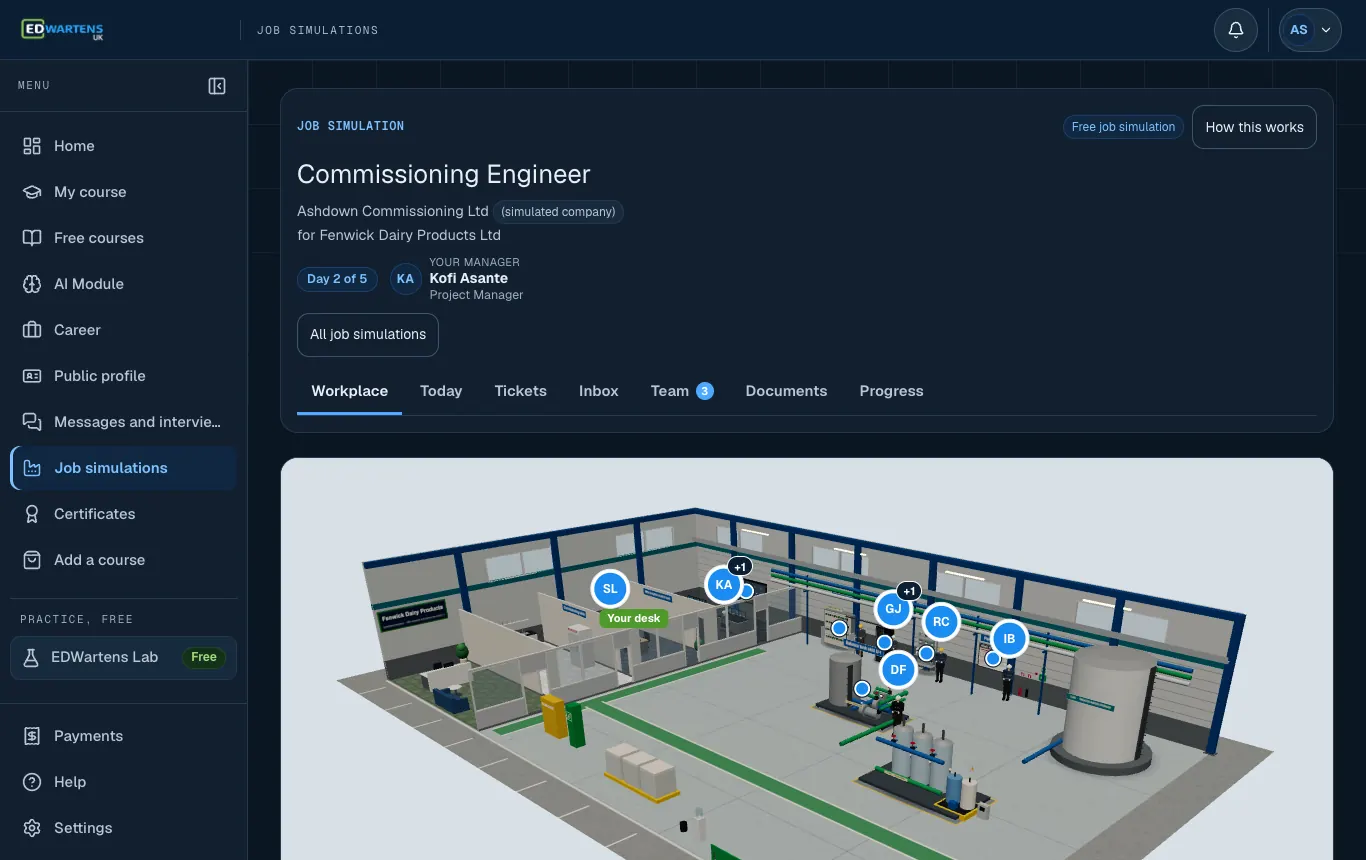
Start in the workplace, with the team around you. 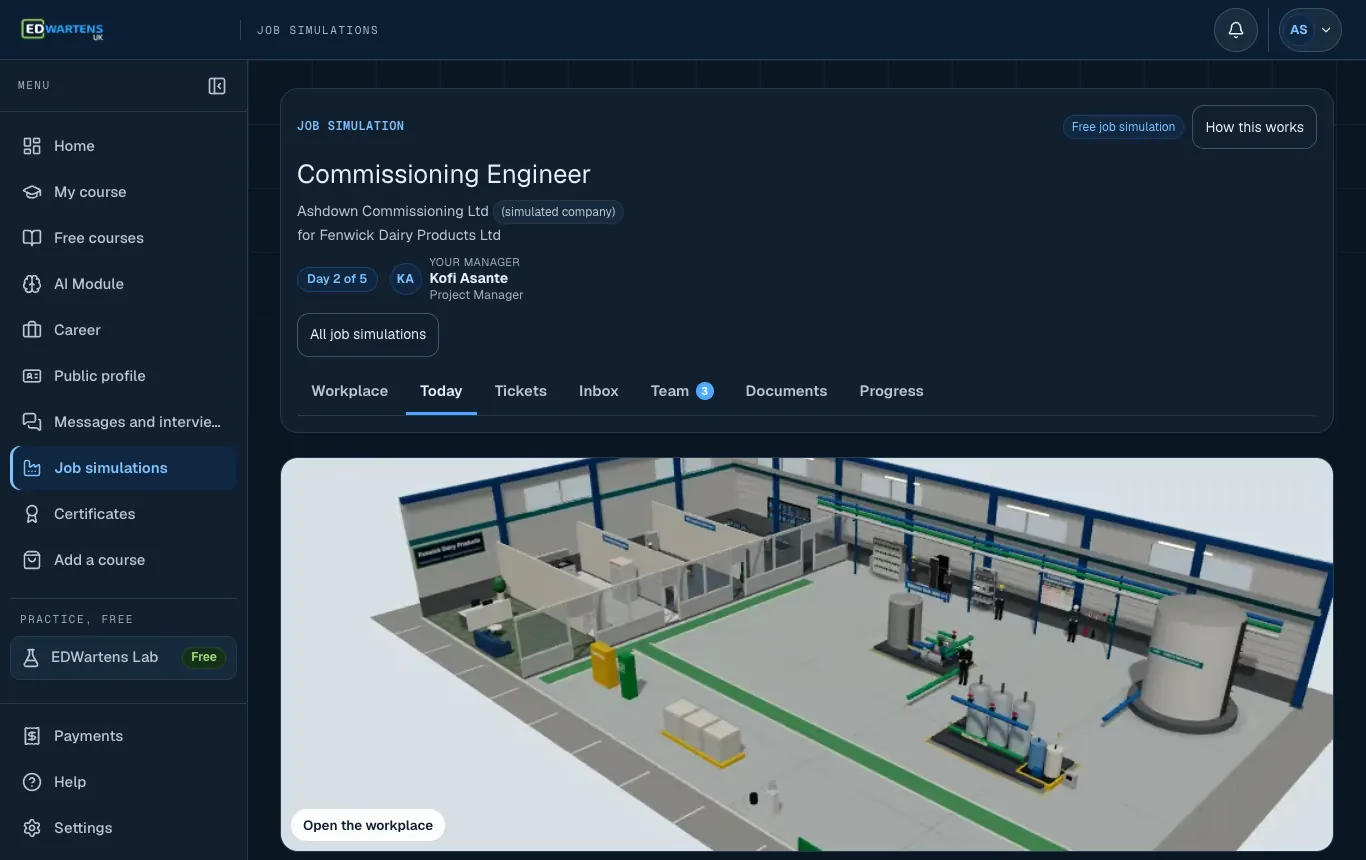
Today: the morning email and your tickets for the day. 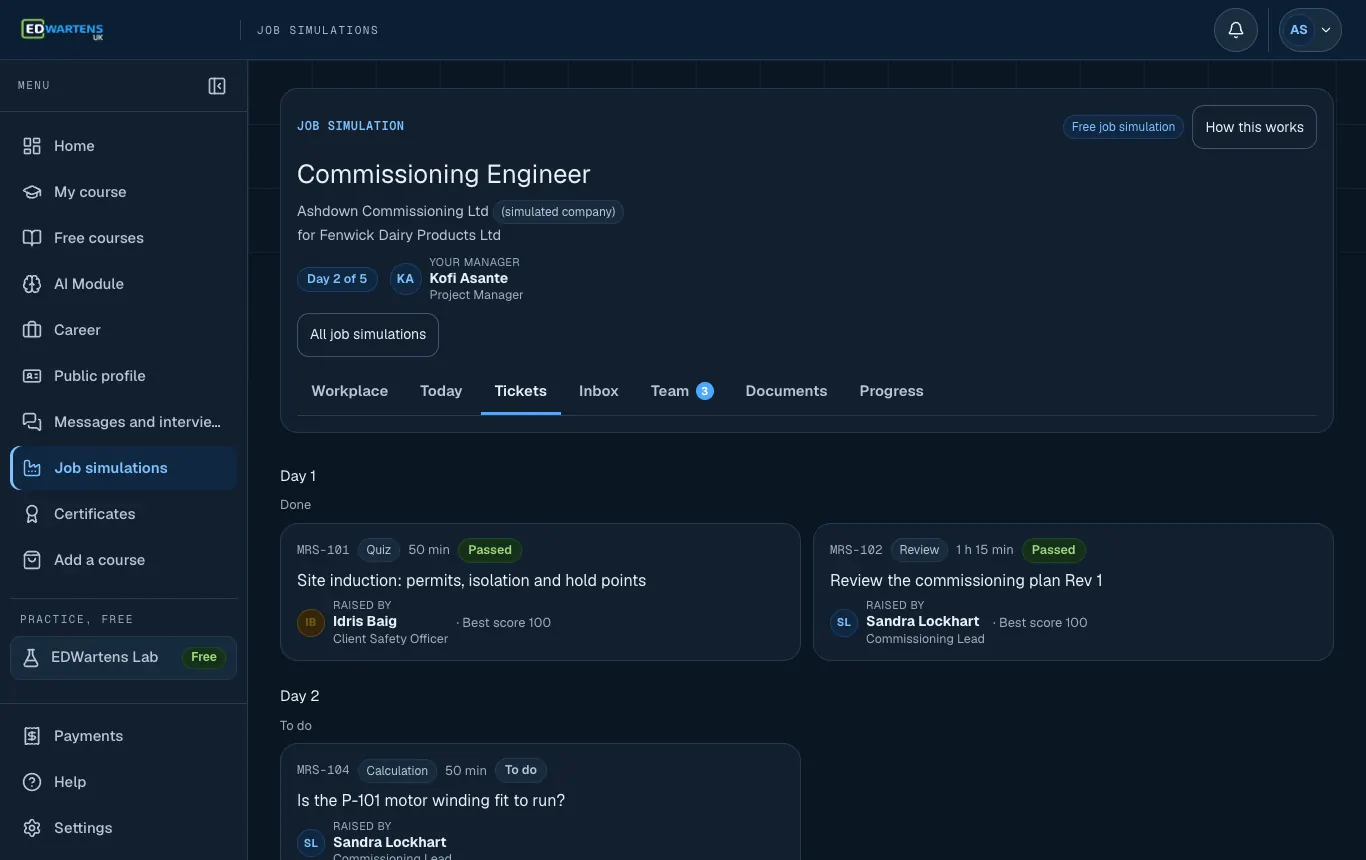
Work: every ticket, by day, with its status. 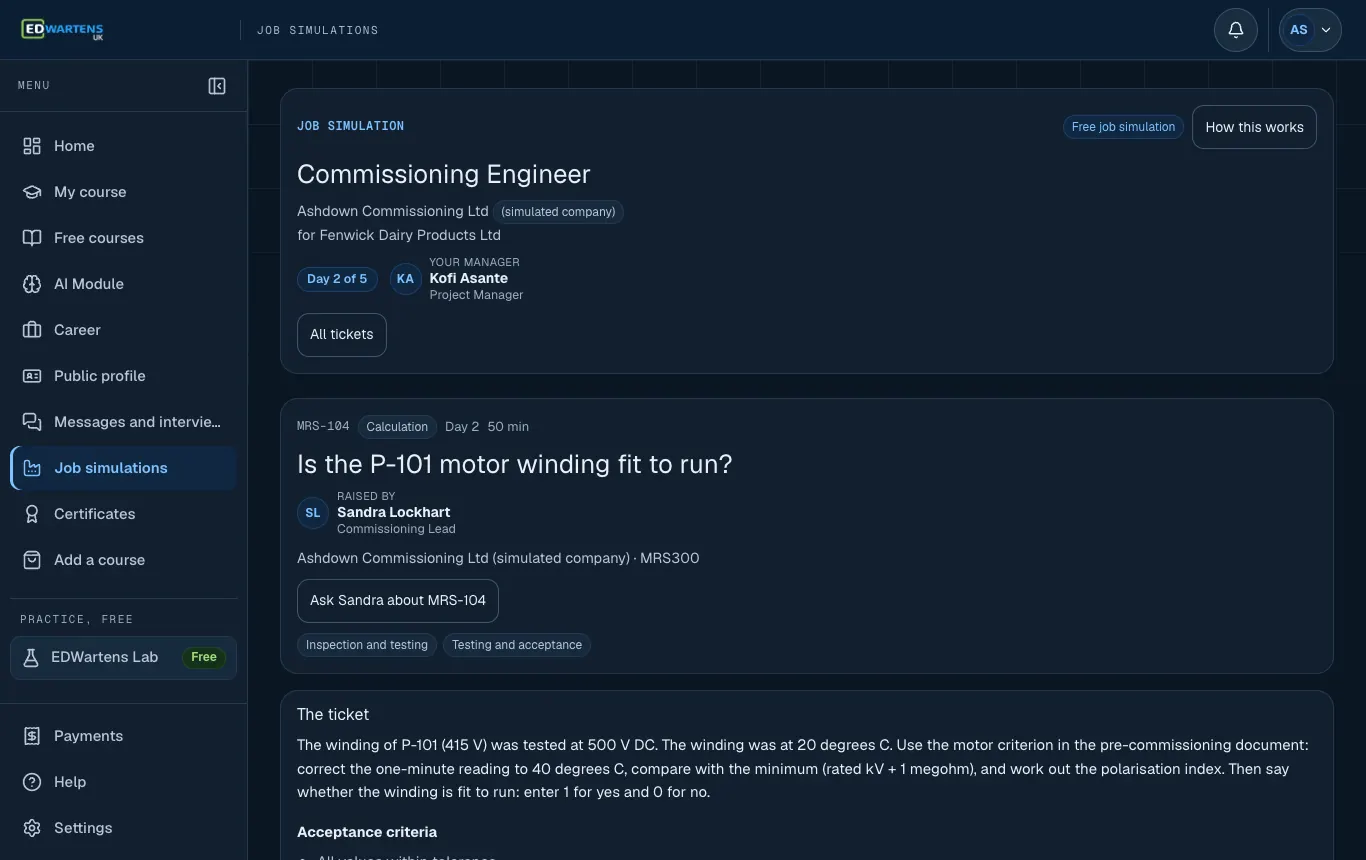
A ticket, written the way a colleague would write it. 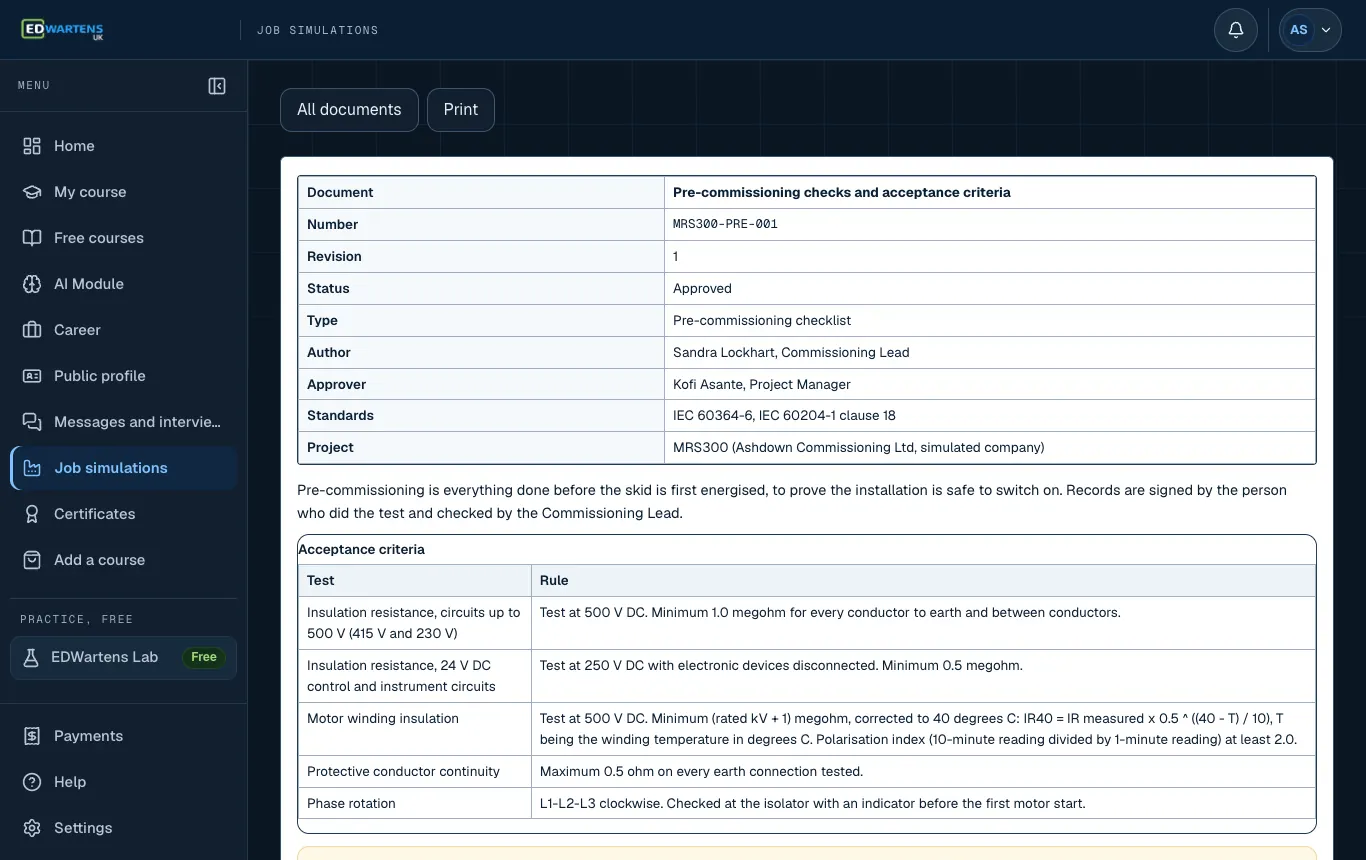
A project document with its number, revision and status. 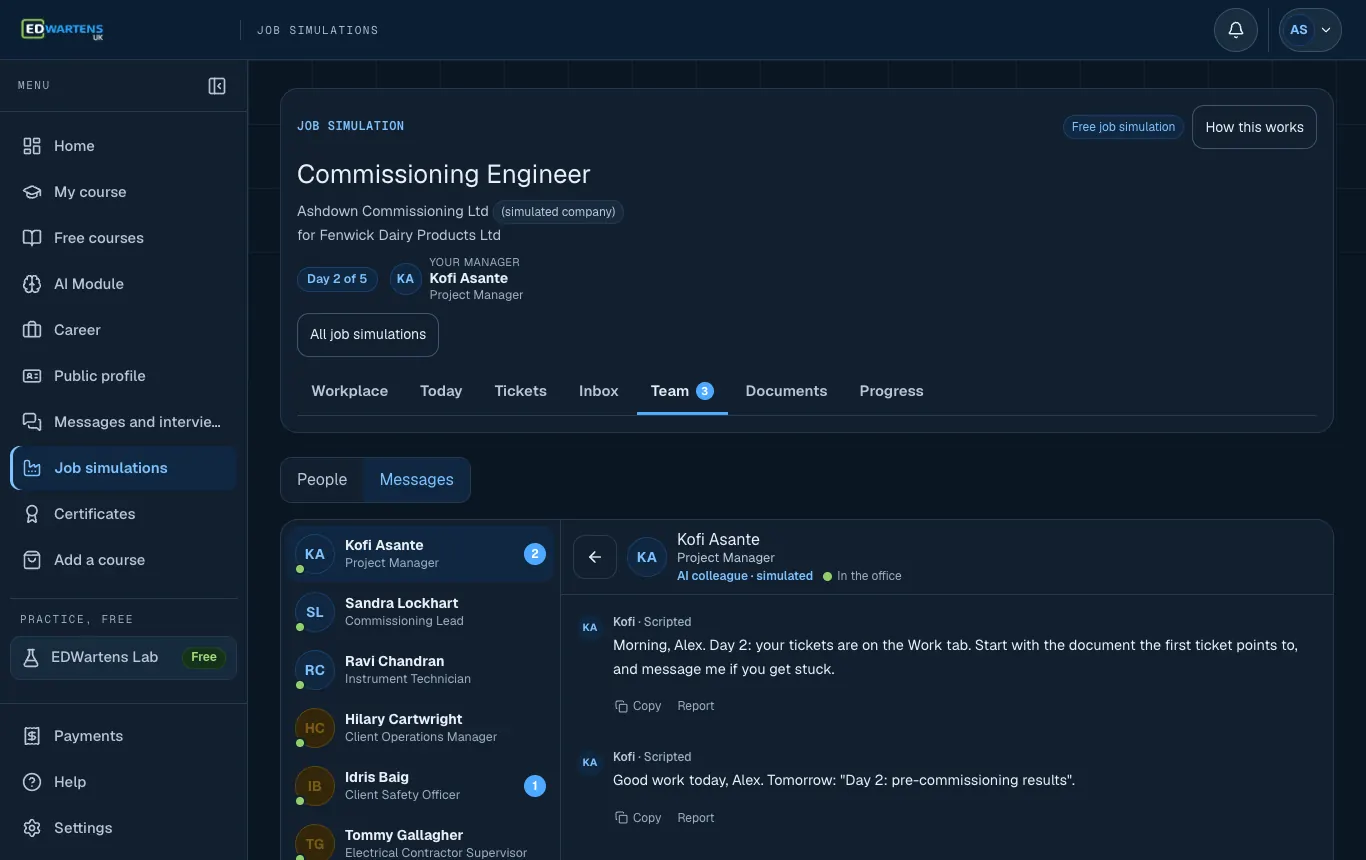
Ask a colleague. They are AI colleagues: they help you think, they do not hand out answers.


Screenshots from the simulator. Company, people and data are fictional. Portraits are AI-generated.
Meet the team
The colleagues you work with
You can read their messages and ask them questions. They are AI colleagues, clearly labelled. They help you think a ticket through; they do not hand out its answer.
- KAKofi AsanteProject ManagerSimulated colleague, company side
- SLSandra LockhartCommissioning LeadSimulated colleague, company side
- RCRavi ChandranInstrument TechnicianSimulated colleague, company side
- IBIdris BaigClient Safety OfficerSimulated colleague, client side
- HCHilary CartwrightClient Operations ManagerSimulated colleague, client side
- TGTommy GallagherElectrical Contractor SupervisorSimulated colleague, client side
- DFDesmond FaganContractor ElectricianSimulated colleague, client side
- GJGreta JankowskiControl System Vendor EngineerSimulated colleague, vendor
Fictional people. Portraits are AI-generated.
What you get
What you walk away with
Commission a dairy skid: pre-commissioning tests, loop checks, functional tests and a handover dossier.
What you produce
Insulation resistance results with pass or fail
Test record
Loop check sheet for three analogue loops
Loop check sheet
Daily commissioning report
Daily report
I/O point-to-point checkout findings
I/O checkoutPremium
Management of change request
Change controlPremium
Categorised punch list
Punch listPremium
Commissioning handover dossier
CapstonePremium
Handover note to the operations manager
Handover notePremium
Skills you practise
- Commissioning
- Written communication
- Safety and safe systems of work
- Testing and acceptance
- Handover and documentation
- Loop checks and I/O checkout
- Fault finding
- Document and revision control
Roles to look for
- Commissioning Engineer
- Commissioning Technician
- C&I Commissioning Engineer
- Field Service Engineer
720 live openings on the UK jobs board, checked 24 Oct 2026. See the jobs
Your proof
- A certificate anyone can verify. Optional, and included in Premium.
- An entry on your EDWartens profile under Work experience, marked as a job simulation.
- A work record with your skill scores, with Premium.
Free courses that go with it
- Free course Instrument Calibration, Loop Checks and Commissioning
- Free course Electrical Safety at Work (UK): Safe Isolation, Lock-off and Arc Flash
- Free course Industrial Motor Control
- Free course Electrical and Instrumentation QA/QC Inspection
- Free course Wiring Regulations in Practice: BS 7671 and IEC 60364
What you can talk about at interview
- You can explain what a pre-commissioning check proves and how you record a pass, a fail or an invalid result.
- You can describe how you loop check an analogue loop and what you write on the sheet.
- In Premium, you can talk through a functional test, a management of change request and how you push back when the client wants to start early.
Day by day
Days 1 to 5, ticket by ticket
Self-paced. A day opens when you hand in the previous day's tickets. Every ticket is checked, and you see the model answer after it.
Day 1
about 2 h 5 min- Site induction: permits, isolation and hold pointsQuiz · 50 min
- Review the commissioning plan Rev 1Document review · 1 h 15 min
Day 2
about 2 h 10 min- Insulation resistance results: pass, fail or invalidTable · 1 h 20 min
- Is the P-101 motor winding fit to run?Calculation · 50 min
Day 3
about 2 h 45 min- Loop check a level loop in the process labHand-in · 1 h 20 min
- Loop check sheet for the three analogue loopsTable · 1 h 25 min
Day 4
about 1 h 35 min- Live work without a permitDecision · 35 min
- Write today's daily commissioning reportWriting · 1 h
Day 5
about 1 h 30 min- Commission the transfer pump starterHand-in · 1 h 30 min
Premium: days 6 to 20about 20 h 35 min more
After day 5 the project goes on with a change request, site work, faults, a handover and a capstone reviewed by an engineer.
Day 6
about 1 h 40 min- Calibrate a pressure transmitterHand-in · 1 h 40 min
Day 7
about 1 h 25 min- I/O checkout: what is wrong at each point?Table · 1 h 25 min
Day 8
about 35 min- Start the plant before the category A items are closed?Decision · 35 min
Day 9
about 1 h 20 min- Raise a management of change request for the low-low interlockWriting · 1 h 20 min
Day 10
about 1 h 40 min- Stroke the control valve and set the controller actionHand-in · 1 h 40 min
Day 11
about 1 h 30 min- Hand, Off, Auto and floats without bypassing the E-stopHand-in · 1 h 30 min
Day 12
about 35 min- The emergency stop runs on for four secondsDecision · 35 min
Day 13
about 1 h 40 min- Site acceptance test and two hidden faultsHand-in · 1 h 40 min
Day 14
about 1 h 30 min- Categorise the punch listTable · 1 h 30 min
Day 15
about 1 h 10 min- Re-plan after the crane delay and the vendor leaveWriting · 1 h 10 min
Day 16
about 1 h 10 min- Check the draft handover dossier indexDocument review · 1 h 10 min
Day 17
about 55 min- Check the first pump run readingsCalculation · 55 min
Day 18
about 3 h 40 min- Capstone: the commissioning handover dossierHand-in · 3 h 40 min
Day 19
about 1 h- Handover note to the Operations ManagerWriting · 1 h
Day 20
about 45 min- A conversation about your own workViva · 45 min
Real documents
The documents you will work with
Each one has a number, a revision and an approver, the way a project document does. You read them, check them and write your own.
MRS300-PTW-001
Site rules, permit to work and hold points
Rev 2Site rules
MRS300-INS-001
Instrument index and equipment list, skid U-1
Rev 2Instrument index
MRS300-PRE-001
Pre-commissioning checks and acceptance criteria
Rev 1Pre-commissioning checklist
MRS300-COM-PLN-001
Commissioning plan and procedure
Rev 1Commissioning plan
MRS300-LCS-001
Loop check sheet template and acceptance rule
Rev 1Loop check sheet
MRS300-LOG-004
Raw site notes, day 4
Rev 1Shift log
Documents that arrive in Premiumchange requests, records, handover
MRS300-IOC-001
I/O point-to-point test record, day 7
Rev AI/O checkoutPremium
MRS300-FTS-001
Functional test procedure and record
Rev AFunctional testPremium
MRS300-MOC-001
Management of change form and rules
Rev AMOCPremium
MRS300-FTS-001
Functional test procedure and record, after MOC-01
Rev BFunctional testPremium
MRS300-SCH-001
Remaining activities and resources
Rev 2SchedulePremium
MRS300-PCH-001
Punch list, raw findings
Rev APunch listPremium
MRS300-HOV-002
Handover dossier index, draft
Rev ADossier indexPremium
MRS300-HOV-001
Handover requirements (taking over)
Rev AHandover indexPremium
Tools
In the industry, and here
| In the industry | Here |
|---|---|
| Insulation tester, multimeter, loop calibrator | EDWartens Lab's process and panel exercises, with injected signals, meters and a calibrator |
| Loop check sheets, punch list, daily report in spreadsheets | Tables and documents you fill in and have checked |
| Permit to work and lock-out records | Site rules, hold points and permit register as documents |
| Completion dossier in a document system | A pack you assemble and upload for review |
Standards
The standards the work follows
- BS 7671 / IEC 60364-6
- BS EN 60204-1 / IEC 60204-1
- ISA-5.1
- Electricity at Work Regulations 1989 (safe work practice)
In the UK
The Commissioning Engineer role in a UK setting
Who employs this kind of engineer: Commissioning contractors, systems integrators and the water, food and drink and process companies whose plants they bring into service.
Where: Industrial regions such as the North West, Yorkshire, the Midlands, Scotland and the South West have many projects of this kind, and commissioning work often involves travel to site. This is context, not a statement about vacancies.
UK standards and regulations to know about
BS 7671 (Part 6) and IEC 60364-6
Inspection and testing of electrical installations, including insulation resistance and continuity.
BS EN 60204-1
Electrical equipment of machines.
Electricity at Work Regulations 1989
The law on safe work with electrical systems. HSE guidance HSG85 explains safe working practices.
Permit to work (HSE HSG250)
HSE guidance on permit-to-work systems for hazardous work, including isolations and hold points.
CDM 2015
The Construction (Design and Management) Regulations: duties for clients, designers and contractors on construction work, including handover information.
Schemes to be aware of
ECS card (Electrotechnical Certification Scheme)
The industry card that many UK electrotechnical employers and sites ask to see. It is linked to qualifications and a health and safety assessment. EDWartens does not issue it, and this simulation does not lead to it.
These are named so that you recognise them. A job simulation does not teach them as a qualification, the tasks use simplified data, and you should always read the current edition of anything you rely on.
Your proof, optional
A certificate you can verify
The free days are free. The graded, verifiable certificate is an optional extra, and it is included in Premium.
- A graded, verifiable certificate with your score and band
- A public verification page and QR code
- One-click add to LinkedIn as a licence or certification
- Issued by WARTENS LTD. It is a training certificate, not an accredited qualification, and the company is simulated
Optional: £14.99 including VAT, once you pass.
Job Simulation Certificate
Your name
completed the Commissioning Engineer job simulation at Ashdown Commissioning Ltd (simulated company). Your score and band are shown on the real certificate.
- Number
- EDW-JS-0000
- Issued by
- WARTENS LTD
Not an accredited qualification. A verification page and QR code are printed on the real certificate.
Prepare
Free courses and labs that get you ready
Linked from the tickets that need them. You can read them before you start.
Free courses
- Instrument Calibration, Loop Checks and Commissioning
- Electrical and Instrumentation QA/QC Inspection
- Electrical Safety at Work (UK): Safe Isolation, Lock-off and Arc Flash
- Wiring Regulations in Practice: BS 7671 and IEC 60364
- P&ID Reading and Instrumentation Design Documents
- Industrial Motor Control
- Industrial Instrumentation and Process Control
- PLC and Electrical Troubleshooting for Maintenance Teams
EDWartens Lab guides
The hands-on tickets are finished in EDWartens Lab, then you record the figures and upload a FAT sheet or notes for checking. Nothing is marked as passed on the lab's say-so.
A course that goes with this role
Professional Module
A paid course in PLC, HMI and WinCC SCADA programming with Siemens TIA Portal, taught live online by an instructor. It is a separate product: you do not need it to finish the job simulation, and it does not lead to a job. Its certificate is a certificate of completion, not a regulated qualification.
- Price
- £2,568 including VAT (£2,140 + VAT)
- Format
- Live online, five days, with self-paced modules after
About the Commissioning Engineer role
FAT, SAT and the loop check: three tests in one table
These tests are often confused, and a commissioning engineer is expected to keep them apart.
- Factory acceptance test (FAT): done at the supplier's works against the agreed specification, before the equipment ships.
- Site acceptance test (SAT): done after installation, on the customer's site, to show the installed system meets the specification.
- Loop check: proves that one instrument, its wiring, the I/O channel and the control system tag all agree, for example a transmitter range reading correctly on the operator screen.
A commissioning day, ticket by ticket
The free days follow the order a real job does. You start with site induction, permits and hold points, review the commissioning plan, judge insulation resistance results, loop check three analogue loops and commission a transfer pump starter in the lab.
Along the way you write the daily commissioning report, which is the document a client reads first. Premium days continue with transmitter calibration, an I/O checkout where every point has a different fault, a site acceptance test with hidden faults and the categorised punch list.
Sign-off sheets, punch lists and the dossier
Commissioning produces evidence. The simulation gives you a loop check sheet template with its acceptance rule, a raw site notes page that you have to turn into a report, and a punch list of raw findings that you must categorise.
You also review a draft handover dossier index against the project records. The point of each task is the same: records that a client's quality manager would accept, with failures shown honestly rather than tidied away.
Each document is a small lesson in tone: plain, dated and signed off, so that a stranger can trust it.
Reading the pack: P&ID, loop diagram and I/O list
Before any test you need to read the documents that define it. The pack includes an instrument index, pre-commissioning checks with acceptance criteria and a management of change form.
ISA-5.1 gives the instrument tag names you will see on drawings, and IEC 60364-6 and IEC 60204-1 sit behind the electrical checks. The simulation also asks you to refuse to start a plant while category A items are open, and to raise a change request instead of patching a live plant.
Where commissioning leads
Commissioning engineers move towards project engineering, controls leadership, or specialist work such as safety systems and instrumentation. Learn next whatever your first project exposes: loop calibration, motor control and permit systems are the common gaps.
The related roles on this page, instrumentation and SCADA, are the two disciplines you will test most often.
Keep your own record of the faults you met and how each was found. Interviewers for commissioning roles often ask for a story about a test that failed, and the daily reports in this simulation give you several to tell.
Keep going
Related job simulations and courses

Instrumentation Engineer
Instrument index, datasheets, loop diagrams and calibration on a process plant.

SCADA and HMI Engineer
Build the tag list, alarm list and screens for a live process.

PLC Programmer
Write the I/O list, program the line, run the FAT and handle a change request.
- Engineering job simulations
- Free courses
- Browse jobs
- Virtual work experience in the UK
- Job simulation questions
Content reviewed 19 Oct 2026; UK context added 21 Oct 2026. Practice, not employment.
Questions
Quick answers
What does a commissioning engineer do?
Job advertisements describe leading or witnessing pre-FAT, FAT and SAT, functional testing, loop checks, I/O checkout, communications checks and sequence validation, and closing a punch list. The simulation turns each of those duties into a task.
What is the difference between FAT and SAT?
A factory acceptance test is done at the supplier's site before shipment. A site acceptance test is done after installation on the customer's site, against the agreed specification.
What is a loop check?
A test that confirms a field instrument or device, its wiring, the I/O channel and the control system tag all agree. For example, a transmitter's range shows correctly on the operator screen.
What is a punch list?
A list of outstanding defects and missing items that must be fixed before handover, usually ranked by importance. In the simulation you categorise the raw findings and decide which items stop the start-up.
How do I become a commissioning engineer with no experience?
Advertisements typically ask for an electrical, instrumentation or related degree or diploma. Show that you can read P&IDs and schematics and run test records. A practice plant with loop checks and a punch list is a practical start.
What documents does a commissioning engineer use?
P&IDs, electrical schematics, a control philosophy, I/O lists, loop diagrams, test procedures and sign-off sheets. The simulation supplies a pack of these for the dairy skid.
Can commissioning be done remotely?
Parts can, such as virtual factory tests and remote I/O checks. Site safety checks and final witness tests normally need people on site, so a simulation shows method and records, not site experience.
Is commissioning travel-heavy?
It is often site-based and project-driven, but patterns vary by employer, so check each advertisement. The simulation does not assume any travel.
Do I need site experience first?
No. The simulation teaches the order of work, the paperwork and the safety rules as you go. Some electrical knowledge helps.
Is the dairy or the contractor real?
No. Ashdown Commissioning and Fenwick Dairy are made-up companies and the project is simulated. The tests, forms and situations follow what a junior commissioning engineer meets.
How long does it take?
The free week is about ten hours over five days. The full Premium edition runs over twenty working days and about thirty to forty hours, at your own pace.
Which equipment brands does it use?
None. The content is vendor-neutral, so it applies to any plant that follows the same standards.
What do I get at the end?
A work record with scores by task and skill, which shows on your EDWartens profile under Work experience, marked as a job simulation.
Is the Commissioning Engineer job simulation free?
Yes, to start. Days 1 to 5 are free. The certificate (£14.99) and the Premium edition (£53.99) are optional, and both prices include VAT.
Does it count as work experience?
No. It is a training project at a simulated company, not employment, an internship or a placement. A job simulation is a realistic training project at a simulated company. It is not employment, an internship or a work placement, and it is not a job offer. Hours are active hours the learner logged on EDWartens UK.
A job simulation is a realistic training project at a simulated company. It is not employment, an internship or a work placement, and it is not a job offer. Hours are active hours the learner logged on EDWartens UK.
Start the Commissioning Engineer job simulation today
Days 1 to 5 are free. No card to start. Practice, not employment.