
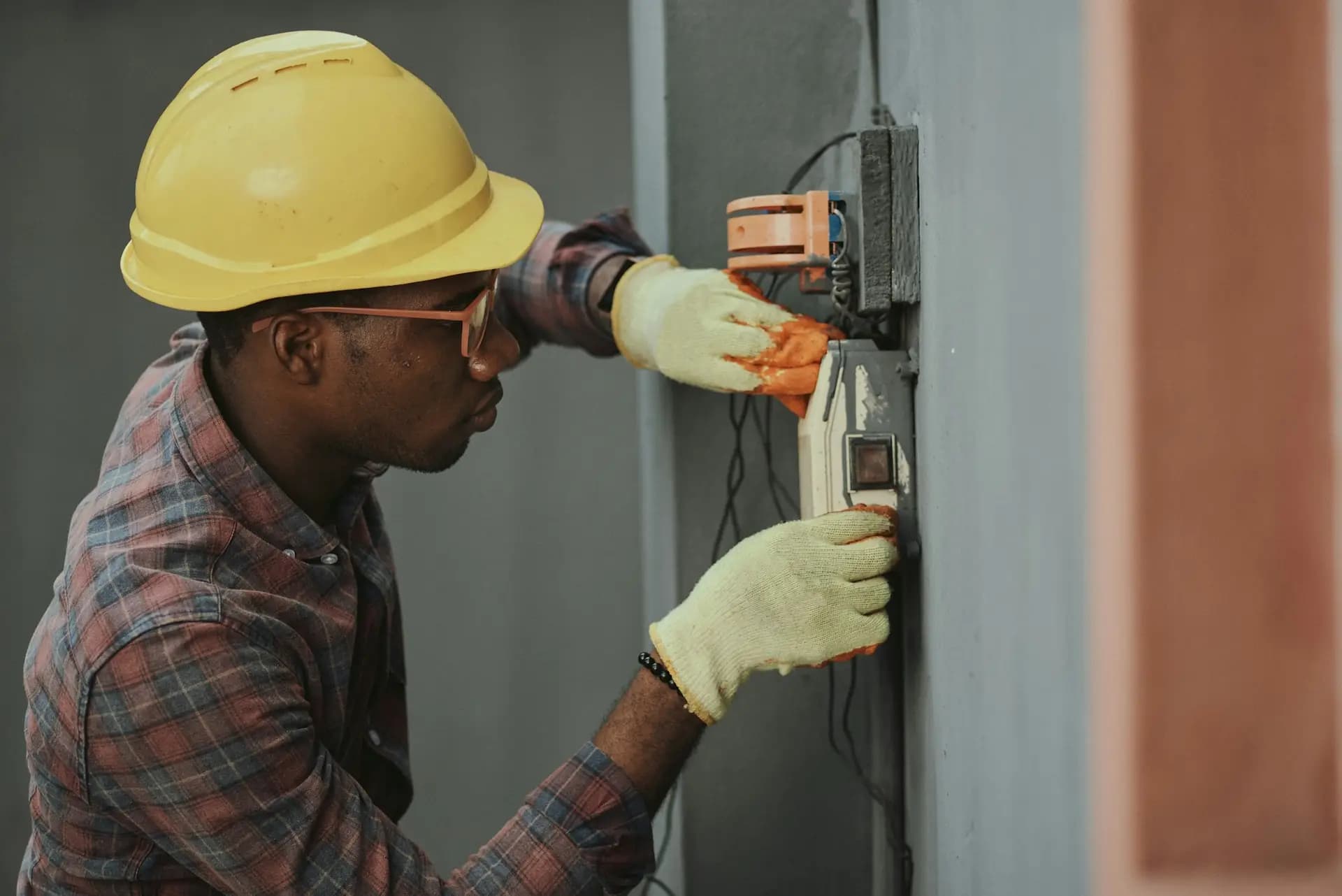
Free job simulation · Electrical and energy
Maintenance technician job simulation
A maintenance technician job simulation is a first month in a maintenance team, written for career changers and apprentices. In a simulated injection-moulding plant you put the safe isolation steps in order, check a motor starter drawing, choose a sensor, write job cards and plan a first PPM route. A patient senior is your buddy. It is practice, not employment or an authorisation to isolate.
You join Millhaven Polymers Ltd (simulated company), a injection moulder, maintenance team in Leicester. Days 1 to 5 are free, with about 8 h 45 min of tickets. Premium continues to day 20. It is practice, not employment.
Days 1 to 5 are free. You need a free account and no card. Create an account.
- Free days
- 1 to 5
- Free tickets
- about 8 h 45 min
- Project documents
- 10
- Certificate, optional
- £14.99
The project
You join Millhaven Polymers Ltd (simulated company)
Millhaven Polymers Ltd (simulated company) is a injection moulder, maintenance team in Leicester. You help its team deliver a project for Millhaven production department, at Moulding hall, machines IM-01 to IM-08.
You are a trainee maintenance technician, a career changer or an apprentice, joining a team that makes plastic parts. A patient senior technician is your buddy. In four weeks you learn the order of safe isolation and do it beside an authorised person, read a drawing, swap a sensor, check a heater band, write job cards, and learn to stop and ask. Later you do your first PPMs on the moulding machines, meet stored hydraulic energy, a request to bypass a gate, and someone else's lock on a machine. You end with a first PPM route pack. The skill is to be safe first, honest about what you do not yet know, and useful.
What you will do
- Put the safe isolation steps in order and practise a lock-out in EDWartens Lab
- Read a motor starter drawing, choose the right sensor and check a heater band
- Write a job card and run a 5S audit the way a maintenance team expects
- Handle stored energy, a bypass request and another person's lock safely
- Plan a PPM route and hand over a clear first-month pack
The people you deal with
- Maintenance Managercompany
- Senior Maintenance Techniciancompany
- Maintenance Plannercompany
- Health and Safety Advisorcompany
- Stores Controllercompany
- Moulding Shift Leaderclient
- Production Managerclient
- Sensor Supplier Supportvendor
The company, client and site are fictional. The people are fictional too.
Look inside
What the simulator looks like
The workplace, your tickets, the documents and the team chat, as a learner sees them.
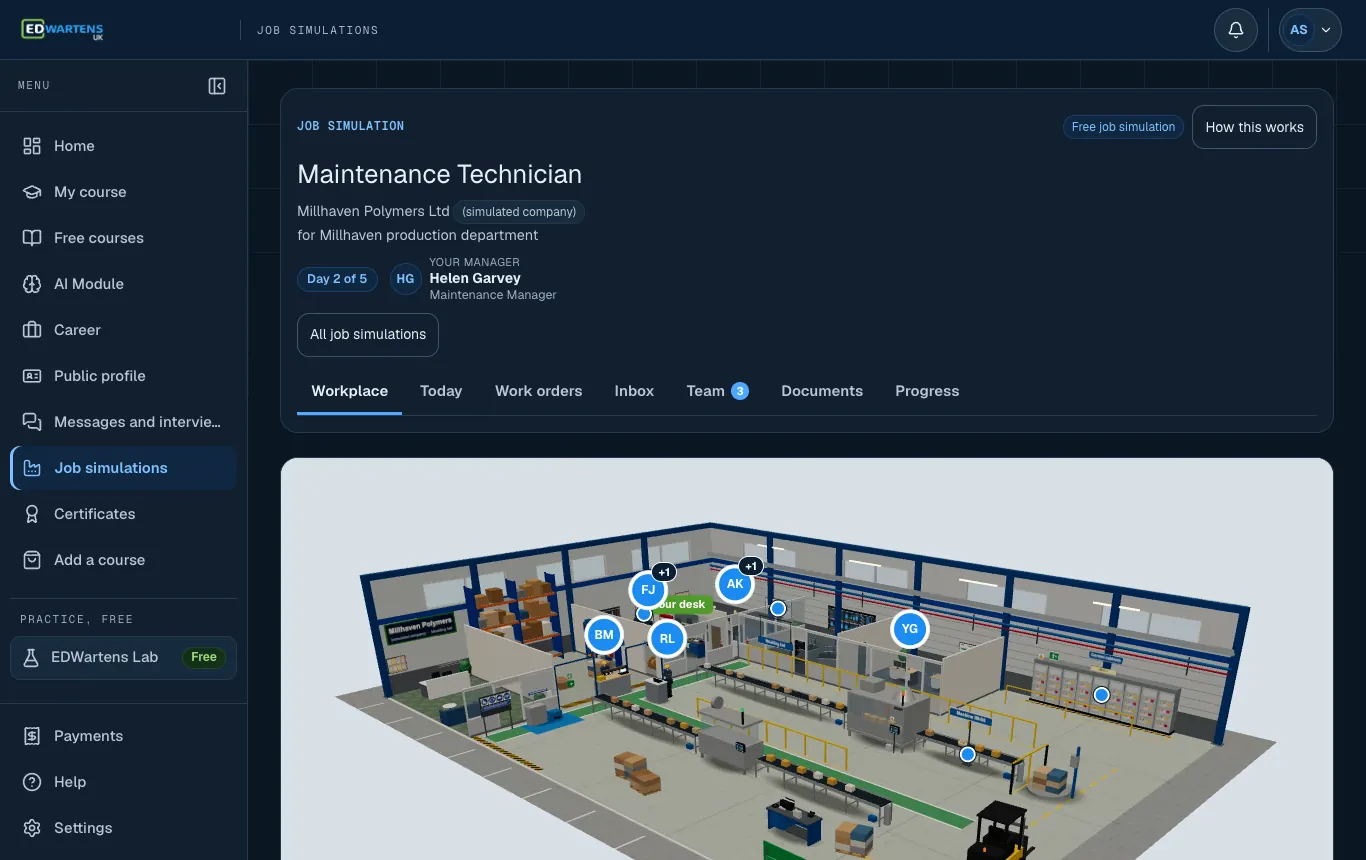
Start in the workplace, with the team around you. 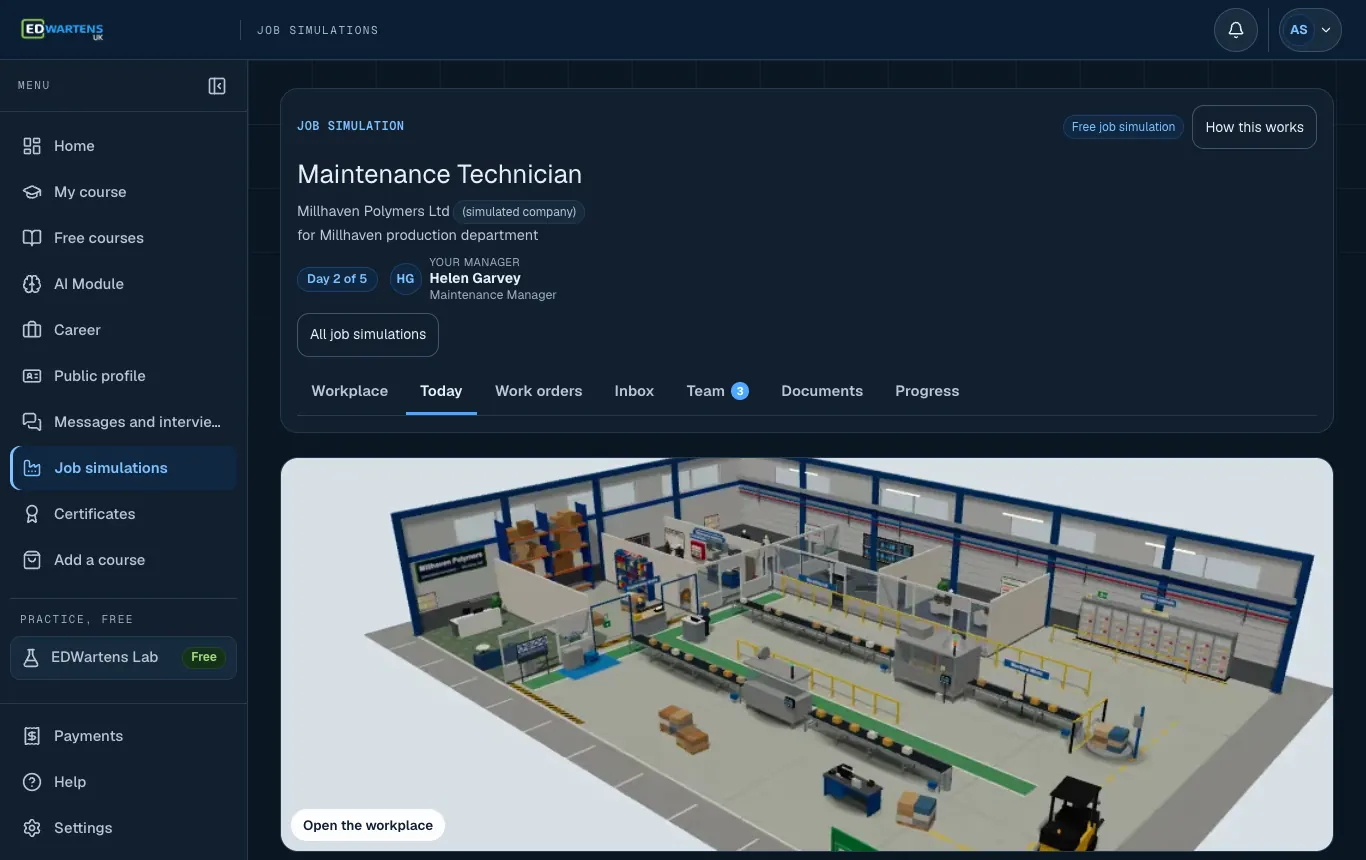
Today: the morning email and your tickets for the day. 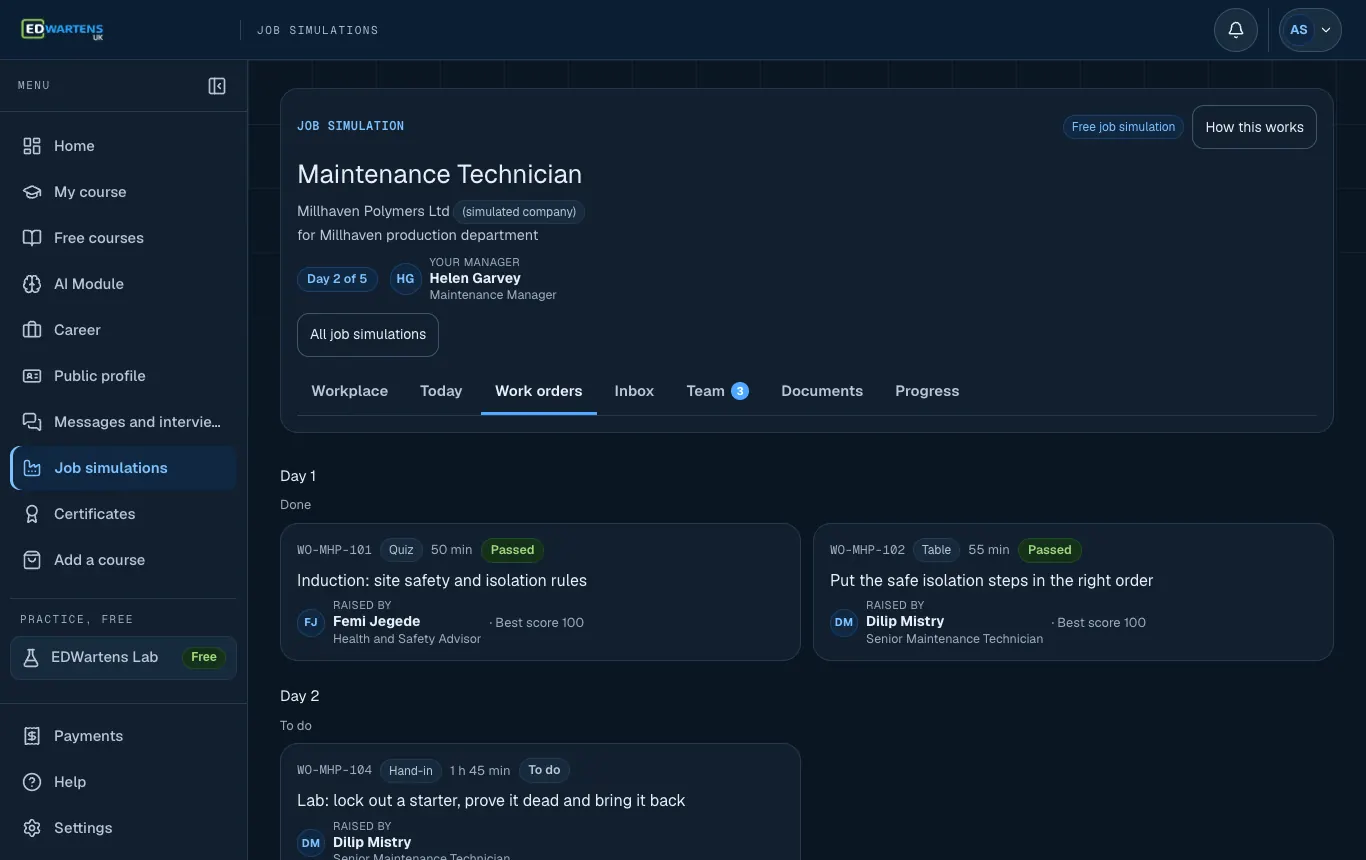
Work: every ticket, by day, with its status. 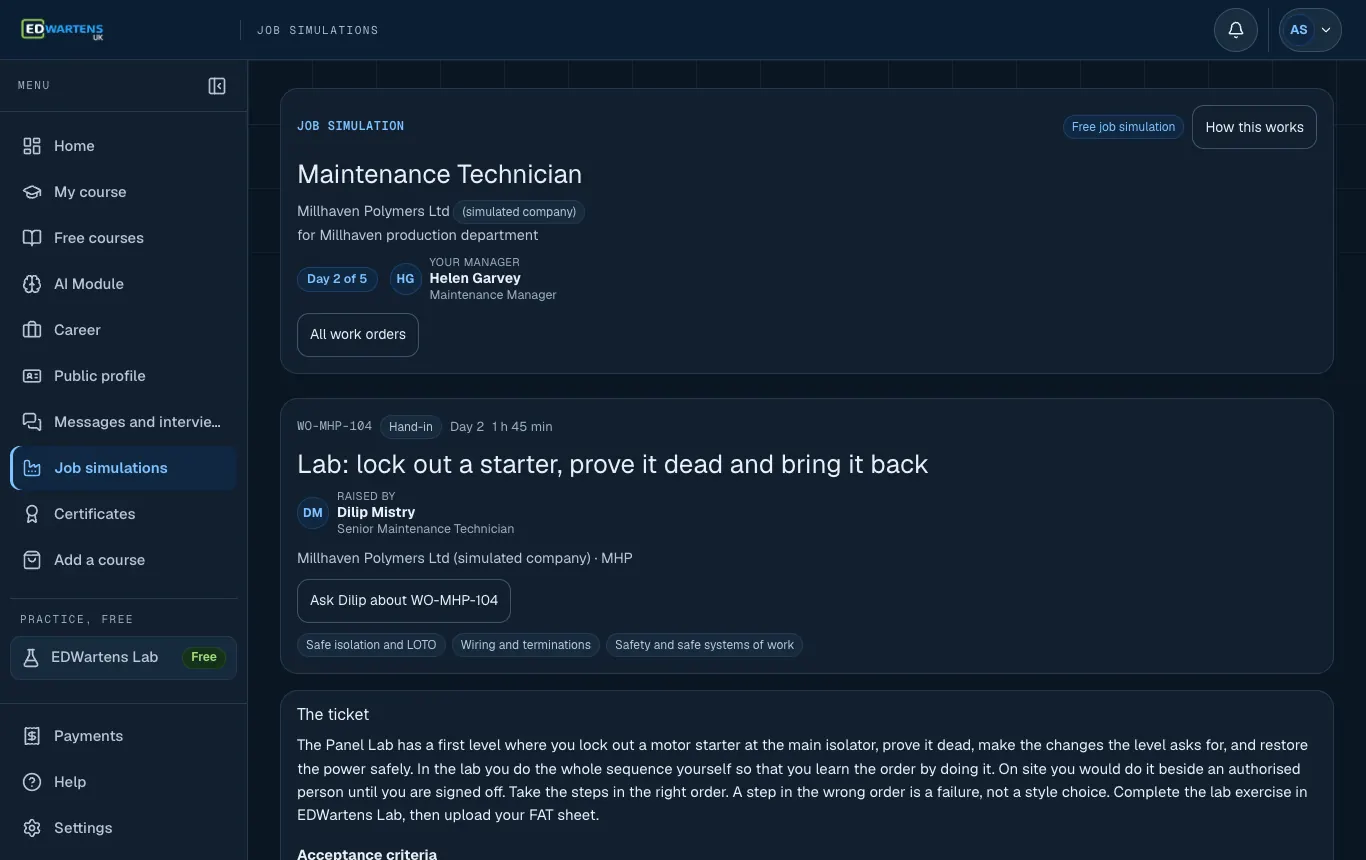
A ticket, written the way a colleague would write it. 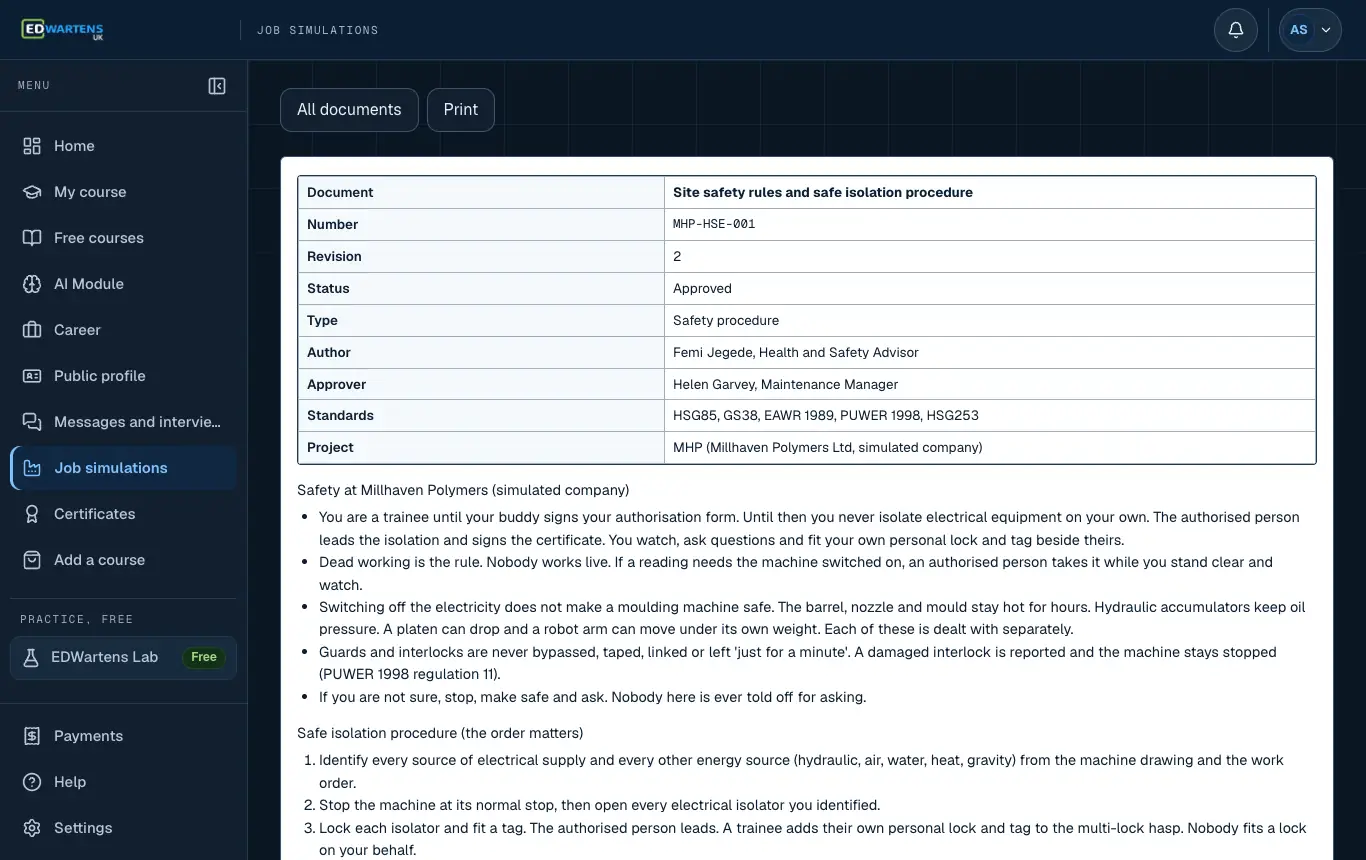
A project document with its number, revision and status. 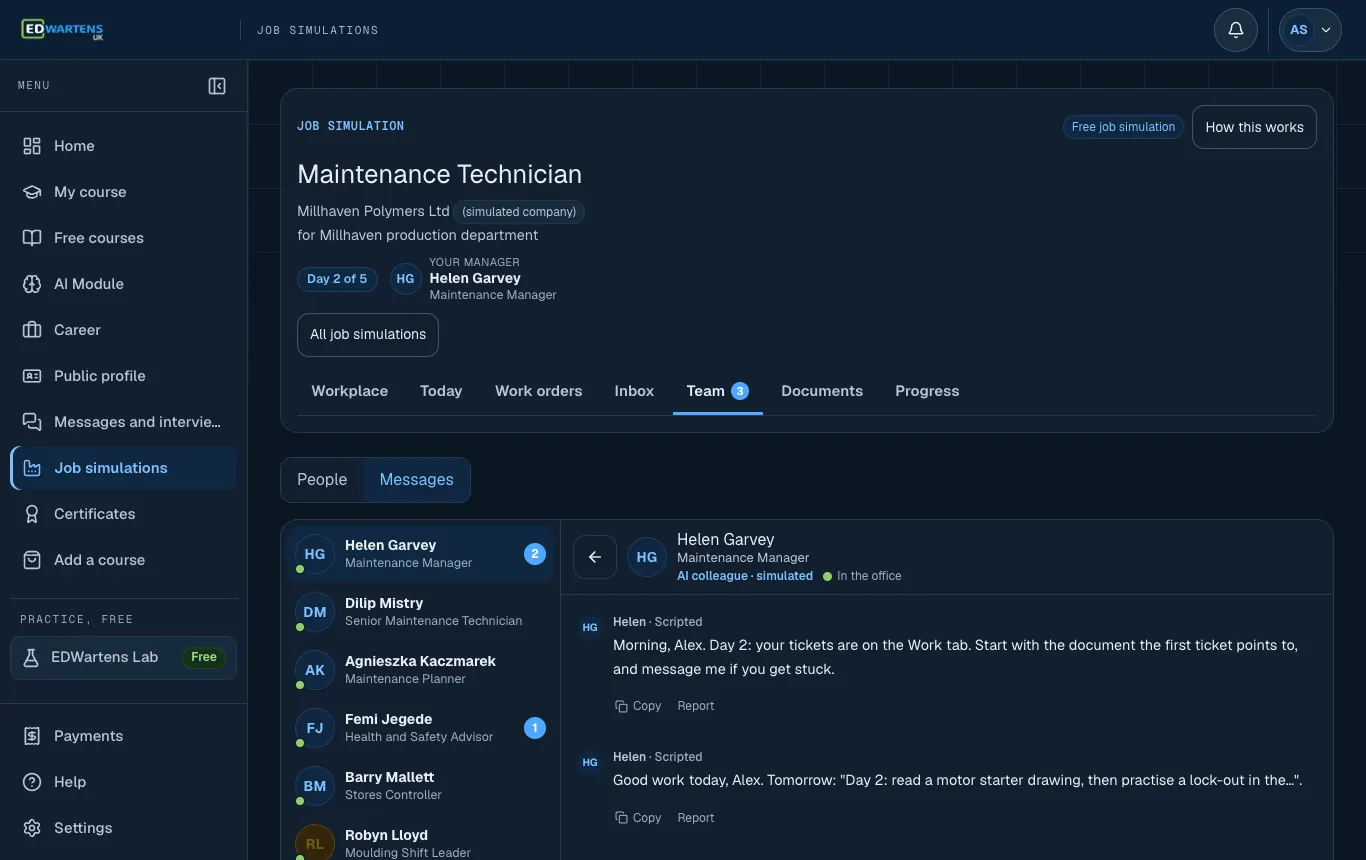
Ask a colleague. They are AI colleagues: they help you think, they do not hand out answers.


Screenshots from the simulator. Company, people and data are fictional. Portraits are AI-generated.
Meet the team
The colleagues you work with
You can read their messages and ask them questions. They are AI colleagues, clearly labelled. They help you think a ticket through; they do not hand out its answer.
- HGHelen GarveyMaintenance ManagerSimulated colleague, company side
- DMDilip MistrySenior Maintenance TechnicianSimulated colleague, company side
- AKAgnieszka KaczmarekMaintenance PlannerSimulated colleague, company side
- FJFemi JegedeHealth and Safety AdvisorSimulated colleague, company side
- BMBarry MallettStores ControllerSimulated colleague, company side
- RLRobyn LloydMoulding Shift LeaderSimulated colleague, client side
- YGYvonne GrealishProduction ManagerSimulated colleague, client side
- AKAnand KulkarniSensor Supplier SupportSimulated colleague, vendor
Fictional people. Portraits are AI-generated.
What you get
What you walk away with
Spend a month in a moulding plant maintenance team: safe isolation beside a buddy, first PPMs and a first route pack.
What you produce
Safe isolation steps in order
Safety procedure
Review of a motor starter drawing
Drawing review
A job card with cause, parts and downtime
Maintenance record
5S audit actions
Audit
Weekly hydraulic round with status
PPM recordPremium
Change impact note for a heater band
Change controlPremium
Toolbox talk
Safety communicationPremium
My first PPM route pack
CapstonePremium
Skills you practise
- Safety and safe systems of work
- Written communication
- Safe isolation and LOTO
- Planned and corrective maintenance
- Wiring and terminations
- Fault finding
- CMMS and work order records
- Planning and prioritising
Roles to look for
- Maintenance Technician
- Trainee Maintenance Technician
- Maintenance Apprentice
- Multi-skilled Maintenance Operative
- Engineering Technician (maintenance)
2264 live openings on the UK jobs board, checked 24 Oct 2026. See the jobs
Your proof
- A certificate anyone can verify. Optional, and included in Premium.
- An entry on your EDWartens profile under Work experience, marked as a job simulation.
- A work record with your skill scores, with Premium.
Free courses that go with it
- Free course Electrical Fundamentals for Technicians: Volts to Multimeter to Drawings
- Free course Electrical Safety at Work (UK): Safe Isolation, Lock-off and Arc Flash
- Free course Industrial Motor Control
- Free course PLC and Electrical Troubleshooting for Maintenance Teams
- Free course Industrial Pneumatics and Hydraulics
What you can talk about at interview
- You can explain the order of a safe isolation and say why a trainee does it beside an authorised person.
- You can describe what is still dangerous on a machine after it is switched off.
- In Premium, you can talk through a request to bypass a guard and what you said, and the first PPM route pack you built.
Day by day
Days 1 to 5, ticket by ticket
Self-paced. A day opens when you hand in the previous day's tickets. Every ticket is checked, and you see the model answer after it.
Day 1
about 1 h 45 min- Induction: site safety and isolation rulesQuiz · 50 min
- Put the safe isolation steps in the right orderTable · 55 min
Day 2
about 3 h- Check a written description of a motor starter drawingDocument review · 1 h 15 min
- Lab: lock out a starter, prove it dead and bring it backHand-in · 1 h 45 min
Day 3
about 1 h 30 min- Which proximity sensor do we order for IM-06?Decision · 45 min
- A heater band reading: is it healthy?Calculation · 45 min
Day 4
about 1 h- Write the job card for the IM-06 sensor repairWriting · 1 h
Day 5
about 1 h 30 min- 5S audit: which S, and how fast?Table · 50 min
- The senior is called away: what do you do?Decision · 40 min
Premium: days 6 to 20about 22 h 20 min more
After day 5 the project goes on with a change request, site work, faults, a handover and a capstone reviewed by an engineer.
Day 6
about 2 h 20 min- How a moulding machine works and where it can hurt youQuiz · 1 h
- The weekly hydraulic round: status and main reasonTable · 1 h 20 min
Day 7
about 50 min- A weeping hose fitting: nip it up?Decision · 50 min
Day 8
about 1 h- Can the zone take a bigger heater band?Calculation · 1 h
Day 9
about 1 h 30 min- Change impact note for the IM-05 heater bandWriting · 1 h 30 min
Day 10
about 1 h 10 min- Spares: order point, order now and quantityTable · 1 h 10 min
Day 11
about 2 h- Lab: find the starter fault and repair it under lock-outHand-in · 2 h
Day 12
about 50 min- The shift leader asks for a link across the gate switchDecision · 50 min
Day 13
about 1 h 30 min- Check a finished PPM job sheetDocument review · 1 h 30 min
Day 14
about 1 h 40 min- Write the job card for the IM-07 heater zone faultWriting · 1 h 40 min
Day 15
about 1 h 15 min- A five-minute toolbox talk: what stays dangerous after switch-offWriting · 1 h 15 min
Day 16
about 1 h 10 min- How long does the PPM round take each week?Calculation · 1 h 10 min
Day 17
about 50 min- Someone else's lock is on IM-01Decision · 50 min
Day 18
about 4 h- Capstone: my first PPM route packHand-in · 4 h
Day 19
about 1 h 15 min- Your handover noteWriting · 1 h 15 min
Day 20
about 1 h- A conversation about your monthViva · 1 h
Real documents
The documents you will work with
Each one has a number, a revision and an approver, the way a project document does. You read them, check them and write your own.
MHP-HSE-001
Site safety rules and safe isolation procedure
Rev 2Safety procedure
MHP-MAC-001
Injection moulding machines IM-01 to IM-08: what is on them and where they can hurt you
Rev AMachine guide
MHP-DSB-004
Design basis: hydraulic pump motor starter, IM-04
Rev BDesign basis
MHP-SCH-004
Motor control schematic extract: hydraulic pump motor starter, IM-04 (written description)
Rev CSchematic extract
MHP-DAT-021
Proximity sensors: the IM-06 mould-closed sensor and the stores candidates
Rev ADatasheet extract
MHP-WO-004417
Work order: IM-06 mould-closed signal missing
Rev 1Work order
MHP-DAT-022
Barrel heater bands and zone data, IM-05
Rev AEquipment data
MHP-LOG-005
Your notes from the IM-06 sensor job, day 4
Rev 1Shift log
MHP-AUD-003
5S audit sheet: maintenance workshop and tool store, week 5
Rev 1Audit sheet
MHP-SOP-006
Stop, make safe and ask: when to escalate
Rev 1Procedure
Documents that arrive in Premiumchange requests, records, handover
MHP-PPM-HYD-004
Hydraulic power pack checks: status rules and this week's readings
Rev APPM sheetPremium
MHP-PPM-001
Planned preventive maintenance schedule, moulding hall IM-01 to IM-08
Rev APPM planPremium
MHP-PPM-001
Planned preventive maintenance schedule, moulding hall IM-01 to IM-08, revised
Rev BPPM planPremium
MHP-ECR-001
Change request: a 3.0 kW heater band in place of the 2.0 kW HB-3 on IM-05
Rev AChange requestPremium
MHP-DAT-022
Barrel heater bands and zone data, IM-05, revised
Rev BEquipment dataPremium
MHP-SPR-001
Critical spares: stock list and order rule
Rev ASpare parts listPremium
MHP-TST-011
Guard interlock: how to test it and what to do when it fails
Rev 1Test methodPremium
MHP-PPM-JOB-0412
Completed PPM job sheet, IM-03, four-weekly (an earlier trainee's draft)
Rev 1PPM job sheetPremium
MHP-FLT-018
Fault evidence: IM-07 zone 2 will not heat
Rev AFault evidencePremium
MHP-SOP-007
Removing a lock that belongs to someone else
Rev 1ProcedurePremium
MHP-TBT-001
Toolbox talk format and facts for the moulding hall
Rev 1GuidancePremium
MHP-HOV-001
First PPM route pack: what goes in it
Rev AHandover indexPremium
Tools
In the industry, and here
| In the industry | Here |
|---|---|
| Voltage indicator and proving unit (GS38), clamp meter, ohmmeter | EDWartens Lab's panel exercises, with readings you take, and test records you read and write up |
| Work orders and job cards in a maintenance system | Work orders, close-out notes and job cards as documents and tickets |
| Isolation certificates, lock and tag, stop-and-ask rules | Procedures to put in order, certificates to check and decisions to make |
| PPM sheets, spares lists and a 5S audit | Tables and calculations you complete and have checked |
Standards
The standards the work follows
- HSG85 (electricity at work, safe working)
- GS38 (electrical test equipment)
- Electricity at Work Regulations 1989
- PUWER 1998
- HSG253 (safe isolation of plant and equipment)
- BS 7671 (awareness)
In the UK
The Maintenance Technician role in a UK setting
Who employs this kind of engineer: Plastics and injection moulding sites, light manufacturing, packaging and assembly plants.
Where: Industrial regions such as the North West, Yorkshire, the Midlands, Scotland and the South West have many manufacturing sites with in-house maintenance teams that take on technicians. This is context, not a statement about vacancies.
UK standards and regulations to know about
Electricity at Work Regulations 1989
The law on safe work with electrical systems. HSE guidance HSG85 explains safe working practices.
PUWER 1998
The Provision and Use of Work Equipment Regulations: equipment must be suitable, maintained and safe to use. HSE guidance L22 explains them.
HSE guidance HSG85 and GS 38
Safe working practices for electricity, and guidance on electrical test equipment.
HSG253
HSE guidance on the safe isolation of plant and equipment, including stored energy.
BS 7671
The IET Wiring Regulations. Awareness only at this level.
Schemes to be aware of
ECS card (Electrotechnical Certification Scheme)
The industry card that many UK electrotechnical employers and sites ask to see. It is linked to qualifications and a health and safety assessment. EDWartens does not issue it, and this simulation does not lead to it.
These are named so that you recognise them. A job simulation does not teach them as a qualification, the tasks use simplified data, and you should always read the current edition of anything you rely on.
Your proof, optional
A certificate you can verify
The free days are free. The graded, verifiable certificate is an optional extra, and it is included in Premium.
- A graded, verifiable certificate with your score and band
- A public verification page and QR code
- One-click add to LinkedIn as a licence or certification
- Issued by WARTENS LTD. It is a training certificate, not an accredited qualification, and the company is simulated
Optional: £14.99 including VAT, once you pass.
Job Simulation Certificate
Your name
completed the Maintenance Technician job simulation at Millhaven Polymers Ltd (simulated company). Your score and band are shown on the real certificate.
- Number
- EDW-JS-0000
- Issued by
- WARTENS LTD
Not an accredited qualification. A verification page and QR code are printed on the real certificate.
Prepare
Free courses and labs that get you ready
Linked from the tickets that need them. You can read them before you start.
Free courses
- Electrical Fundamentals for Technicians: Volts to Multimeter to Drawings
- Electrical Safety at Work (UK): Safe Isolation, Lock-off and Arc Flash
- Industrial Pneumatics and Hydraulics
- Health and Safety Foundations: HSWA 1974, RIDDOR and ISO 45001
- Industrial Motor Control
- PLC and Electrical Troubleshooting for Maintenance Teams
- Maintenance Planning, Scheduling and CMMS with SAP PM
- Lean Manufacturing, OEE and TPM
EDWartens Lab guides
The hands-on tickets are finished in EDWartens Lab, then you record the figures and upload a FAT sheet or notes for checking. Nothing is marked as passed on the lab's say-so.
About the Maintenance Technician role
Safe isolation: the order, and who does it
Safe isolation is a fixed sequence: identify every energy source, switch off and open the isolators, lock and tag, prove the voltage indicator, test dead, prove the indicator again, then release stored energy. The order is the safety. UK guidance for this is HSE's HSG85 for electrical work and GS38 for test equipment.
A trainee does not isolate alone. In the simulation an authorised senior leads and you add your own lock and tag, so you learn the steps by watching and doing them together. A practice level in the panel lab lets you run the whole sequence yourself, so the order sticks.
Heat, oil pressure and the other energy on a machine
Switching off the electricity does not make a moulding machine safe. The barrel stays hot for hours, a hydraulic accumulator holds oil pressure, and a platen or arm can move under its own weight. Each one is dealt with separately, and oil under pressure can pierce skin, so nobody feels for a leak with a hand.
The simulation puts you in front of a weeping hose fitting where the shift leader says it is only a drip. The right answer is not to touch it until it is isolated and the pressure reads zero. You also check a heater band, and see why resistance is measured only when the machine is isolated and the band is cold.
Reading drawings, sensors and job cards
Entry-level maintenance still means reading. You check a written description of a motor starter against its design basis and find the stop button wired the wrong way and an overload set too high. You choose between PNP and NPN proximity sensors for an input card, and see that a normally closed type would invert the signal.
You then write the job card the planner needs, with the fault, cause, parts, labour, downtime and tests. A clear job card is a safety record as well as a cost record, and it is how the next shift knows what happened.
First PPMs, change control and the capstone pack
Planned preventive maintenance is the checking done on a schedule so machines do not fail. You read a hydraulic round, check a finished PPM job sheet for mistakes, work out how long a weekly route takes and write a toolbox talk for the setters.
Two cases test your nerve. Production asks for a bigger heater band than the zone can carry, which needs a change note. Then production asks for a link across a gate switch, which you refuse and report. The capstone is a first PPM route pack that a new starter could use. Stopping and asking is treated as part of the job.
Keep going
Related job simulations and courses

Maintenance Electrical Engineer
Work orders, safe isolation, fault finding and a root-cause report.
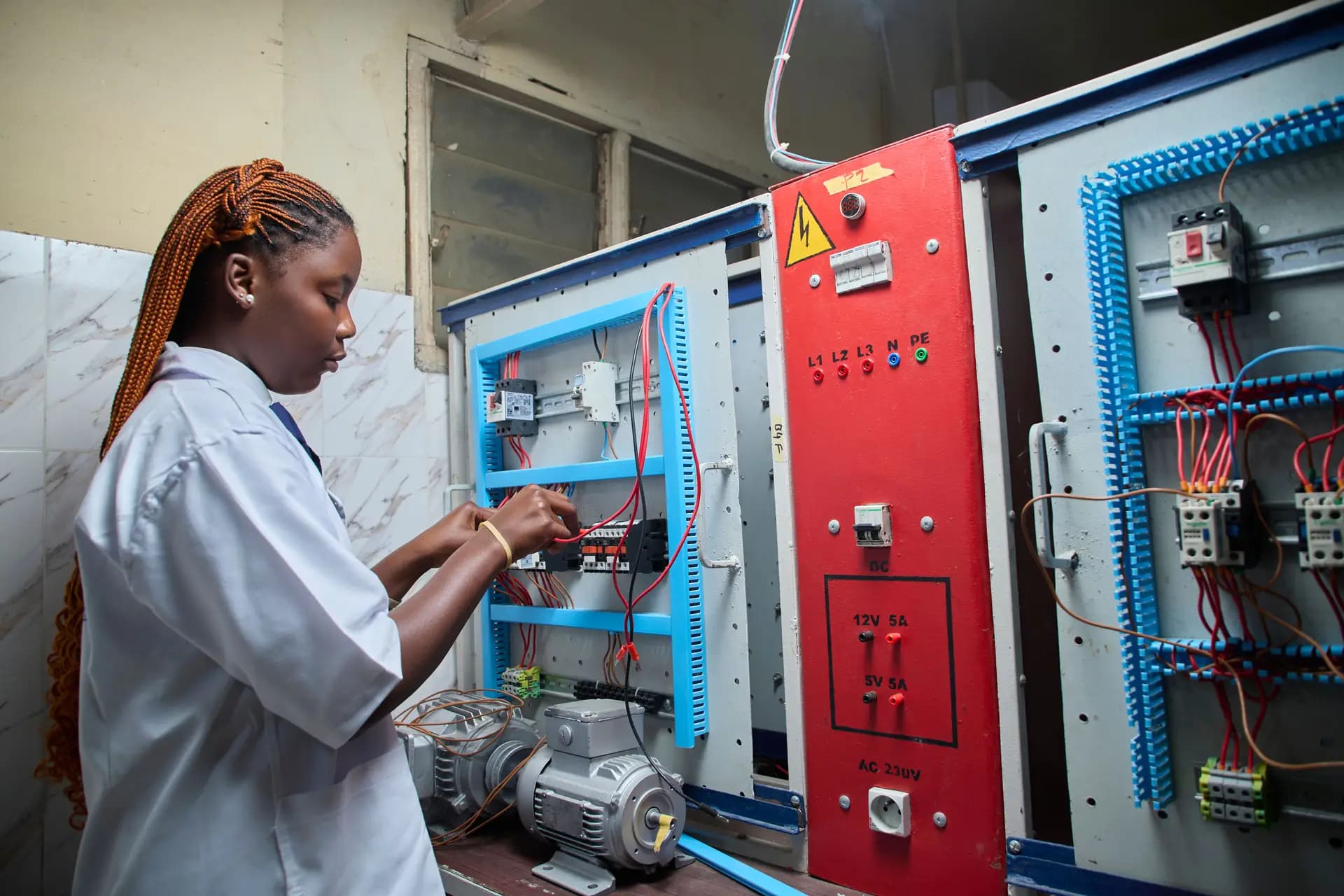
Control Panel Design Engineer
GA drawing, schematics, BOM, heat calculation and the routine test.
Electrical Design Engineer
Load list, single-line diagram, cable sizing and a late design change.
- Engineering job simulations
- Free courses
- Browse jobs
- Virtual work experience in the UK
- Job simulation questions
Content reviewed 19 Oct 2026; UK context added 21 Oct 2026. Practice, not employment.
Questions
Quick answers
Can I start a maintenance career with no experience?
Many employers take apprentices and career changers, and routes vary by employer and region. The simulation shows the habits they look for: safe isolation, clear records and a willingness to ask.
What is safe isolation?
It is a documented sequence to prove equipment is dead and secured before work: identify, isolate, lock and tag, prove the tester, test dead and prove the tester again. Follow your site rules and HSE guidance such as HSG85.
What does GS38 cover?
It is HSE guidance on electrical test equipment used on low voltage systems. It covers probes with short exposed tips, finger guards and fused leads, and why a voltage indicator is proved before and after use.
What is PPM?
PPM means planned preventive maintenance: checks and servicing done on a schedule to stop breakdowns. A route lists the tasks, the machines, the time and whether isolation is needed.
What is the difference between PNP and NPN sensors?
A PNP sensor switches the positive supply to the input and an NPN sensor switches the zero volt side. The input card decides which one works, so the wrong type may fit but never switch.
Does this make me authorised to isolate machines?
No. Authorisation comes from your employer after training and assessment. The simulation teaches the order and the reasons, and a real trainee works beside an authorised person.
Why do technicians refuse to bypass a safety gate?
A gate interlock stops the clamp when the gate opens. A link or tape defeats it and can lead to a crush injury. PUWER 1998 requires guards and interlocks to work, so the machine stays stopped until it is repaired.
Is a virtual exercise a substitute for hands-on training?
No. It builds the order of steps and the habit of stopping and asking. Hands-on skill comes from supervised practice at work or college, which a simulation complements and does not replace.
Do I need any experience to start?
No. The role is written for career changers and apprentices. It explains the words as it goes and starts with the safety rules and the order of safe isolation.
Will this teach me to isolate machines on my own?
No. It teaches the order and the reasons. On a real site you isolate only when your employer has authorised you, and until then you work beside an authorised person.
Is the plant a real one?
No. Millhaven Polymers is a made-up company and the site is simulated. The documents, readings and situations follow what a trainee meets in a real moulding plant.
How long does it take?
The free week is about nine hours over five days. The full Premium edition runs over twenty working days and about thirty to forty hours, at your own pace.
What do I get at the end?
A work record with scores by task and skill, which shows on your EDWartens profile under Work experience, marked as a job simulation.
Is the Maintenance Technician job simulation free?
Yes, to start. Days 1 to 5 are free. The certificate (£14.99) and the Premium edition (£53.99) are optional, and both prices include VAT.
Does it count as work experience?
No. It is a training project at a simulated company, not employment, an internship or a placement. A job simulation is a realistic training project at a simulated company. It is not employment, an internship or a work placement, and it is not a job offer. Hours are active hours the learner logged on EDWartens UK.
A job simulation is a realistic training project at a simulated company. It is not employment, an internship or a work placement, and it is not a job offer. Hours are active hours the learner logged on EDWartens UK.
Start the Maintenance Technician job simulation today
Days 1 to 5 are free. No card to start. Practice, not employment.