

Free job simulation · AI and data
Computer vision engineer job simulation: specify, label and test an inspection model
A computer vision engineer job simulation is a guided exercise in which you define what a camera must detect on a production line, review labelling, judge an inspection model by its escapes and false rejects, and handle night-shift lighting and latency. It is practice, not employment. This version follows a solder bridge inspection on a simulated circuit board line, and ends with a validation pack.
You join Brightfield Vision Systems Ltd (simulated company), a machine vision integrator in Coventry. Days 1 to 5 are free, with about 10 h 45 min of tickets. Premium continues to day 20. It is practice, not employment.
Days 1 to 5 are free. You need a free account and no card. Create an account.
- Free days
- 1 to 5
- Free tickets
- about 10 h 45 min
- Project documents
- 7
- Certificate, optional
- £14.99
The project
You join Brightfield Vision Systems Ltd (simulated company)
Brightfield Vision Systems Ltd (simulated company) is a machine vision integrator in Coventry. You help its team deliver a project for Wrenfield Electronics Manufacturing Ltd, at SMT line 3, sensor board W3-220 (ticket CVI-054).
You are the junior vision engineer on a camera inspection system for solder bridges on a connector. The Senior Vision Engineer gives you a ticket, an inspection spec, an acquisition sheet with blanks, a labelling guide with mistakes and a set of image-level results. Over four weeks you check the optics, review the labels, find that the test set shares boards with the training set, show that 97 percent accuracy means nothing, discover that the night shift is dark, and then handle a new board variant, a production manager who wants to loosen the threshold in secret, lens dust, a customer escape and the handover to the line team.
What you will do
- Work out resolution, blur and time to the reject gate from an image acquisition sheet
- Review a labelling guide, measure annotator agreement and find a split that puts the same board in train and test
- Show why 97 percent accuracy means nothing when 97 percent of boards are good, and report escapes and false rejects by shift
- Choose a threshold with costs, resist a zero-escape demand and a request to loosen the threshold in secret
- Judge latency at the 95th percentile, track lens dust, review a validation report and hand the system to the line team
The people you deal with
- Head of Vision Engineeringcompany
- Senior Vision Engineercompany
- Delivery Managercompany
- Client Quality Managerclient
- Client Production Managerclient
- Client Line Engineerclient
- Client Lead Inspectorclient
The company, client and site are fictional. The people are fictional too.
Look inside
What the simulator looks like
The workplace, your tickets, the documents and the team chat, as a learner sees them.
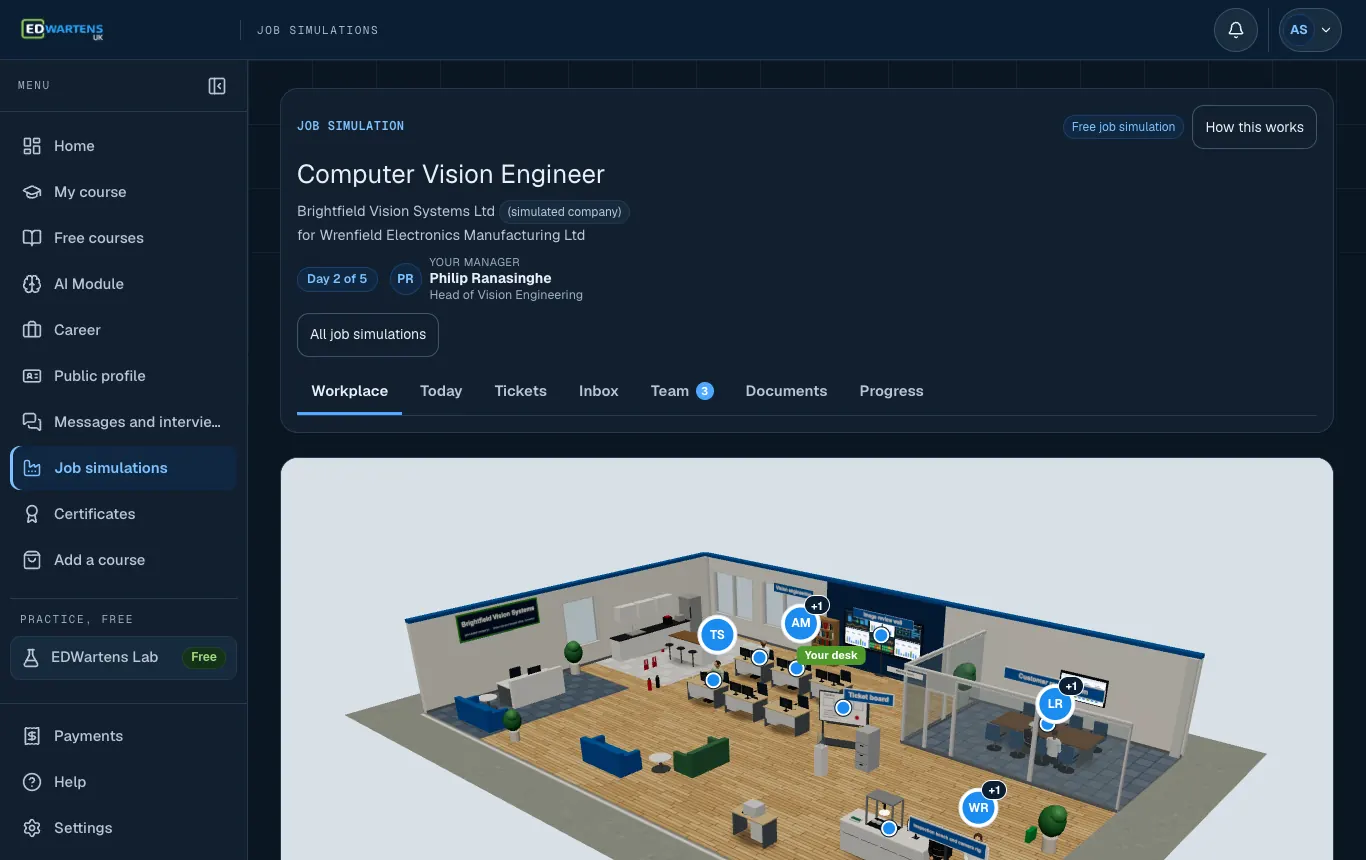
Start in the workplace, with the team around you. 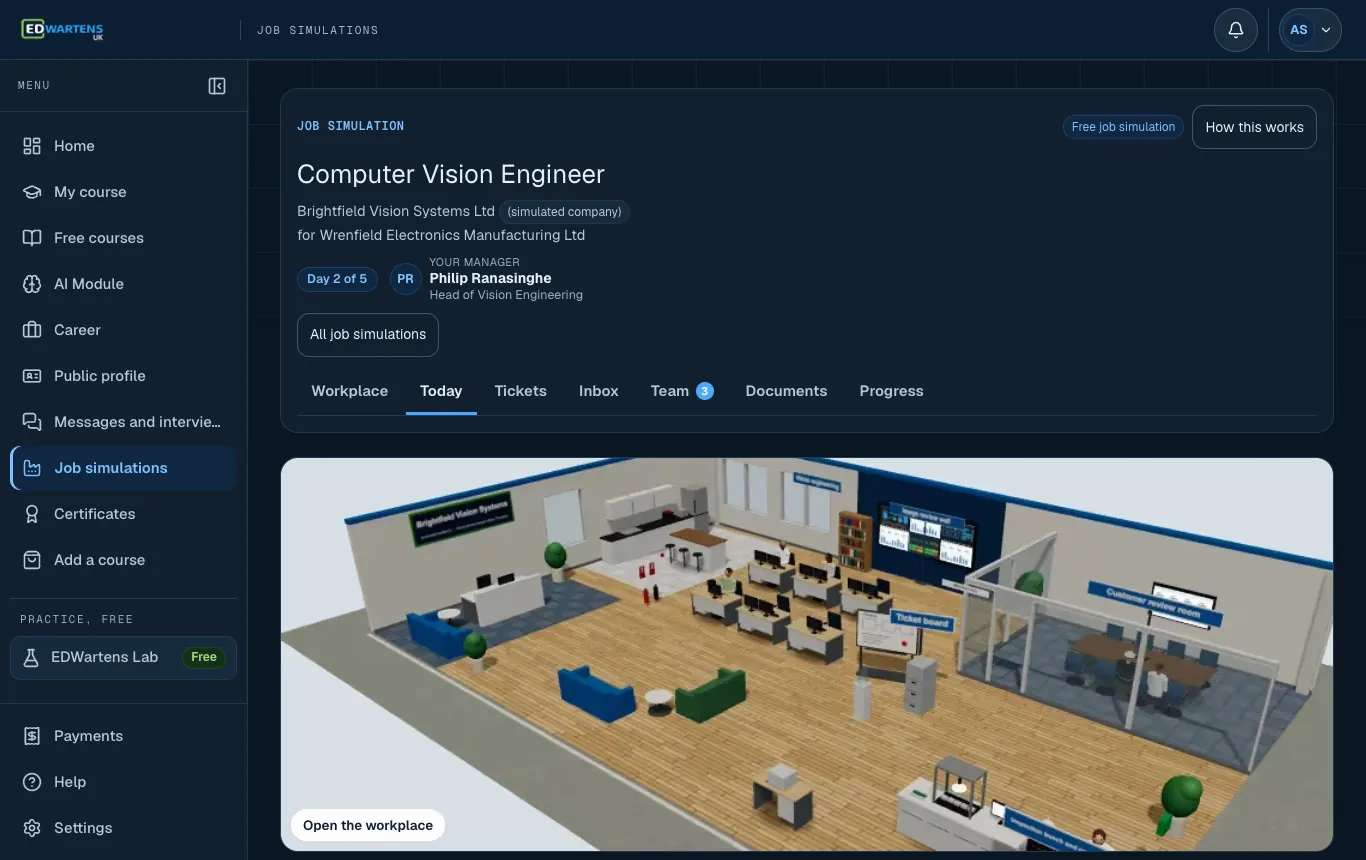
Today: the morning email and your tickets for the day. 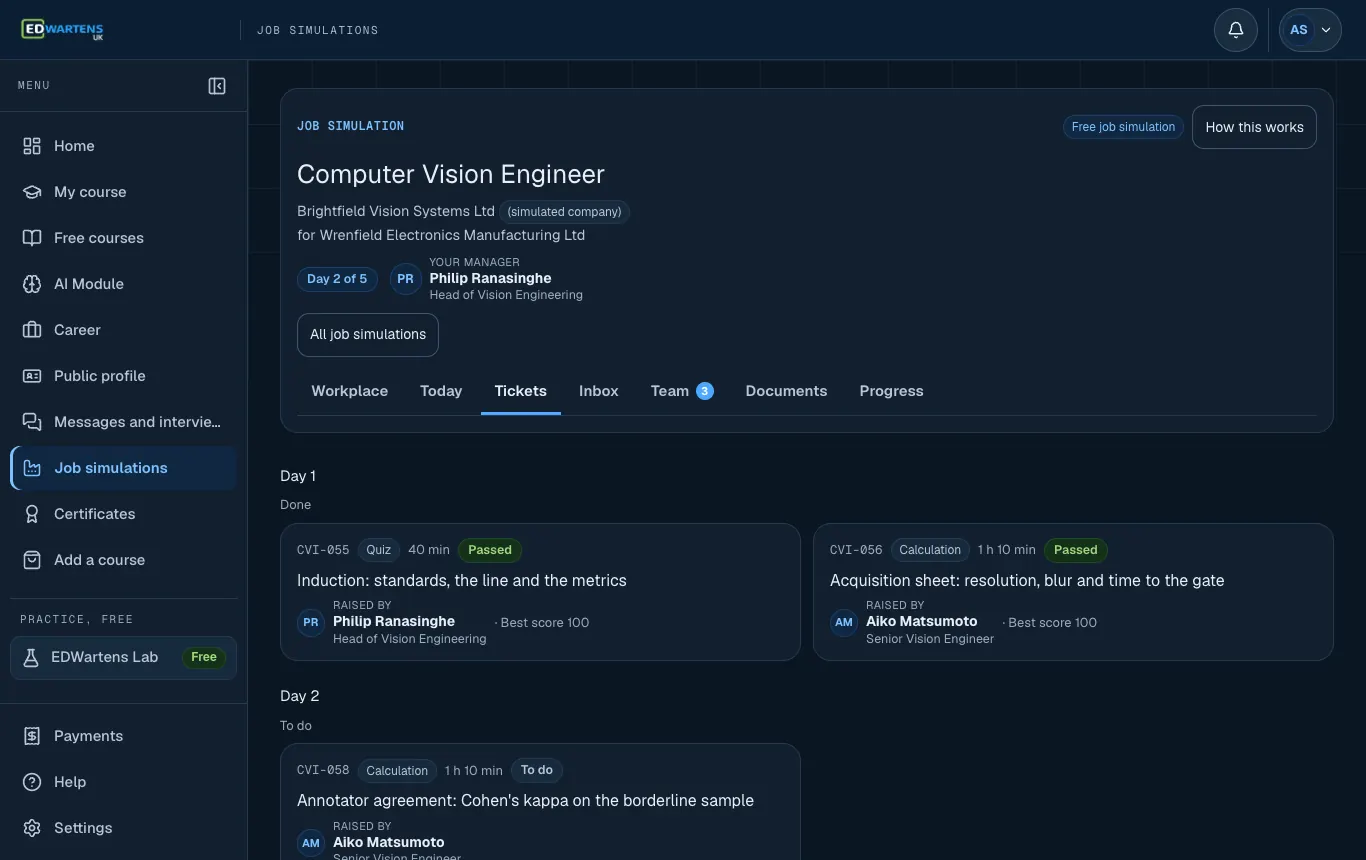
Work: every ticket, by day, with its status. 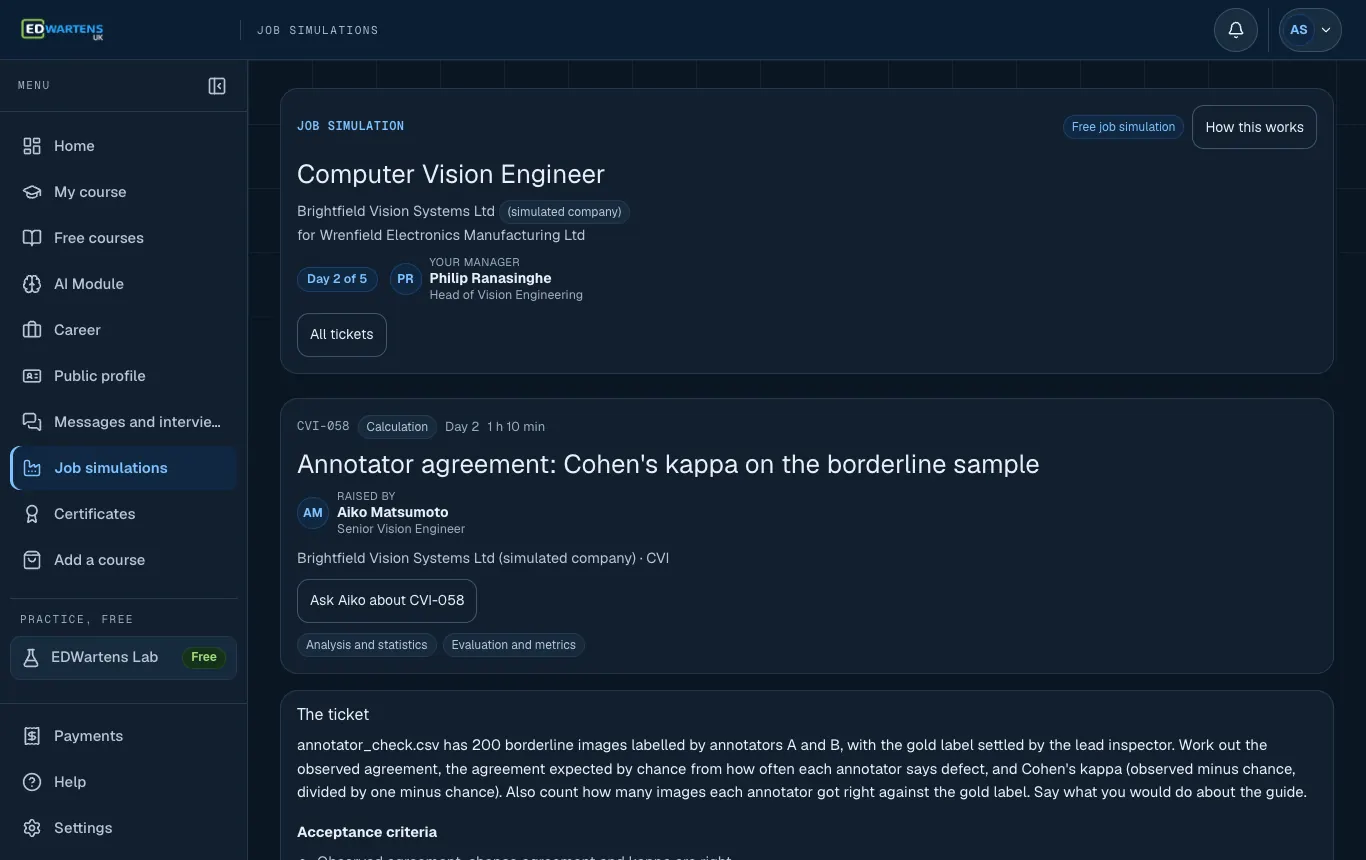
A ticket, written the way a colleague would write it. 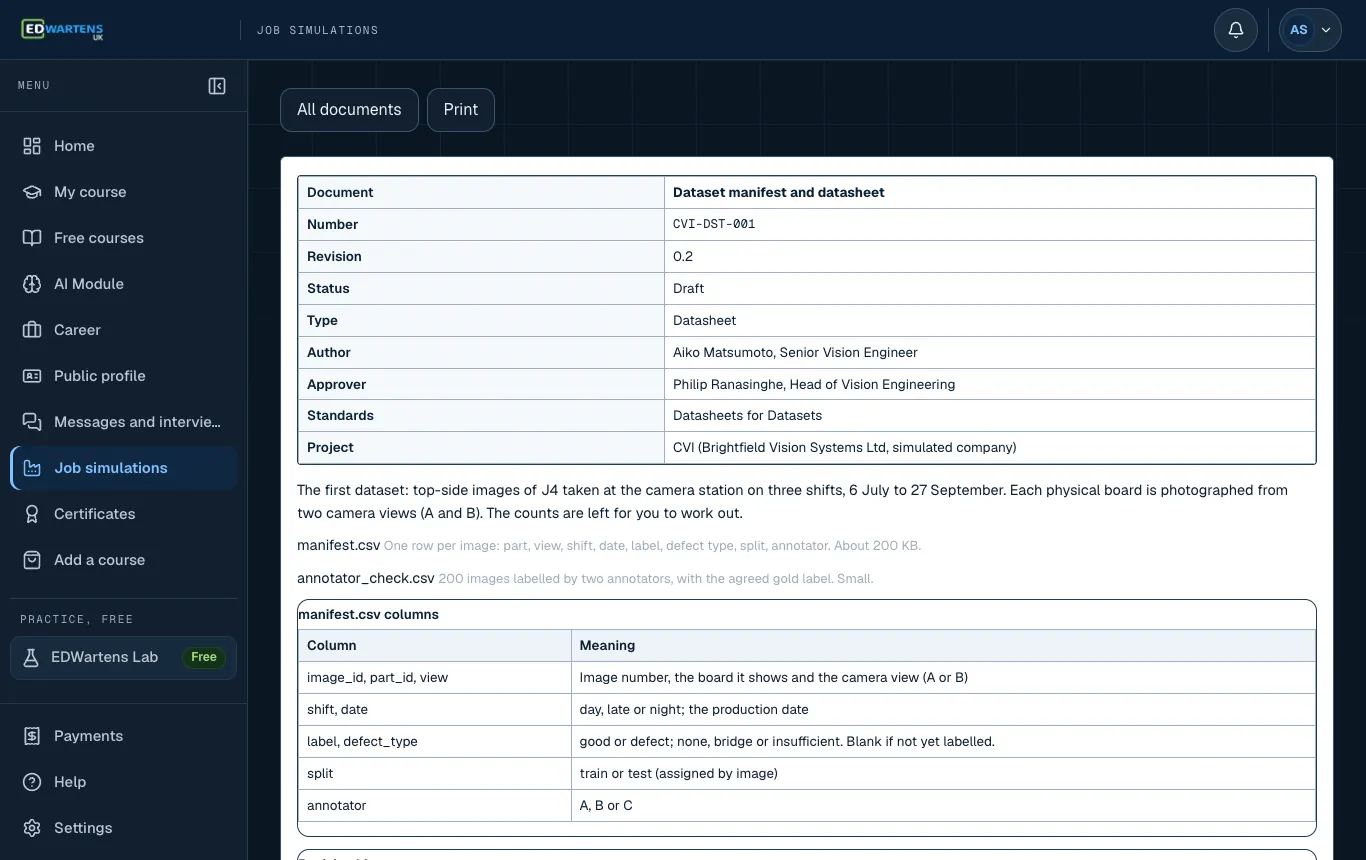
A project document with its number, revision and status. 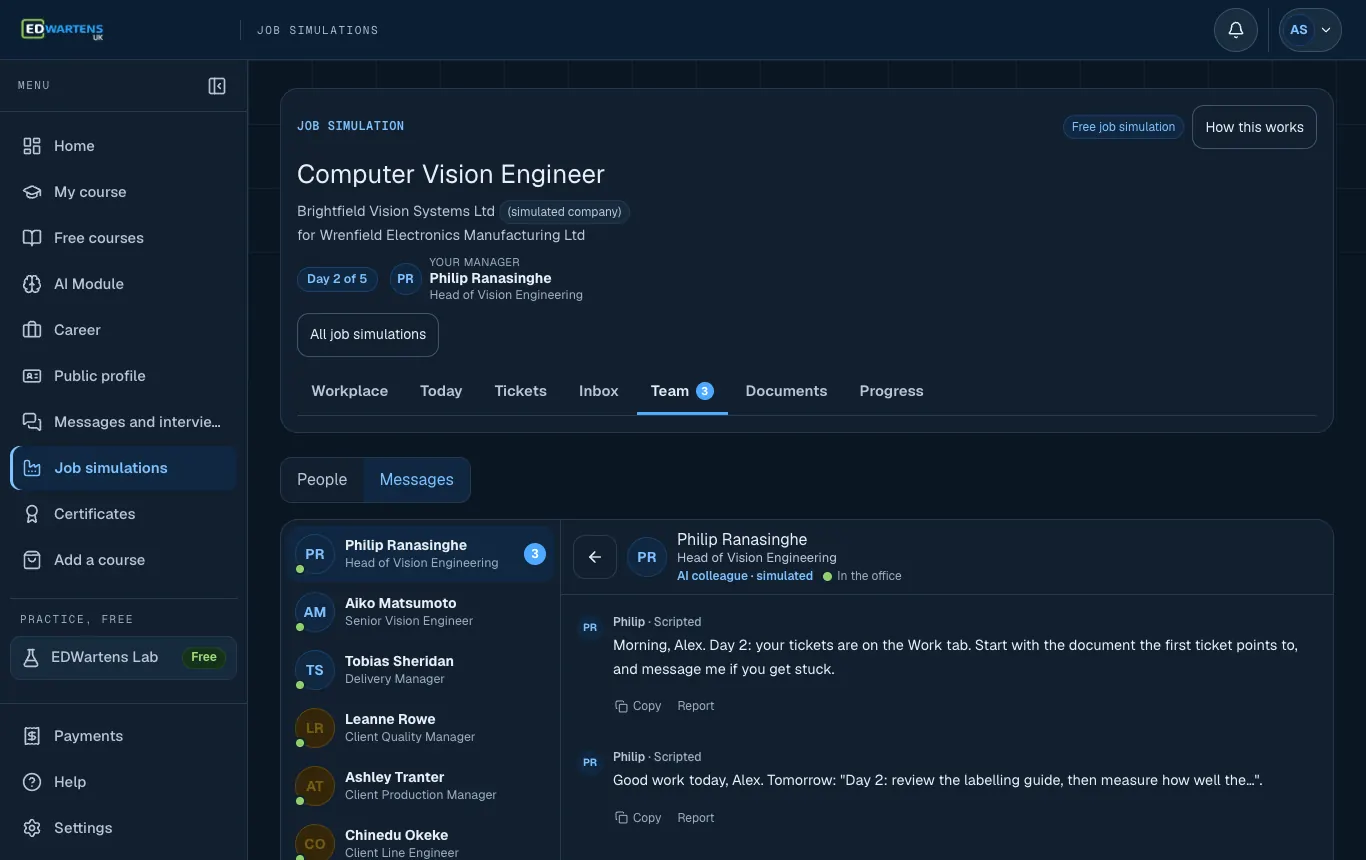
Ask a colleague. They are AI colleagues: they help you think, they do not hand out answers.


Screenshots from the simulator. Company, people and data are fictional. Portraits are AI-generated.
Meet the team
The colleagues you work with
You can read their messages and ask them questions. They are AI colleagues, clearly labelled. They help you think a ticket through; they do not hand out its answer.
- PRPhilip RanasingheHead of Vision EngineeringSimulated colleague, company side
- AMAiko MatsumotoSenior Vision EngineerSimulated colleague, company side
- TSTobias SheridanDelivery ManagerSimulated colleague, company side
- LRLeanne RoweClient Quality ManagerSimulated colleague, client side
- ATAshley TranterClient Production ManagerSimulated colleague, client side
- COChinedu OkekeClient Line EngineerSimulated colleague, client side
- WRWendy RothwellClient Lead InspectorSimulated colleague, client side
Fictional people. Portraits are AI-generated.
What you get
What you walk away with
Build the evidence for a camera inspection: optics, labels, metrics, thresholds and a validation and handover pack.
What you produce
Acquisition sheet check: resolution, blur and time to the gate
Optics calculation
Review comments on the labelling guide
Specification review
Annotator agreement (Cohen's kappa)
Data quality analysis
Dataset manifest with counts and split
Dataset documentation
Confusion matrix, escape rate and false reject rate
Evaluation report
End-of-week evaluation note for the Quality Manager
Customer update
Impact note for a change request
Change controlPremium
Validation and handover pack
CapstonePremium
Skills you practise
- Evaluation and metrics
- Analysis and statistics
- Written communication
- Applying standards
- Testing and acceptance
- Working with clients and stakeholders
- Root-cause analysis
- Reading specifications
Roles to look for
- Computer Vision Engineer
- Machine Vision Engineer
- Vision Systems Engineer
- Applications Engineer (Machine Vision)
394 live openings on the UK jobs board, checked 24 Oct 2026. See the jobs
Your proof
- A certificate anyone can verify. Optional, and included in Premium.
- An entry on your EDWartens profile under Work experience, marked as a job simulation.
- A work record with your skill scores, with Premium.
Free courses that go with it
What you can talk about at interview
- You can explain how you worked out whether a camera and lens could see a defect in the time available.
- You can walk through a confusion matrix and say what escape rate and false reject rate each mean on a line.
- In Premium, you can describe the night shift lighting problem, an attribute agreement study and a validation report.
Day by day
Days 1 to 5, ticket by ticket
Self-paced. A day opens when you hand in the previous day's tickets. Every ticket is checked, and you see the model answer after it.
Day 1
about 1 h 50 min- Induction: standards, the line and the metricsQuiz · 40 min
- Acquisition sheet: resolution, blur and time to the gateCalculation · 1 h 10 min
Day 2
about 2 h 30 min- Review the labelling guide v1.3 against the inspection specDocument review · 1 h 20 min
- Annotator agreement: Cohen's kappa on the borderline sampleCalculation · 1 h 10 min
Day 3
about 2 h 20 min- Lab: vision inspection on the conveyorHand-in · 1 h 10 min
- Dataset manifest: counts and the splitTable · 1 h 10 min
Day 4
about 1 h 50 min- EXP-007: the confusion matrix, escape rate and false reject rateCalculation · 1 h 15 min
- "Zero escapes, I do not care how many good boards it rejects"Decision · 35 min
Day 5
about 2 h 15 min- Results by shift: the night shift is differentTable · 1 h 15 min
- End-of-week evaluation note for the Quality ManagerWriting · 1 h
Premium: days 6 to 20about 21 h 40 min more
After day 5 the project goes on with a change request, site work, faults, a handover and a capstone reviewed by an engineer.
Day 6
about 1 h 40 min- Choose the threshold by cost: escapes against false rejectsTable · 1 h 40 min
Day 7
about 1 h 20 min- Lab: overfitting on a small datasetHand-in · 1 h 20 min
Day 8
about 1 h 50 min- Impact note for change request CR-12Writing · 1 h 50 min
Day 9
about 40 min- The night shift is dark: how do we fix it?Decision · 40 min
Day 10
about 1 h 40 min- Attribute agreement study: inspectors against the modelTable · 1 h 40 min
Day 11
about 1 h 20 min- Latency budget: can the edge device reach the gate in time?Calculation · 1 h 20 min
Day 12
about 40 min- "Raise the threshold to 0.9 and do not copy the Quality Manager"Decision · 40 min
Day 13
about 1 h 20 min- Lens dust: the false reject rate by weekCalculation · 1 h 20 min
Day 14
about 1 h 20 min- Review the deployment note for the edge deviceDocument review · 1 h 20 min
Day 15
about 1 h 20 min- A customer escape: containment and root cause in 24 hoursWriting · 1 h 20 min
Day 16
about 1 h 10 min- How many defective boards prove a 1 percent escape rate?Calculation · 1 h 10 min
Day 17
about 1 h 20 min- Review the validation report before it is signedDocument review · 1 h 20 min
Day 18
about 4 h- Capstone: the validation and handover packHand-in · 4 h
Day 19
about 1 h 10 min- Handover note for the line teamWriting · 1 h 10 min
Day 20
about 50 min- A conversation about your own workViva · 50 min
Real documents
The documents you will work with
Each one has a number, a revision and an approver, the way a project document does. You read them, check them and write your own.
CVI-TKT-054
Ticket CVI-054: detect solder bridges on connector J4, SMT line 3
Rev ATicket
CVI-STD-001
Vision team working standards (one page)
Rev BStandard
CVI-SPC-001
Inspection specification: connector J4 on sensor board W3-220
Rev AInspection spec
CVI-ACQ-001
Image acquisition sheet: line 3 camera station
Rev AAcquisition sheet
CVI-LBL-001
Labelling guide v1.3
Rev 1.3Labelling guide
CVI-DST-001
Dataset manifest and datasheet
Rev 0.2Datasheet
CVI-EXP-001
Experiment log and first evaluation (EXP-007)
Rev BExperiment log
Documents that arrive in Premiumchange requests, records, handover
CVI-CHG-012
Change request CR-12: new board variant W3-240 on line 3
Rev AChange requestPremium
CVI-SPC-001
Inspection specification: connectors J4 and J9, boards W3-220 and W3-240
Rev BInspection specPremium
CVI-ACQ-001
Image acquisition sheet: line 3 camera station, with controlled lighting
Rev BAcquisition sheetPremium
CVI-MSA-001
Attribute agreement study: inspectors and model
Rev AMSA studyPremium
CVI-LAT-001
Latency log: edge device on line 3
Rev ATest recordPremium
CVI-DEP-001
Deployment note: model v1.0 on the line 3 edge device
Rev ADeployment notePremium
CVI-VAL-001
Validation report and model card v1.1 (draft)
Rev AValidation reportPremium
CVI-HOV-001
Validation and handover pack requirements
Rev AHandover indexPremium
Tools
In the industry, and here
| In the industry | Here |
|---|---|
| OpenCV, a deep learning framework and an annotation tool | Per-image labels and model scores in CSV files you analyse in your own spreadsheet or Python, plus the vision exercise in EDWartens Lab |
| Image acquisition: camera, lens, lighting and trigger sheet | A numbered acquisition sheet and the calculations that go with it |
| Measurement system analysis software | An attribute agreement study file you compute yourself |
| Edge device profiling and a ticket tracker | A latency log and numbered tickets in the inbox |
Standards
The standards the work follows
- IPC-A-610
- AIAG MSA
- ISO 2859 (sampling)
In the UK
The Computer Vision Engineer role in a UK setting
Who employs this kind of engineer: Machine vision integrators, electronics and automotive manufacturers, food producers and logistics operators.
Where: Industrial regions such as the North West, Yorkshire, the Midlands, Scotland and the South West have many manufacturing sites that use inspection cameras. This is context, not a statement about vacancies.
UK standards and regulations to know about
IPC-A-610
Acceptability criteria for electronic assemblies, used here as the inspection reference.
PUWER 1998
The Provision and Use of Work Equipment Regulations: equipment must be suitable, maintained and safe to use. HSE guidance L22 explains them.
BS EN ISO 13849-1
Relevant where a reject gate or stop is part of a safety function.
UK GDPR
Applies if images can identify people. The simulation uses images of boards, not people.
These are named so that you recognise them. A job simulation does not teach them as a qualification, the tasks use simplified data, and you should always read the current edition of anything you rely on.
Your proof, optional
A certificate you can verify
The free days are free. The graded, verifiable certificate is an optional extra, and it is included in Premium.
- A graded, verifiable certificate with your score and band
- A public verification page and QR code
- One-click add to LinkedIn as a licence or certification
- Issued by WARTENS LTD. It is a training certificate, not an accredited qualification, and the company is simulated
Optional: £14.99 including VAT, once you pass.
Job Simulation Certificate
Your name
completed the Computer Vision Engineer job simulation at Brightfield Vision Systems Ltd (simulated company). Your score and band are shown on the real certificate.
- Number
- EDW-JS-0000
- Issued by
- WARTENS LTD
Not an accredited qualification. A verification page and QR code are printed on the real certificate.
Prepare
Free courses and labs that get you ready
Linked from the tickets that need them. You can read them before you start.
Free courses
- Machine Vision and Quality Inspection
- Computer Vision with OpenCV
- Six Sigma Green Belt Training for Manufacturing
- Deep Learning with PyTorch for Engineers
- Edge AI and TinyML for Industrial Sensing
- Machine Safety: ISO 12100, ISO 13849 and SISTEMA
- Docker and Containers for Automation Engineers
- ISO 42001 and AI Governance
A course that goes with this role
AI Module
A paid, self-paced course in AI and machine learning for industry: 83 lessons, 5 graded projects and career sessions. It is a separate product: you do not need it to finish the job simulation, and it does not lead to a job. The certificate is a certificate of completion, not a regulated qualification.
- Price
- £2,688 including VAT (£2,240 + VAT); or start with a £100 deposit
- Format
- Self-paced online, 12 months' access
About the Computer Vision Engineer role
The inspection specification: the page tutorials skip
A model cannot be judged without a specification: which defects matter, what the lighting and speed are, and what miss rate the customer accepts.
The pack has an inspection specification and an image acquisition sheet, and your first task works out resolution, blur and time to the reject gate from the sheet. If the camera cannot see the defect, no model will. This is the engineering step that lists of project ideas rarely include.
The specification also sets the acceptance test the line team will use, so it is worth writing carefully.
Labelling quality and annotator disagreement
Labels cap model quality. Two annotators can disagree on a borderline image, and a guide that is unclear produces inconsistent data.
You review the labelling guide against the inspection specification, measure annotator agreement with Cohen's kappa on a borderline sample, and read a dataset manifest for a split that puts the same board in both training and test. That last mistake inflates results and is easy to make.
The kappa figure then tells you how much of the model's apparent error is really the humans disagreeing.
The confusion matrix in cost terms
Defects are rare, so a model that calls every board good looks accurate and misses everything. Escape rate and false reject rate tell you what accuracy hides.
You compute both from a confusion matrix, then see results by shift, where the night shift behaves differently. Choosing the threshold means weighing the cost of a scrapped good board against a defective board that escapes. A demand for zero escapes at any cost is a decision case, as is a request to loosen the threshold in secret.
Latency, lens dust and the validation report
A model that is accurate but late misses the reject gate. You judge latency at the 95th percentile on an edge device, track the false reject rate by week to spot lens dust, and review a deployment note.
A customer escape then arrives, and you write containment and root cause in 24 hours. Finally you review the validation report before it is signed. IPC-A-610 is the usual acceptability reference for electronic assemblies, and attribute agreement studies come from the AIAG measurement system analysis guidance.
Public datasets to go further
After the simulation, public industrial inspection datasets let you practise on more defect types. Check label quality before you trust any of them, because inconsistent labels hide behind good-looking images.
The linked free courses cover machine vision for quality inspection and OpenCV. The related roles are the machine learning engineer and the quality engineer, whose 8D and SPC work is the other half of an inspection story.
Keep the evaluation note and the validation review. Reviewers value a clear account of what the model misses, why, and what the line team should do about it, more than a headline accuracy figure.
Keep going
Related job simulations and courses

Machine Learning Engineer
Train, evaluate and document a model, and catch target leakage.

Quality Engineer
8D, PFMEA, SPC and a customer complaint with 24-hour containment.
Robotics Engineer
Risk-assess, program and hand over a robot cell.
- Data and AI job simulations
- Free courses
- Browse jobs
- Virtual work experience in the UK
- Job simulation questions
Content reviewed 19 Oct 2026; UK context added 21 Oct 2026. Practice, not employment.
Questions
Quick answers
What does a computer vision engineer do in a factory?
They specify what the camera must catch, collect and label images, train a model and check false rejects and misses on the real line. The simulation follows that order.
How do I build a defect detection project?
Pick a dataset with defect labels, split by batch or board so near-duplicates do not cross the split, train, then report precision and recall for each rare defect type. Write down which defects matter before you start.
Why is accuracy a poor metric for defects?
Defects are rare, so a model that says good every time scores high while missing every defect. Escape rate and false reject rate, or precision and recall per defect, show what is missed.
How many images do I need?
It depends on defect variety and lighting, and there is no single number. Start small, measure, and add examples of the failures.
What is image labelling and why does it matter?
Labelling marks what is in each image so a model can learn. Inconsistent labels cap model quality, which is why the simulation measures annotator agreement.
Can I do computer vision without a GPU?
Small inspection models can often be trained on modest hardware or free notebooks. In this simulation you analyse per-image scores in files, plus a vision level in the browser lab.
Is a computer vision simulation useful for a CV?
Yes, as a project line with a metric and a failure analysis, and not as work experience. Name the metric and the failure you found.
What do computer vision roles pay in the UK?
UK advertisements that mention computer vision show a median salary of £80,000, with the middle half between £57,251 and £90,000, over the six months to 19 October 2026. This covers UK IT vacancies only, and pay in other countries varies.
Source: ITJobsWatch, Computer Vision (UK IT vacancies) (opens in a new tab), checked 19 Oct 2026.
Do I need to know image processing or deep learning?
No. The tasks are checked as numbers, decisions and writing, and the data comes as per-image labels and scores in CSV files. A spreadsheet is enough. The vision exercise in EDWartens Lab shows the ideas on a conveyor.
Is this a real factory and a real model?
No. Brightfield Vision Systems and Wrenfield Electronics Manufacturing are made-up, the data is synthetic and generated with planted problems. The documents, tickets and situations follow what a junior vision engineer meets on a real line.
How long does it take?
The free week is about ten hours of work spread over five days. The full Premium edition runs over twenty working days and roughly thirty to forty hours, at your own pace.
Which cameras, libraries or cloud do I have to use?
None. The content is vendor-neutral and talks about a camera, a lens, a model and an edge device, so what you learn applies to any supplier.
What do I get at the end?
A work record with your scores by task and skill, which shows on your EDWartens profile under Work experience, marked as a job simulation.
Is the Computer Vision Engineer job simulation free?
Yes, to start. Days 1 to 5 are free. The certificate (£14.99) and the Premium edition (£53.99) are optional, and both prices include VAT.
Does it count as work experience?
No. It is a training project at a simulated company, not employment, an internship or a placement. A job simulation is a realistic training project at a simulated company. It is not employment, an internship or a work placement, and it is not a job offer. Hours are active hours the learner logged on EDWartens UK.
A job simulation is a realistic training project at a simulated company. It is not employment, an internship or a work placement, and it is not a job offer. Hours are active hours the learner logged on EDWartens UK.
Start the Computer Vision Engineer job simulation today
Days 1 to 5 are free. No card to start. Practice, not employment.