
The main free AI courses in the UK are the government's AI Skills Boost, open to every UK adult with courses from under 20 minutes and a virtual badge, plus longer free options such as Elements of AI and our own engineering-focused AI courses. Most are free to learn, and certificates vary: the government badge is free, Google's AI Essentials needs paid Coursera access, and the EDWartens UK certificate is an optional £19 and is not an accredited qualification.
Checked 24 October 2026. Government programmes change often, so confirm details on the official pages.
What is the government's free AI Skills Boost?
On 28 January 2026 the government said every adult in the UK could take free, newly benchmarked AI courses. The courses are made by industry, and the release says some take as little as under 20 minutes. People who complete the selected courses receive a "government-backed virtual AI foundations badge". The aim is to give 10 million workers key AI skills by 2030, including at least 2 million employees of small and medium-sized businesses.
The courses are checked against Skills England's AI foundation skills for work benchmark. Its four skill areas are:
- understanding the risks and consequences of using AI
- creating prompts and adapting settings for generative AI tools
- using simple AI dashboards to interpret data trends
- automating routine tasks with AI tools
The courses teach simple AI tools for tasks such as drafting text, creating content and admin work. We could not open the AI Skills Hub itself from our checking tools, so the details above come from the government release and the Skills England blog. Check each course page on the hub to confirm it is free before you start.
Which free AI courses can you take in the UK?
| Option | Free? | Time | Certificate or badge | Best for |
|---|---|---|---|---|
| Government AI Skills Boost | Free for UK adults | From under 20 minutes per course | Free virtual AI foundations badge | A first, short introduction to everyday AI tools |
| Elements of AI | Free online courses by MinnaLearn and the University of Helsinki | Self-paced; length not stated on the page | A certificate is offered; its price is not stated on the page | Understanding what AI is, with no maths or coding assumed |
| Google AI Essentials (on Coursera) | No: the FAQ says it cannot be taken for free | Listing says about 4 hours; description says under 10 | Shareable Google certificate with paid access | Workplace AI skills if you will pay |
| EDWartens UK AI courses | Free to learn: 26 AI and machine learning courses and 5 AI for professionals courses | 6 to 27 hours each | Optional £19 including VAT; not accredited | Engineers, technicians and job seekers who want depth |
Coursera's listing for Google AI Essentials shows $49 a month in the US and Canada after a 7-day trial. UK prices may differ, so check the page.
What do our free AI courses cover for engineers?
The government badge is generic. If you work in engineering, maintenance or automation, you need AI skills that fit your job, and that is what our free courses aim at. All are free to learn, with an optional £19 certificate (see below).
- AI Essentials for Work: 6.2 hours on using ChatGPT, Claude, Gemini and Copilot properly, checking answers and keeping confidential data out. No technical background needed.
- Prompt Engineering for Engineers: 13.2 hours on writing prompts with checkable output and testing them against a golden set.
- Python for AI and Engineering Data: 18.3 hours from absolute beginner level.
- Generative AI and LLM Foundations: 16.5 hours.
- AI for PLC Programming: 17.5 hours for people who already write ladder logic or Structured Text, on using AI to write, convert and test PLC code without trusting it blindly.
- AI for Industrial Automation: 12.4 hours on where AI sits beside PLC, SCADA and the historian, with predictive maintenance as a business case.
The video lessons are by named independent creators, credited on each course page. EDWartens writes the study plan, practice tasks and assessments. Browse the full set under free AI courses for engineers and free AI courses for professionals.
The eight-minute video above, from ACC Automation, shows ChatGPT being used to program a CLICK PLC. It is another educator's work, not ours. It is a good reminder that AI output must be checked against the machine, which is the habit our AI for PLC Programming course teaches.
How do you choose between the government badge and a deeper course?
Think about what you need to show and do:
- You have never used an AI assistant at work: take the government course first. It is short, free and builds confidence.
- You want to use AI safely in an engineering job: take AI Essentials for Work, then Prompt Engineering for Engineers.
- You write PLC code: take AI for PLC Programming once you are comfortable with ladder logic or Structured Text. Our free ladder logic course is the place to start if you are not.
- You work in maintenance, quality or operations: try AI for Industrial Automation, then look at predictive maintenance with AI.
- You want a career in AI: the learning path from Python to machine learning, then deep learning, is in the AI courses hub.
What does applied AI look like on an engineering course?
The difference from a general course is the task. In AI for PLC Programming you write a specification an AI can follow, generate Structured Text, import it into TIA Portal, fix its compile errors and test it in simulation before trusting it. You also write a code review checklist and a team AI policy. In Prompt Engineering for Engineers you build a tested prompt with a golden set and a score. In AI for Industrial Automation you end by writing a readiness audit of a real process that a plant manager could fund.
That is the gap between "I completed an AI course" and "I can show how I would use AI safely in my job", and it is the second statement that helps in an interview.
How many hours is a sensible AI starter path?
About 20 hours before you pick a specialism:
- A short government AI Skills Boost course, from under 20 minutes, for the free badge and basic confidence.
- AI Essentials for Work, 6.2 hours.
- Prompt Engineering for Engineers, 13.2 hours.
- Then choose one specialism: AI for PLC Programming, AI for Industrial Automation, or the Python and machine learning route.
These hours come from our course pages and are for study time at your own pace, not a promise about outcomes.
How do you practise AI skills, not only watch them?
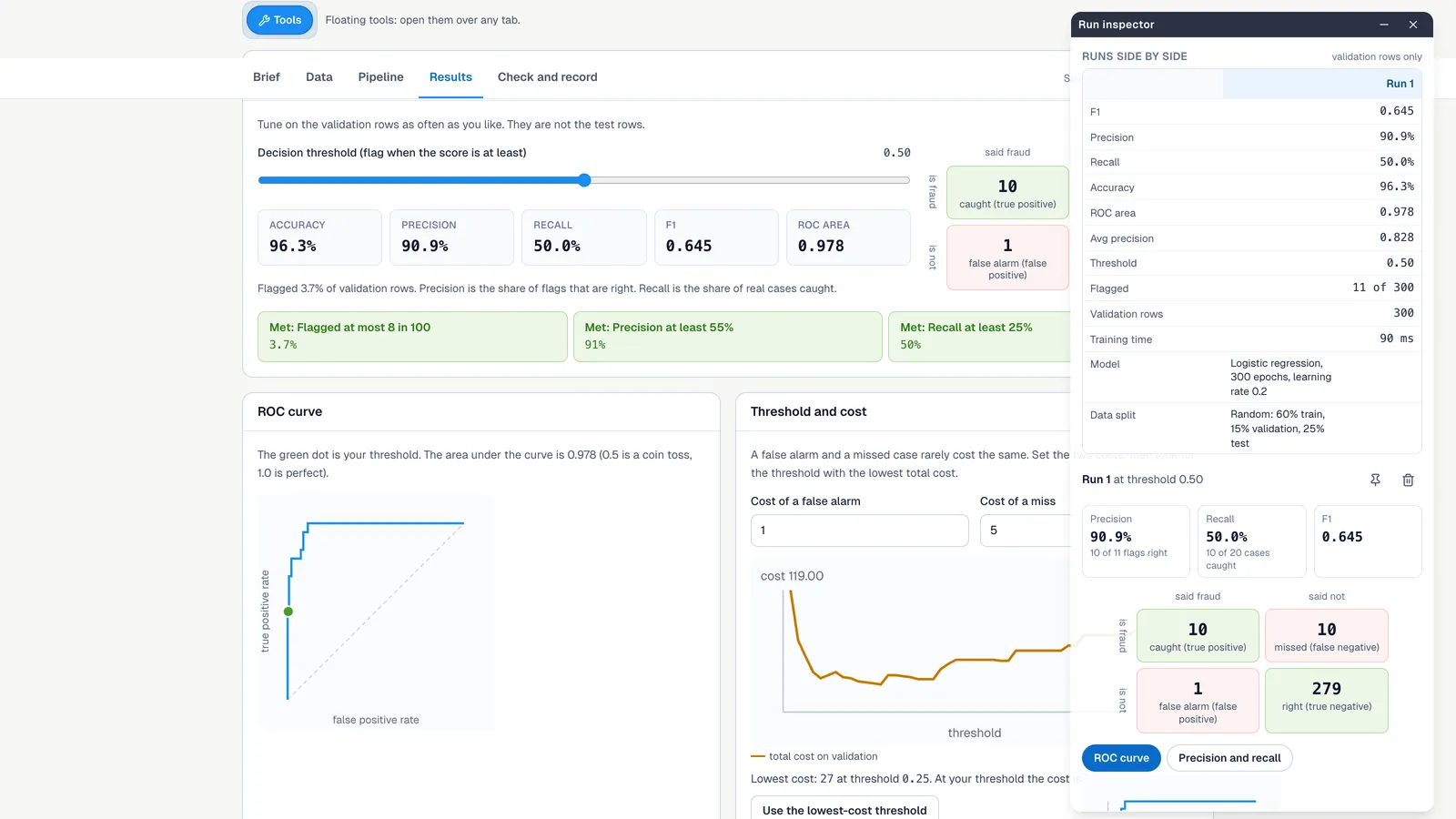
Courses on their own do not show employers what you can do. The EDWartens Lab includes a free AI Workbench with 16 levels where you train a model on plant data, move the decision threshold and weigh the cost of errors. The AI and data job simulations go further, with roles such as AI and LLM Application Engineer and Data Analyst. The first five days of a simulation are free, and they are practice, not employment.
What should you check before starting any free AI course?
- The certificate line. Free to learn does not always mean free to certify. Look for the price and what you must pass.
- The cost of the next step. Some free introductions lead to paid courses or subscriptions.
- Your data. Never paste confidential company or customer data into a public AI tool. Our AI Essentials for Work course treats this as a core skill.
- The checking habit. AI assistants can give invented facts, so any course worth taking teaches you to verify answers before you use them.
- The fit to your job. A badge for drafting emails does not show you can use AI in maintenance, controls or design work.
What is the EDWartens certificate, and what is it not?
Every free course is free to learn in full, including the quizzes and the final exam. If you pass the final (15 questions, 60% pass mark, 3 attempts) you can buy a certificate for £19 including VAT. It has a number and a QR code that employers can check on our verify page.
It is a certificate of completion from EDWartens. It is not an accredited or regulated qualification, it is not issued or endorsed by any AI company named in a course, and it does not guarantee a job. The details are on the certificate page. The government badge is free and Google's certificate sits behind a paid Coursera plan, so choose by the proof you need.
Start free
Open AI Essentials for Work for a six-hour start, or pick an engineering course from the list above. Then try the AI Workbench in the Lab and look at live AI and machine learning jobs to see which skills employers list. If you want live teaching later, the AI Module is a paid course; see our courses for details.