

Free PLC courses with a certificate do exist in the UK, but "free" almost always means free to learn, not a free certificate. On 24 October 2026 only one provider we checked, Automation Community, listed a certificate of completion with its free course. Alison and most others charge for the certificate. EDWartens UK offers 30 free PLC courses with an optional certificate at £19 including VAT, and it is not an accredited qualification.
Checked 24 October 2026. We read each provider's own page on that date. Prices and terms change, so check before you rely on them.
Which free PLC courses come with a certificate?
The table sets the options side by side. "Free" in the second column means free to learn.
| Provider | What is free to learn | Certificate | The catch |
|---|---|---|---|
| EDWartens UK | 30 PLC courses, 555 hours in all, with quizzes and a final exam | Optional, £19 including VAT per course, verifiable online | A free account is needed. Not an accredited qualification. We make the Lab and the courses, so weigh our own claims accordingly |
| Automation Community | One general PLC course: 6 hours, 13 lessons, 13 quizzes (13,412 enrolled on the page) | "Certificate of completion" listed; the page does not state the conditions | Account needed. No PLC brand named on the page |
| Alison | Master PLC Programming: 5 to 6 hours, beginner | Optional and paid. A free Learner Record can be downloaded instead | Price not shown on the course page. The page carries ads and a Premium upsell and says "CPD-Accredited" |
| Solis PLC | Three beginner courses: Siemens TIA Portal, RSLogix 500, PLCnext | No course certificate listed on the page | Other courses are labelled "Pro" and are paid. Prices not shown |
| Inductive University | Ignition (SCADA) courses | An Ignition credential programme exists; its fee is not stated | One product, and SCADA rather than PLC programming |
| Coursera (Packt PLC and HMI specialisation) | Not free: the FAQ says you cannot take it for free | Shareable certificate with paid access or Coursera Plus | About 18 hours. The "Enroll for free" button on the page conflicts with the FAQ |
| RealPars | A 7-day trial only | Certificates of completion with membership | $600 a year, or $50 a month after the trial, quoted in US dollars |
Two other routes come up in searches. AutomationDirect's free video library needs registration according to 2019 announcements, but we could not open its current page. Siemens offers time-limited trials of TIA Portal, which are software trials, not courses.
What does "free" mean on a PLC course?
Three different things hide behind one word:
- Free to learn, paid certificate. You study everything without paying and buy a certificate only if you want proof. Alison and EDWartens work this way.
- Free including the certificate. Automation Community lists a certificate of completion with its free course, though its page does not say what you must do to earn it.
- Free trial. RealPars gives full access for 7 days, then charges. That is a trial, not a free course.
Searches such as "free plc courses online with certificate" rarely tell you which one you are getting. Read the certificate line before you start.
What is in the EDWartens free PLC courses?
There are 30 free PLC courses, from absolute-beginner to intermediate, totalling about 555 hours. A few that UK learners start with:
- Siemens TIA Portal: 28.4 hours, absolute beginner. A shorter route is Siemens TIA Portal in Three Hours, 5.9 hours.
- Allen-Bradley Studio 5000: 17.1 hours, and RSLogix 500 and MicroLogix, 23.8 hours.
- CODESYS and IEC 61131-3: 20.9 hours. Our course page says the CODESYS Development System is free from the CODESYS Store.
- OpenPLC on Arduino, ESP32 and Raspberry Pi: 28.6 hours, using open-source software.
- PLC and Electrical Troubleshooting for Maintenance Teams: 14.1 hours, for technicians and maintenance staff.
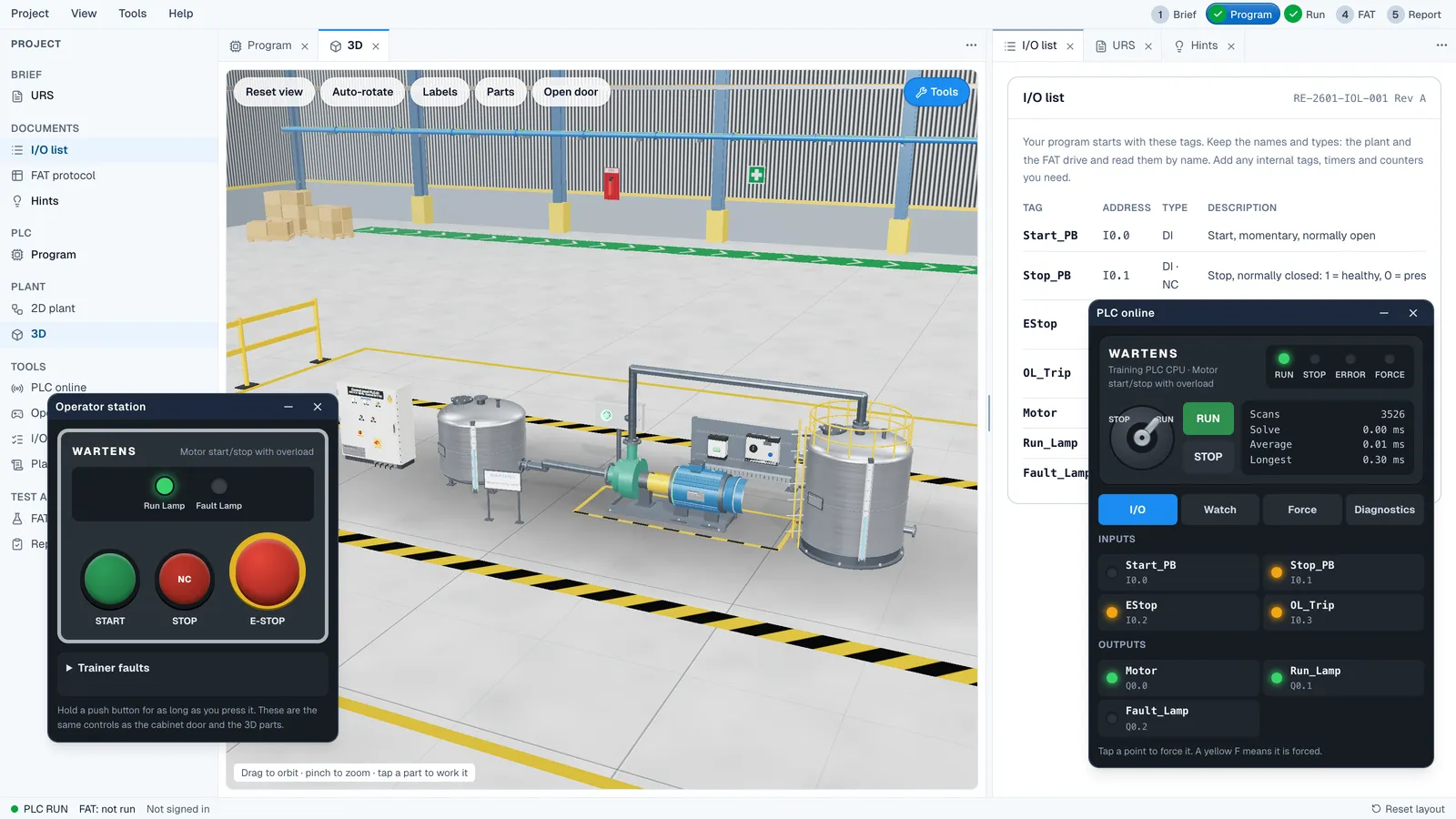
Be clear about how they are made. The video lessons are by independent trainers on their own YouTube channels, credited on each course page. EDWartens writes the study plan, practice tasks and assessments. You practise in the EDWartens Lab, a browser simulator that needs no install and no licence.
Software is the other cost to check. Our Siemens course page lists a 21-day TIA Portal trial. Our Studio 5000 page says Studio 5000 Logix Designer and Logix Emulate are paid Rockwell software with no public trial, so it points you to a free alternative for the exercises.
The video above is a free full-length PLC introduction from another educator, LeMaster Tech, to show what a free course looks like before you commit. We do not make it or control it.
How does the £19 certificate work?
Every free course is free to learn in full, including the quizzes and the final exam. If you pass the final exam you can buy a certificate for £19 including VAT. The final has 15 questions, a 60% pass mark and 3 attempts, then a 24-hour wait. Each certificate has a number and a QR code, and an employer can check it on our verify page.
Read the limits as plainly as the price. It is a certificate of completion from EDWartens. It is not an accredited or regulated qualification, it carries no academic credit, and Siemens, Rockwell and other vendors named in a course do not issue or endorse it. The full terms are on the certificate page.
What should you check before starting any free PLC course?
Six quick checks save hours of wasted study:
- The certificate line. Is it free, paid or "optional"? What must you do to earn it, and can an employer verify it?
- The software. Does the course need a paid licence, a time-limited trial or free software? A 21-day trial is short for a 28-hour course, so plan your study weeks to fit.
- The brand. A Siemens course teaches TIA Portal workflow, an Allen-Bradley course teaches Logix, and a CODESYS or OpenPLC course teaches the IEC 61131-3 standard. The logic carries across, the menus do not.
- The practice. Can you test what you learn in a simulator or on hardware, or is it video only?
- The accreditation claim. "CPD-Accredited" on a course page describes how the provider records training, not a regulated qualification. Ask what body stands behind it.
- The next step. Does the provider show you what to do after the course, such as projects, jobs or a path?
How could you spend your first 30 days?
A realistic plan for about 40 to 60 focused hours, which is our own estimate for reaching basic ladder logic:
- Week 1: learn what a PLC is, how inputs, outputs and the scan cycle work, and build a motor start/stop with seal-in in the Lab.
- Week 2: timers and counters, then the first modules of a brand course such as Siemens TIA Portal.
- Week 3: interlocks, sequences and a small project such as a tank filling pump or a traffic light.
- Week 4: write up one project, take the course final if you want the certificate, and check the PLC jobs board to see how adverts describe the skills.
Is a PLC certificate worth buying?
For most people the free course is the valuable part and the certificate is optional. When we read live trainee adverts on Reed on 21 October 2026, employers asked for an electrical, mechanical or maintenance background and real interest in controls, not a particular certificate. Our write-up is in trainee PLC jobs in the UK: what employers want.
A certificate helps when it proves something specific: you finished a long course and passed an exam. What persuades more is a small project you can explain. Build two or three in the simulator, write up the I/O list and the test results, and put those on your CV beside the certificate.
Which free PLC course should you start with?
Pick by your situation, not by the longest title:
- No PLC knowledge, no software yet: start with the free PLC foundations path, then choose a brand.
- Aiming at UK industry work: Siemens is common in UK plants, and our comparison of Siemens vs Allen-Bradley PLCs explains the trade-offs.
- Want to avoid licences altogether: use CODESYS or OpenPLC, then practise ladder logic in the free ladder logic course and the Lab.
- Already an electrician or technician: the PLC and electrical troubleshooting course builds on what you know.
- Changing career: see free courses for career changers and our guide to how long it takes to learn PLC programming.
What can a free PLC course not do?
It cannot give you hands-on time with real hardware, a regulated qualification or a job. No provider should promise a job, and we do not. The free route teaches you the logic, the software workflow and how to talk about your practice.
If you later want live teaching and career support, the Professional Module is a five-day live online class at £2,140 + VAT (£2,568 including VAT). It is CPD accredited, with 80 CPD credits from The CPD Group, and is not a regulated qualification. Compare it honestly with other paid options in best PLC training in the UK, and see the Professional Module for the full outline.
Start free
Create a free account and open Siemens TIA Portal or your chosen brand. Then try the PLC Programmer job simulation, where the first five days are free, and look at live PLC and automation jobs and the PLC programmer role guide to see what employers ask for. The simulation is practice, not employment.