


BS 7671 Amendment 4 (BS 7671:2018+A4:2026) was published on 15 April 2026 and became the only current edition of the UK wiring regulations on 15 October 2026, when the previous text was withdrawn. It adds a chapter on stationary batteries, a section on Power over Ethernet and a new rule that an EICR observation coded FI no longer makes an installation unsatisfactory. The 18th Edition qualification is a paid course. Ours are free study courses and are not that qualification.
When did BS 7671 Amendment 4 take effect?
| Date | What happened | Source |
|---|---|---|
| 15 April 2026 | Amendment 4 published by the IET and BSI | BSI, NICEIC |
| 15 October 2026 | Previous text withdrawn; Amendment 4 became the only version | BSI, IET, NICEIC |
The IET words the second date as the end of the transition period for BS 7671:2018+A2:2022 (Amendment 2), and says that book plus the free Amendment 3:2024 PDF "bolt-on" were valid until 15 October 2026. BSI and NICEIC name the combined text BS 7671:2018+A2:2022+A3:2024. All describe the same withdrawal on the same day.
NICEIC's guidance for certificated contractors is practical. From 15 October 2026 you must carry out EICRs to Amendment 4. Certificates for work started on or after that date go to Amendment 4, and work started before it is certificated to the edition it was designed against. The declaration is dated "BS 7671 2026" for Amendment 4 and "BS 7671 2024" for the older text.
What changed in BS 7671 Amendment 4?
BSI calls it "not a minor update". Here are the changes the sources list, with who published each.
| Change | What it is | Source |
|---|---|---|
| Stationary batteries | A new chapter (Chapter 57) for stationary secondary batteries that store and supply an installation | IET, BSI, NICEIC |
| Functional earthing for ICT | A new Section 545 on functional earthing and functional equipotential bonding for ICT equipment | BSI, NICEIC |
| Power over Ethernet | A new Section 716 on PoE | BSI, NICEIC |
| Medical locations | Section 710 substantially revised, with a schedule of test results for supplementary bonding conductor resistance | IET, BSI, NICEIC |
| PNB earthing | Protective neutral bonding included for the first time; certificates reference it | NICEIC |
| EV charging | Residual direct current (RDC) protective devices introduced for EV charging installations | NICEIC |
| AFDD wording | "Higher risk residential buildings" reworded to "high rise residential buildings" (over 18 metres or more than six storeys). The requirement was not removed. NICEIC also says BS 7671 has no AFDD requirement for circuits supplying battery energy storage | NICEIC |
| Functional earthing conductors | Pink is preferred, but the conductor must be identified at termination | NICEIC |
| Minor Works Certificate | End-to-end resistance wording changes to r1-r1, rn-rn and r2-r2 | NICEIC |
| Earlier amendment | Amendment 3:2024 incorporated into the main document | BSI |
What changed for EICR codes?
The observations section of the EICR is now split in two. Observations coded C1 or C2 affect the overall outcome and make the report "unsatisfactory". C3 and FI do not. FI now reads "further investigation is advised", with "without delay" removed. Under Amendment 3 an FI made the installation unsatisfactory. Under Amendment 4 it does not.
NICEIC calls this one of the most impactful changes for anyone doing EICRs and tells contractors to make clients aware of it. The usual codes are C1 (danger present), C2 (potentially dangerous), C3 (improvement recommended) and FI. The IET publishes the model forms for BS 7671:2018+A4:2026 as free PDFs.
The five-minute video above is by NICEIC and was published on 27 April 2026, before the October withdrawal, so use it for the overview and check dates against the written guidance.
What about plug-in solar and other searches?
"BS 7671 Amendment 4 plug in solar" is a popular search. None of the IET, BSI or NICEIC pages we read list plug-in solar among the changes, so we make no claim either way. Check the current IET guidance if it matters to you.
What does the Amendment 4 qualification cost?
The qualification is the City & Guilds Level 3 Award in Requirements for Electrical Installations BS 7671:2018 (2382-26). City & Guilds' April 2026 handbook gives it Ofqual number 603/3319/4, 35 guided learning hours and 40 hours total qualification time. The exam is an open-book online multiple-choice test of 60 questions in 120 minutes, graded pass or fail with a pass mark of about 60%, and you take the Amendment 4 IET book into it.
Training providers set their own prices. Two examples we read on 24 October 2026: electriciancourses4u sells an online 2382-26 course at £259 including VAT with the exam included but not the book, and NAPIT lists a three-day course from £445 excluding VAT (£534 including VAT). Prices change, so check each provider.
How can you study Amendment 4 for free?
You can learn the knowledge behind the standard free, and then decide whether to pay for the exam. Our free courses are:
- Wiring Regulations in Practice: BS 7671 and IEC 60364: about 25 hours, written to BS 7671:2018+A4:2026, including the battery chapter, PoE, PNB, AFDD wording and EICR outcomes.
- BS 7671 Inspection and Testing Essentials: safe isolation, test sequence, Zs and RCD checks, and EIC and EICR coding.
- Reading UK Electrical Drawings: BS EN 60617 symbols and schematics.
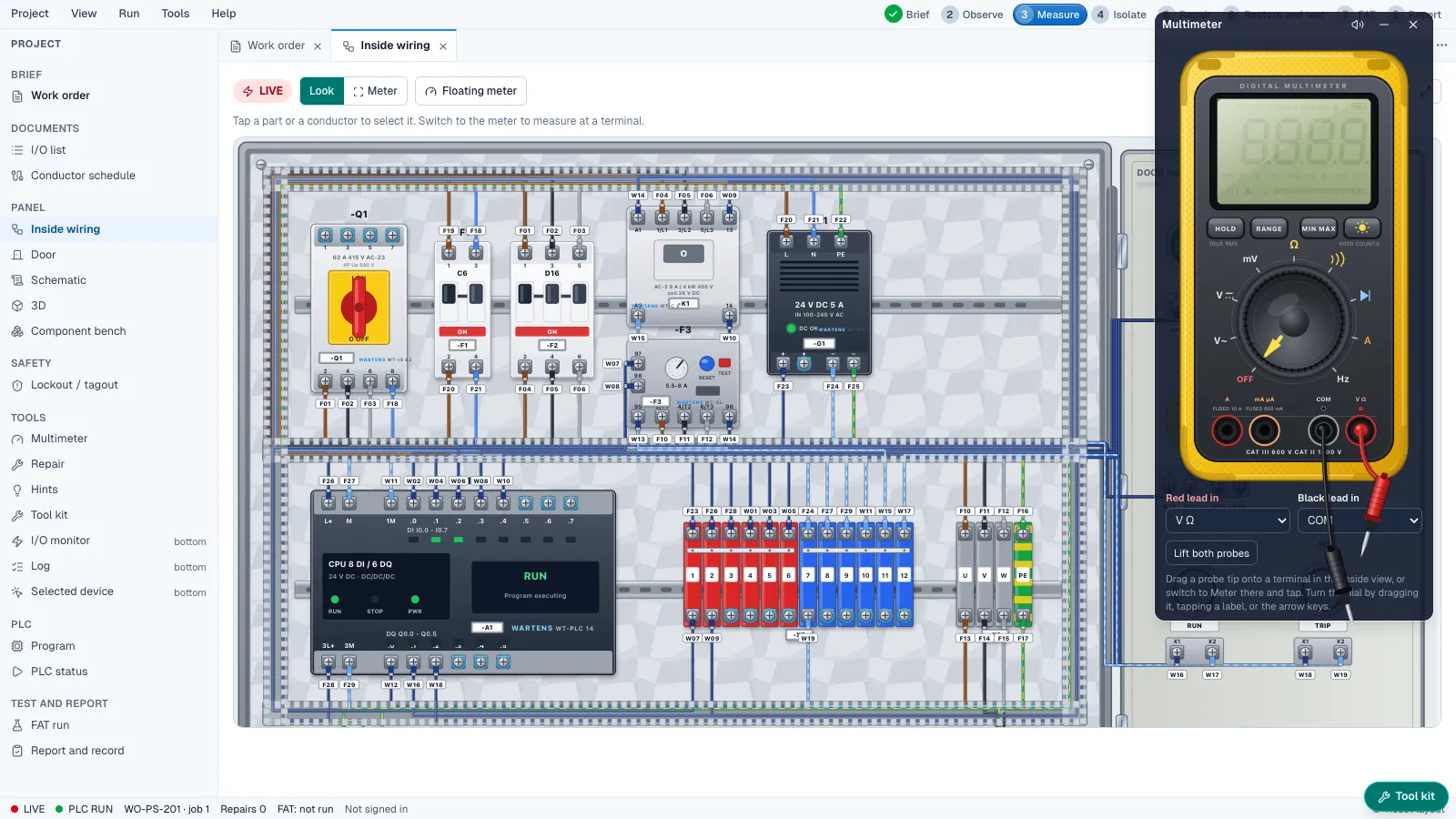
The course videos are by independent UK electrical trainers on their own YouTube channels, credited on each page. EDWartens wrote the study plan, practice tasks and assessments. You can practise isolation and measurement in the Lab's multimeter simulator and panel wiring lab.
The optional certificate is £19 including VAT per course if you want proof you finished and passed a 15-question final. It is not an accredited or regulated qualification and does not make you competent to inspect, test or certify. A free BS 7671 hub collects these courses, and you can browse more under free electrical courses.
What should electricians and designers do now?
NICEIC's guidance gives a clear checklist for certificated contractors, and the same logic applies to anyone who inspects, designs or certifies:
- Have the current text. NICEIC says businesses must demonstrate access to a copy of Amendment 4:2026 to keep their certification from 15 October 2026. The IET sells print and digital versions and warns about counterfeit copies.
- Use Amendment 4 for new work. That covers new installations, modifications, and periodic inspection and testing.
- Date the paperwork correctly. Certificates for work started on or after 15 October 2026 go to Amendment 4.
- Explain the FI change to clients. Reports now treat C1 and C2 as the outcome-changing codes.
- Flag older designs. Make clients aware of any design that was made to a withdrawn standard.
- Know your own limits. The new Section 716 on PoE needs no extra qualification under NICEIC's schemes, but you must be able to show you understand it.
How could you study Amendment 4 in four weeks?
A suggested order if you are preparing for the exam or just keeping up. These hours are our estimate, not an official guide:
- Week 1: read the changes in this article, then start the wiring regulations course with the structure of the standard and earthing arrangements.
- Week 2: automatic disconnection, Zs, RCD types and cable sizing, with the worked problems.
- Week 3: the Amendment 4 additions: batteries, PoE, AFDD wording, PNB and special locations.
- Week 4: inspection and testing, then a practice run on the Lab multimeter and the EIC and EICR coding examples.
Do you have to retake the 18th Edition for Amendment 4?
Not necessarily, according to NICEIC. Its page says it expects qualified supervisors to hold an 18th Edition qualification and is not requiring those who already have one to upgrade to the latest amendment. It does expect them to be conversant with the Amendment 4 changes that affect their work and to do relevant CPD. Other schemes and employers set their own rules, so ask yours.
What next?
If you work around electrical installations, the free electrician to PLC path shows how this knowledge connects to controls work, and our guide to electrical safety regulations in UK industrial automation covers the wider rules. You can also try the Maintenance Electrical Engineer job simulation, where the first five days are free, and see live maintenance and electrical jobs. The simulation is practice, not employment.