


Free virtual work experience for engineering exists in the UK, and most of it is genuinely free: Springpod programmes (which UCAS lists), Forage simulations, some employer and professional-body programmes, and the first five days of every EDWartens job simulation. None of it is a placement or a job. What "counts" depends on who is asking, so describe it accurately and check with your school, college or employer.
*Checked 24 October 2026. Facts about other providers come from their own pages as we read them on that date. They change, so check the provider before you decide.*
What is virtual work experience for engineering?
It is an online programme that lets you try a job or a sector without leaving home. UCAS describes its Virtual Work Experiences as interactive, on-demand programmes led by industry experts from major employers, lasting about 6 to 10 hours, free, with a certificate on completion. They are provided through Springpod.
That is one model: an employer-branded introduction. Another is a job simulation: one role's project, done ticket by ticket, with documents to read and work to hand in. A third is a seasonal employer scheme with an application. All three get called "virtual work experience" in search results, and they are not the same thing. If you want to see how the terms differ, our job simulation or virtual work experience comparison sets them side by side with a real placement.
Does virtual work experience count?
It counts as evidence that you looked into the work and learned something. It does not count as employment or as a placement, and nobody is obliged to treat it as one. Here is how it tends to work in practice:
| Who is asking | What to say | Why |
|---|---|---|
| UCAS or a university admissions team | Describe what you did and learned. UCAS says virtual work experiences can be included in personal statements and apprenticeship applications | UCAS lists these programmes itself. The university still decides what weight to give them |
| An apprenticeship employer | Name the programme, what you did and one thing you took from it | It shows interest. It does not replace a qualification or a placement |
| A graduate or technician employer | List it under projects or training, not employment | Forage's own guidance says its simulations belong under certifications, extracurricular activities or achievements, and a University of Arizona careers page says not to list them as work experience or employment |
| Your school or college | Ask before you rely on it | Many will not count a virtual programme as a work placement |
A fair rule is to be exact. "Completed a four-hour virtual programme with a certificate" is true. "Worked at a major employer" is not. We go further into this in do job simulations count as work experience.
Which free engineering options are there in the UK?
The table lists the main routes. Everything marked "checked" was read on 24 October 2026.
| Option | Who it suits | Length | Certificate | Engineering coverage |
|---|---|---|---|---|
| Springpod (listed on UCAS) | School and college age. Springpod's page says ages are a guideline, not a strict limit | Varies by programme (UCAS says about 6 to 10 hours) | Free on completion | About 20 engineering programmes (Siemens, JLR, Network Rail and others). No PLC or maintenance programme found |
| IMechE Mechanical Engineering programme | Students aged 13 to 16, through a school or college Unifrog account | Not stated | Not mentioned on the page | Mechanical engineering, AI and automation, routes into the profession. Available until June 2027 |
| Forage | Open sign-up | 30 minutes to 5 hours, self-paced | Free on completion | A few engineering simulations (GE Aerospace, Siemens Mobility, Johnson & Johnson, British Airways). No PLC, SCADA or maintenance simulation found |
| Bright Network Internship Experience UK | UK university students aged 18 and over | Four days. The 2026 run was 15 to 18 June | Not covered in our research | Technology and Engineering stream. Once a year, with an application window |
| EDWartens job simulations | Aged 16 and over, including adults and career changers | Days 1 to 5 free (about ten hours); Premium runs to day 20 | Optional, £14.99 including VAT. Not accredited | 23 roles including PLC, maintenance, electrical, commissioning and SCADA |
Forage and Springpod give free certificates and carry employer names. Ours costs £14.99 and is set at simulated companies. If a free certificate and a big name matter most, use them. If you want PLC, electrical or maintenance practice with every task checked, that is where we fit. Our Forage alternatives page compares them in more detail.
Which route fits your stage?
- 16 to 18, at school or sixth form. Springpod programmes (through UCAS) fit best for an employer name. If you are 16 or over, an EDWartens simulation adds hands-on practice. If you are under 18, ask a parent, carer or teacher before you sign up. Under 16, use something built for your age, such as the IMechE programme through your school.
- College students and apprentices. Use a simulation to practise tasks you may not have been given yet, such as closing out a work order or checking an isolation certificate. It does not replace your training or assessment.
- Undergraduates. Bright Network's Internship Experience UK runs once a year. In between, a simulation or a Forage programme can fill the gap when a placement is hard to find.
- Career changers and over-18s. Most free programmes are built for school pupils. A role-based simulation is a better fit, and our engineering work experience page for career changers walks through starting points.
For the real thing, This is Engineering describes work experience as real-life experience in a job role, usually a week or two, and suggests asking your school's careers leader, using personal contacts, contacting local employers or trying schemes such as In2Science and Springpod. If an in-person placement is possible, take it.
What does a week of hands-on virtual engineering work look like?
The first week of an EDWartens simulation is about ten hours of tickets across five working days. Here is the free week of the Maintenance Electrical Engineer role at a simulated company, Kelbridge Foods Ltd:
- Day 1: induction on safe isolation and site electrical rules, then check a draft isolation certificate.
- Day 2: safely isolate a motor control centre bucket in EDWartens Lab, where a step in the wrong order fails the ticket.
- Day 3: read a thermography survey and decide the class and action for each point, then work out how far over its rating a mixer motor is running.
- Day 4: a ticket where the isolation boundary is not clear, then closing out a work order.
- Day 5: find a hidden fault and repair it under lock-out, then set re-order points for critical spares.
Every task is checked as you hand it in, and you see a model answer and the reasoning. Standards are named in the work, among them BS 7671, the Electricity at Work Regulations 1989 and PUWER 1998. The data is simplified, so always read the current edition of anything you rely on.
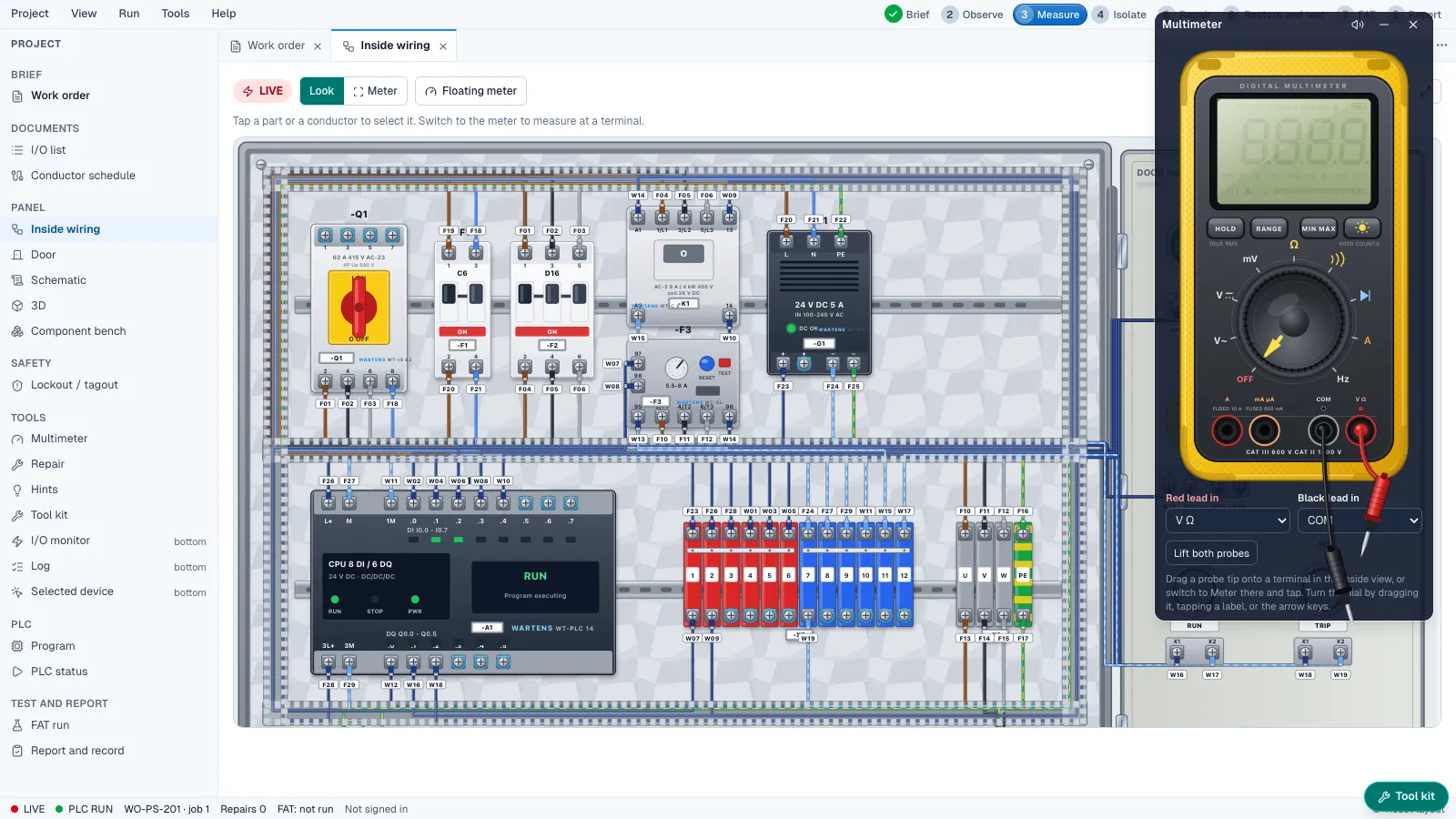
The same pattern applies in the other roles. A PLC Programmer week, for example, runs from a site induction and clarification queries through reviewing a functional specification, an I/O list and a cause and effect matrix, to counting bottles once each and filling a bowl between two levels without running it dry. Our electrical engineering virtual work experience page lists the five electrical roles.
How do you describe it on a CV, UCAS form or LinkedIn?
Name what it was, name who it was with, and say what you did. Never describe a simulation as employment, an internship or a placement.
- CV: put it under projects, training or certifications. For example: "Maintenance Electrical Engineer job simulation, Kelbridge Foods (simulated company), EDWartens UK, 2026. Reviewed an isolation certificate, closed a work order and found a hidden starter fault."
- Personal statement or apprenticeship application: write what you did, one decision you made and what it taught you. For instance, why you would not accept a request to bypass a safety function, and what you would check first on a real site.
- LinkedIn: add it under certifications or projects, link the verification page if you have a certificate, and use the words "job simulation".
- Interview: pick one piece of work you can explain from start to finish. That is more convincing than the certificate on its own.
What can virtual work experience not do?
It cannot give you site contact, a supervisor's reference or the feel of a workshop. It cannot make you competent or authorised to work on live equipment, and it is not a qualification. It does not guarantee a job, an interview or an apprenticeship place. Treat it as a way to try a role, learn the vocabulary and have specific work to talk about, and keep applying for real placements and apprenticeships alongside it.
Start free
Pick a role and do days 1 to 5 of its simulated project at no cost and with no card: the PLC Programmer job simulation and the Maintenance Electrical Engineer job simulation are good starting points. Then work through the free electrical courses to fill gaps, and read real adverts on our UK maintenance jobs page to see what employers ask for. The certificate (£14.99 including VAT) and Premium (£53.99 including VAT) are optional. See the virtual work experience overview for the full picture.